

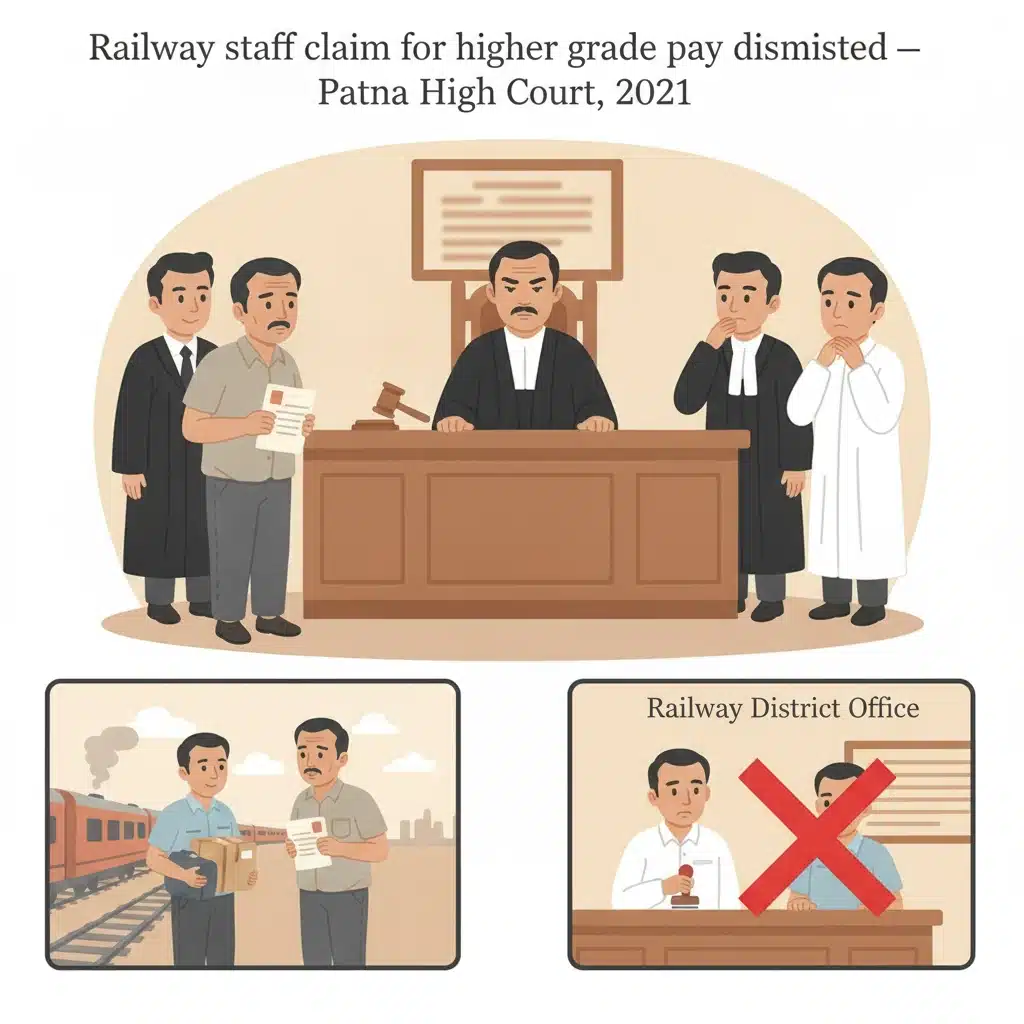
Case Background
The case concerns two railway employees of East Central Railway, Samastipur Division. Both were appointed on compassionate grounds to the post of Relieving Unskilled (RUS/Hamal), which was a Group-D post at that time.
Petitioner 1 was appointed on 12.11.1993 and Petitioner 2 on 06.04.1990. According to them, from 1994 onwards they were asked to work as Couriers on an officiating basis. Courier was a Group-C post. Despite this, they continued to receive the pay-scale applicable to the Group-D post of RUS (Hamal).
With the implementation of the 6th Pay Revision Commission (6th PRC), Group-D posts in the Railways were merged with Group-C posts with effect from 01.01.2006. As a result, the post of RUS (Hamal) got merged with the Group-C post of Courier from that date.
Under the 6th PRC recommendations, the Group-C post of Courier carried a pay-scale of Rs. 5200-20200 with Grade Pay of Rs. 1800. The petitioners were extended this pay band with Grade Pay of Rs. 1800 following the merger.
Several years later, in October 2014, the petitioners submitted a representation. They claimed that, since they had been made to work as Couriers from 1994, they should be given the pay-scale of Courier, including a higher Grade Pay of Rs. 1900, from the date they started working as Couriers. They also sought arrears of salary for the past period and regularisation to the post of Courier.
The Railway authorities rejected their claim by letter dated 10.11.2014. The petitioners then approached the Central Administrative Tribunal, Patna Bench, in Original Application No. 050/00336/2015 under Section 19 of the Administrative Tribunals Act, 1985.
Before the Tribunal, they challenged the rejection letter and asked for directions to grant them higher pay band and grade pay with retrospective effect, and all consequential benefits. They also relied upon certain Railway Board orders and Rule 108 of the Indian Railway Establishment Manual, 2009 to support their plea for higher pay and regularisation as Couriers.
By judgment and order dated 13.05.2019, the Tribunal dismissed their Original Application. It held that they could not claim a pay-scale higher than that allowed for the post of Courier, and rejected their claim for arrears and other reliefs.
Aggrieved by this Tribunal order, the petitioners filed Civil Writ Jurisdiction Case No. 13169 of 2021 before the Patna High Court under Article 226 of the Constitution of India.
What the Court Examined and Decided
The writ petition came before a Division Bench of the Patna High Court comprising Hon’ble Mr. Justice Chakradhari Sharan Singh and Hon’ble Mr. Justice Madhuresh Prasad. The oral judgment, delivered on 07.12.2021 by Justice Chakradhari Sharan Singh, examined two main aspects of the petitioners’ claim.
First, the Court considered the demand for Grade Pay of Rs. 1900 instead of Rs. 1800 for the post of Courier after the 6th PRC. Second, it looked at the claim for arrears of salary for the period during which the petitioners said they worked as Couriers on officiating basis from 1994 till 01.01.2006.
The petitioners’ side argued that the minimum Grade Pay applicable to Group-C posts, as per the 6th PRC, was Rs. 1900. On this basis, they contended that the Grade Pay of Rs. 1800 given to them was less than what was legally due. They submitted that they should have been granted Rs. 1900 as Grade Pay upon merger of their Group-D post with the Group-C post of Courier.
The petitioners’ counsel further submitted that they had actually been performing the work of Couriers since 1994 on the instructions of the railway authorities. Since they were discharging functions of a higher post, they should be paid the higher scale and arrears for that entire period. They also invoked the principle of “equal pay for equal work”, arguing that people doing the same work should receive the same pay, regardless of their original designation.
To support their case, they relied on Railway Board Establishment Order No. 137/2007 dated 31.10.2007, certain Railway Board orders dated 09.06.1965 and 20.10.2002, Rule 108 of the Indian Railway Establishment Manual, 2009, and a Division Bench decision of the Patna High Court reported in 2017 (4) PLJR 282 (Chairman, Bihar State Power Holding Company Limited & Ors. vs. Ganesh Lal).
The Court first dealt with the claim regarding Grade Pay of Rs. 1900. It noted that the petitioners had already been granted pay band with Grade Pay of Rs. 1800 as a consequence of the merger of their Group-D post (RUS/Hamal) with the Group-C post of Courier. The Court found it “preposterous” that they would seek a higher Grade Pay than what was allowed for the post of Courier itself.
Critically, the Court pointed out that the petitioners could not produce any material to show that Rs. 1900 was the minimum Grade Pay recommended by the 6th PRC for Group-C posts. In absence of any such document or rule, the Court held that their claim of Rs. 1900 as minimum Grade Pay had rightly been rejected by the Tribunal.
The Court then turned to the claim for arrears of salary for the period during which the petitioners said they had worked as Couriers before the merger. The Court rejected this claim on two clear grounds, both factual and procedural in nature.
First, the Court examined the delay. The petitioners stated that they had been working as Couriers since 1994. According to the Court, if they believed they were entitled to higher pay for bearing responsibilities of a higher post, their cause of action arose in 1994 itself, when they were first directed to discharge Courier duties.
However, they did not make any claim for higher pay at that time or for many years thereafter. They waited until October 2014, nearly twenty years later and well after the 2006 merger, to file their first representation. On these facts, the Court held that the claim was clearly belated and could not be entertained.
Second, the Court looked for evidence that the petitioners were actually discharging “higher responsibilities” compared to their substantive post of RUS (Hamal). The Court noted that the petitioners had not placed specific pleadings on record about the nature of their work as Couriers and how those duties were materially different or higher in responsibility from their original post.
Without such detailed pleadings or factual basis, the Court held that they could not claim that they were shouldering higher responsibilities so as to be entitled to higher pay or arrears. The Court found an absence of evidence describing and distinguishing the responsibilities of the two posts—RUS (Hamal) and Courier.
The Court also addressed the reliance placed on Railway Board Establishment Order No. 137/2007. The relevant portion, as reproduced in the judgment, clarified that when staff in lower grades are made to shoulder responsibilities of higher grade posts, they “may be compensated momentarily” by suitable awards granted by General Managers, depending on the circumstances and extent of work involved.
From this, the Court concluded that the Railway Board order did not create an automatic right to higher pay-scale or permanent upgradation. At best, it left it to the discretion of General Managers to grant suitable awards. Therefore, this guideline could not support the petitioners’ claim for retrospective higher pay and arrears or regularisation as Couriers.
On the broader question of whether the Court could interfere with pay fixation, the Bench observed that fixation of pay is essentially an executive function. Judicial interference is limited. Unless an employee can show that the pay fixation is arbitrary or discriminatory in violation of Articles 14 and 16 of the Constitution of India, a writ court under Article 226 will generally not interfere with such executive decisions.
In this case, the petitioners were unable to demonstrate any such arbitrariness or discrimination in the pay band and Grade Pay fixed for the post of Courier or in the merger of Group-D and Group-C posts after the 6th PRC. Consequently, the Court declined to interfere with the established pay structure.
The Court also considered the precedent cited by the petitioners, namely the Division Bench judgment in Chairman, Bihar State Power Holding Company Limited vs. Ganesh Lal, reported in 2017 (4) PLJR 282. The Bench expressly held that this decision had no application to the present case, given the factual matrix and pleadings on record.
In the final analysis, the Court agreed with the Tribunal on all key points. It upheld the findings that the petitioners could not seek Grade Pay higher than what was fixed for the Courier post, that they were not entitled to arrears of salary for the officiating period, and that their belated and inadequately pleaded claim could not be entertained.
Accordingly, the Patna High Court concluded that the writ application had no merit and dismissed it.
Why This Judgment Matters
This judgment is important for railway employees and other government staff who are asked to work on higher posts without formal promotion.
First, the Patna High Court makes it clear that a person cannot claim Grade Pay higher than what is fixed for the post itself. If the notified Grade Pay for a particular post is Rs. 1800, an employee working on that post cannot insist on Rs. 1900 only by saying that Group-C posts should start at that level, especially without official proof.
Second, the decision underlines that pay fixation is mainly an administrative decision. Courts will interfere only if there is clear proof of unfairness or discrimination. Merely disagreeing with the pay-scale or feeling underpaid is not enough.
Third, the judgment highlights that employees must raise pay-related claims in time. Waiting for decades and then seeking arrears for long-past periods is risky. Courts are reluctant to entertain such delayed claims, especially when no protest was raised earlier.
Fourth, the Court stresses the need for detailed facts. To claim that one has been doing “higher duties”, it is not enough to say so in general terms. The employee must clearly show how the work and responsibilities of the two posts differ. Without such material, the plea of equal pay for equal work or higher responsibilities will not succeed.
Finally, for those relying on internal circulars or Board orders, the judgment shows that such documents will be read according to their actual wording. Where an order only allows discretionary awards by authorities, it does not create a legal right to higher pay or promotion.
Legal Issues and Answers
- Issue: Were the petitioners entitled to Grade Pay of Rs. 1900 instead of Rs. 1800 after merger of their Group-D post with the Group-C post of Courier under the 6th Pay Revision Commission?
Answer: No. The Court held that they could not claim a Grade Pay higher than what was prescribed for the Courier post (Rs. 1800), and they failed to show that Rs. 1900 was the minimum Grade Pay for Group-C posts. - Issue: Were the petitioners entitled to arrears of higher salary for the period during which they claimed to have worked as Couriers on officiating basis since 1994?
Answer: No. The Court rejected the claim as highly belated and also because the petitioners did not furnish specific pleadings or evidence to show that they were actually shouldering higher responsibilities than those of their substantive post. - Issue: Could the High Court interfere with the pay fixation and grant relief under Article 226 of the Constitution based on the cited Railway Board guidelines and the principle of equal pay for equal work?
Answer: No. The Court held that pay fixation is an executive function, and in absence of demonstrated arbitrariness or discrimination, judicial interference was not warranted. The Railway Board guideline cited only allowed discretionary awards and did not create a right to higher pay.
Cases Cited by the Court
- 2017 (4) PLJR 282, Chairman, Bihar State Power Holding Company Limited & Ors. vs. Ganesh Lal (held to be inapplicable on the facts of this case).
Case Details
Case Number: Civil Writ Jurisdiction Case No. 13169 of 2021
Case Title: Bishnudeo Roy & Anr. vs. The Union of India & Ors.
Citation: 2022 (4) PLJR 126
Court: High Court of Judicature at Patna
Coram: Hon’ble Mr. Justice Chakradhari Sharan Singh and Hon’ble Mr. Justice Madhuresh Prasad
Date of Judgment: 07.12.2021
Advocates:
- For the Petitioners: Mr. Munna Pd. Dixit, Advocate; Mr. S.K. Dixit, Advocate; Mr. Sanjay Kr. Choubey, Advocate; Ms. Swastika, Advocate
- For the Respondents: Mr. Ramadhar Shekhar, Addl. Standing Counsel (Railway); Mr. Anil Singh, Advocate
Respondent Authorities: Union of India through General Manager, East Central Railway, and various officers of East Central Railway, Samastipur Division, along with a private respondent.
Nature of the Case: Writ petition under Article 226 of the Constitution challenging an order dated 13.05.2019 of the Central Administrative Tribunal, Patna Bench, in Original Application No. 050/00336/2015, relating to pay-scale, Grade Pay, and arrears claimed by railway employees.
Link to Judgment: Click here to read the full judgment of the Patna High Court
If you found this explanation helpful and wish to stay informed about
how legal developments may affect your rights in Bihar,
you may consider following Samvida Law Associates for more updates.




