

Case Background
The case arose from Udwantnagar (Gajrajganj) P.S. Case No.195 of 2017, in District Bhojpur, Ara. The sole appellant was one of the accused in this FIR.
After investigation, the police submitted charge-sheet only against the appellant, as shown by Exhibit-8. Investigation against other named co-accused persons was kept pending.
The appellant was tried before the Court of the 4th Additional Sessions Judge-cum-Special Judge, Excise Act, Bhojpur at Ara, in N.D.P.S. Case No.25 of 2017.
By judgment dated 25.11.2019, the trial court convicted the appellant under Section 20(b)(ii)(c) of the Narcotic Drugs and Psychotropic Substances Act (NDPS Act) for alleged possession of commercial quantity of ganja. By order dated 02.12.2019, the court sentenced him to 10 years of rigorous imprisonment and a fine of Rs. 10,000, with six months’ further imprisonment in default.
The appellant filed Criminal Appeal (SJ) No.5632 of 2019 before the Patna High Court, challenging both the conviction and the sentence.
What the Court Examined and Decided
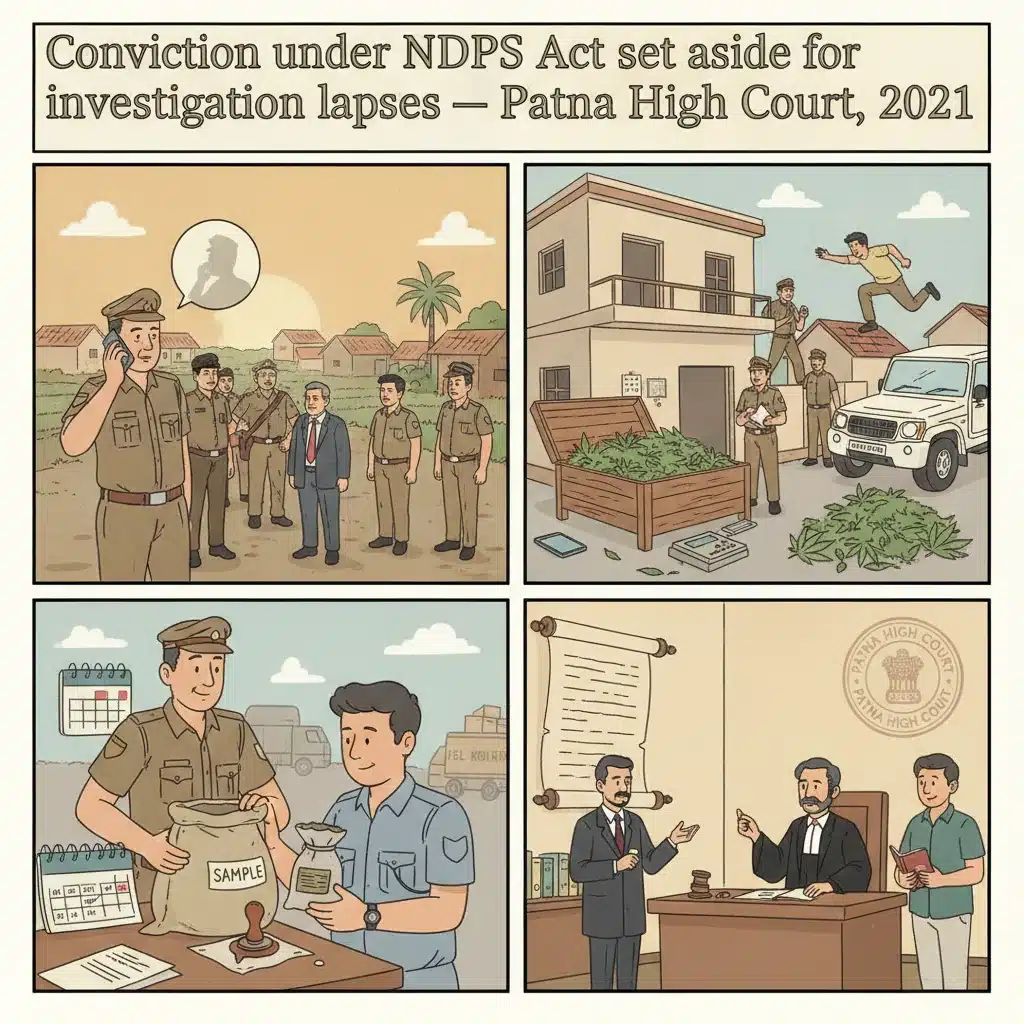
The prosecution story began with a telephonic call received by PW 6 Satyendra Kumar, the Sub-Inspector of Police at Gajrajganj outpost, on 07.07.2017 at about 6:15 AM. The Sub-Divisional Police Officer (SDPO), Ara, informed him that the appellant’s house in village Masarh needed to be raided, as it had been learnt that the appellant was involved in ganja business. The SDPO also stated that he would accompany the police team.
A raid team was then formed, consisting of PW 6 along with other Officer-in-Charges of different police stations named in the FIR. The Block Development Officer (BDO), Udwantnagar (PW 1) was also telephonically requested to be present at the time of raid.
According to the prosecution, during the raid on the appellant’s house, 30 kg of ganja was recovered from a box inside a bed in a room located at the south-west corner of the house. Additionally, 25 kg of ganja was allegedly recovered from a Bolero vehicle bearing registration number BR3P 2190 parked near the house. An electronic weighing machine and a Samsung mobile phone were also said to have been seized.
The prosecution stated that while the raid was going on, the appellant tried to flee by jumping onto the neighbour’s roof but was caught on the spot. It was further claimed that the appellant disclosed that his uncle and certain other villagers were involved in the ganja trade, and that he had purchased the seized ganja from one person for supply to others. A seizure list was prepared and marked as Exhibit-5.
During trial, the prosecution examined seven witnesses. PW 1, the BDO, supported the fact of search and seizure and identified his signature on the seizure list. PW 2, a Hawaldar, and PW 3, a constable, claimed to be eyewitnesses of the search and seizure. PW 4 Sanjay Singh and PW 5 Dina Nath Singh were local chaukidars and seizure-list witnesses. PW 6 was the informant and raid officer. PW 7 was the Investigating Officer.
The defence, represented by learned counsel Mr. Vikram Deo Singh, attacked the prosecution case mainly on the ground of serious procedural lapses and inconsistencies.
First, it was argued that there was complete non-compliance with Section 42 of the NDPS Act. This section requires that any information about possible presence of narcotic substances at a place must be reduced into writing and immediately sent to a superior officer. The defence pointed out that there was no evidence that either PW 6 or the SDPO recorded the information in writing or informed their superior in the manner mandated by law.
Second, counsel contended that there was no reliable evidence about sealing of the seized ganja at the spot or its safe custody in the malkhana. There was also no clear evidence about when, where, how and in whose presence the sample of the seized substance was drawn. The seizure was from two different places (house and vehicle), but only one sample was prepared, making it unclear from which lot the sample was taken.
Third, PW 4 and PW 5, who were seizure-list witnesses and local chaukidars, clearly stated that 55 kg of ganja was recovered from the vehicle alone. They did not speak of any separate recovery from inside the house. These witnesses were not declared hostile by the prosecution. Thus, their version conflicted with the main prosecution story that 30 kg came from the room and 25 kg from the vehicle.
The defence also highlighted that the house had three floors occupied by family members. The police had not clarified whether all floors were in exclusive possession of the appellant or who exactly occupied each floor. The SDPO, who initiated the raid, was not examined during trial, despite being a key witness. These omissions, according to the defence, cast serious doubt on the prosecution case.
In his statement under Section 313 CrPC, the appellant claimed that he was the sarpanch of the village. He alleged false implication because he had refused a request of the Sub-Inspector (Daroga ji) to act as a police informer, instead suggesting that the police should obtain information through the local chaukidar.
On the other hand, learned Additional Public Prosecutor Mr. Zeyaul Hoda argued that the appellant was apprehended at the time of the raid and seizure and there was no evidence of enmity with the police. According to the State, minor lapses or non-compliance should not be used to disbelieve the prosecution in such circumstances.
Justice Birendra Kumar of the Patna High Court approached the matter by first reaffirming that Article 21 of the Constitution guarantees to every accused a right to fair trial, which includes fair investigation. The burden lies on the prosecution to demonstrate that investigation has been conducted fairly and without prejudice to the accused.
The Court then listed several “serious infirmities” in the prosecution case and evidence.
First, the Court held that this was a case of “total non-compliance” with sub-sections (1) and (2) of Section 42 of the NDPS Act. Relying on the Constitution Bench judgment of the Supreme Court in Karnail Singh v. State of Haryana, (2009) 8 SCC 539, the Court noted that total non-compliance of Section 42 is impermissible and adversely affects the prosecution case.
The High Court observed that there was nothing on record to show that the informant police officer or the SDPO who gave the information reduced it to writing or sent it to their immediate superior officer, in physical or electronic form. No witness even “whispered” about such compliance. The Court held that this lapse alone was sufficient to disbelieve and discard the prosecution case.
Second, the Court considered the testimony of PW 4 and PW 5. Both local chaukidars from the same village testified that 55 kg of ganja was recovered from the Bolero vehicle of the appellant, and that they had signed blank papers at the police station. They were not declared hostile. Referring to the Supreme Court decision in Raja Ram v. State of Rajasthan, (2005) 5 SCC 272, the High Court pointed out that if a witness is not declared hostile, the defence can rely on his evidence and it is binding on the prosecution.
The statements of PW 4 and PW 5 directly contradicted other witnesses and the FIR regarding the place of recovery. They suggested the entire recovery was from the vehicle and not partly from the room in the house. Furthermore, the prosecution had not proved that the Bolero vehicle actually belonged to the appellant. This contradiction created serious doubt about the search and seizure.
Third, the Court found “complete lack of evidence” about sealing of the seized substance and the sampling process. The BDO, who acted like a Magistrate at the time of search and seizure, did not say anything about sealing of ganja packets.
The seizure was made on 07.07.2017. The prosecution obtained the court’s order to send the sample to the Forensic Science Laboratory (FSL) only on 24.07.2017. The sample was dispatched on 10.08.2017 and received at FSL, Kolkata on 23.08.2017. However, there was no evidence about where and in whose custody the seized ganja remained in this long period, who took the sample, from how many packets it was taken, and in whose presence this was done.
In the Court’s view, these lapses created serious doubt about the sanctity of the sample that reached the FSL and, therefore, about the scientific examination report itself.
After weighing all these infirmities, the High Court concluded that the prosecution case could not be believed. The trial court had failed to appreciate these serious defects in procedure and evidence.
Accordingly, the Court held that the conviction of the appellant under Section 20(b)(ii)(c) NDPS Act was not sustainable either on facts or in law. The judgment of conviction dated 25.11.2019 and the order of sentence dated 02.12.2019 were set aside. The appeal was allowed and the Court ordered that the appellant be set free at once.
Why This Judgment Matters
This judgment is significant for anyone facing NDPS proceedings in Bihar and beyond. It shows that even in serious narcotics cases, the police must strictly follow the law.
The Patna High Court made it clear that when officers receive specific information about drugs, they must record that information in writing and inform their superior officers as required by Section 42. If they do not do this, the entire case can fall apart.
The ruling also stresses that sealing, custody and sampling of seized contraband must be clearly proved. When there is no clear record of who sealed the packets, where they were kept, and how samples were taken, courts will be slow to uphold a conviction.
This protects ordinary citizens from being convicted on the basis of doubtful or loosely handled evidence. It reminds investigating officers, especially in Bihar, that fair investigation is a part of the fundamental right to life and liberty under Article 21.
Legal Issues and Answers
Issue: Whether non-compliance with Section 42 of the NDPS Act and lack of proof of proper seizure, sealing, custody and sampling could sustain a conviction for possession of commercial quantity of ganja.
Answer: No. The Patna High Court held that there was total non-compliance of Section 42 and serious gaps in proof of search, seizure and sampling. These infirmities made the prosecution case unreliable and the conviction was set aside.
Issue: Whether the prosecution could ignore the testimony of its own seizure witnesses who contradicted the main recovery story without declaring them hostile.
Answer: No. Relying on Supreme Court precedent, the Court held that when such witnesses are not declared hostile, their evidence can be used by the defence and is binding on the prosecution, further weakening the prosecution case.
Cases Cited by the Court
- Karnail Singh v. State of Haryana, (2009) 8 SCC 539 – on mandatory compliance with Section 42 of the NDPS Act and effect of total non-compliance.
- Raja Ram v. State of Rajasthan, (2005) 5 SCC 272 – on the right of the defence to rely on evidence of prosecution witnesses not declared hostile.
Case Details
Case Number: Criminal Appeal (SJ) No.5632 of 2019; arising out of Udwantnagar (Gajrajganj) P.S. Case No.195 of 2017, District Bhojpur
Case Title: Banke Bihari Singh @ Sonu Singh v. State of Bihar
Citation: 2022 (4) PLJR 191
Coram: Hon’ble Mr. Justice Birendra Kumar
Advocates: For the appellant – Mr. Vikram Deo Singh, Advocate; Mr. Sada Nand Roy, Advocate. For the State – Mr. Zeyaul Hoda, Special Public Prosecutor.
Nature of Case: Criminal appeal (single judge) against conviction and sentence under Section 20(b)(ii)(c) of the NDPS Act passed by the 4th Additional Sessions Judge-cum-Special Judge, Excise Act, Bhojpur at Ara, in N.D.P.S. Case No.25 of 2017.
Link to Judgment: View full judgment on Patna High Court website
If you found this explanation helpful and wish to stay informed about how legal developments may affect your rights in Bihar, you may consider following Samvida Law Associates for more updates.




