

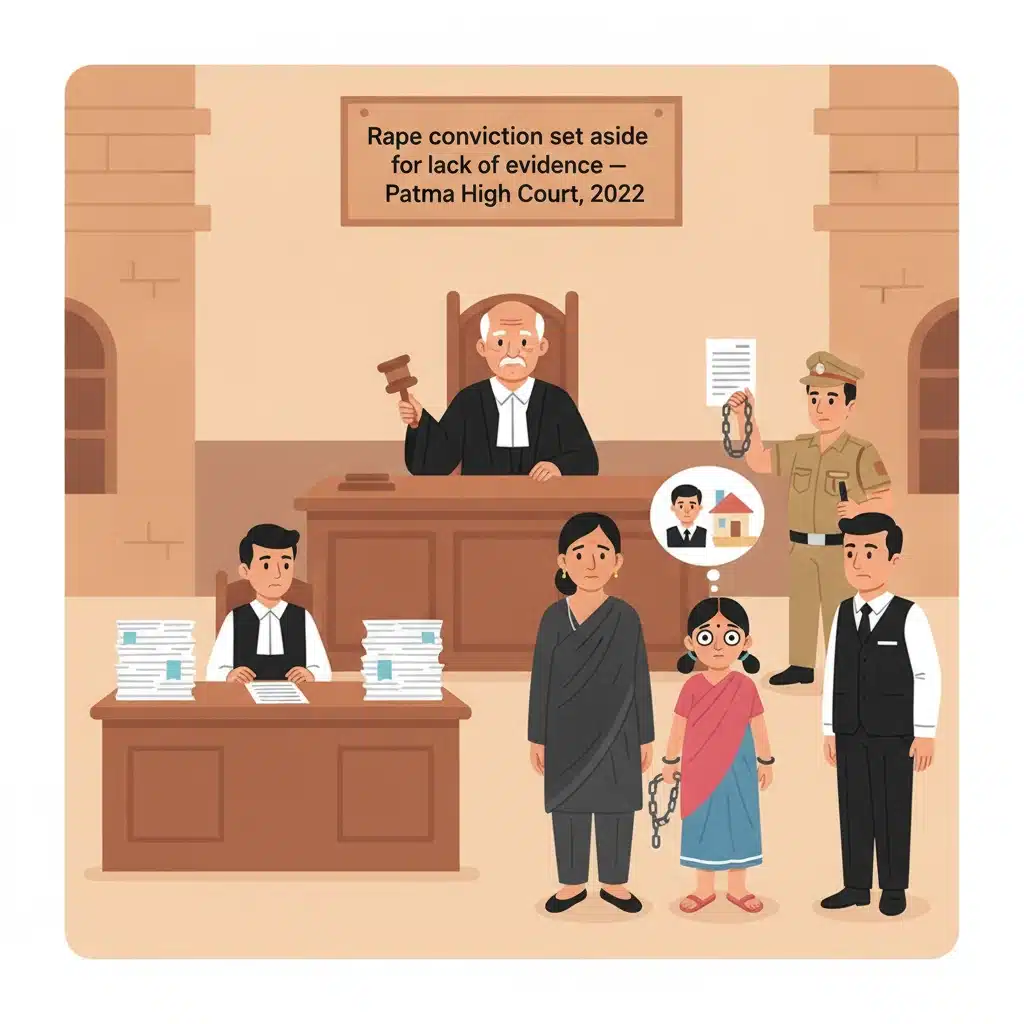
Case Background
This case arose from Kahalgaon (Buddhuchak) P.S. Case No. 10 of 2015 in Bhagalpur district. The informant was the father of a girl described as a child of unsound mind. According to the written report, the girl was below 12 years, and because of her condition, her parents used to keep her chained near the house to restrict her movements.
On 02.04.2015, at around 10:30 a.m., the father went to “Buddhuchak crossing”. When he returned, he did not see his daughter playing near the house. He searched for her. Around 11:45 a.m., he saw her coming from the direction of Madhya Vidyalaya, Buddhuchak.
When he asked her about the chain, the girl allegedly said that the chain was with the appellant. She then took him towards the appellant’s house and said that the chain was inside. The informant, keeping in mind what he described as the appellant’s antecedents, began to suspect that the appellant had sexually assaulted his daughter.
On reaching the appellant’s house, the informant found it locked. On further questioning, the girl disclosed that she had been raped. The informant’s wife (the victim’s mother) then also asked the child, and according to the prosecution, she too was satisfied that the child had been raped. On this basis, the father lodged the written report on the same day, leading to registration of the FIR.
The victim was medically examined by a Medical Board on 03.04.2015. While the informant had roughly put her age at about 14 years, the Board opined that her age was below 12 years. The doctor who examined her later deposed that there was no evidence of sexual intercourse or sexual assault.
Police investigated and submitted charge-sheet against the appellant under Section 376 of the Indian Penal Code and Section 4 of the Protection of Children from Sexual Offences (POCSO) Act. Cognizance was taken and, on 01.02.2016, the trial court framed charges under these provisions.
The trial was conducted before the 1st Additional Sessions Judge-cum-Special Judge, POCSO, Bhagalpur, in Sessions Trial Case No. 645 of 2015. On 29.08.2019/05.09.2019, the trial court convicted the appellant and sentenced him to rigorous imprisonment for 12 years with fine of Rs. 50,000 under Section 376 IPC, and rigorous imprisonment for 10 years with fine of Rs. 50,000 under Section 4 POCSO Act, with default sentences of six months each.
The appellant challenged this conviction before the Patna High Court in Criminal Appeal (DB) No. 1230 of 2019.
What the Court Examined and Decided
The Division Bench of Hon’ble Mr. Justice Chakradhari Sharan Singh and Hon’ble Mr. Justice Chandra Prakash Singh heard the appeal. They examined the evidence produced in the trial, the reasoning of the trial court, and the legal submissions on both sides.
Seven prosecution witnesses had been examined in the trial:
(i) PW-1 – the doctor who was part of the Medical Board,
(ii) PW-2 – the victim’s mother,
(iii) PW-3 – the victim’s father and informant,
(iv) PW-4 and PW-5 – the Investigating Officers,
(v) PW-6 – a purported seizure witness regarding the chain, and
(vi) PW-7 – the victim herself.
According to the prosecution, the clothes worn by the victim at the time of the alleged occurrence were seized by the police. PW-6 was examined, apparently to support the claim that the chain used to tie the girl was recovered from the appellant’s house and seized in his presence.
However, the High Court noted that the seizure list for the chain, said to be recovered from the appellant’s house, was never proved in the trial. PW-6 also stated that he had seen the chain lying on a table at the police station, which further weakened the claim that it was seized from the appellant’s possession or from the place of occurrence.
The conviction by the trial court was primarily based on the oral testimony of PW-7, the victim. The trial court had recorded that she used explicit language in the witness box and implicated the appellant.
The appellant’s counsel argued that reliance on her uncorroborated testimony was unsustainable because she was admittedly of unsound mind and, from the record, was unable to properly understand what she was saying. He highlighted the following key points:
First, the victim was medically examined the very next day, on 03.04.2015, when she was a minor aged below 12 years. The doctor (PW-1) found no sign of rape or sexual assault; her hymen was intact and there were no injuries on any part of her body, including her private parts.
Second, although police claimed to have seized the clothes worn by the victim at the time of the alleged incident, those clothes were never sent for forensic examination. This was said to be a major lacuna in the investigation, especially where the medical examination did not support the allegation.
Third, from the evidence of PW-7, it emerged that she was not in a position to clearly understand the questions put to her and to give rational answers. Counsel argued that, in such circumstances, her solitary testimony could not form the safe basis of conviction.
In support of these submissions, the appellant relied upon the Supreme Court judgment in Krishan Kumar Malik v. State of Haryana, reported in 2011 (7) SCC 130. In that case, the Supreme Court had observed that failure to send the prosecutrix’s undergarments, which contained semen stains, for forensic analysis was a serious lapse and could be fatal to the prosecution.
The appellant’s counsel further relied upon a Division Bench judgment of the Patna High Court in Criminal Appeal (DB) No. 1031 of 2019 (Md. Islam v. The State of Bihar), decided on 10.10.2022. That decision, following Krishan Kumar Malik, held that non-sending of clothes of the victim, though seized, to the forensic science laboratory weakens the prosecution case in sexual assault matters.
The State, through the Additional Public Prosecutor, defended the conviction and argued that the testimony of the victim, even if she was of unsound mind, should not be ignored given the serious nature of the allegation.
The Patna High Court carefully examined the trial court judgment and the lower court records. It recorded that the victim was “admittedly of unsound mind”, to such an extent that her own father kept her in chains. The trial court itself had observed her demeanour while deposing as PW-7 and found her behaviour in court to be “weird and erratic”.
Keeping this in mind, the High Court looked at Section 118 of the Indian Evidence Act, which sets out who is a competent witness. Under this section, every person is competent to testify unless the court considers that the person cannot understand the questions or give rational answers due to tender years, extreme old age, disease of body or mind, or similar cause. The Explanation specifically clarifies that a “lunatic” is not automatically disqualified, but becomes incompetent if he or she is, by reason of lunacy, unable to understand questions and give rational answers.
On analysing the evidence of PW-7, the Bench concluded that because of her unsoundness of mind she was not able to properly comprehend the questions and her answers were not rational, but rather “weird”. In such circumstances, the Court held it was unsafe to base a conviction entirely on her testimony, especially when the supporting medical and forensic evidence was missing.
The medical evidence of PW-1 assumed central importance. The doctor categorically deposed that there was no evidence of sexual assault or intercourse, the hymen was intact, and there were no injuries on any part of the child’s body. The High Court acknowledged that, in law, a conviction for rape can be based solely on the testimony of the prosecutrix, even without medical corroboration. However, it emphasised that where medical evidence does not support the allegation, the court must scrutinise the victim’s testimony with utmost care and caution.
Here, the victim was not only a minor but also a child of unsound mind. Her testimony, therefore, required very careful assessment, and, in the High Court’s view, it could not be treated as reliable enough to sustain the conviction in the face of contrary medical findings.
The Bench then agreed with the appellant’s argument that failure to send the seized clothes for forensic examination was a “major lapse” by the prosecution. Drawing support from Krishan Kumar Malik and Md. Islam, the Court reasoned that forensic results might have revealed the true state of affairs. The lack of such scientific evidence, combined with negative medical findings and doubtful competence of the victim as a witness, created serious doubts about the prosecution story.
The Court also noted that, even at the FIR stage, the appellant was implicated mainly on suspicion by the informant, based on the alleged statement of the child and the father’s perception of the appellant’s antecedents.
In view of all these factors, the High Court held that the prosecution had failed to discharge its primary obligation to prove commission of sexual assault on the victim. Since the basic ingredients of the offence were not established, the statutory presumption under Section 29 of the POCSO Act could not be invoked against the appellant.
On this reasoning, the Division Bench concluded that it would be unsafe to affirm the trial court’s finding of guilt. It therefore set aside the judgment and order dated 29.08.2019/05.09.2019 of the 1st Additional Sessions Judge-cum-Special Judge, POCSO, Bhagalpur, in Sessions Trial Case No. 645 of 2015.
The appellant was acquitted of all charges under Section 376 IPC and Section 4 POCSO Act. As he was in custody, the High Court directed that he be released forthwith, if not required in any other case.
Why This Judgment Matters
This judgment of the Patna High Court shows how carefully courts must handle sexual offence cases involving children with mental disabilities. It recognises the vulnerability of such victims but also stresses that conviction cannot rest on suspicion or on testimony that the court itself finds irrational or unreliable.
The decision underlines that where medical evidence does not support allegations of rape, and forensic steps like sending clothes for examination are not taken, courts must be slow to confirm a conviction. The case also clarifies that Section 29 of the POCSO Act, which allows a presumption against the accused, does not come into play unless the prosecution first proves basic facts showing that an offence may have been committed.
Practically, this ruling will affect how police investigate and how trial courts evaluate evidence in POCSO cases. It reminds investigating agencies that failure to collect and test crucial physical evidence can seriously weaken their case, even in sensitive matters involving minors.
Legal Issues and Answers
Issue: Whether the appellant’s conviction for rape and penetrative sexual assault under Section 376 IPC and Section 4 POCSO Act could stand when medical evidence showed no signs of sexual assault and the victim was a child of unsound mind whose testimony appeared irrational.
Answer: No. The Patna High Court held that, in these circumstances, it was unsafe to rely solely on the victim’s evidence. Absence of medical and forensic support, and the victim’s inability to give rational answers, created serious doubt. The conviction was set aside and the appellant was acquitted.
Issue: Whether the prosecution’s failure to send the victim’s seized clothes for forensic examination affected the case.
Answer: Yes. The Court held that this was a major lapse. Referring to Krishan Kumar Malik and Md. Islam, it ruled that such failure weakened the prosecution’s case and contributed to the finding that guilt was not proved beyond reasonable doubt.
Issue: Whether the presumption under Section 29 of the POCSO Act could be applied to uphold the conviction.
Answer: No. The Court found that the prosecution had not even discharged its primary burden to establish a case of sexual assault. Therefore, Section 29 could not be invoked against the appellant.
Cases Cited by the Court
- Krishan Kumar Malik v. State of Haryana, 2011 (7) SCC 130
- Md. Islam v. The State of Bihar, Criminal Appeal (DB) No. 1031 of 2019, Patna High Court, decided on 10.10.2022
Case Details
Case Number: Criminal Appeal (DB) No. 1230 of 2019; arising out of Kahalgaon (Buddhuchak) P.S. Case No. 10 of 2015; Sessions Trial Case No. 645 of 2015
Case Title: Sudhakar Jha v. The State of Bihar
Citation: 2022 (4) PLJR 634
Coram: Hon’ble Mr. Justice Chakradhari Sharan Singh; Hon’ble Mr. Justice Chandra Prakash Singh
Advocates: Mr. Bharat Bhushan, Advocate, for the appellant; Mr. Abhimanyu Sharma, Additional Public Prosecutor, for the State
Nature of the Case: Criminal appeal (Division Bench) against conviction and sentence under Section 376 of the Indian Penal Code and Section 4 of the POCSO Act
Date of High Court Judgment: 15.11.2022
Link to Judgment: Patna High Court Judgment – Criminal Appeal (DB) No. 1230 of 2019
If you found this explanation helpful and wish to stay informed about
how legal developments may affect your rights in Bihar,
you may consider following Samvida Law Associates for more updates.




