

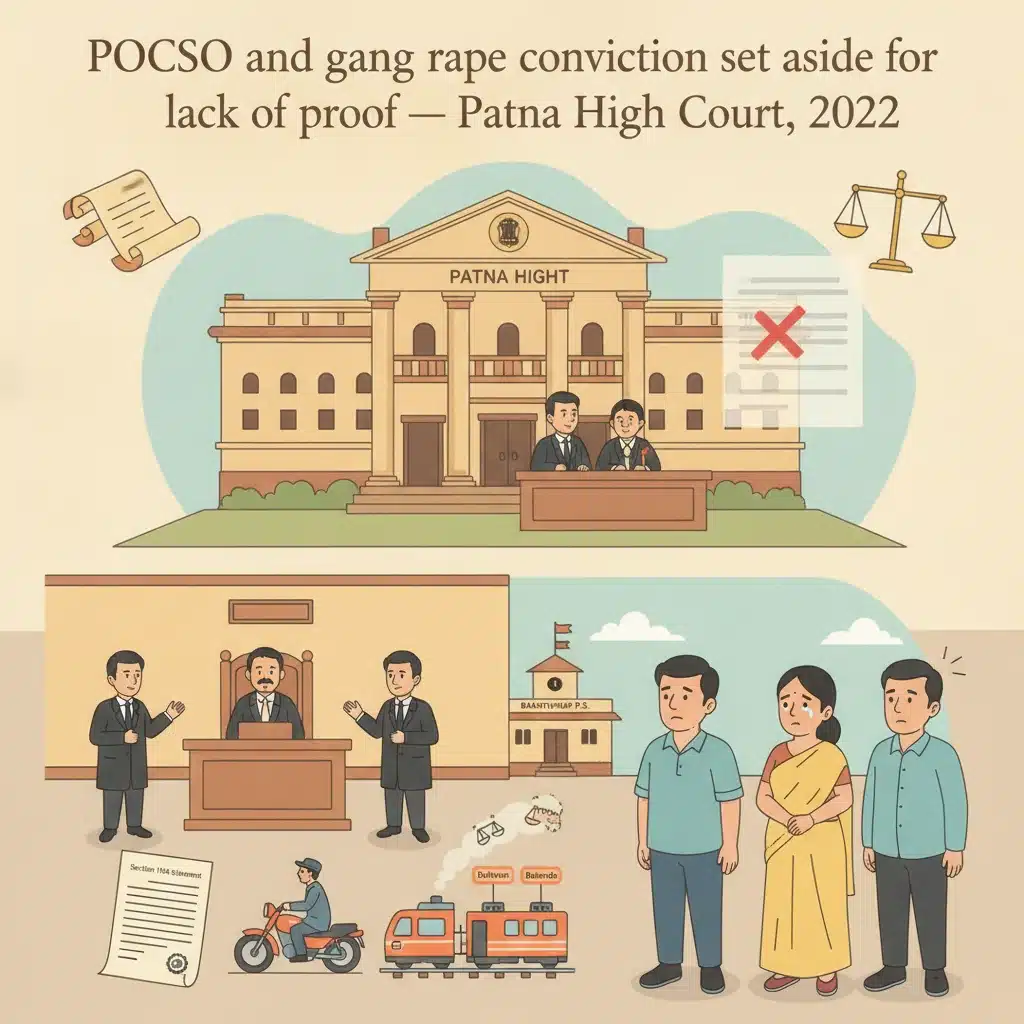
Case Background
This case arose from Bakhtiyarpur P.S. Case No. 66 of 2017, District Saharsa. The informant was the father of a girl, referred to in the judgment as the victim/PW‑7.
On 18.03.2017, the girl left home at about 9:30 AM to go to school. She did not return till 5:30 PM. The father feared that she might have been kidnapped either for marriage or for killing her, and lodged a written report on 20.03.2017.
In this written report, he clearly stated that his daughter was 18 years and seven months old and that she had been married to someone about six months before the incident. On this report, a case was registered initially under Sections 365 and 366 of the Indian Penal Code.
On 23.03.2017, the girl was recovered along with one of the accused (appellant no. 1) from a railway platform at Bhatinda Railway Station in Punjab by the Punjab Police. Later, she was brought back to Bihar by the police and her brother.
The victim underwent medical examination on 27.03.2017. The doctor found no signs of sexual assault. However, on the basis of a radiology report from J.L.N.M.C.H., Bhagalpur, the doctor assessed her age to be less than 16 years. Her statement under Section 164 of the Cr.P.C. was recorded but that statement itself was never exhibited at the trial; only her signature on it was marked as an exhibit.
After the Section 164 Cr.P.C. statement, the court below on 05.05.2017 directed that serious offences be added. Sections 366A, 376 read with 120B of the IPC and Section 4 of the POCSO Act were added to the FIR.
Upon completion of investigation, police filed charge‑sheet under Sections 365, 366A, 376, 120B IPC and Section 4 POCSO. Cognizance was taken and the case was committed for trial.
The trial court framed charges against both accused under Section 6 of the POCSO Act and Sections 366A and 376D IPC. Eight witnesses were examined for the prosecution and two for the defence. After recording their statements under Section 313 Cr.P.C., the trial court convicted both accused and sentenced them to rigorous imprisonment up to 20 years with fines, with sentences to run concurrently.
Aggrieved, both convicts filed this Criminal Appeal (DB) No. 14 of 2020 before the Patna High Court under Section 374(2) Cr.P.C. The appeal was heard by a Division Bench and was decided on 17.11.2022.
What the Court Examined and Decided
The Patna High Court carefully examined whether the essential ingredients of the offences under Section 6 of the POCSO Act and Sections 366A and 376D IPC were proved.
The appellants’ counsel argued that the conviction was patently erroneous. Their main points were:
First, the prosecution failed to prove beyond reasonable doubt that the victim was under 18 years on the date of occurrence, which is necessary for both POCSO and Section 366A IPC. They pointed out that the girl’s parents themselves had stated that she was more than 18 years old and already married.
Second, they argued that the victim’s own testimony at trial did not support the allegation of gang rape under Section 376D IPC. There was no clear description of sexual assault and no medical support.
On the other side, the Additional Public Prosecutor relied mainly on the medical opinion that the victim was below 16 years of age. The State also relied on the detailed version allegedly given by the victim in her statement under Section 164 Cr.P.C., in which she had described events from the time she was taken away from her parents’ guardianship until she was rescued at Bhatinda. According to the State, those disclosures showed offences under Section 6 POCSO and Section 376D IPC.
The High Court began its analysis by examining the age of the victim. It noted two clear facts from the FIR lodged by the father:
One, he stated her age as 18 years and seven months.
Two, he also stated that she had been married around six months before the occurrence.
During trial, the mother (PW‑3) in paragraph 7 of her deposition firmly said that the victim was a major at the time of her marriage. Since the incident took place around six months after this marriage, her evidence also supported majority.
The Court observed that parents are generally the best witnesses to speak about the age of their child. Apart from the doctor’s opinion, there was no other evidence on age. The Court found it unsafe to rely on the medical opinion in the face of clear and consistent statements from both parents that the girl was above 18.
Therefore, the High Court held that it could not uphold the finding of the trial court that the victim was a minor at the relevant time. As a direct result, the conviction under Section 6 of the POCSO Act could not stand. For the same reason, conviction under Section 366A IPC, which applies only where the girl is under 18, was also held unsustainable.
After setting aside those findings, the Court turned to the conviction for gang rape under Section 376D IPC. It reproduced the section in the judgment, which defines punishment where a woman is raped by one or more persons acting as a group or in furtherance of common intention.
The Court then closely evaluated the evidence of the victim (PW‑7) given at the trial. It highlighted that there was “no evidence at all” against appellant no. 2 to even indicate commission of any offence. The only material against him was that he was present on the motorcycle along with appellant no. 1 when the girl was offered a lift to her father’s shop. The Court observed that this, by itself, could not form the basis of a conviction for gang rape.
Therefore, the High Court held that the conviction of appellant no. 2 under Section 376D IPC was “not at all sustainable.”
With regard to appellant no. 1, the Court again focused on the victim’s testimony at trial, not on the unproved Section 164 statement. It noted that there was no clear evidence of sexual assault committed by appellant no. 1.
During cross‑examination, the victim had only given a vague statement in paragraph 6 that appellant no. 1 had done “something wrong” with her (“galat kaam kiya tha”). The Court held that this vague expression did not, in law, amount to evidence of rape under Section 376 IPC, much less evidence of gang rape under Section 376D.
The Court also found merit in the defence submission that the chain of events narrated by the victim herself showed that she and appellant no. 1 were mostly in public places. On such facts, the Court found it difficult to accept that appellant no. 1 could have had the opportunity to engage in sexual intercourse with the victim, whether with or without consent.
Another important aspect was that the statement under Section 164 Cr.P.C., on which the prosecution heavily relied, was never exhibited as a document at the trial. Only the victim’s signature on that statement was marked as Exhibit‑3. Since the statement itself was not proved, the High Court did not treat its contents as substantive evidence.
Further, the medical examination, conducted shortly after the recovery of the victim, had not found any evidence of sexual assault. Taken together—lack of medical support, lack of clear testimony, and absence of credible evidence of gang action—the Court held that the charge under Section 376D IPC was not proved.
After reviewing the entire record, the Division Bench concluded that the prosecution had failed to establish, beyond reasonable doubt, the offences under Section 6 POCSO and Sections 366A and 376D IPC. It held that it would not be safe to uphold the conviction based on such weak evidence.
Consequently, the Patna High Court set aside the judgment of conviction dated 12.12.2019 and the order of sentence dated 18.12.2019, passed by the 1st Additional Sessions Judge‑cum‑Special Judge (POCSO), Saharsa in POCSO Case No. 21/2017.
The criminal appeal was allowed. The Court directed that the appellants, who were in custody, be released forthwith, if they were not wanted in any other case.
Why This Judgment Matters
This judgment is important for both accused persons and victims’ families because it shows how strictly courts look at evidence in serious cases like POCSO and gang rape.
First, the Patna High Court clarified that simply having a medical age estimate is not enough when both parents clearly state that the girl is a major and there is no documentary proof to the contrary. For POCSO cases, age must be proved carefully because the entire law depends on the victim being a minor.
Second, the judgment underlines that vague statements such as “something wrong was done” are not sufficient to convict someone for rape or gang rape. The victim’s statement in court is the most important evidence, and it must clearly describe the offence for the law to apply.
Third, the case shows that if a statement under Section 164 Cr.P.C. is not properly proved as an exhibit during trial, the court cannot rely on its contents to convict. Proper procedure in marking documents is crucial.
For people facing similar allegations, the judgment highlights that courts will not uphold convictions where age is doubtful and where there is no clear, consistent evidence of sexual assault. For families of victims, it is a reminder that accurate information and proper documentation (especially on age) are vital when approaching the police and courts.
Legal Issues and Answers
- Issue: Was the victim a minor on the date of the incident so as to attract Section 6 of the POCSO Act and Section 366A IPC?
Answer: No. Relying on the clear statements of both parents that the victim was more than 18 years old and already married, the Court held that she could not be treated as a minor. The medical opinion alone was not enough. - Issue: Did the prosecution prove the charge of gang rape under Section 376D IPC against both appellants?
Answer: No. There was no evidence of any offence by appellant no. 2 beyond his presence on the motorcycle, and the victim’s trial testimony gave no clear account of sexual assault by appellant no. 1. The vague statement that “something wrong” was done and lack of medical evidence were insufficient. - Issue: Could the contents of the victim’s statement under Section 164 Cr.P.C. be relied upon to sustain the conviction?
Answer: No. The statement itself was never exhibited at trial; only the signature was marked. Therefore, its contents could not be treated as proved for the purpose of conviction.
Cases Cited by the Court
- The judgment does not mention or rely upon any earlier case law. No prior decisions are cited.
Case Details
Case Number: Criminal Appeal (DB) No. 14 of 2020; arising out of Bakhtiyarpur P.S. Case No. 66 of 2017; POCSO Case No. 21/2017.
Case Title: Mojahid Ansari @ Mozahid @ Mozahid Ansari @ Md. Mojahi Ansari and another v. The State of Bihar.
Coram: Hon’ble Mr. Justice Chakradhari Sharan Singh and Hon’ble Mr. Justice Chandra Prakash Singh.
Date of Judgment: 17.11.2022.
Citation: 2022 (4) PLJR 625.
Advocates: For the appellants – Mr. Bikramdeo Singh, Advocate; Mr. Satish Kumar Singh, Advocate; Mr. Dinesh Maharaj, Advocate. For the State – Km. Shashi Bala Verma, Additional Public Prosecutor.
Nature of the Case: Criminal appeal (Division Bench) under Section 374(2) Cr.P.C. against conviction and sentence under POCSO Act and Indian Penal Code.
Link to Judgment: Click here to read the full judgment of the Patna High Court.
If you found this explanation helpful and wish to stay informed about
how legal developments may affect your rights in Bihar,
you may consider following Samvida Law Associates for more updates.




