

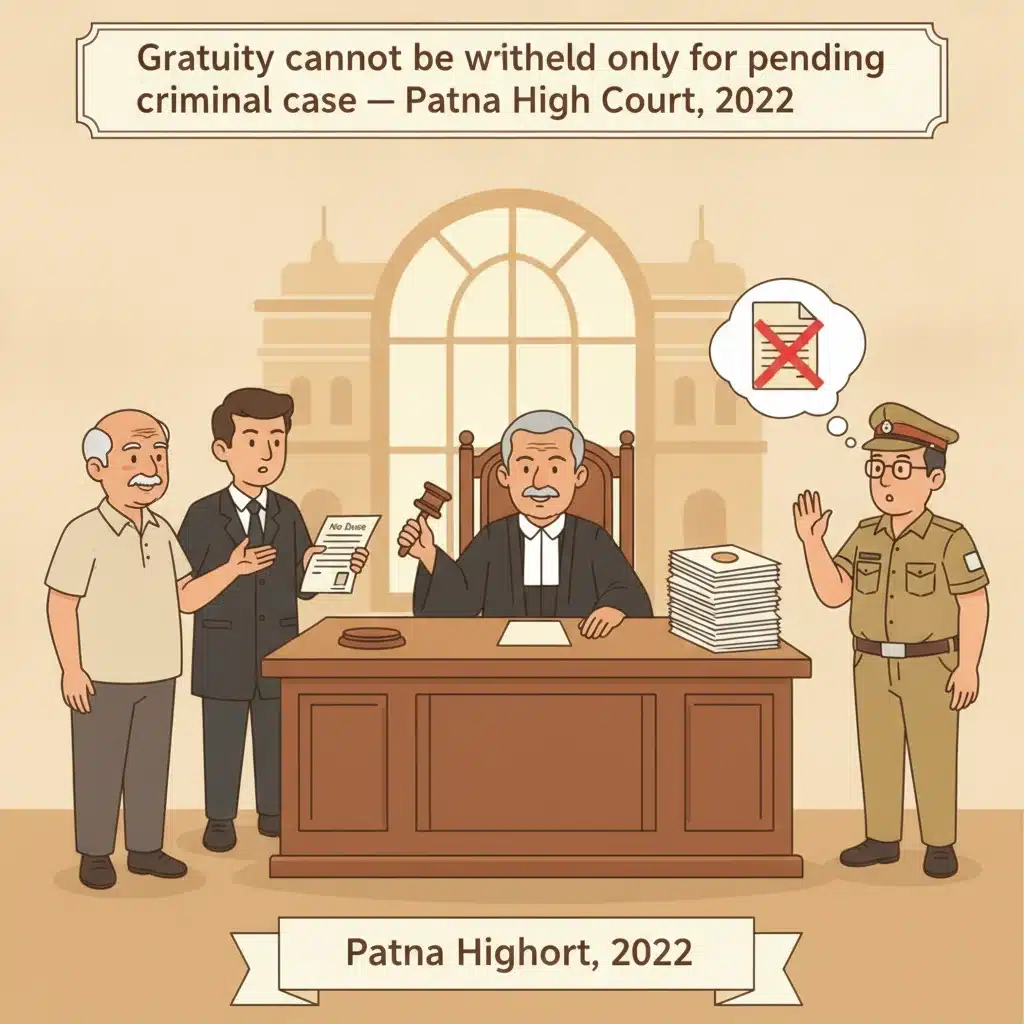
Case Background
The petitioner was a government school teacher under the Education Department of Bihar. He was appointed as an Assistant Teacher on 14.08.1984.
After more than 34 years of service, he rose to the post of Head Master, Middle School Hardia, Pupri, Sitamarhi. He superannuated from service on 30.11.2018.
Before his retirement, Pupri P.S. Case No. 84 of 2014 was registered. The case related to alleged irregularities in the distribution of mid-day meal.
On the same allegations, a departmental proceeding was also started against him. That departmental proceeding ended in his exoneration. In simple words, in the internal departmental inquiry he was not found guilty.
After retirement, a No Dues Certificate was issued in his favour. All other retiral dues except gratuity were released and paid to him.
However, his gratuity was withheld by the District Programme Officer (Establishment), Sitamarhi, on the ground that the criminal case of 2014 was still pending. An endorsement dated 08.07.2019 directed that gratuity would be paid only after disposal of that criminal case.
Feeling aggrieved, the petitioner approached the Patna High Court under its civil writ jurisdiction in CWJC No. 1071 of 2021. He asked the Court to direct payment of his gratuity and to set aside the endorsement of the District Programme Officer.
What the Court Examined and Decided
The case came before Hon’ble Mr. Justice Harish Kumar of the Patna High Court. The Court heard Mr. Ravi Ranjan, counsel for the petitioner, and Ms. Namrita Singh, counsel for the State of Bihar.
The central dispute was narrow but important: could the department legally withhold gratuity only because a criminal case was pending, when there was no departmental finding of guilt?
The petitioner’s side highlighted a few basic facts. First, he had served for more than three decades and retired on 30.11.2018 as Head Master. Second, a criminal case relating to mid-day meal distribution (Pupri P.S. Case No. 84 of 2014) was indeed pending, but the departmental proceeding on the same allegations had already ended in his exoneration.
Third, a No Dues Certificate had been issued in his favour. All other retiral dues had been cleared. Only his gratuity remained unpaid, and this was solely because of the pending criminal case.
On the other side, the State’s counsel strongly defended the withholding of gratuity. The State argued that the petitioner was found involved in irregularities and that the criminal case was still pending. According to the State, gratuity could be paid only after the case ended, and only if the petitioner was exonerated from the charges.
Therefore, the State’s position was that the pendency of a judicial proceeding justified postponing gratuity until final outcome.
The Court then turned to the legal framework. It noted that there was no departmental proceeding pending against the petitioner. There was also no outcome of any departmental case holding him guilty of misconduct.
The only adverse factor on record was the pending criminal case arising out of Pupri P.S. Case No. 84 of 2014.
The Court further noted that before the petitioner’s retirement, the Bihar Pension Rules, 1950 had been amended. By notification dated 19.07.2012, Rule 43(c) was inserted.
The Court reproduced Rule 43(c), which states in substance that where a departmental proceeding or judicial proceeding, with prosecution sanctioned during service, continues beyond retirement, the retired employee is to be paid provisional pension. This provisional pension must not be less than 90% of the maximum admissible pension.
Importantly, Rule 43(c) itself speaks only of pension, not of withholding of gratuity.
The Patna High Court then recalled that a Full Bench of the same Court had already examined this issue in detail in Arvind Kumar Singh vs State of Bihar and Ors, reported in 2018 (II) PLJR 933.
The judgment quoted at length paragraphs 25 and 30 of that Full Bench decision. In those paragraphs, the Full Bench explained the effect of the 2012 amendment:
First, when Rule 43(c) was introduced, the State was already aware of earlier statutory and administrative circulars that had allowed withholding of gratuity during pending proceedings. However, while amending the statutory rule, the rule-maker chose to use only the word “pension”, without carving out any exception for holding back gratuity.
The omission of the word “gratuity” was held by the Full Bench to be deliberate and conscious. Under the Bihar Pension Rules, pension includes gratuity. When the rule speaks of payment of provisional pension, it must be read as including payment of gratuity as well, unless the rule clearly says otherwise.
Therefore, once Rule 43(c) was inserted into the rules, the earlier statutory notification dated 30.07.1980 and circulars of 1974, which had provided for withholding gratuity, were considered wiped out or annulled. The Court stated that the statutory rule must be given full effect by using its plain meaning.
The Full Bench categorically held that after the amendment of 19.07.2012, an employee facing departmental inquiry or judicial proceeding on the date of superannuation is entitled to provisional pension, which includes gratuity, to an amount not less than 90%.
In paragraph 30 of Arvind Kumar Singh, the Full Bench further clarified two important points. First, leave encashment can be withheld under executive instructions, but not under the Pension Rules. Second, and more relevant here, the earlier view that gratuity could be withheld under the Bihar Pension Rules was declared to be an incorrect proposition of law.
The Full Bench clearly ruled that gratuity cannot be withheld in view of Rule 43(c). To that extent, earlier Division Bench decisions such as State of Bihar v. Mozaffar Hassan, Ram Prakash Yadav, and Vijay Kumar Mishra were overruled.
Applying this settled law to the present case, the Single Judge in this writ petition concluded that there was no justification for withholding the petitioner’s gratuity only because a criminal case was pending.
The Court emphasised that, in light of Rule 43(c) and the Full Bench judgment, gratuity could not be stopped merely due to pendency of judicial proceedings. The State’s stand that payment of gratuity would be deferred until the criminal case ended was inconsistent with the binding Full Bench decision.
Accordingly, the Court disposed of the writ petition by issuing directions. It directed respondent no. 4, the District Education Officer, Sitamarhi, to consider the petitioner’s case preferably within eight weeks from the date of receipt or production of a copy of the order.
The Court also made an important clarification for administrative practice: any endorsement made in the official file “against the mandate of the law” is unsustainable and should be ignored.
The Court added that if, on such consideration, the petitioner’s case “finds favour,” then the order for payment of gratuity must be passed within the same eight-week period.
Thus, while the Court did not itself compute or order payment of a specific amount, it laid down a clear obligation on the authorities to re-examine the matter strictly according to law, keeping in mind that gratuity cannot be withheld only because of the pending criminal case.
Why This Judgment Matters
This judgment is significant for retired government employees in Bihar, especially teachers and other staff facing old or slow-moving criminal or departmental cases.
The Patna High Court reaffirmed that after the 2012 amendment to the Bihar Pension Rules, gratuity is not to be withheld merely because a judicial proceeding is pending.
Employees who have retired and have not been held guilty in departmental proceedings, but whose gratuity is stopped only due to a pending criminal case, can rely on this ruling and the Full Bench decision in Arvind Kumar Singh.
The decision also sends a message to district and block level officers. Internal notes or endorsements contrary to Rule 43(c) and the Full Bench judgment are without legal value and must be ignored.
For families depending on retirement benefits, this ruling can make a major financial difference. It ensures that a pending case, which may take years to conclude, does not automatically deprive a retired employee of his or her lawful gratuity.
Legal Issues and Answers
Issue: Can the Education Department withhold a retired employee’s gratuity solely because a criminal case, started during service, is still pending at the time of retirement?
Answer: No. In view of Rule 43(c) of the Bihar Pension Rules, 1950 and the Full Bench judgment in Arvind Kumar Singh, gratuity cannot be withheld on this ground alone.
Issue: Do earlier circulars or decisions allowing withholding of gratuity during pending proceedings still apply after the 2012 amendment to Rule 43(c)?
Answer: No. The Full Bench has held that incorporation of Rule 43(c) annulled the earlier notification and circulars, and earlier decisions permitting withholding of gratuity under the Pension Rules do not state the correct law.
Cases Cited by the Court
- Arvind Kumar Singh vs State of Bihar and Ors, 2018 (II) PLJR 933 (Full Bench of Patna High Court)
- The Full Bench decision also refers to earlier cases such as Vijay Kumar Mishra, State of Bihar and Ors v. Mozaffar Hassan, and Ram Prakash Yadav, mainly to clarify that their view on withholding gratuity is incorrect after Rule 43(c).
Case Details
Case Number: Civil Writ Jurisdiction Case No. 1071 of 2021
Case Title: Mohan Shah v. State of Bihar and Others
Coram: Hon’ble Mr. Justice Harish Kumar
Citation: 2022 (4) PLJR 629
Advocates: Mr. Ravi Ranjan, Advocate for the petitioner; Ms. Namrita Singh for the respondents/State of Bihar
Nature of the case: Writ petition under civil writ jurisdiction challenging withholding of gratuity and seeking direction for its payment
Date of Judgment: 21.11.2022
Link to Judgment: https://patnahighcourt.gov.in/viewjudgment/MTUjMTA3MSMyMDIxIzEjTg==-8jMuFBE8axY=
If you found this explanation helpful and wish to stay informed about
how legal developments may affect your rights in Bihar,
you may consider following Samvida Law Associates for more updates.




