

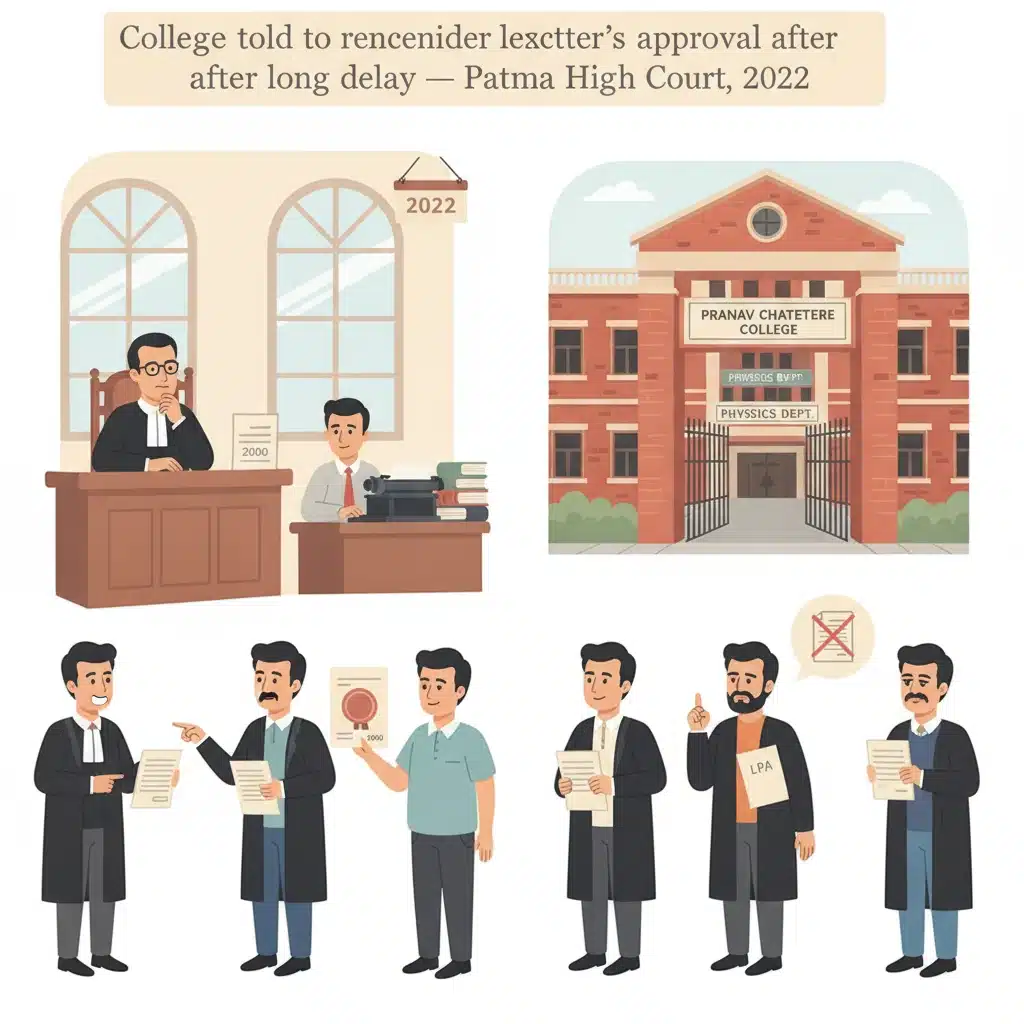
Case Background
The dispute arises from the appointment of a lecturer in Physics at Pranav Chatterjee College, Itarhi Road, Buxar, an affiliated college under Veer Kunwar Singh University, Ara.
The teacher, Mahesh Dutt Singh, had been working in the college as a Lecturer since 1988. According to him, the Bihar College Service Commission later recommended him for appointment to the post of Lecturer in Physics through its letter no.1542 dated 18.01.2000, issued after an examination held in terms of Advertisement No.80/90.
On the strength of this recommendation, the Governing Body of the college allegedly took up a proposal for his permanent appointment and for approval of his post. However, according to the teacher, nothing concrete was done thereafter and his appointment was not approved.
Feeling aggrieved by this inaction, he filed Civil Writ Jurisdiction Case No.4332 of 2005 before the Patna High Court. In the writ petition he sought directions to the Bihar College Service Commission and the University authorities to regularise his position as a Lecturer in Physics and to approve his post.
The learned Single Judge allowed the writ petition by order dated 18.02.2011. The Single Judge directed the college to send his name to the Commission within two months, and directed the Commission (described as Bihar Public Service Commission in the order) to consider his case within three months, keeping in mind that he had already been recommended by letter no.1542 dated 18.01.2000 and that he had taught in the college for about 23 years since 1988.
The Governing Body of Pranav Chatterjee College and the Professor Incharge were not satisfied with this direction. They filed Letters Patent Appeal No.605 of 2011 before a Division Bench of the Patna High Court, challenging the Single Judge’s judgment.
What the Court Examined and Decided
The Division Bench of the Patna High Court, consisting of Hon’ble Mr. Justice P. B. Bajanthri and Hon’ble Mr. Justice Rajiv Roy, heard the appeal and delivered an oral judgment on 20.07.2022.
First, the Court recorded the stand of Veer Kunwar Singh University. The Registrar of the University, Mr. Dhirendra Kumar Singh, was present in Court pursuant to an earlier order. On instructions, he submitted that there was no proposal before the University for approval of the teacher’s appointment from Pranav Chatterjee College. Because of this, the University described itself as only a formal party in these proceedings.
The Bench then asked a pointed question: was there any statute or executive order which allowed regularisation or absorption of ad hoc lecturers appointed in affiliated colleges? The response placed on record was that there was no statutory provision for regularisation or absorption of ad hoc lecturers in affiliated colleges.
On the other side, learned counsel for Mahesh Dutt Singh argued that the Governing Body of Pranav Chatterjee College had in fact considered a proposal for approving his appointment on a permanent basis. According to this side, the problem was that after this consideration there was total inaction; nothing moved further, and his appointment was never approved or rejected by a proper speaking order. This, they argued, forced the teacher to move the High Court in 2005.
The Division Bench then looked at what exactly the learned Single Judge had ordered. The Single Judge had directed the Incharge Principal/Principal/Managing Committee of the college to send the teacher’s name to the Commission within two months. The Commission was directed to take a decision within three months of receipt, taking into account that the teacher had already been recommended earlier by letter no.1542 dated 18.01.2000.
The Single Judge also noted the important fact that the teacher had been working as Lecturer in the college since 1988, i.e., about 23 years by the time of that order, and held that this was a relevant factor for consideration. The writ petition was allowed to that extent.
The college, in appeal, brought a new factual aspect to the notice of the Division Bench. Its counsel submitted that there had indeed been a proposal for approval of the teacher’s appointment, but that this was rejected by Resolution No.6 dated 02.06.2001 of the Governing Body. It was admitted, however, that this decision had never been communicated to the teacher.
This omission was crucial. The Court noted that in other words, the grievance of the teacher had in fact been turned down by the college, but kept confined to the resolution book. The person whose right was directly affected was not informed of this adverse decision.
The Division Bench also emphasised that it was hearing a Letters Patent Appeal. The scope of such an appeal is limited: the Court mainly has to see whether the Single Judge’s order is valid in law and consistent with the relevant provisions, not to completely reopen the entire factual matrix as in a first instance hearing.
The Bench found that the college authorities had not disclosed before the Single Judge that they had already rejected the teacher’s grievance by a resolution in 2001. This non-disclosure meant the Single Judge decided the case without being aware of that internal decision. The Division Bench therefore had to balance the new material with fairness to both sides, while staying within the limited scope of an LPA.
Another important feature noted by the Court was the passage of time. The writ petition dated back to 2005, and the appeal was being decided in 2022. Counsel for the teacher pointed out that, after such a long delay, it was unfair for the college to suddenly rely on an old internal resolution to say that his grievance had already been rejected.
He also argued that other similarly situated persons had their grievances regarding approval of appointment redressed, whereas his client had been left out and discriminated against by both the college and the University. The Court recorded that the teacher’s case was still pending at the level of the college management and had not even reached the University for approval, despite the Governing Body having taken a decision relating to his appointment.
Taking all these facts into account, the Division Bench decided not to outright approve the teacher’s appointment itself, and also not to mechanically uphold the internal rejection recorded in Resolution No.6 of 02.06.2001. Instead, it adopted a middle path focusing on procedural fairness and timely decision-making.
The Court directed Mahesh Dutt Singh to file a detailed representation before the college authorities, with an advance copy to the University. On receiving this representation, the Governing Body of Pranav Chatterjee College was instructed to take a fresh decision on his grievance.
While reconsidering his case, the Governing Body must specifically examine why he appears to have been discriminated against when compared with others whose appointments had been approved. The Court made it clear that every contention raised by the teacher in his representation must be considered.
The Court further required the Governing Body to pass a detailed speaking order. A speaking order means the authority must record clear reasons for accepting or rejecting the representation so that the affected person understands the basis of the decision and can challenge it further if necessary.
If, while dealing with the representation, the Governing Body feels that some further clarification or information is needed from the teacher, it is permitted to grant him an oral hearing before taking a final decision.
The Court fixed a strict time frame. The Governing Body must take its decision within three months from the date of the teacher’s representation, and this decision must be communicated to him.
If the Governing Body finds that he is entitled to approval of his appointment, then it must immediately forward all necessary papers to the University for further action. The University, on receipt of the Governing Body’s recommendation, has been directed to take an appropriate decision strictly in accordance with law within a further period of three months.
With these directions and observations, the Letters Patent Appeal was disposed of. The Division Bench did not set aside the Single Judge’s concern for the teacher’s long service, but replaced the earlier directions with a clearer procedure and time-bound steps, focusing on a fair, reasoned decision-making process at the college and university level.
Why This Judgment Matters
This judgment is important for teachers in affiliated colleges, especially those who have worked for many years without formal approval of their appointments.
The Patna High Court has stressed that colleges cannot quietly reject a teacher’s claim in an internal resolution and keep the decision hidden. Any decision affecting the rights of an employee must be communicated to that person.
The Court also underlined that long-standing grievances cannot be kept pending indefinitely. When a representation is made, the authority must take a timely, reasoned decision and must explain why one teacher is treated differently from others in similar situations.
For employees, this case shows that if an institution has not taken a clear, communicated decision on their appointment or approval, they can seek a direction from the Court for a fresh, speaking order within a fixed time, along with an opportunity of hearing.
Legal Issues and Answers
Issue: Can a college rely on an uncommunicated internal resolution rejecting a teacher’s approval claim, after many years of inaction, to resist judicial directions for consideration of his appointment?
Answer: The Court did not accept such reliance as final. Instead, it ordered a fresh consideration of the teacher’s case through a detailed, reasoned, and time-bound decision, with an opportunity of hearing.
Issue: What steps must be followed when an affiliated college teacher seeks approval of appointment, and the University has no proposal before it?
Answer: The teacher must file a detailed representation to the college; the Governing Body must decide it by a speaking order within three months and, if approval is found due, forward the case to the University, which must then decide within another three months in accordance with law.
Issue: Is there any statutory provision for automatic regularisation or absorption of ad hoc lecturers in affiliated colleges?
Answer: The Registrar of the University stated, and the Court recorded, that there are no statutory provisions for regularisation or absorption of ad hoc lecturers appointed in affiliated colleges.
Cases Cited by the Court
- No previous judgments are cited or relied upon in the text of this decision.
Case Details
Case Number: Letters Patent Appeal No.605 of 2011 in Civil Writ Jurisdiction Case No.4332 of 2005
Case Title: The Governing Body, Pranav Chatterjee College & Anr. v. Mahesh Dutta Singh & Ors.
Coram: Hon’ble Mr. Justice P. B. Bajanthri and Hon’ble Mr. Justice Rajiv Roy
Date of Judgment: 20.07.2022
Citation: 2022 (4) 598
Advocates:
- For the Appellants (college authorities): Mr. Suresh Chand Giri, Advocate
- For the Respondent No.1 (teacher): Mr. Sunil Kumar Mandal, Advocate
- For Respondent Nos.2 & 3 (University authorities): Mr. P. K. Verma, Senior Advocate; Mr. Rajesh Prasad Chaudhary, Advocate; Mr. Viveka Nand Pathak, Advocate
Nature of the Case: Letters Patent Appeal against the order of a Single Judge in a writ petition relating to approval of appointment of a college lecturer.
Link to Judgment: Click here to read the full judgment on the Patna High Court website
If you found this explanation helpful and wish to stay informed about
how legal developments may affect your rights in Bihar,
you may consider following Samvida Law Associates for more updates.




