

Case Background
The writ petition was filed before the Patna High Court in Civil Writ Jurisdiction Case No. 5583 of 2022. The petitioner is a resident of Bhadsera village in Bhojpur district. The State of Bihar and several district-level officers, including the District Magistrate, Additional Collector and Circle Officer, were made respondents, along with a private respondent from the same village.
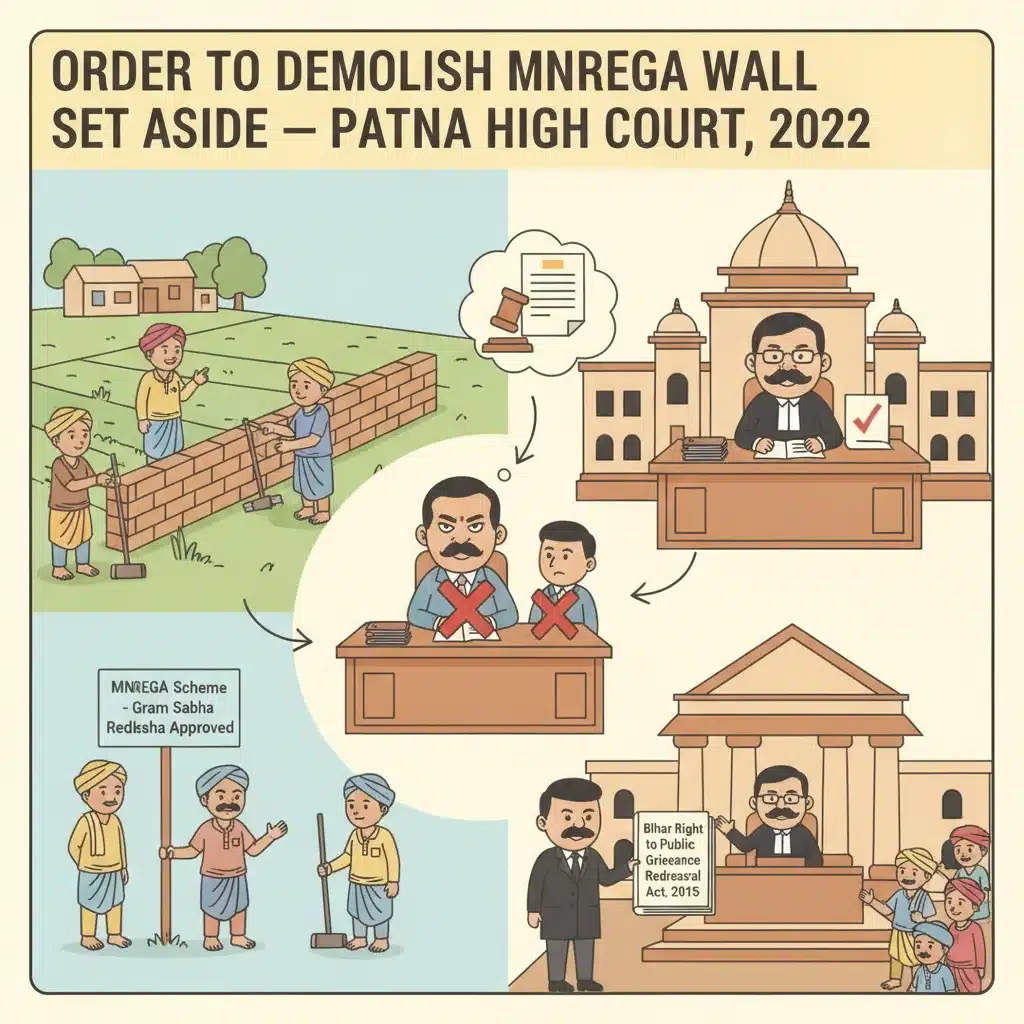
The dispute arose from an order dated 28.06.2021 passed by the District Magistrate, Bhojpur at Ara. The District Magistrate was acting in his capacity as the Second Appellate Authority under the Bihar Right to Public Grievance Redressal Act, 2015. By this order, the Circle Officer, Tarari, was directed to demolish a particular wall.
According to the writ petition, this wall was not an illegal private construction. It was a retaining wall constructed by the respondent authorities themselves. The construction was done under the MNREGA scheme after approval by the Gram Sabha, as later confirmed in the counter affidavit filed by the Circle Officer.
Feeling aggrieved by the direction to demolish this wall, the petitioner approached the Patna High Court. The core question was whether such a direction could legally be issued under the Bihar Right to Public Grievance Redressal Act, 2015.
What the Court Examined and Decided
The matter was heard by Hon’ble Mr. Justice Mohit Kumar Shah, who delivered an oral judgment on 21.07.2022. The petitioner was represented by learned counsel, and the State was represented by learned counsel Sri Rishi Raj Sinha (SC-19).
The petitioner’s side focused on the scope and limits of the Bihar Right to Public Grievance Redressal Act, 2015. They argued that the Second Appellate Authority under this Act could not pass an order directing demolition of a wall, whether it was an unauthorized construction or, as in this case, a wall constructed by the authorities under a government scheme.
To support this, the petitioner’s counsel referred specifically to Section 2(a) of the Bihar Right to Public Grievance Redressal Act, 2015. This provision defines what counts as a “complaint” under the Act. The definition was reproduced in the judgment.
Section 2(a) states that a complaint is an application by a citizen or group of citizens to a Public Grievance Redressal Officer seeking any benefit or relief relating to schemes, programmes or services run by the State Government, or in respect of failure or delay in providing such benefit or relief. It also covers matters arising out of failure in the functioning of, or violation of, any law, policy, service, programme or scheme in force in the State by a public authority.
Importantly, the same provision excludes several classes of matters from its scope. It does not include grievances relating to service matters of public servants, whether serving or retired. It also excludes matters where any Court or Tribunal has jurisdiction, matters under the Right to Information Act, 2005, and services notified under the Bihar Right to Public Services Act, 2011.
Based on this statutory language, the petitioner contended that the nature of the grievance being decided by the Second Appellate Authority in this case went beyond what Section 2(a) allows. The question of whether a wall should be demolished, when that wall was a retaining wall constructed under MNREGA, was not a typical grievance about obtaining benefits or relief under a scheme. Rather, it was a dispute about removal of a physical structure.
The petitioner’s argument, as noted in the judgment, was that “removal of any unauthorized structure or for that matter, an authorized structure” does not fall within the domain of the Second Appellate Authority exercising powers under the 2015 Act. Therefore, the petitioner claimed, the District Magistrate as Second Appellate Authority could not lawfully direct the Circle Officer to demolish the wall.
On the other hand, the State’s counsel, Sri Rishi Raj Sinha (SC-19), defended the actions of the Circle Officer. Referring to the counter affidavit filed by the Circle Officer, Tarari, he submitted that the Circle Officer was merely implementing the order of the District Magistrate-cum-Second Appellate Authority dated 28.06.2021.
The State’s counsel also drew attention to paragraph 6 of the counter affidavit. There, it was stated that the retaining wall had indeed been constructed under the MNREGA scheme, after approval by the Gram Sabha. It was also specifically asserted that the wall did not hinder the farmers in their irrigation activities.
After hearing both sides, the Court turned to the scope of the Bihar Right to Public Grievance Redressal Act, 2015. The Court considered the kinds of complaints that can be entertained by the Public Grievance Redressal Officer, First Appellate Authority, and Second Appellate Authority. The Court treated Section 2(a) as the guiding provision to understand this scope.
The Patna High Court observed that the issue at hand was about removal of an encroachment or retaining wall constructed under the MNREGA scheme. The Court held that such an issue “does not lie within the domain of the authorities concerned” acting under the Bihar Right to Public Grievance Redressal Act, 2015.
In other words, the Court accepted the petitioner’s core contention. Even if a complaint had been made against the wall, the mechanism under the 2015 Act was not the correct legal route to decide demolition of such a structure. These authorities are meant to ensure delivery of benefits and services under government schemes, not to exercise powers similar to a civil court or land authority deciding demolitions and encroachments.
Having reached this conclusion on jurisdiction, the Court examined the specific order dated 28.06.2021 passed by the District Magistrate-cum-Second Appellate Authority. Since the subject matter of that order went beyond what the Act allows, the Court found that the order was “illegal” and “beyond the scope” of the Bihar Right to Public Grievance Redressal Act, 2015.
The High Court, therefore, quashed the order dated 28.06.2021 directing the Circle Officer, Tarari, to demolish the wall in question. Once that order was set aside, there was no valid basis under the 2015 Act for the demolition to proceed.
On this reasoning, the Patna High Court allowed the writ petition. No further directions were mentioned in the judgment beyond quashing the impugned order.
Why This Judgment Matters
This judgment is important for citizens and officials in Bihar who use the Bihar Right to Public Grievance Redressal Act, 2015. It clarifies that the Act has a limited field. It is meant to ensure timely and proper delivery of government schemes and services, not to decide all types of local disputes.
People often try to use grievance forums to resolve land issues, boundary disputes, or complaints about constructions. The Patna High Court has made it clear that such forums cannot pass demolition orders regarding walls or other structures, especially those built by the government itself under a scheme like MNREGA.
For government officers, the decision is a reminder to act only within the powers granted by law. If they act beyond the Act’s scope, their orders can be struck down as illegal. For villagers and other citizens, it shows that if a grievance authority orders demolition without proper legal power, such orders can be challenged before the High Court.
Legal Issues and Answers
Issue: Could the District Magistrate, acting as Second Appellate Authority under the Bihar Right to Public Grievance Redressal Act, 2015, lawfully direct demolition of a retaining wall constructed under the MNREGA scheme?
Answer: No. The Patna High Court held that the issue of removal of an encroachment or retaining wall constructed under MNREGA does not fall within the domain of authorities under the 2015 Act. The demolition order was therefore illegal and beyond the scope of the Act.
Cases Cited by the Court
- No previous judgments or case law are cited or relied upon in the text of this decision.
Case Details
Case Number: Civil Writ Jurisdiction Case No. 5583 of 2022
Case Title: Hareram Tiwari v. The State of Bihar & Ors.
Coram: Hon’ble Mr. Justice Mohit Kumar Shah
Citation: 2022 (4) PLJR 495
Advocates:
For the petitioner: Mr. Parth Gaurav, Adv.; Mr. Rajiv Shankar Dvivedi, Adv.; Mr. Ashutosh Kumar Pandey, Adv.; Ms. Shilpa, Adv.; Mr. Praveen, Adv.
For the respondents: Mr. Rishi Raj Sinha (SC-19)
Nature of the Case: Writ petition under Article 226 of the Constitution challenging an order of the Second Appellate Authority under the Bihar Right to Public Grievance Redressal Act, 2015.
Link to Judgment: Patna High Court Judgment in CWJC No. 5583 of 2022
If you found this explanation helpful and wish to stay informed about
how legal developments may affect your rights in Bihar,
you may consider following Samvida Law Associates for more updates.




