

Case Background
This case arose from Bhagwanpur P.S. Case No. 108 of 2010, District Kaimur (Bhabua), relating to an incident on 08.09.2010 in village Dabauli under Belaon Police Station.
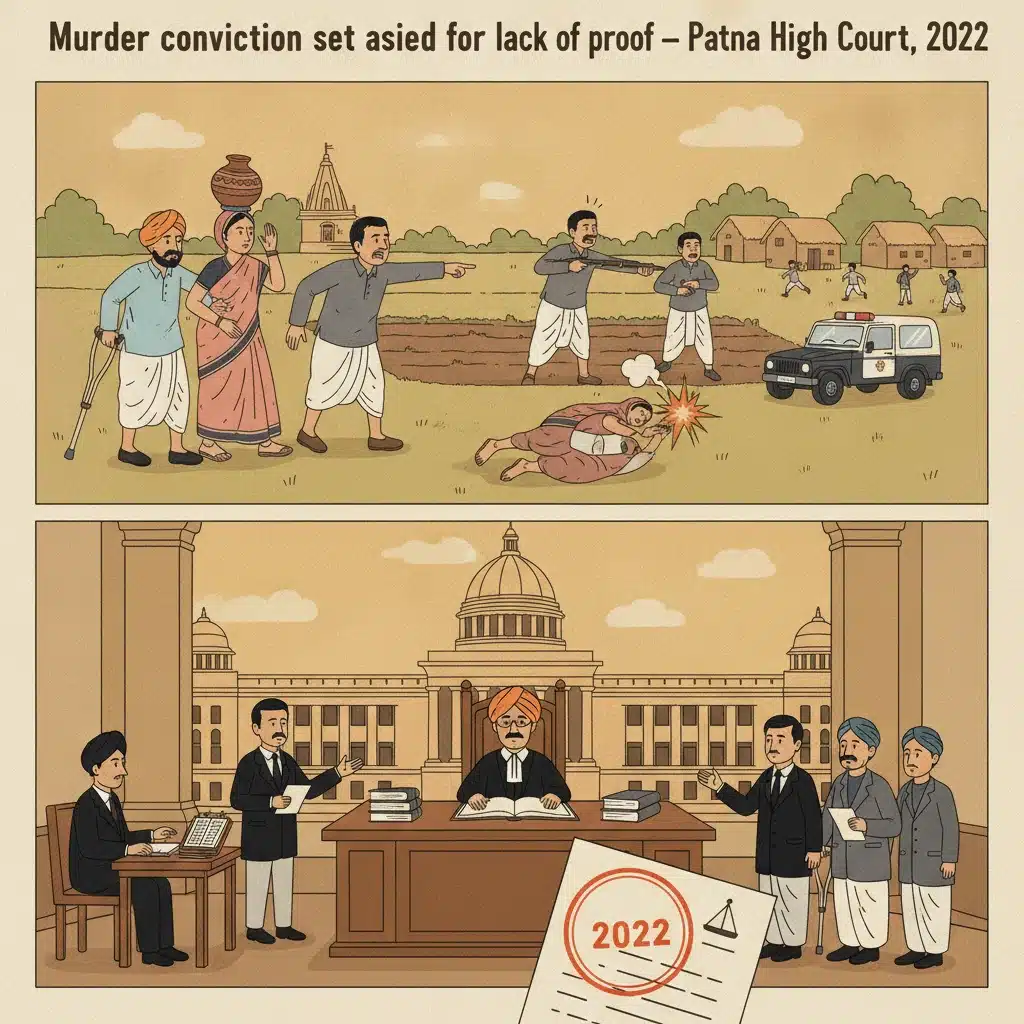
According to the police report, Narayan Ram, a physically handicapped person belonging to the Chamar community, lived in the village with his wife, Dhanvarti Devi. On the morning of 08.09.2010, around 9:00 a.m., Narayan Ram was suffering from dysentery and went outside the village to an open area to relieve himself. He used crutches for walking, and his wife accompanied him carrying a pot of water.
The prosecution alleged that when they passed near a disputed field close to the village Kaliasthan, accused persons, including the present appellant and two others, abused Narayan Ram. When he protested, one co-accused allegedly exhorted the appellant and another co-accused to kill him. The appellant was said to have fired at Narayan Ram and his wife. Narayan was allegedly hit in the groin and injured, while Dhanvarti Devi died on the spot from gunshot injuries.
The incident was reported to Belaon Police Station. A Sub-Inspector visited the spot around 10:30 a.m. and, according to the prosecution, recorded a First Information Report on the spot on the statement of injured Narayan Ram. The case was registered as Crime No. 108 of 2010 against three accused including the appellant.
The dead body of Dhanvarti Devi was sent for post-mortem to Sadar Hospital, Bhabhua, where Dr. Arvind Kumar conducted the autopsy. After routine investigation, a charge-sheet was filed against all three accused.
The 1st Additional Sessions Judge, Kaimur (Bhabhua), conducted Sessions Case No. 244 of 2011/31 of 2011. The appellant was charged under Sections 302, 307, 326 IPC, Section 27 of the Arms Act, and Section 3(2)(v) of the Scheduled Castes and Scheduled Tribes (Prevention of Atrocities) Act, 1989. The other two accused were charged with related offences under Sections 302/149, 307/34 IPC and Section 3(2)(v) of the SC/ST Act.
After trial, by judgment dated 17.06.2014 and order dated 18.06.2014, the Trial Court acquitted the two co-accused but convicted the appellant under Section 302 IPC, Section 27 of the Arms Act and Section 3(2)(v) of the SC/ST Act, and sentenced him to life imprisonment with fines and additional imprisonment in default.
The appellant then filed Criminal Appeal (DB) No. 654 of 2014 before the Patna High Court challenging his conviction and sentence.
What the Court Examined and Decided
The Division Bench of the Patna High Court, comprising Hon’ble Mr. Justice A. M. Badar and Hon’ble Mr. Justice Rajesh Kumar Verma, heard the appeal. The Court carefully went through the trial record, witness statements, and medical evidence.
On behalf of the appellant, it was argued that no witness had clearly seen the appellant with a gun at the time of the incident and that no firearm was ever seized during investigation. Therefore, the story of firing bullets itself became doubtful. Counsel also pointed out that while the prosecution claimed that Narayan Ram was injured and later died, there was no medical record of his treatment, no doctor was examined regarding his injuries, and no supplementary charge-sheet was filed for his alleged death under Section 302 IPC.
It was further argued that, although the police were said to have reached the spot within hours, no material from the scene—such as the blood-stained soil, the water pot carried by the deceased, or the crutches used by Narayan Ram—was seized. Even the blood-stained clothes of witnesses who claimed to have lifted Narayan Ram were not taken into custody.
The defence highlighted contradictions in the prosecution evidence. Narayan Ram was a crippled person who, according to family members, had been passing stools several times in the house due to dysentery. This raised a serious question whether he would go far outside the village to ease himself. It was also emphasised that all eyewitnesses were closely related to the deceased and the informant, and there was an existing land dispute and a civil suit between their family and the accused’s family. On the same set of evidence, the Trial Court had already acquitted two co-accused, yet convicted the appellant alone.
The Additional Public Prosecutor, on the other hand, supported the conviction, arguing that several eyewitnesses had consistently named the appellant as the shooter who killed Dhanvarti Devi by firing at her.
The High Court started its examination by looking at the alleged injuries to informant Narayan Ram and the charge of attempt to murder him. The Court noted that no treating doctor had been examined, and no medical documents regarding his alleged bullet injury were produced. Although relatives claimed he had been treated at B.H.U. Hospital, Varanasi, and later died due to his injuries, the prosecution had not filed any supplementary charge-sheet alleging murder of Narayan Ram, and no post-mortem report or death certificate was on record.
Importantly, the Court found that it did not even have the benefit of the testimony of injured eyewitness Narayan Ram, probably because he died during investigation or trial. None of the witnesses could state the exact date, time, or place of his death. The Court termed this absence of material evidence and non-explanation by the prosecution as a serious lacuna.
Another major defect was that the Investigating Officer was never examined. As a result, the First Information Report allegedly recorded by the Sub-Inspector on the spot was not formally proved. Without the investigating officer, the defence had no opportunity to cross-examine on vital aspects like scene inspection, seizures, and the progress of investigation.
On the death of Dhanvarti Devi, however, the High Court accepted the medical evidence. Dr. Arvind Kumar’s post-mortem report showed multiple oval-shaped lacerated wounds with inverted, tattooed, charred margins, and extensive internal damage to lungs, heart, and abdominal organs. He clearly stated that the injuries were ante-mortem, caused by a firearm, and that death was due to haemorrhage and shock. This evidence was unchallenged and sufficient to prove that she died a homicidal death by firearm injury on 08.09.2010.
The Court then considered whether the offence under Section 3(2)(v) of the SC/ST (Prevention of Atrocities) Act was made out. While the prosecution had alleged that both Narayan Ram and his wife were from a Scheduled Caste (Chamar), no caste certificate or caste validity document of Dhanvarti Devi was produced. Only oral statements of her relatives described her as Chamar. The Bench held that such oral descriptions alone were insufficient to prove that she belonged to a Scheduled Caste for the purposes of Section 3(2)(v). In absence of formal proof of caste, the charge under the SC/ST Act necessarily failed.
The core question then was whether the appellant could be safely held to be the person who fired the fatal shot.
The prosecution claimed six eyewitnesses: PW 4 Ram Surat Ram, PW 6 Guddu Ram, PW 7 Nathuni Ram, PW 8 Binda Devi, PW 9 Bhairo Ram, and PW 10 Madan Ram. All were close relatives of the informant and deceased. The Court acknowledged that relatives are not to be discarded merely because of their relationship, but emphasised that where parties are on hostile terms, as here due to land disputes and a pending civil suit, their evidence must be scrutinised with great care.
The Court examined the testimony of each eyewitness in detail. In their examination-in-chief, these witnesses all claimed to have been near the scene and to have seen the appellant fire at Narayan Ram and Dhanvarti Devi after exhortation by co-accused.
However, their cross-examination revealed major contradictions:
PW 4 stated he was at a hand pump just 10 feet away, heard the gunshot, and immediately saw the injured lying on the road. Yet he mentioned that other relatives reached the spot after him, and he said nothing about the police coming or the FIR being recorded at the spot. He also did not explain how the accused left the scene.
PW 6 claimed he was easing himself in the field and came running after hearing the shot. He asserted that when he reached, no one else from the village was there; only later did other witnesses arrive. He too did not describe seeing any firearm in the hands of the accused or the arrival of the police.
PW 7, brother of Narayan Ram, said he was drinking water at a hand pump when he heard the shot and ran to the spot. He also claimed to be the first to reach, and asserted that injured Narayan lay on the ground for about two hours, yet he did not say that Narayan told him anything about the assailants. He did not mention the police recording the FIR on the spot either.
PW 8, wife of PW 7, gave a version that directly undercut the earlier three witnesses. She said she was making cow dung cakes near her house, heard the gunshot, and then saw PW 4, PW 6, and PW 7 running from the village side. She then joined them, and all of them went together to the spot. This suggested that none of them was actually near the scene when the firing occurred.
PW 9 claimed he was cutting grass near a pond, heard the firing, and then went to the spot, again claiming to be the first person there. But in cross-examination he admitted that no one was present when he reached and that others came later from the village. This again clashed with the versions of the other witnesses.
PW 10, son of the deceased and injured, said he was at home digging earth and went to the place after hearing the shot, seeing the accused running away. He said PW 9, PW 7, PW 6, and PW 8 also came from the village side with him, undermining their claim that they were already near the spot or had arrived earlier.
Thus, each witness claimed to be first at the scene, yet their statements mutually contradicted each other. When read together, the Court concluded that they were in fact in the village when the incident occurred and only came after hearing the shot. This created a serious doubt whether any of them had actually seen the firing or the shooter.
Further, some witnesses, such as PW 9, claimed their clothes were stained with blood when they lifted Narayan Ram, and that these clothes were shown to the police. Yet the police seized no such clothes. No blood-stained earth, no water pot, and no crutches were seized from the place, although these items should have been present if the incident occurred as described.
No firearm or empty cartridges were recovered. Though several labourers were said to be working in the adjacent field at the time, none of them were examined as independent witnesses. Three prosecution witnesses (PW 1, PW 2, and PW 3) turned hostile; PW 5 was only a hearsay witness; PW 12, an advocate’s clerk, merely proved handwriting on the FIR form.
Taking all these factors together—the internally inconsistent versions of closely related eyewitnesses, the absence of corroborating physical evidence, non-examination of the Investigating Officer, non-proof of the FIR, and the pre-existing land dispute—the High Court held that the prosecution had failed to prove beyond reasonable doubt that the appellant fired the shot that killed Dhanvarti Devi.
The Court observed that the Trial Court had overlooked these major shortcomings and that its finding of guilt was perverse. Consequently, the High Court allowed the appeal, set aside the conviction and sentences under Section 302 IPC, Section 27 of the Arms Act, and Section 3(2)(v) of the SC/ST Act, and acquitted the appellant of all charges. He was directed to be released if not required in any other case.
Why This Judgment Matters
This judgment highlights how critical proper investigation and credible evidence are in criminal cases, especially those involving life imprisonment.
For villagers and ordinary citizens, it shows that even serious allegations like murder must be proved with reliable witnesses and objective material, not just with statements from relatives who may be involved in land or family disputes. Courts will look closely at contradictions, missing documents, and whether the police have done basic things like seizing weapons, blood-stained clothes, or other items from the scene.
The decision also underscores that to apply special laws like the SC/ST (Prevention of Atrocities) Act, the prosecution must strictly prove caste status through documents such as caste certificates. Oral claims alone are not enough.
For accused persons, the case confirms that if the prosecution withholds the Investigating Officer or key records like medical reports and post-mortem of an injured informant, the benefit of doubt can go to the accused. For victims and their families, it serves as a reminder of the importance of insisting on proper documentation, medical examination, and thorough investigation so that guilty persons are not acquitted on technical flaws.
Legal Issues and Answers
Issue: Did the prosecution prove beyond reasonable doubt that the appellant fired the gunshot that caused the death of Dhanvarti Devi?
Answer: No. Due to contradictory eyewitness accounts, absence of physical evidence or firearm recovery, and non-examination of the Investigating Officer, the Court held that the prosecution failed to establish the appellant’s guilt beyond reasonable doubt.
Issue: Was the offence under Section 3(2)(v) of the SC/ST (Prevention of Atrocities) Act made out against the appellant?
Answer: No. The Court found that the prosecution had not produced any documentary proof that deceased Dhanvarti Devi belonged to a Scheduled Caste. Oral statements by relatives were held insufficient to sustain the charge under Section 3(2)(v).
Issue: Could the conviction under Section 27 of the Arms Act stand without recovery of the weapon or corroborating evidence?
Answer: No. In the absence of seizure of any firearm or cartridges and with doubtful eyewitness evidence, the Court held that the Arms Act offence was also not proved.
Cases Cited by the Court
- The judgment, as reproduced, does not mention or rely upon any other cited case law. The Court decided the matter on the facts and evidence of this case alone.
Case Details
Case Number: Criminal Appeal (DB) No. 654 of 2014; arising out of Bhagwanpur P.S. Case No. 108 of 2010, District Kaimur (Bhabua).
Case Title: Raju Dubey v. The State of Bihar
Citation: 2022 (4) PLJR 418
Court: High Court of Judicature at Patna
Coram: Hon’ble Mr. Justice A. M. Badar and Hon’ble Mr. Justice Rajesh Kumar Verma
Date of Patna High Court Judgment: 11.10.2022 (CAV; CAV Date 14.09.2022)
Trial Court: 1st Additional Sessions Judge, Kaimur (Bhabhua), in Sessions Case No. 244 of 2011/31 of 2011
Trial Court Judgment and Order: Conviction judgment dated 17.06.2014 and sentence order dated 18.06.2014 (later set aside in appeal)
Advocates:
- For the Appellant: Mr. Vikramdeo Singh, Advocate; Mr. Dr. Rajesh Kumar Singh, Advocate
- For the Respondent-State: Mr. Binod Bihari Singh, APP
- For the Informant: Mr. Kumar Sunil, Advocate
Nature of the Case: Criminal appeal (Division Bench) against conviction under Section 302 IPC, Section 27 of the Arms Act, and Section 3(2)(v) of the SC/ST (Prevention of Atrocities) Act.
Final Outcome: Appeal allowed; conviction and sentence set aside; appellant acquitted of all charges and directed to be released if not required in any other case.
Link to Full Judgment: Click here to read the Patna High Court judgment
If you found this explanation helpful and wish to stay informed about
how legal developments may affect your rights in Bihar,
you may consider following Samvida Law Associates for more updates.




