

Case Background
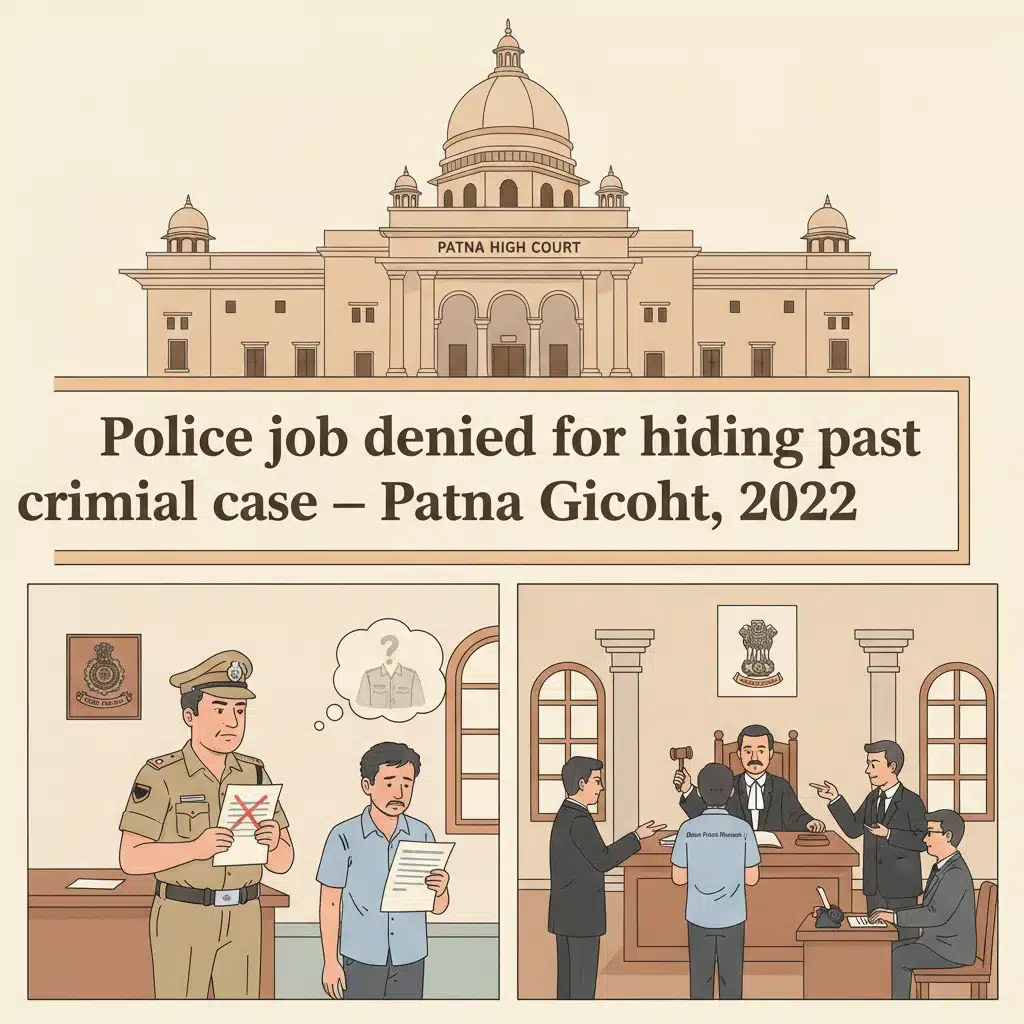
This case arose from a recruitment process for the post of Sub-Inspector in the Bihar Police, advertised through Advertisement No.01/2017.
The petitioner, a resident of Saran district, applied for the post. He cleared the selection stages, his documents were verified, and he was medically found fit for appointment as Sub-Inspector.
As part of the final process, every candidate’s background has to be checked through a verification roll under Rule 673 of the Bihar Police Manual, 1978. Literate candidates like the petitioner must fill up the verification form themselves in P.M. Form No.101 and sign it.
During this verification, the department found that the petitioner had earlier been an accused in Rivilganj P.S. Case No.12/2010 dated 23.01.2010, under Sections 341, 323, 354, 504 and 34 of the Indian Penal Code.
That criminal case ended in his acquittal on 25.07.2016 in Trial No.774 of 2016, after a compromise between the parties and lack of evidence. However, when he filled the verification roll for the Sub-Inspector recruitment, he did not disclose this past case.
On 21.03.2020, the Deputy Inspector General of Police, Saran Range, Chapra, passed an order under Rule 673(c) of the Bihar Police Manual holding the petitioner ineligible for enlistment as Sub-Inspector in the Bihar Police Force. This order stated that, given the gravity of allegations in the earlier case and the nature of his acquittal, the petitioner could not be treated as “honourably acquitted” and was therefore not fit for enlistment.
The petitioner filed Civil Writ Jurisdiction Case No.3805 of 2021 before the Patna High Court, challenging this order and seeking its quashing.
What the Court Examined and Decided
Hon’ble Mr. Justice Madhuresh Prasad heard the matter and delivered the oral judgment on 11.10.2022.
First, the Court looked at the central facts that were not in dispute. The petitioner was an accused in Rivilganj P.S. Case No.12/2010 and had been acquitted on 25.07.2016 on the basis of compromise and lack of evidence. He clearly did not mention this case when filling the verification roll in Form No.101.
The petitioner’s lawyer argued that, because he had already been acquitted before the advertisement dated 16.09.2017 was issued and before the selection process began, he believed it was unnecessary to disclose this past case. He treated the acquittal as wiping out the earlier accusation.
Counsel for the petitioner further argued that the DIG wrongly labelled his acquittal as “not honourable” and that, in any case, whether his acquittal was honourable or not was irrelevant under Rule 673(c) of the Bihar Police Manual. On this basis, they claimed the DIG’s order was illegal and should be struck down.
The State counsel replied that the key point was the petitioner’s non-disclosure. Form No.101 specifically asks whether an applicant has “ever been accused in a criminal or civil case or has ever been in prison”, and requires details. The petitioner’s failure to mention the 2010 case meant he did not make a truthful statement about his antecedents.
According to the State, his acquittal, being based on compromise and lack of evidence, was not an honourable acquittal and did not automatically prove good character. Under Rule 673(c), if either the candidate’s character is bad or his statement in the verification roll is false, he must be removed from or denied entry into the Force. Therefore, the DIG’s order needed no interference.
The Court then carefully considered Rule 673 of the Bihar Police Manual. Rule 673(a) requires preparation of a verification roll in P.M. Form No.101 and its transmission to the candidate’s home district for verification for posts including Sub-Inspector and Constable.
Rule 673(b) states that literate candidates must fill and sign the answers in the verification roll themselves, after which the Superintendent of Police, if satisfied, orders enlistment and sends the roll for verification.
Rule 673(c) deals with what happens after verification. Once the verification roll returns with a report that the person bears a good character and has made a truthful statement as to his antecedents, the Superintendent makes entries in the service-book and files the roll. But crucially, the Rule adds that if the man’s character is reported to be bad or his statement false, “he shall be removed from the force.”
The Court also reproduced Clause 7 of Form No.101, which asks:
“Whether applicant has ever been accused in a criminal or civil case or has ever been in prison. Give details.”
From this clear wording, the Court held that disclosure is not limited to pending criminal cases. The form requires disclosure if the applicant has “ever been” accused in a criminal or civil case, whether or not he has been acquitted already.
The Court found the petitioner’s explanation—that since he was acquitted in July 2016 he considered the old case irrelevant during the 2017 recruitment—to be “clearly unsustainable”. There is nothing in Clause 7 or Rule 673 to allow an applicant to decide that acquitted cases need not be disclosed. The requirement is unambiguous and applies to all past accusations.
The Court then turned to the second argument about “honourable acquittal”. Under Rule 673(c), even if the disclosure issue did not exist, a candidate can be removed or denied enlistment if his character is reported to be “bad”.
It was admitted that the petitioner’s acquittal came about due to compromise and lack of evidence. To understand how such acquittals should be viewed, the Court relied on the Supreme Court judgment in Union of India and others v. Methu Meda, (2022) 1 SCC 1.
The Court extracted paragraphs 20 and 21 of Methu Meda. The Supreme Court there held that candidates seeking to join the police must have “utmost rectitude and impeccable character and integrity”. Even after an acquittal, the employer has the right to examine the nature of the acquittal and decide whether the person is fit for a disciplined force.
The Supreme Court clarified that if acquittal is based on benefit of doubt, hostile witnesses, or similar reasons, a candidate is not automatically entitled to appointment. The employer can still refuse appointment, especially in police service, where character and discipline are critical.
Applying this law, the Patna High Court held that an acquittal resulting from compromise and lack of evidence cannot be described as an “honourable acquittal”. On this basis, the authority was within its jurisdiction to consider that the petitioner’s character was not acceptable for the purpose of Rule 673(c).
The Court framed its conclusion in two parts.
First, there was no dispute that the petitioner had not disclosed his past criminal case in the verification form. This meant he had not made a truthful statement about his antecedents and had in fact made a false statement. Rule 673(c) makes the consequence of such falsehood explicit: removal from, or denial of enlistment in, the Force.
Second, in view of the nature of the acquittal and the Supreme Court’s guidance in Methu Meda, the record contained enough material to treat the petitioner as a person of “bad character” for the limited purpose of recruitment under Rule 673(c). Thus, even independently of the non-disclosure, his candidature could be rejected on character grounds.
Combining these two strands, the Court held that the DIG’s decision was based on relevant material, consistent with Rule 673(c), and consistent with the binding law laid down by the Supreme Court. Such administrative discretion by the employer did not call for interference in writ jurisdiction.
Accordingly, the Patna High Court dismissed the writ application and upheld the order dated 21.03.2020 denying the petitioner’s enlistment as Sub-Inspector in the Bihar Police.
Why This Judgment Matters
This judgment is important for anyone applying to government posts in Bihar, especially to the police or other disciplined forces.
The Court made it clear that all past criminal cases must be disclosed in verification forms, even if the person has been acquitted and even if the case is old or ended in compromise.
Non-disclosure itself is treated as making a false statement about one’s antecedents. Under the Bihar Police Manual, such falsehood alone is enough to deny a person a police job.
The decision also shows that not every acquittal cleanses a person’s record for purposes of police recruitment. Where acquittal is due to compromise or lack of evidence, the authorities can still consider the candidate unsuitable on character grounds.
For aspirants, the judgment is a strong warning: hiding any past case, or assuming that an acquittal need not be mentioned, can cost you the job, and courts may not interfere with such rejection.
Legal Issues and Answers
Issue: Whether a candidate for Bihar Police Sub-Inspector is required to disclose a past criminal case in the verification form even after acquittal, and whether non-disclosure can justify denial of appointment under Rule 673(c) of the Bihar Police Manual.
Answer: Yes. Clause 7 of Form No.101 requires disclosure of whether the applicant has “ever been” accused in a criminal or civil case. Non-disclosure amounts to a false statement regarding antecedents and attracts the consequence under Rule 673(c) of denial of enlistment.
Issue: Whether an acquittal based on compromise and lack of evidence can be treated as “honourable acquittal” so as to automatically entitle a candidate to appointment in the police force.
Answer: No. Relying on the Supreme Court decision in Union of India and others v. Methu Meda, (2022) 1 SCC 1, the Court held that such an acquittal is not “honourable” and the employer is entitled to consider the candidate’s character unsuitable for police service.
Cases Cited by the Court
- Union of India and others v. Methu Meda, (2022) 1 SCC 1.
- Within the extracted passage from Methu Meda, the Supreme Court also referred to:
- State (UT of Chandigarh) v. Pradeep Kumar, (2018) 1 SCC 797 : (2018) 1 SCC (Cri) 504 : (2018) 1 SCC (L&S) 149.
- State v. Mehar Singh, (2013) 7 SCC 685 : (2013) 3 SCC (Cri) 669 : (2013) 2 SCC (L&S) 910.
- State v. Raj Kumar, (2021) 8 SCC 347 : (2021) 2 SCC (L&S) 745.
Case Details
Case Number: Civil Writ Jurisdiction Case No.3805 of 2021
Case Title: Ravi Kumar Singh v. The State of Bihar & Ors.
Coram: Hon’ble Mr. Justice Madhuresh Prasad
Citation: 2022 (4) PLJR 410
Advocates:
- For the Petitioner: Mr. Harish Kumar, Advocate
- For the State: Mr. Suman Kumar Jha, A.C. to AAG-3
- For the Bihar Police Subordinate Service Commission (BPSSC): Mr. Sanjay Pandey, Advocate; Mr. Nishant Kumar Jha, Advocate
Nature of the Case: Writ petition (challenge to order rejecting enlistment as Sub-Inspector in Bihar Police under Rule 673(c) of Bihar Police Manual, 1978)
Link to Full Judgment: Patna High Court Judgment – CWJC No.3805 of 2021
If you found this explanation helpful and wish to stay informed about
how legal developments may affect your rights in Bihar,
you may consider following Samvida Law Associates for more updates.




