

Case Background
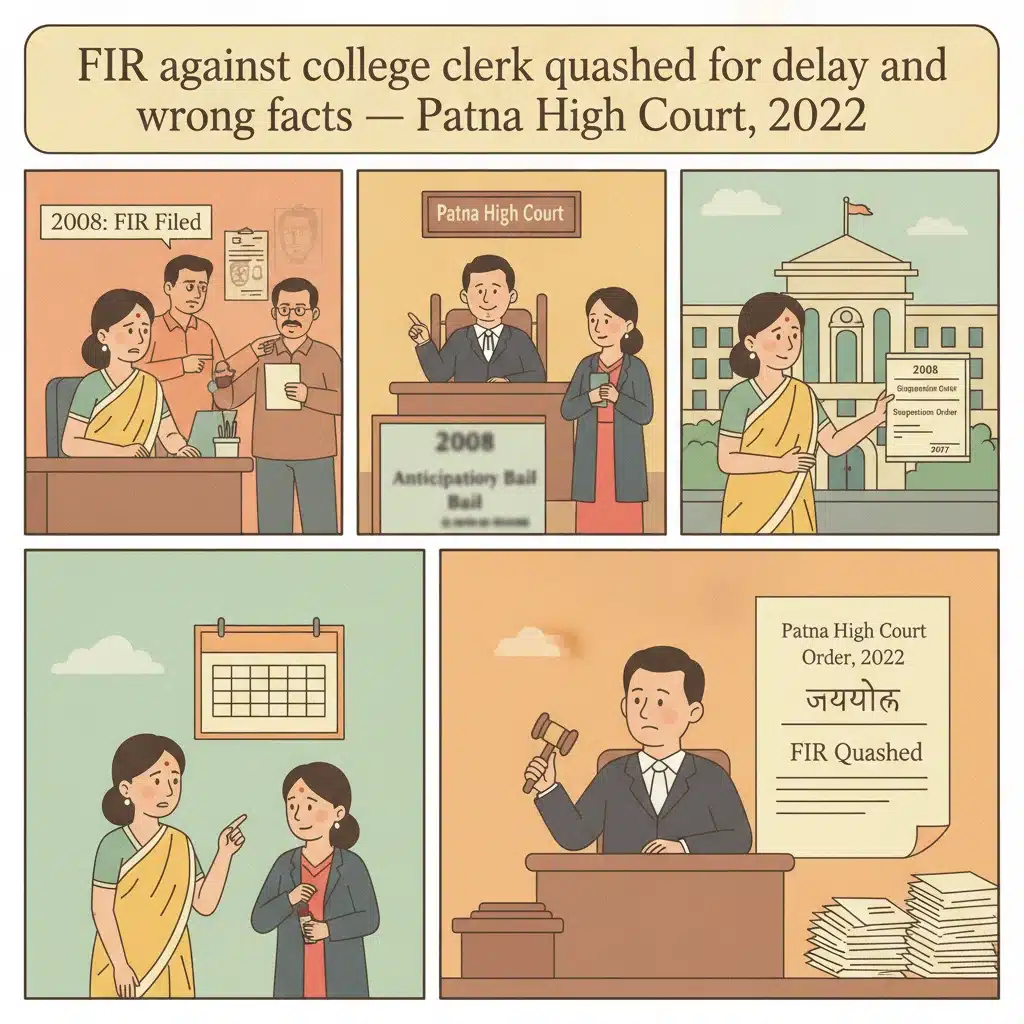
This case arose from Sri Guru Gobind Singh College, Patna City, where the informant was the Principal. She received information that some people were working in the college in the name of other employees for a long time.
On this information, the Principal held an internal inquiry. She formed a suspicion against some persons, including the present petitioner, and named those co-accused in her written report. She further stated that, in place of the petitioner and another co-accused, one Dinanath Singh had been putting his signature on various documents, including salary bills.
On the basis of this written report, Patna City Chowk P.S. Case No. 93 of 2008 was registered on 04.06.2008 for offences under Sections 419, 420, 467, 468, 471 and 170 of the Indian Penal Code against the petitioner and others.
The petitioner is a Routine Clerk in the said college. Her husband was earlier working as Store Keeper in the Department of Psychology on permanent basis. He was appointed on 26.06.1985 and died in harness on 11.08.1997, leaving behind his wife and three minor children. On compassionate grounds, the petitioner was appointed as Routine Clerk on 17.07.1999 in the same institution.
According to the petitioner, since her appointment she had a clean service record and was performing her duties satisfactorily. However, after registration of the FIR, she was suspended by the Registrar, Magadh University, through an order dated 15.10.2008.
She applied for anticipatory bail before the Sessions Judge, Patna, in A.B.P. No. 390 of 2008. In that proceeding, it was observed that her compassionate appointment was legal and valid. She was granted anticipatory bail on 22.07.2008.
The petitioner then submitted a representation dated 22.06.2010 to the Principal, asserting her innocence. No show cause notice or departmental inquiry was initiated against her even after this representation.
Later, a Division Bench of the Patna High Court disposed of LPA No. 236 of 2018 on 24.04.2018. The University was directed to examine her claim for subsistence allowance and to take a final decision on her suspension. When the University did not act, the petitioner filed a contempt petition, MJC No. 3047 of 2018.
During the pendency of that contempt case, the University revoked her suspension through Memo No. 332/PPU/L/2019 dated 14.10.2019 and directed her to join duty. She rejoined the college on 21.10.2019 and, as per the record, has been discharging her duties to the satisfaction of the University.
Earlier, on 27.04.2017, the college had issued a certificate vide Memo No. GSC/303/17, stating that the petitioner was a working staff member in the college as a Routine Clerk on compassionate ground.
What the Court Examined and Decided
The petitioner approached the Patna High Court in Criminal Miscellaneous No. 24543 of 2018 seeking quashing of the FIR in Patna City Chowk P.S. Case No. 93 of 2008 and all criminal proceedings arising from it.
Her main grievance was that, despite the FIR having been lodged on 04.06.2008, the investigation had not been completed even after more than 12–14 years and no charge-sheet had been submitted against her. She argued that she was wrongly implicated and that there was no material to show any criminal act on her part.
The petitioner’s counsel highlighted that she was an employee of the institution, legally appointed on compassionate grounds. There was no allegation in the FIR that she had forged documents or taken salary by impersonation. According to her, the only basis for suspicion was that someone else, namely Dinanath Singh, had been signing documents, including salary bills, in the place of some employees, including her.
The petitioner stressed that she had not been given any opportunity to defend herself in departmental proceedings. No show cause notice was ever issued, and no departmental inquiry was initiated, even though she remained under suspension for many years. She stated that this denial of hearing was against the principles of natural justice.
Her counsel argued that allowing such a criminal case to hang over her head, without progress and without evidence of wrongdoing, caused humiliation and mental agony. In these circumstances, continuing the criminal proceedings would serve no useful purpose and would amount to harassment.
To support the plea for quashing, the petitioner relied on several Supreme Court judgments. She referred to Abdul Rehman Antulay vs. R.S. Nayak, where the right to speedy trial under Article 21 of the Constitution was recognised as covering investigation, inquiry, trial, appeal, revision and re-trial.
She also cited Raghubir Singh and Ors. vs. State of Bihar, Santosh De vs. Archana Guha, and Vakil Prasad Singh vs. State of Bihar, where the Supreme Court had emphasised that unreasonable delay in criminal proceedings violates Article 21.
Further, she relied on P.S. Rajye vs. State of Bihar, where the Supreme Court held that when a charge cannot be proved in departmental proceedings, there remains even less basis to continue criminal prosecution, because the standard of proof in criminal cases is higher.
Her counsel additionally argued that her case clearly fell within the guidelines laid down by the Supreme Court in State of Haryana and Ors. vs. Bhajan Lal and Ors. In that landmark case, the Court had listed situations in which the High Court could quash an FIR using its inherent powers under Section 482 of the Code of Criminal Procedure.
In particular, the petitioner claimed that the allegations in the FIR were so absurd and inherently improbable that no prudent person could come to the conclusion that there was sufficient ground to proceed against her. She also asserted that the prosecution appeared to be malicious and attended with mala fide, attracting the Bhajan Lal guidelines.
Significantly, in the present case, the learned senior counsel for the informant and the learned Additional Public Prosecutor did not oppose the petitioner’s plea. On the contrary, they supported the contention made on behalf of the petitioner.
The learned APP submitted that, if the petitioner had been lawfully appointed, as found in earlier proceedings, no offence was made out on the given facts. The senior counsel for the informant pointed out that the informant (the Principal) had already superannuated and now accepted that the case against the petitioner arose from a mistake of fact.
The High Court then examined the principles laid down in Bhajan Lal. The judgment reproduced the seven illustrative categories where an FIR could be quashed, including cases where the allegations, taken at face value, do not constitute any offence; where they appear absurd and inherently improbable; or where the criminal proceedings are manifestly attended with mala fide.
On the facts of this case, the Court observed that the petitioner had been able to show that the FIR was lodged under circumstances which could not be described as legal. It held that the FIR against the petitioner was based on “completely wrong facts” and therefore could not be sustained.
The Court was also deeply concerned with the delay in investigation. During the hearing, a status report was called from the Senior Superintendent of Police, Patna. That report disclosed that a final report treating the case as a “mistake of fact” had been directed to be submitted by the Superintendent of Police Town (East), Patna, as early as 30.01.2013.
However, despite this direction, no final report had actually been filed in court till the date of hearing in 2022. The Court expressed shock at this state of affairs and commented that it was “aghast to see the working of the police department.”
The Court stated that continuing criminal proceedings against the petitioner, in light of the above circumstances, would certainly amount to abuse of the process of law. It emphasised that the right to speedy trial is a valuable right flowing from Article 21 of the Constitution and that this right covers every stage of a criminal case, including investigation. Authorities cannot curtail or ignore this right as they please.
Considering that the FIR was based on wrong facts, that the University and college had accepted the legality of the petitioner’s appointment and revoked her suspension, that the police themselves had treated the matter as a mistake of fact but failed to close it formally, and that there had been an inordinate delay of around 14 years without filing a charge-sheet, the Court found no justification to allow the criminal proceedings to continue.
The Court concluded that the case clearly fell under more than one of the Bhajan Lal categories. It therefore exercised its powers to quash the criminal proceedings.
Accordingly, the Patna High Court quashed Patna City Chowk P.S. Case No. 93 of 2008 and all criminal proceedings arising out of it, so far as the petitioner was concerned. The criminal miscellaneous petition was allowed.
Why This Judgment Matters
This judgment is important for employees who face criminal cases based only on suspicion or administrative confusion, especially in government or university institutions.
First, the Patna High Court made it clear that if an FIR is based on wrong facts and there is no real material to show an offence, the Court can step in and quash the case, even if the police have not filed a final report.
Second, it reinforces that the right to speedy trial under Article 21 starts from the moment the FIR is registered. If the police do not file a charge-sheet for many years without valid reason, the accused should not be made to suffer endlessly.
Third, the decision shows that when an employer itself accepts the legality of an appointment and revokes suspension, and even issues a certificate that the employee is working, it becomes very difficult to sustain a criminal case alleging impersonation or similar offences on the same facts.
Finally, the judgment highlights that courts will look critically at delay and administrative inaction by the police. Keeping an old case pending as a “mistake of fact” without filing a report is not acceptable.
Legal Issues and Answers
Issue: Whether the FIR alleging impersonation and related offences against a lawfully appointed college clerk, without timely investigation or charge-sheet for about 14 years, should be allowed to continue.
Answer: No. The Patna High Court held that the FIR was based on completely wrong facts, attracted the Bhajan Lal guidelines, violated the right to speedy trial under Article 21, and that continuing the proceedings would be an abuse of process. The FIR and criminal case were quashed against the petitioner.
Cases Cited by the Court
- Abdul Rehman Antulay vs. R.S. Nayak, (1992) 1 SCC 225
- Raghubir Singh and Ors. vs. State of Bihar, (1986) 4 SCC 48
- Santosh De vs. Archana Guha, AIR 1994 SC 1129
- Vakil Prasad Singh vs. State of Bihar, (2009) 3 SCC 355
- P.S. Rajye vs. State of Bihar, (1996) 9 SCC 1
- State of Haryana and Ors. vs. Bhajan Lal and Ors., AIR 1992 SC 604
Case Details
Case Number: Criminal Miscellaneous No. 24543 of 2018; arising out of Patna City Chowk P.S. Case No. 93 of 2008
Case Title: Anju Kumari vs. State of Bihar and Anr.
Citation: 2022 (4) PLJR 407
Court: High Court of Judicature at Patna
Coram: Hon’ble Mr. Justice Arun Kumar Jha
Date of Judgment: 22.09.2022
Advocates:
- For the petitioner: Mr. Puneet Sidhartha, Advocate; Mr. Ravi Kumar, Advocate
- For the State / Opposite Party: Mr. Sri Shailendra Kumar-2, for the Opposite Parties; Mr. Ramakant Sharma, Senior Advocate, for the informant
Nature of the Case: Criminal miscellaneous petition under Section 482 Cr.P.C. seeking quashing of FIR and criminal proceedings.
Link to Judgment: Patna High Court official judgment link
If you found this explanation helpful and wish to stay informed about
how legal developments may affect your rights in Bihar,
you may consider following Samvida Law Associates for more updates.




