

Case Background
The matter arose from the cancellation of a saw mill licence granted to M/s Rajkishore Saw Mill, located at Labhra-Panchanpur in Gaya district. The licence was issued under the Bihar Saw Mills (Regulation) Act, 1990 and the Bihar Saw Mills (Regulation) Rules, 1993.
The Licensing Officer-cum-Divisional Forest Officer, Gaya Forest Division, cancelled the licence. The cancellation was based on the allegation that the licence holder had parted with control of the saw mill in favour of another person, to whom he had executed a power of attorney.
The licence holder challenged this cancellation order before the appellate authority, i.e., the Conservator of Forest-cum-Prescribed Officer, Gaya Circle, Gaya in Appeal Case No. 3 of 2014. On 23.07.2014, the appellate authority dismissed the appeal and upheld the cancellation.
Aggrieved, the licence holder approached the Patna High Court in Civil Writ Jurisdiction Case No. 168 of 2015. On 02.01.2019, the learned Single Judge dismissed the writ petition and affirmed the orders of the Licensing Officer and appellate authority.
The licence holder then filed the present Letters Patent Appeal No. 310 of 2019 before a Division Bench of the Patna High Court, challenging the Single Judge’s order dated 02.01.2019.
What the Court Examined and Decided
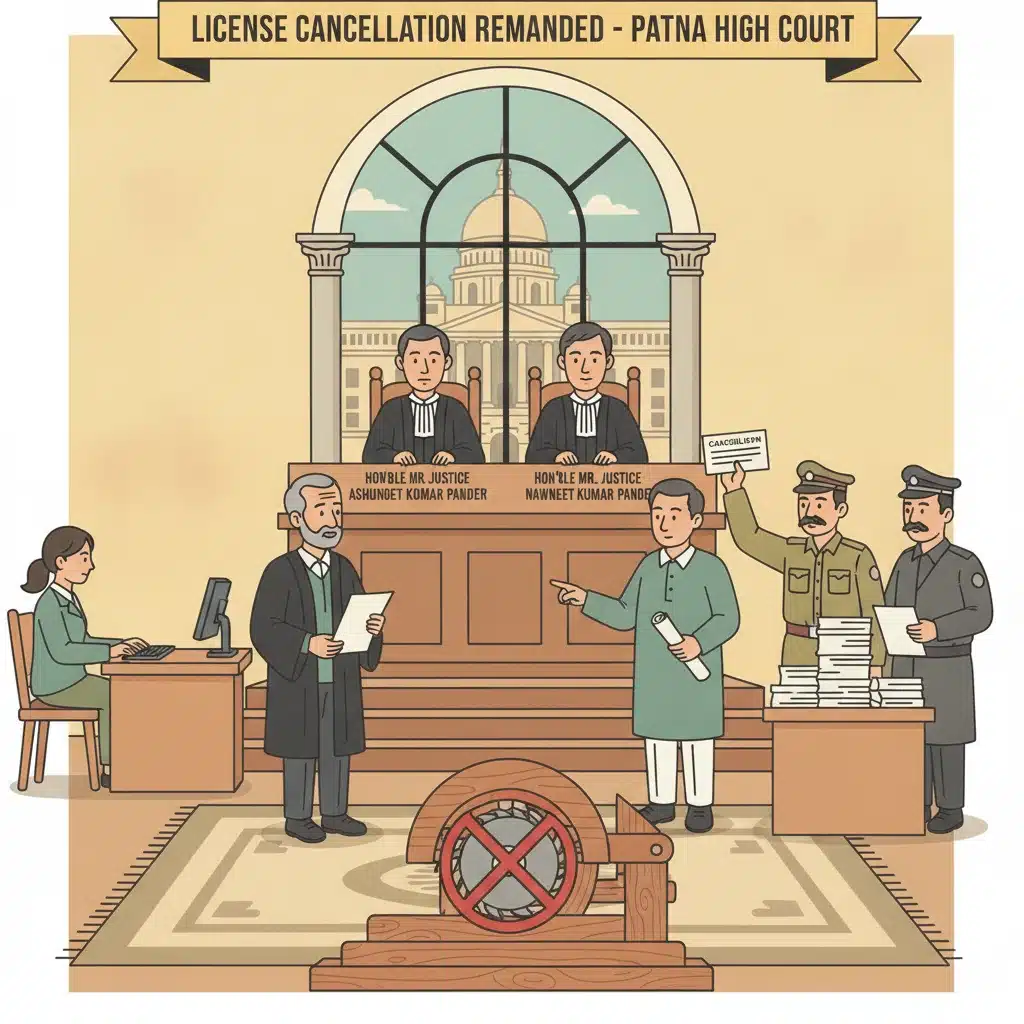
The Division Bench, comprising Hon’ble Mr. Justice Ashutosh Kumar and Hon’ble Mr. Justice Nawneet Kumar Pandey, heard the appeal. The main question was whether mere execution of a power of attorney in favour of a third person, to run the saw mill on behalf of the owner, could be treated as an unlawful transfer of control and justify cancellation of the licence.
The appellant’s counsel, Mr. Vinay Mistry, first drew the Court’s attention to the actual contents of the power of attorney. According to the judgment, the document clearly stated that the power of attorney was given only for the limited purpose of running the saw mill on behalf of the appellant.
The reason for this arrangement, as recorded by the Court, was the appellant’s bad health. The power of attorney was meant to enable another person to operate the saw mill in his place. Nowhere in this document was there any clause suggesting that the entire ownership or control of the saw mill had been transferred to the power of attorney holder.
In other words, the appellant argued that he remained the owner and licence holder. The power of attorney holder was merely acting as an agent, carrying on the day-to-day running of the saw mill because of the appellant’s illness.
The Court then examined the legal provisions under which the licence had been cancelled.
Section 7 of the Bihar Saw Mills (Regulation) Act, 1990 deals with the grant, renewal, revocation or suspension of licence under the Act. It provides the framework for giving a licence, taking fees and security deposit and laying down conditions, and also governs renewal of the licence under the same section.
Section 7(5) is particularly important. It authorises the Licensing Officer to cancel a licence if he is satisfied that:
(a) The licensee has parted, in whole or in part, with his control over the saw mill or saw pit; or
(b) The licensee has ceased to operate or own such mill or saw pit; or
(c) The licensee, without reasonable cause, has failed to comply with conditions of the licence or directions of the Licensing Officer; or
(d) The licensee has contravened provisions of the Act or Rules; or
(e) The licensee is not able to satisfactorily account for the wood in the premises of the saw mill or saw pit.
However, Section 7(5) also requires that before cancellation, the licensee must be given an opportunity to show cause. The authority may also forfeit part or all of the security deposit if conditions are breached.
The appellant’s counsel further referred to Rule 3(4) of the Bihar Saw Mills (Regulation) Rules, 1993 and Form-C appended to those Rules. Rule 3(4) states that an application for licence for a saw mill or saw pit, along with the prescribed fee, has to be filed before the Licensing Officer.
Significantly, Rule 3(4) also recognises that a person can file such an application on behalf of another person or a company, provided an executed copy of the power of attorney is enclosed. The original power of attorney or the certificate of registration of the company must be produced before the Licensing Officer.
Form-C, which is part of the Rules, further makes it clear that a power of attorney holder is allowed to apply for operating an existing saw mill or saw pit or for a new saw mill or saw pit. The form is to be filled in by the power of attorney holder when renewing the licence.
From these provisions, the appellant argued that the Act and Rules themselves contemplate and permit execution of a power of attorney by the licence holder. They recognise that a power of attorney holder may apply for and secure renewal of the licence on behalf of the licence holder.
In this particular case, the Court recorded that due to ill health, the appellant executed a power of attorney. The power of attorney holder then got the licence renewed on not less than three occasions in subsequent years.
Despite this history of renewals, the Licensing Officer later cancelled the licence on the ground that the licence holder had parted with control of the licence unauthorisedly. The appellant claimed he could not understand why such an action was taken after the same arrangement had been openly accepted during earlier renewals.
The Division Bench noted that the authorities had not properly considered the relevant provisions of the Act and Rules. The Court observed that the orders of the Licensing Officer and the appellate authority did not adequately engage with Section 7 and Rule 3(4) or with the clear language of Form-C permitting use of a power of attorney.
The Bench also found that the learned Single Judge, when upholding the cancellation in the writ petition, did not properly examine the contents of the power of attorney. The document did not show any outright sale of the saw mill, nor any intention by the licence holder to surrender all control of the establishment.
The Court emphasised that merely because a power of attorney has been executed in favour of a third person, who has been running the saw mill and getting the licence renewed over several years, this alone cannot be treated as a valid ground for cancellation of the licence.
This was especially so when there was no allegation, on record, of any violation of the conditions of the licence. There was no finding that the appellant had failed to account for wood, had breached licence conditions, or had otherwise contravened the Act or Rules.
On these considerations, the Division Bench held that it could not agree with the order passed by the learned Single Judge. The Bench therefore found it appropriate to set aside the Single Judge’s decision.
However, the Court did not straightaway restore the licence. Instead, the matter was remitted to the Licensing Authority / Licensing Officer-cum-Divisional Forest Officer, Gaya Forest Division, for a fresh look.
The Bench directed the Licensing Officer to examine the records of the case afresh, particularly the power of attorney executed by the appellant, and then pass an order strictly in accordance with law.
To ensure fairness and timeliness, the Court laid down specific time limits. The Licensing Officer must seek the response of the appellant again within 30 days from the date of production or receipt of a copy of the High Court’s order. After receiving the appellant’s reply, the Licensing Officer will have 60 days to pass a final, reasoned order.
The Court also clarified that, if the licence holder is aggrieved by any fresh decision of the Licensing Officer, he will be at liberty to challenge that order before an appropriate forum.
With these directions, the Letters Patent Appeal was allowed and the earlier orders, including that of the Single Judge, stood set aside.
Why This Judgment Matters
This judgment is important for small business owners, especially saw mill operators in Bihar, who may be forced by age or illness to let someone else run their business using a power of attorney.
The Patna High Court made it clear that simply giving a power of attorney to another person to run a licensed business does not automatically mean that the owner has unlawfully transferred the licence or parted with control.
The decision reminds licensing authorities that they must carefully read the power of attorney and the law before taking harsh steps like cancelling a licence. They must also record reasons and give the licence holder a fair chance to explain.
For licence holders, this judgment shows that they have legal protection if an authority cancels a licence without properly considering the law, the actual documents, and the absence of any proven breach of licence conditions.
Legal Issues and Answers
- Issue: Can a saw mill licence be cancelled merely because the licence holder executes a power of attorney in favour of a third person to run the mill on his behalf?
Answer: No. The Patna High Court held that mere execution of a power of attorney, without evidence of transfer of ownership or complete control and without any proven breach of licence conditions, is not a valid ground for cancellation. The matter must be reconsidered after properly examining the power of attorney and the relevant provisions of the Act and Rules. - Issue: Did the earlier authorities and the learned Single Judge properly consider the statutory scheme and the content of the power of attorney while upholding the cancellation?
Answer: No. The Division Bench found that the authorities and the Single Judge had not adequately examined Section 7 of the Act, Rule 3(4) of the Rules, Form-C, or the actual language of the power of attorney, and therefore set aside the Single Judge’s order and remitted the matter.
Cases Cited by the Court
- The judgment does not mention or rely upon any other decided case. No precedents are cited.
Case Details
Case Number: Letters Patent Appeal No. 310 of 2019 in Civil Writ Jurisdiction Case No. 168 of 2015
Case Title: M/s Rajkishore Saw Mill v. The State of Bihar & Ors.
Coram: Hon’ble Mr. Justice Ashutosh Kumar and Hon’ble Mr. Justice Nawneet Kumar Pandey
Citation: 2022(4) PLJR 717
Advocates: Mr. Vinay Mistry, Advocate for the appellant; Mr. Sarvesh Kumar Singh (AAG 13) and Mr. Rajat Kumar Tiwari for the State respondents
Nature of the Case: Letters Patent Appeal against dismissal of a writ petition challenging cancellation of saw mill licence under the Bihar Saw Mills (Regulation) Act, 1990 and Bihar Saw Mills (Regulation) Rules, 1993
Link to Judgment: Click here to read the full judgment of the Patna High Court
If you found this explanation helpful and wish to stay informed about how legal developments may affect your rights in Bihar, you may consider following Samvida Law Associates for more updates.




