

Case Background
The dispute began with 616 contract labourers working at the Muzaffarpur Thermal Power Station of the Bihar State Electricity Board. They were engaged through contract arrangements and claimed they were in fact doing work of a permanent, continuous (perennial) nature.
Because they were not being absorbed into the regular service of the Electricity Board, an industrial dispute was raised. This led to a reference under Section 10(1)(d) of the Industrial Disputes Act, 1947 to the Industrial Tribunal.
The key point of reference asked the Tribunal to decide whether a workman listed in Schedule “K” of Muzaffarpur Thermal Power Station, who was engaged in work of a perennial nature despite a Government prohibition on using contract labour for such work, had earned a right to be absorbed in the services of the Electricity Board, and if so, from which date.
The Tribunal rejected the Union’s claim and refused to direct absorption. The workers’ union challenged that award before the Patna High Court in Civil Writ Jurisdiction Case No. 808 of 1997. A learned Single Judge dismissed the writ petition and upheld the Tribunal’s award.
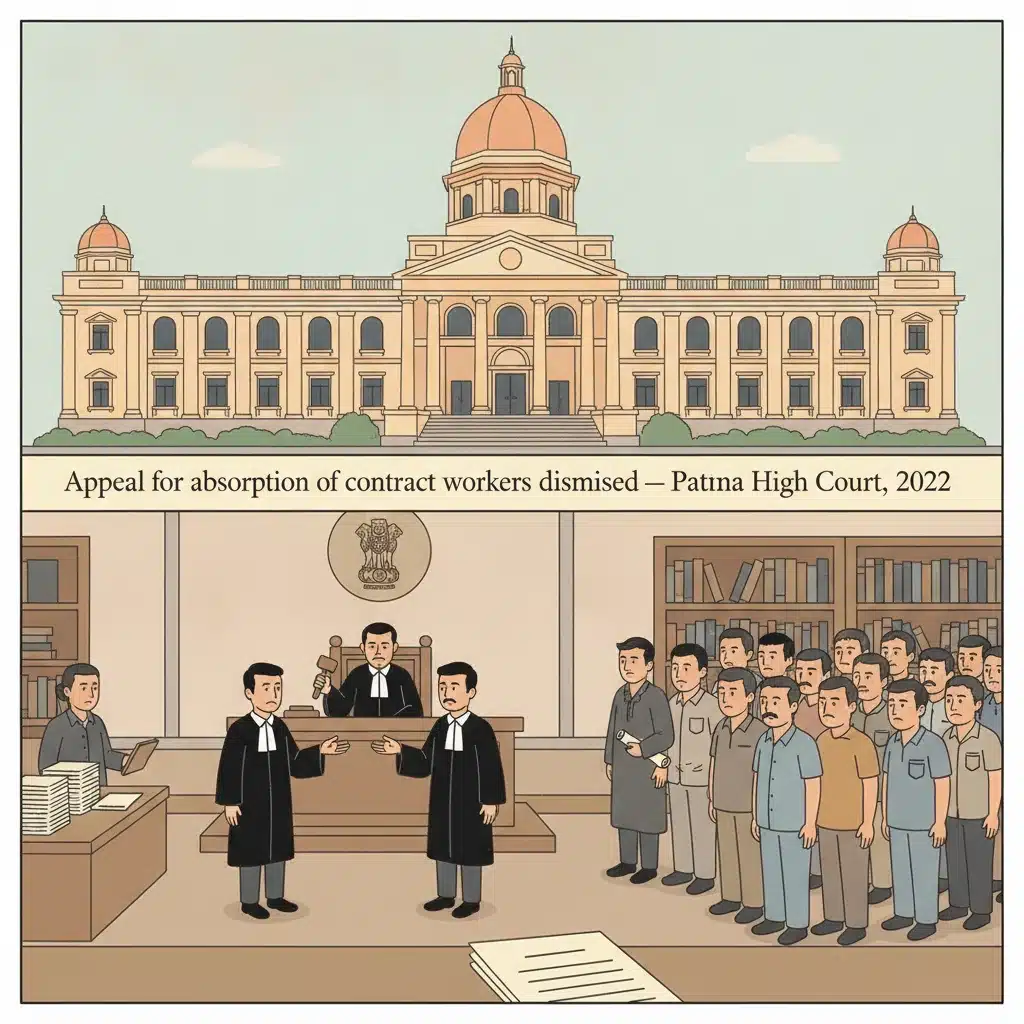
The Union then filed a Letters Patent Appeal, L.P.A. No. 700 of 2018, before a Division Bench of the Patna High Court. This appeal led to the present judgment dated 10-11-2022.
What the Court Examined and Decided
The Division Bench of the Patna High Court heard arguments from the workers’ Union as appellant and from the Bihar State Electricity Board (through its Chairman) and State authorities as respondents.
The Union, representing contract workers, was upset that despite many years of work, the Tribunal had refused to recognise a right of absorption. It approached the High Court to set aside the Tribunal’s award and the Single Judge’s order.
The central question revolved around whether these 616 contract labourers, working against different posts in the Muzaffarpur Thermal Power Station, were in fact doing work of a permanent and perennial nature and had thereby earned a right to be absorbed into the Electricity Board’s regular workforce.
The Tribunal had carefully examined the documents submitted by the Union. It concluded that there was no strong proof that the listed workmen were working as contract labourers against permanent and perennial jobs in the organization.
According to the Tribunal, the evidence fell short in several ways. First, there was a complete lack of evidence that the workmen were actually engaged against posts of permanent or perennial nature. Second, it was not shown that they possessed the required qualifications for the jobs they were performing. Third, it was not demonstrated that their services were satisfactory.
The Tribunal was also unclear about the actual number of vacancies available in the Muzaffarpur Thermal Power Station. Without proof of existing vacancies, the Union’s demand for absorption of all 616 workers could not be supported.
Further, the Tribunal noted the sanctioned strength of the workmen cadre at Muzaffarpur Thermal Power Station was only 575 posts. Out of these, approximately 540 posts were already occupied.
The remaining posts, as per the Tribunal’s findings, required a very high level of training and technical expertise. They were essentially technical posts which only properly trained operators or assistant operators in a power station could perform.
If the Tribunal had directed absorption of the 616 contract labourers, it would effectively have required the creation of more than the sanctioned number of posts. The Tribunal held that such an order would amount to “carving out” extra sanctioned posts, which it was not empowered to do.
On these grounds, the Tribunal declined to grant the relief of absorption and passed an award against the Union’s claim.
Before the Division Bench, counsel for the appellant Union attacked both the Tribunal’s award and the Single Judge’s order. He argued that the Tribunal and the Single Judge had gone beyond the terms of the reference. According to him, the only question was whether workers doing perennial nature of work, despite a Government prohibition on contract labour for such work, had earned a right to be absorbed.
The Union’s counsel contended that there was no dispute about the fact that the job entrusted to these workmen was really of a perennial nature. He submitted that the issue was not whether the work was perennial, but whether, by being engaged against such jobs in breach of the Government’s prohibition, the workers had earned a right to be absorbed against those posts in the Board’s regular establishment.
He argued that neither the Tribunal nor the Single Judge should have reopened the question whether the work was of a perennial nature. In his view, that fact stood admitted, and the authorities should have focused only on whether the breach of the Government proscription affected the workers’ claimed right of absorption.
In response, counsel for the Board defended the Tribunal’s reasoning. He pointed out that, because there was a clear Government proscription against employing contract labour against perennial nature of work, it could not simply be assumed that the contract workers were in fact working against such prohibited posts.
Rather, it would be presumed that the employer had not engaged contract labour on such perennial jobs unless proved otherwise. Therefore, the Tribunal was justified in demanding evidence that the contract labourers were actually working against permanent or perennial posts.
The Board’s counsel emphasised that the Tribunal had looked for such evidence and found it lacking. Thus, its refusal to direct absorption was based on an evidentiary assessment within its jurisdiction.
The Division Bench then turned to the reasoning adopted by the learned Single Judge, who had dismissed the writ petition challenging the Tribunal’s award. The Single Judge had reminded himself of the limitations of a High Court under Article 226 of the Constitution when interfering with an award of a statutory Tribunal.
The Single Judge had emphasised that interference would be justified only where there was an error apparent on the face of the record in the appreciation of evidence, or where the Tribunal had acted without jurisdiction, or where principles of natural justice had been violated.
The Division Bench examined the Tribunal’s award and found no such defect. It observed that the Tribunal had not acted without jurisdiction and that procedural fairness had been followed while passing the award.
The Bench, therefore, saw no ground to interfere with the Single Judge’s order. It did not accept the Union’s grievance that the Tribunal or the Single Judge had travelled beyond the reference.
Instead, the Division Bench effectively agreed that, in the absence of proper evidence regarding the nature of the posts, the qualifications and satisfactory service of the workers, and the availability of sanctioned vacancies, a direction for mass absorption could not be issued.
As a result, the Division Bench concluded that it was not appropriate to interfere with the order of the learned Single Judge. Consequently, the Letters Patent Appeal was dismissed. The Union’s effort to secure a judicial direction for absorption of the 616 contract workers thus came to an end with this decision.
Why This Judgment Matters
This judgment is important for contract workers, unions and public sector employers in Bihar, especially those dealing with large utilities like the Electricity Board.
The Patna High Court has made it clear that, even where workers say they are doing permanent, continuous work, they must produce solid evidence: the nature of the job, the existence of sanctioned posts, their qualifications, and their satisfactory performance.
The Court also signalled that Tribunals and High Courts cannot create new posts indirectly by directing absorption of large groups of workers beyond the sanctioned strength. Any such step would go beyond their powers.
For workers and unions, the case shows the importance of gathering proper documents and records before raising a demand for regularisation or absorption. Mere assertions that the work is perennial or that a Government prohibition has been violated will not, by themselves, secure relief.
Legal Issues and Answers
Issue: Whether the 616 contract labourers of Muzaffarpur Thermal Power Station, claimed to be doing perennial nature of work despite a Government prohibition, had earned a right to be absorbed in the regular service of the Bihar State Electricity Board.
Answer: No. The Industrial Tribunal found no sufficient evidence of their working against permanent/perennial posts, of available vacancies, or of required qualifications and satisfactory service, and the Patna High Court upheld this view.
Issue: Whether the Industrial Tribunal and the Single Judge had gone beyond the scope of the reference while deciding the dispute and whether the High Court under Article 226 should have interfered with the Tribunal’s award.
Answer: No. The Division Bench held that the Tribunal acted within its jurisdiction, followed procedural fairness, and that there was no error apparent on the face of the record justifying interference with the award or the Single Judge’s order.
Cases Cited by the Court
- No prior judgments are expressly cited or relied upon in the text provided.
Case Details
Case Number: Letters Patent Appeal No. 700 of 2018 in Civil Writ Jurisdiction Case No. 808 of 1997
Case Title: Bihar Rajya Vidtyut Parishad Filed Kamgar Union Through Its General Secretary, Amrendra Prasad Mish v. The Presiding Officer, Industrial Tribunal and Ors.
Coram: Hon’ble Mr. Justice Ashutosh Kumar and Hon’ble Mr. Justice Nawneet Kumar Pandey
Date of Judgment: 10-11-2022
Citation: 2022 (4) PLJR 936
Advocates: For the appellant/Union: Mr. Amrendra Kumar Sinha-I, Advocate. For the Bihar State Electricity Board: Mr. Vijoy Nandan Sahay. For the State: Mr. Naman Nayak, Advocate. The appearance table in the cause title also mentions Mr. Ajay Kumar Rastogi (AAG10) for the respondents.
Nature of the Case: Letters Patent Appeal against dismissal of a writ petition challenging an Industrial Tribunal award under the Industrial Disputes Act, 1947.
Link to Judgment: Click here to read the full judgment of the Patna High Court
If you found this explanation helpful and wish to stay informed about
how legal developments may affect your rights in Bihar,
you may consider following Samvida Law Associates for more updates.




