

Case Background
The case arose from a Criminal Writ Jurisdiction petition filed under Article 226 of the Constitution of India before the Patna High Court. The petitioner sought a writ of habeas corpus and quashing of orders passed under the Bihar Control of Crimes Act, 1981.
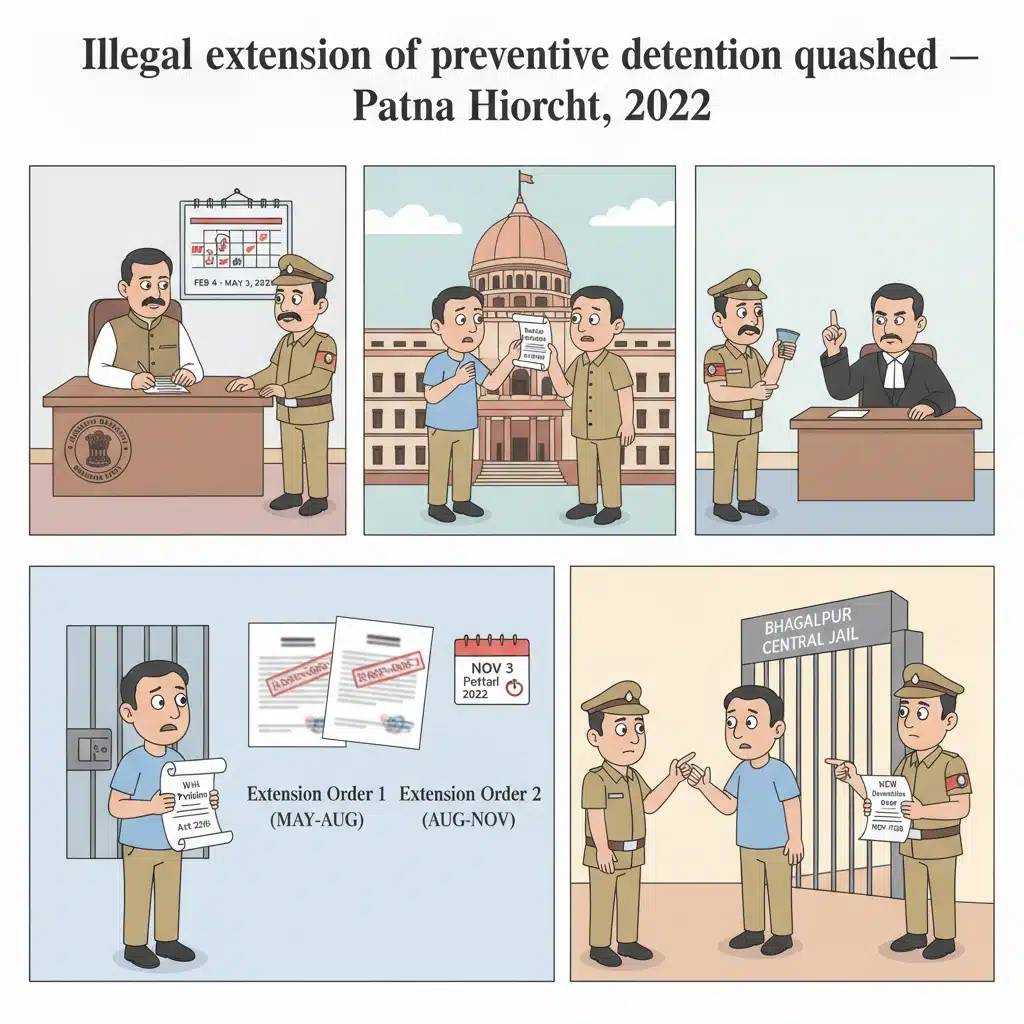
The District Magistrate, Begusarai, initially passed an order of preventive detention on 04.02.2022 under sub-section (2) of Section 12 of the Bihar Control of Crimes Act, 1981. This order put the petitioner under preventive detention for three months, from 04.02.2022 to 03.05.2022.
The State Government, by an order dated 25.02.2022 issued by the Department of Home, Bihar, affirmed the District Magistrate’s detention order. The petitioner filed the present writ petition on 13.04.2022 challenging the detention.
Before the first three-month period ended, the State invoked sub-section (2) of Section 12 read with Sections 21 and 22 of the Act. By order dated 29.04.2022, the detention was extended for a further three months, from 04.05.2022 to 03.08.2022. Then, by another order dated 02.08.2022, the detention was again extended for three months, from 04.08.2022 to 03.11.2022.
The petitioner moved I.A. No. 1 of 2022 to amend the writ petition so as to challenge these subsequent extension orders, including the order dated 02.08.2022.
When the extended period of detention ended on 03.11.2022, there was no further order of detention in force. Accordingly, the petitioner was released from custody on 04.11.2022 at 12:00 noon.
According to the petitioner, he was again apprehended on 05.11.2022 on the strength of a fresh order dated 04.11.2022 issued by the Home Department (Police). This later order purported to extend the period of preventive detention up to 03.02.2023 in continuation of the original detention order and its earlier extensions.
Through I.A. No. 2 of 2022, the petitioner sought to amend the relief portion of the writ petition to specifically challenge this last order dated 04.11.2022. The amendment was allowed by order dated 14.11.2022, and the 04.11.2022 order was brought on record as Annexure-9.
What the Court Examined and Decided
The Patna High Court, speaking through Hon’ble Mr. Justice Chakradhari Sharan Singh (for the Bench also comprising Hon’ble Mr. Justice Chandra Prakash Singh), first recorded the petitioner’s core challenge to the 04.11.2022 order.
The petitioner argued that after the extended period of preventive detention ended on 03.11.2022, there was no detention order in force. He was therefore validly released on 04.11.2022. In such a situation, Section 23 of the Bihar Control of Crimes Act, 1981 did not allow the State to simply “extend” an already expired detention order.
The petitioner’s case was that once the detention expired and he was released, the only legally permissible way to detain him again was by passing a fresh detention order under Section 12 of the Act. Such a fresh order could be passed only if fresh facts had arisen after the date of expiry, as mandated by Section 23(2). According to him, the Home Department’s order dated 04.11.2022, treating the detention as if it were merely being further extended, was without jurisdiction and violated both Section 23(2) and Article 22 of the Constitution of India.
The petitioner had also attacked the original detention order and its confirmation. He submitted that his representation against the detention was not decided expeditiously and that it was rejected without any reasons, contrary to Article 22(5) of the Constitution.
He stated that the detention order was served on him on 06.02.2022, and he handed over his representation in Bhagalpur Central Jail on 07.02.2022. The jail authorities forwarded the representation to the Home Department only on 10.02.2022. In the meantime, on 14.02.2022, the State Government confirmed the detention order.
The Home Department thereafter sent his representation to the District Magistrate, Begusarai for comments. Eventually, his representation was rejected on 25.02.2022, around 18 days after submission. The petitioner contended that this delay was unexplained and thus fatal to the detention. He relied on the Supreme Court decision in Rashid Kapadia v. Medha Gadgil, (2012) 11 SCC 745, regarding the need to explain every day’s delay in deciding a detention representation.
On the other side, the State submitted that the delay of 18 days in disposing of the representation was neither undue nor unreasonable. The State argued that before deciding the representation, the Home Department had sought comments from the District Magistrate and decided only after analysing those comments. According to the State, this process was explained in the counter affidavit and satisfied the legal requirements.
However, after hearing both sides, the Bench considered it unnecessary to go into all these broader issues about the original order and delay. The Court noted that the petitioner had already undergone preventive detention from 04.02.2022 to 03.11.2022 under the original order and its extensions. The central surviving controversy, with real practical effect, related to the legality of the last order dated 04.11.2022 under which he had been re-detained after release.
The Court therefore focused on whether the 04.11.2022 order was valid in law under the Bihar Control of Crimes Act, 1981, especially Section 23(2).
To answer this, the Bench reproduced Section 23 of the Act on revocation of detention orders. Section 23(2), in particular, states that the revocation or expiry of a detention order does not bar passing a fresh detention order under Section 12 against the same person, “in any case where fresh facts have arisen after the date of revocation or expiry”.
The Court noted that the extended period of preventive detention, by virtue of the order dated 02.08.2022, had admittedly expired on 03.11.2022. Consequently, there was no detention order in operation, and the petitioner had been released from custody.
The Court observed that, under Section 22 of the Act, the maximum permissible period of preventive detention could be up to one year. However, once a particular detention order had run its course and expired, and the detenue had been released, there was no legal scope to continue that same detention by a further “extension”.
The Bench held that in view of Section 23(2), the proper legal course for the State, if it still believed that preventive detention was required, would have been to pass a fresh detention order under Section 12, based on fresh facts arising after the expiry of the earlier order. Only then could a new period of detention have been validly imposed.
Instead of adopting this lawful route, the Home Department issued the order dated 04.11.2022 purporting to extend the earlier detention up to 03.02.2023 in continuation of the original and extended orders. This was treated by the Court as an attempt to revive an already expired detention order without complying with Section 23(2).
The Court found no ambiguity in the language of Section 23(2). Once the earlier detention order expired, its life ended. The statute allowed a fresh order only on fresh facts after the expiry. It did not permit a retrospective or post-expiry extension of the same order.
Going beyond the statute, the Bench linked this to constitutional protections. Article 21 protects every person from being deprived of life or personal liberty except according to procedure established by law. Article 22 provides specific safeguards against arrest and detention. While clause (b) of Article 22(3) allows the State to make laws for preventive detention, Articles 22(4) to (7) lay down strict conditions and safeguards for such detention.
The Court described preventive detention as a “serious invasion of personal liberty” and emphasised that laws permitting such detention must be “zealously followed”. Any breach of mandatory statutory requirements in this area would render the detention illegal and unconstitutional.
Applying these principles, the Bench held that the order of preventive detention passed on 04.11.2022—after the petitioner’s release upon completion of his earlier detention—was “wholly illegal and unconstitutional”. It violated Articles 21 and 22 of the Constitution as well as Section 23(2) of the Bihar Control of Crimes Act, 1981.
Accordingly, the Court quashed the impugned order dated 04.11.2022 and directed that the petitioner be released from detention forthwith. At the same time, the Court clarified that the State would remain at liberty to act in accordance with law, especially the provisions of the Act, if future circumstances so warranted.
Why This Judgment Matters
This judgment is important for anyone who is, or may be, placed under preventive detention in Bihar under the Bihar Control of Crimes Act, 1981.
The Patna High Court has made it clear that once a detention order expires and the person is released, the government cannot simply issue another “extension” of the old order. The law requires a fresh detention order, based on fresh facts arising after the first order has expired or been revoked.
The decision emphasises that preventive detention is an exceptional step that cuts into personal liberty. Because it is such a serious measure, every requirement of the law and the Constitution must be strictly respected. Any shortcut—such as reviving an expired order without fresh facts—will not be tolerated.
For affected individuals and families, this ruling shows that courts can intervene when authorities go beyond the limits set by law, and that unlawful detention orders can be struck down even after a person has already spent months in custody.
Legal Issues and Answers
-
Issue: Whether the State could lawfully extend a preventive detention order under the Bihar Control of Crimes Act, 1981 after its expiry, by an order dated 04.11.2022, without passing a fresh detention order under Section 12 based on fresh facts.
Answer: No. The Patna High Court held that once the earlier detention order expired on 03.11.2022 and the petitioner was released, Section 23(2) barred any further extension of that order. Only a fresh detention order under Section 12, founded on fresh facts arising after the expiry date, could have been passed. The order dated 04.11.2022 was therefore illegal, unconstitutional, and liable to be quashed. -
Issue: Whether, in view of the Court’s finding on the 04.11.2022 order, it was necessary to examine the other challenges to the original detention order and alleged delay in deciding the petitioner’s representation.
Answer: No. The Court held that those issues had become academic because the petitioner had already undergone the earlier period of detention. Since the later 04.11.2022 order was in clear breach of Section 23(2) and the Constitution, the writ petition could be allowed on that ground alone.
Cases Cited by the Court
- The petitioner relied upon: Rashid Kapadia v. Medha Gadgil, (2012) 11 SCC 745. The Patna High Court, however, ultimately did not base its decision on this precedent, as it disposed of the case on the statutory and constitutional illegality of the 04.11.2022 order.
Case Details
Case Number: Criminal Writ Jurisdiction Case No. 403 of 2022
Case Title: Prince Kumar v. The State of Bihar & Ors.
Citation: 2022(4) PLJR 678
Coram: Hon’ble Mr. Justice Chakradhari Sharan Singh; Hon’ble Mr. Justice Chandra Prakash Singh
Advocates: For the petitioner – Mr. Shashank Shekhar, Advocate; For the respondents – Mr. Prabhu Narayan Sharma, AC to AG
Nature of the Case: Criminal writ petition under Article 226 of the Constitution of India seeking a writ of habeas corpus and quashing of preventive detention orders under the Bihar Control of Crimes Act, 1981
Date of Judgment: 15.11.2022
Link to the Judgment: Click here to access the official Patna High Court judgment
If you found this explanation helpful and wish to stay informed about
how legal developments may affect your rights in Bihar,
you may consider following Samvida Law Associates for more updates.




