

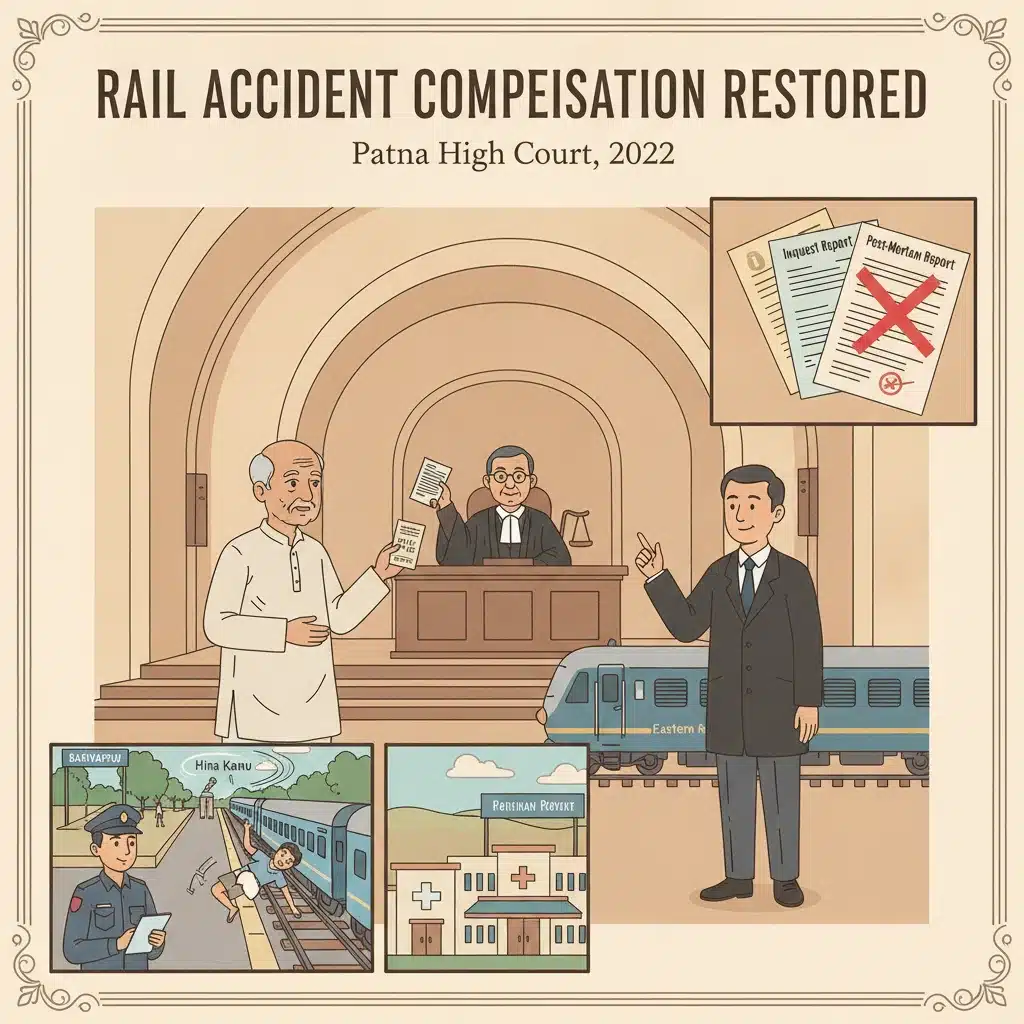
It held that the deceased youth was a valid train passenger and that the Tribunal had wrongly refused compensation.
The Court set aside the Tribunal’s order and directed the Railways to pay compensation with 6% interest from the date of accident.
The Railways must complete payment within two months.
Case Background
This case arose from a tragic railway accident that took place on 24.09.2007.
The appellant’s son, Hira Kanu, allegedly purchased a second-class ticket and was travelling by train from Jamalpur to Bhagalpur. At Bariyarpur Railway Station, he is said to have fallen between the train and the railway platform due to a jerk of the moving train. He suffered grievous injuries and later died.
On the basis of the appellant’s fardbeyan, an Unnatural Death (U.D.) case was instituted at Bariyarpur Police Station. Post-mortem was conducted at Jawaharlal Nehru Medical College and Hospital, Bhagalpur. A death certificate was then issued by the concerned authority.
The appellant, a rustic person from Khagaria district, states that he moved from office to office within the Railways seeking compensation for the death of his son, but received no relief. Finally, he filed a claim before the Railway Claims Tribunal, Patna Bench, registered as OA No. 00035/2008 (C. No. 176/2008).
The Tribunal heard the matter years later and, by order dated 02.07.2018, dismissed the claim. It held that the appellant had failed to prove that his son was a bona fide passenger and that the death occurred due to a railway accident.
Aggrieved by the dismissal, the father approached the Patna High Court by way of Miscellaneous Appeal No. 817 of 2018. The appeal challenged the Tribunal’s findings and sought compensation under the Railways Act, 1989.
What the Court Examined and Decided
Justice Rajiv Roy of the Patna High Court heard the appeal. Both sides were represented: the appellant by his counsel and the Railways by their counsel.
The Court first noted what the appellant had placed before the Tribunal. According to the appellant, his son had a valid second-class ticket bearing No. 240907 for travel from Jamalpur to Bhagalpur on 24.09.2007. In support, he had filed:
- Fardbeyan dated 26.09.2007 (Ext. A1)
- Inquest Report dated 25.09.2007 (Ext. A2)
- Post-mortem report (Ext. A4)
- Photocopy of the railway ticket (Ext. A6)
Despite these documents, the Railway Claims Tribunal rejected the claim. It reasoned that the Inquest Report did not record any ticket having been found on the deceased. It further observed that apart from the fardbeyan, no FIR, final report or police report had been produced. On this basis the Tribunal concluded that it could not hold the deceased to be a bona fide passenger.
The Tribunal also pointed out that no report from the railway authorities or Government Railway Police (GRP) had been filed to show that the death was due to a train accident. It ultimately held that, apart from the claim application itself, there was no material to establish that the deceased had fallen from a moving train and suffered injuries that caused his death.
Before the High Court, the appellant’s counsel attacked this reasoning. He submitted that:
First, the photocopy of the ticket was already on record before the Tribunal, and the original ticket was with the appellant. According to him, the Tribunal never asked to see the original ticket. Once the photocopy was produced and the appellant expressed readiness to produce the original, the burden shifted to the Railways to disprove that the deceased was a bona fide passenger.
Second, counsel argued that the Tribunal had, on its own, raised doubts about the ticket without even calling upon the Railways to contest its genuineness or to deny that the deceased was a passenger. There was no specific stand of the Railways to that effect on record.
Third, reliance was placed on Section 124A of the Railways Act, 1989, which provides for compensation on account of an “untoward incident” in the course of working a railway. The section makes the Railways liable to pay compensation for death or injury of a passenger, irrespective of any wrongful act or negligence on their part, except in limited situations such as suicide, self-inflicted injury, criminal act, intoxication, insanity or death due to natural cause or disease.
The appellant’s counsel also cited the Supreme Court judgment in Union of India v. Reena Devi (AIR 2018 SC 2632). The Patna High Court reproduced and relied upon key passages of this decision. The Supreme Court had held that:
Mere presence of a dead body on railway premises is not enough to assume that the person was a passenger. However, mere absence of a ticket with the injured or deceased cannot, by itself, defeat the claim that the person was a bona fide passenger. The initial burden is on the claimant, which can be discharged by filing an affidavit stating relevant facts. Once that is done, the burden shifts onto the Railways, and the issue must be decided on the facts and surrounding circumstances of each case.
The Railways, through their counsel, defended the Tribunal’s order. They argued that a person named Pradeep Roy was said to have been travelling with the deceased and would have been an important witness, but he was not examined. They further pointed out that the parents had claimed that the deceased’s legs were amputated, whereas the Inquest Report and the Post-mortem Report mentioned only hard and blunt abrasions.
The Railways also questioned the claim by pointing out that neither the original ticket nor any FIR, railway memo, or report by the Station Master or GRP had been produced. In their view, submission of only a photocopy of the ticket was not enough to prove that the victim was a bona fide passenger.
The High Court then turned to the facts on record. It noted that the appellant had filed the photocopy of the ticket on affidavit. The Inquest Report, Post-mortem Report, death certificate and fardbeyan together established that the deceased died in ‘the hospital’ following injuries received after falling between the train and the platform at Bariyarpur Railway Station.
Justice Rajiv Roy made an important observation regarding the appellant’s position as a “rustic person.” The Court stated that once the fardbeyan had been recorded, it was the duty of authorities in a welfare State to register an FIR, investigate the matter and submit a final report. Any failure to carry the matter forward was the authorities’ fault. The appellant could not be made to suffer for this non-action.
On the question of absence of a report from railway officials at the station, the Court took a similar view. It held that once the accident occurred and the injured passenger was rushed to hospital, it was the duty of the railway authorities to report the accident and act accordingly. The appellant could not be expected to run back to the station to check whether the accident had been recorded while his son was fighting for life in the hospital.
As to the non-examination of the co-passenger Pradeep Roy, the Court said that appearing as a witness is the personal choice of that individual. His non-appearance could not be used against the appellant to deny compensation.
After dealing with these factual aspects, the Court referred again to Section 124A of the Railways Act and to the judgment in Union of India v. Reena Devi. Applying those principles, the Court held that once the appellant had filed an affidavit stating that his son was a bona fide passenger and had annexed a photocopy of the railway ticket, the onus shifted to the Railways to disprove the claim.
The Court emphasized that the Railway Claims Tribunal had, “on its own,” rejected the claim without asking the Railways to discharge this burden. This was contrary to the legal position explained by the Supreme Court.
During the hearing before the High Court, when the Court specifically asked about the original ticket, the appellant’s counsel produced the original Ticket No. 240907 dated 24.09.2007 in court. The document was shown to and checked by the Railways’ counsel as well.
In light of this, the High Court made a clear factual finding: the appellant’s son died due to injuries caused by falling from the train and he was a valid passenger holding Ticket No. 240907 dated 24.09.2007.
Having reached this conclusion, the Court held that the Tribunal’s order dismissing the claim was erroneous. It set aside the order dated 02.07.2018 passed in OA No. 00035/2008 (C. No. 176/2008).
The Court then turned to the question of interest on compensation. Referring again to the Supreme Court’s observations in Reena Devi, which discussed interest rates and the starting point for calculation, the Court directed that the appellant is entitled to compensation with interest at the rate of 6% per annum. This interest is to run from the date of the accident until the date of final payment.
Finally, the Patna High Court directed the Railway authorities to complete the entire exercise of payment within two months. With these directions, Miscellaneous Appeal No. 817 of 2018 was allowed.
Why This Judgment Matters
This judgment is important for families of railway accident victims, especially from rural or less-educated backgrounds.
First, the Patna High Court made it clear that a victim’s family cannot be denied compensation just because the police did not complete formalities like registering an FIR or filing a final report. When the family has already given a statement (fardbeyan), it is the State’s job to take the matter forward.
Second, the Court stressed that merely not finding a ticket on the dead body, or only having a photocopy, does not automatically prove that the person was travelling without a ticket. Once the family swears on affidavit and produces some proof, the Railways must come forward with evidence if they want to deny that the victim was a passenger.
Third, the Court underlined that poor, rustic citizens cannot be expected to chase different railway offices during a medical emergency. The burden of reporting and recording accidents lies with railway and police authorities, not grieving families.
Finally, by awarding 6% interest from the date of accident, the Court ensured that delay in deciding the claim does not completely erode the value of the compensation. This can guide similar cases before tribunals and courts in Bihar and elsewhere.
Legal Issues and Answers
-
Issue: Was the deceased a bona fide railway passenger entitled to compensation under Section 124A of the Railways Act, 1989?
Answer: Yes. The Court held that, on the basis of the affidavit, photocopy and production of the original ticket, and in the absence of any rebuttal by the Railways, the deceased was a valid ticket-holding passenger. -
Issue: Did the Railway Claims Tribunal rightly reject the claim for compensation for want of FIR, railway reports, and original ticket?
Answer: No. The Court held that the Tribunal erred by placing the entire burden on the claimant, ignoring the duties of the authorities, and not calling upon the Railways to disprove the claim, contrary to the law laid down in Union of India v. Reena Devi. -
Issue: What relief was the claimant entitled to once the accident and passenger status were established?
Answer: The appellant was held entitled to compensation under Section 124A with 6% interest per annum from the date of the accident till payment, to be completed by the Railways within two months.
Cases Cited by the Court
- Union of India v. Reena Devi, AIR 2018 SC 2632
- Thazhathe Purayil Sarabi v. Union of India, AIR 2009 SC 3098 (referred to within the quoted passage from Reena Devi)
- Mohamadi (referred to within the quoted passage from Reena Devi)
Case Details
Case Number: Miscellaneous Appeal No. 817 of 2018
Case Title: Gandori Sah @ Bandori Sah v. The Union of India through the General Manager, Eastern Railway, Kolkata
Citation: 2022 (4) PLJR 752
Coram: Hon’ble Mr. Justice Rajiv Roy
Advocates:
- For the Appellant: Mr. Hare Krishna Prasad, Advocate
- For the Respondent (Railways): Mr. Tuhin Shankar, Advocate
Nature of the Case: Miscellaneous Appeal against an order of the Railway Claims Tribunal, Patna Bench, in an original application for compensation arising out of an alleged railway accident death.
Date of Patna High Court Judgment: 28.11.2022
Impugned Order: Order dated 02.07.2018 passed by the Railway Claims Tribunal, Patna Bench, in OA No. 00035/2008 (C. No. 176/2008)
Key Statutory Provision: Section 124A of the Railways Act, 1989
Link to the Judgment: Official Patna High Court judgment
If you found this explanation helpful and wish to stay informed about
how legal developments may affect your rights in Bihar,
you may consider following Samvida Law Associates for more updates.




