

Case Background
The dispute arose from a business dealing between a nursing home and a medicine supplier in Muzaffarpur. The accused, a doctor running “Jivandeep Clinic”, allegedly purchased medicines on credit from the complainant, who ran “Utsav Drug Enterprises” at Imlichatti, Muzaffarpur.
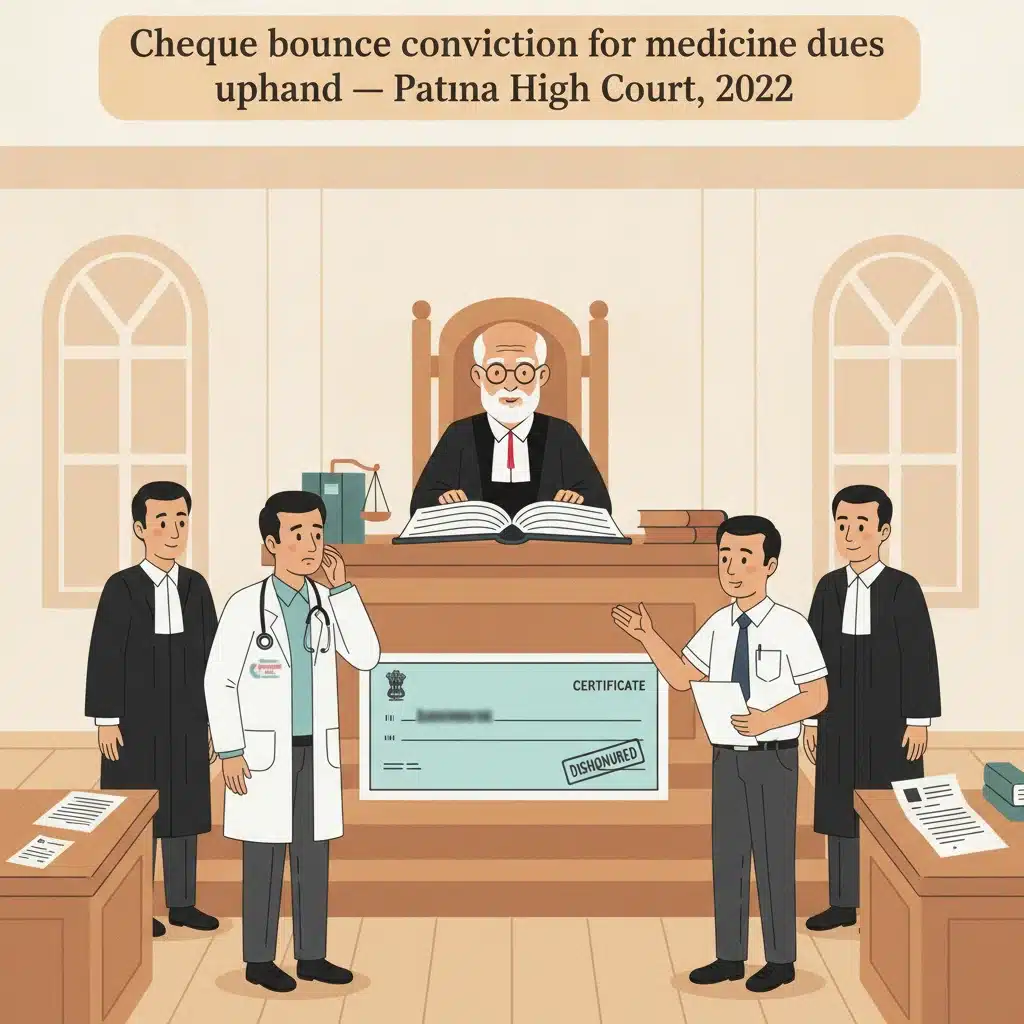
According to the complainant, medicines worth Rs. 3,47,180/- were supplied on credit on 08.10.2011. To clear the outstanding dues, the accused allegedly issued a cheque of Rs. 3,47,000/- dated 25.04.2012 in favour of the complainant. When this cheque was presented to the bank, it was dishonoured for lack of sufficient funds.
On 11.06.2012, the complainant filed a complaint case alleging offences under Sections 403, 406, 420 and 120B of the Indian Penal Code and Section 138 of the Negotiable Instruments Act (N.I. Act). However, by order dated 28.01.2014, the Magistrate took cognizance only under Section 138 of the N.I. Act.
At trial, the complainant examined three witnesses: himself as C.W.1, a medical representative as C.W.2 and an employee of the medicine company as C.W.3. The accused was examined under Section 313 of the Code of Criminal Procedure. He denied the allegations and claimed innocence, but did not produce any defence witness.
The Additional Chief Judicial Magistrate (East), Muzaffarpur, in Complaint Case No. C-1557/12, by judgment dated 25.08.2017, convicted the accused under Section 138 of the N.I. Act. The court directed him to pay double the cheque amount of Rs. 3,47,000/- and to undergo one year of simple imprisonment, with benefit of set-off under Section 428 Cr.P.C.
The accused then filed Criminal Appeal No. 87/2017 before the 2nd Additional District and Sessions Judge, Muzaffarpur. The appellate court dismissed the appeal by judgment dated 02.05.2018/03.05.2018 and affirmed the conviction and sentence. The doctor then moved the Patna High Court by way of Criminal Revision No. 897 of 2018.
What the Court Examined and Decided
Before the Patna High Court, the accused–petitioner raised two main grounds. First, he argued that no legal demand notice had been served upon him after the cheque was dishonoured, which is a key requirement under Section 138 of the N.I. Act. Second, he claimed that the cheque was issued only as a security for future supply of medicines and not towards any existing liability. On this basis, he contended that the statutory presumption under Section 139 of the N.I. Act stood rebutted.
On the question of notice, the petitioner relied on a portion of the cross-examination of C.W.1 (paragraph 11), where the complainant said that he had not sent any notice for payment. The appellate court, however, had already examined this aspect and held that the question put to the complainant was vague. The question referred to “notice for payment”, and not specifically to the legal demand notice required under Section 138.
The appellate court had also noted that a copy of the legal notice and the postal receipt were available in the case record, though these documents had not been formally exhibited during evidence. The appellate court treated them as part of the record and took judicial notice of them.
In the High Court, counsel for the complainant openly accepted that the legal notice and postal receipt were not properly exhibited at trial. However, he argued that this omission was not fatal, relying on the Supreme Court judgment in C.C. Alavi Haji v. Palapetty Muhammed and another (2007 AIR SCW 3578). That decision explains that even if the drawer of a cheque claims not to have received the notice, he still has an opportunity to make payment within 15 days from receiving the summons along with the complaint. If he does not pay within that time, he cannot later avoid liability by merely alleging non-service of notice.
The Patna High Court examined the evidence. It found it undisputed that the accused had issued the cheque (marked Exhibit 1) and that the cheque was dishonoured for insufficiency of funds, as proved by the bank certificate issued by Andhra Bank on 05.05.2012 (Exhibit 2). C.W.1, the complainant, clearly stated in his examination-in-chief that a legal notice was issued after dishonour. The defence did not challenge this specific statement in cross-examination by putting a direct suggestion that no legal notice was sent.
The Court accepted the view of the appellate court that the question put to the complainant in paragraph 11 of cross-examination was not a proper or specific challenge to the sending of a legal notice. Further, when C.W.1 was asked in paragraph 14 about the date on which the accused received the notice, he answered that he did not know. The High Court found that, again, no suggestion was put that no legal notice had been sent at all.
Taking guidance from C.C. Alavi Haji, the Court held that even if the accused claimed non-receipt of notice, he could have paid the cheque amount within 15 days of receiving court summons with a copy of the complaint. If he had done so, he could then argue that the complaint ought to be rejected. In this case, the accused did not do so. Therefore, the Court concluded that the plea of non-service of notice could not succeed.
On the second issue, the petitioner asserted that the cheque was given only as a security against future supply of medicines and that no medicines were in fact supplied. To support this argument, the petitioner’s counsel pointed to certain parts of cross-examination where suggestions were put to C.W.1 and C.W.2 that no medicines were supplied and the cheque was issued as security.
The petitioner also relied upon several judgments: Parveen Mehta v. Vishal Joshi (Punjab and Haryana High Court), Vijay v. Laxman and another (2013) 3 SCC 86, and Raj Kumari Jawa v. Parmod Kumar (2015 SCC OnLine P&H 7452). These judgments highlight that for conviction under Section 138, the cheque must be issued for discharge of a legally enforceable debt or liability; that the presumption under Section 139 is rebuttable; and that if the accused can make his defence reasonably probable, the burden shifts back to the complainant.
On the other side, counsel for the complainant relied upon the Supreme Court’s decision in Kishan Rao v. Shankargouda (AIR 2018 SC 3173) to emphasise the strength of the presumption under Section 139 and argued that the accused had failed to rebut it.
The Patna High Court analysed the earlier precedents cited by both sides. The Court noted that in those cases where the accused successfully rebutted the presumption, there was substantial material on record supporting the defence, such as income tax documents, contradictions in the complainant’s own statements, or failure to produce admitted account books. In contrast, in the present case, the accused had not led any independent evidence.
The Court carefully looked at the testimony of the complainant and his witnesses. It noted that the accused did not dispute that he ran a nursing home about four kilometres from the complainant’s medicine shop. The complainant also clarified that there was no long-term contract or running account between them; he was not claiming that there was a regular business with detailed account books for this accused. Instead, he said that he had handed over the original receipt for the medicines to the accused at the time of receiving the cheque.
Importantly, during cross-examination, the defence did not offer any clear, positive story about why the accused issued the cheque if no medicines were supplied. The accused’s claim that the cheque was merely a security was made only through suggestions in cross-examination and arguments of counsel, not supported by any documentary evidence or witness testimony from the defence side.
The High Court highlighted that in paragraph 16 of the cross-examination of the complainant, the defence suggested that the complainant had obtained the accused’s signature on the cheque “in the name of supply of medicines by way of security” but no medicines were supplied. The Court observed that this very suggestion indicated that the accused had approached the complainant for purchase of medicine and had issued the cheque in connection with that transaction.
In this background, the Court held that the statutory presumption under Section 139 of the N.I. Act—that the cheque was issued towards discharge of debt or liability—actually became stronger, not weaker. The accused had not produced any purchase order, any document showing a different purpose of the cheque, or any other material to make his defence “reasonably probable”, as required by the Supreme Court in Vijay v. Laxman.
While acknowledging that the standard of proof for the accused to rebut the presumption is lighter than that on the prosecution, the Court stressed that some credible material is still necessary. Mere denial or bald assertion that the cheque was a security cheque is not enough. Since no such material was produced, the Court found that the accused had failed to discharge his burden.
Thus, both grounds raised in revision—non-service of notice and cheque as security—were rejected. Sitting in revisional jurisdiction, the Patna High Court also noted that it could interfere only if the findings of the courts below were perverse or based on misreading of evidence. Finding no such defect, the Court refused to disturb the concurrent findings of guilt.
Accordingly, the criminal revision application was dismissed. The Court directed the petitioner to surrender before the trial court within 30 days to serve the sentence and comply with the order of payment.
Why This Judgment Matters
This judgment is significant for small traders, medical stores, and service providers who often supply goods on credit and accept cheques. It shows that courts will protect cheque holders where the drawer admits the cheque but only raises vague defences without proof.
For people accused in cheque bounce cases, the decision is a warning that simply saying “it was a security cheque” or “I did not get the notice” will not be enough. The accused must bring some solid material to support such a story or must act promptly by paying after receiving court summons.
The Patna High Court’s reliance on the Supreme Court decision in C.C. Alavi Haji also reinforces that technical arguments about non-service of notice will not easily help a defaulting drawer who ignores even the summons stage and still does not pay.
Overall, this ruling strengthens the reliability of cheques as a mode of payment in commercial dealings in Bihar and underlines that revisional courts will rarely interfere with well-reasoned concurrent convictions in Section 138 cases.
Legal Issues and Answers
-
Issue: Whether the complaint under Section 138 of the N.I. Act was invalid due to alleged non-service of legal demand notice on the accused.
Answer: No. The Court held that the complainant had deposed about issuing legal notice, notice and postal receipt were on record, the defence did not directly challenge the fact of sending notice, and in any case, relying on C.C. Alavi Haji, the accused could not claim benefit after failing to pay even within 15 days of receiving court summons. -
Issue: Whether the accused had successfully rebutted the presumption under Section 139 of the N.I. Act by claiming that the cheque was issued only as security for future supply of medicines and not towards an existing liability.
Answer: No. The Court found that the accused had led no evidence to support this claim, had not shown any alternative purpose for the cheque, and the cross-examination in fact supported the complainant’s case. Therefore, the presumption under Section 139 remained unrebutted and the conviction under Section 138 was upheld. -
Issue: Whether the High Court, in revisional jurisdiction, should interfere with the concurrent findings of guilt recorded by the trial and appellate courts.
Answer: No. The Court held that there was no perversity or misreading of evidence in the judgments below and hence no ground to interfere. The revision application was dismissed and the conviction and sentence were maintained.
Cases Cited by the Court
- C.C. Alavi Haji v. Palapetty Muhammed and another, 2007 AIR SCW 3578.
- Vijay v. Laxman and another, (2013) 3 SCC 86.
- Dashrath Rupsingh Rathod v. State of Maharashtra and another, Criminal Appeal No. 2287 of 2009.
- Raj Kumari Jawa v. Parmod Kumar, 2015 SCC OnLine P&H 7452.
- Ashok Kumar v. State of Rajasthan, (1991) 1 SCC 166.
- Kishan Rao v. Shankargouda, AIR 2018 Supreme Court 3173.
- Parveen Mehta v. Vishal Joshi, CRM-A-1997-MA-2015 (Punjab and Haryana High Court, Chandigarh).
Case Details
Case Number: Criminal Revision No. 897 of 2018 (arising out of Complaint Case No. C-1557/2012; P.S. Case No. 1557/2012, Muzaffarpur Complaint Case, District Muzaffarpur)
Case Title: Umesh Kumar Rajak @ Dr. Umesh Kumar Rajak v. The State of Bihar & Ajit Kumar
Citation: 2022 (4) PLJR 681
Coram: Hon’ble Mr. Justice Rajeev Ranjan Prasad
Advocates:
For the petitioner (accused): Mr. Sanjay Kumar @ S.K., Advocate
For the State: Mr. Narendra Kumar Singh, APP
For Opposite Party No. 2 (complainant): Mr. Prakash Chandra, Advocate
Nuture of the Case: Criminal revision against dismissal of criminal appeal and affirmation of conviction and sentence under Section 138 of the Negotiable Instruments Act.
Date of Patna High Court Judgment: 08.09.2022
Link to Judgment: Full text of Patna High Court judgment
If you found this explanation helpful and wish to stay informed about
how legal developments may affect your rights in Bihar,
you may consider following Samvida Law Associates for more updates.




