

Case Background
The petitioner is a resident of village Bararhi, under Bagengola Police Station in the Buxar district of Bihar. He applied in the prescribed form to the Arms Magistrate, Buxar, for a rifle licence. He said he needed the weapon for personal safety and protection of his life and property.
After his application, the Officer-in-Charge of Bagengola Police Station carried out verification and recommended his case for grant of licence. This recommendation was endorsed by the Deputy Superintendent of Police, Dumraon, and then by the Superintendent of Police, Buxar. The matter then went to the District Magistrate, Buxar, who is the licensing authority.
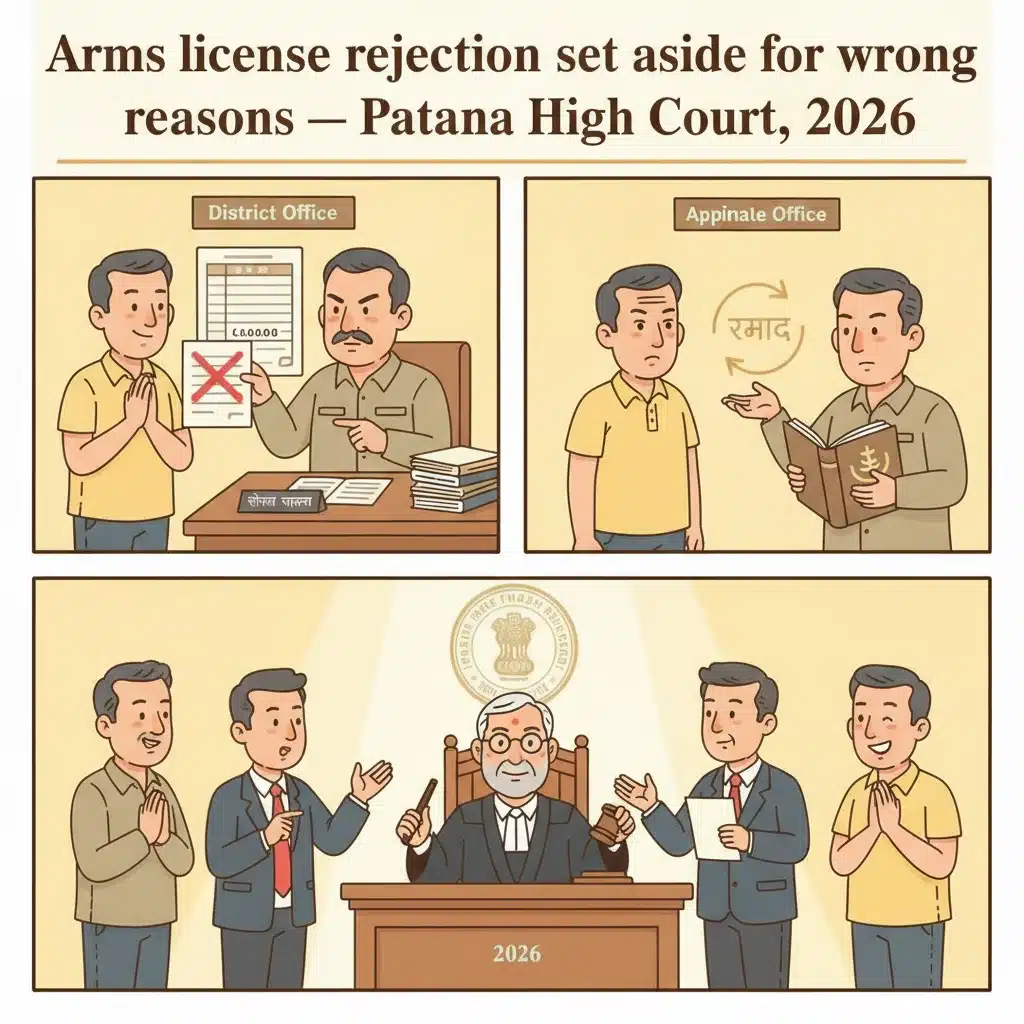
Despite these favourable police reports, by order dated 23.02.2016 in Arms Case No. 192 of 2011, the District Magistrate rejected the application. The only reason given was that the petitioner’s annual income was Rs. 63,000/-, and he was allegedly not “competent” to hold an arms licence because of this.
The petitioner challenged that order in Arms Appeal No. 164 of 2016 before the Divisional Commissioner, Patna. The appellate authority set aside the order and sent the case back to the District Magistrate for fresh consideration. The Commissioner directed that the case be decided in light of the law under Sections 13 and 14 of the Arms Act, 1959, and a judgment of the Patna High Court reported in 2015 (4) PLJR 212. Fresh verification of the petitioner’s character and antecedents by the local police was also ordered.
On remand, new reports were called from the Superintendent of Police, Buxar, the Sub-Divisional Police Officer, Dumraon and the Officer-in-Charge of Bagengola Police Station. These reports, including Letter No. 3454 dated 19.08.2019 and Letter No. 3606/Go dated 01.09.2019, stated that there was no criminal case against the petitioner and no adverse material against his character or conduct.
The police reports also recorded certain background facts: that the petitioner’s grandfather, Late Jugli Singh, had been killed by Naxalites in 1987, and a family servant, Vishwanath Paswan, had been killed by Naxalites in connection with Bagengola P.S. Case No. 39 of 2000 dated 31.12.2000 under Sections 302/34 of the IPC. The reports further stated that the petitioner was an agriculturist with an annual income of about Rs. 4,00,000/-.
Even after this, by order dated 25.11.2019 in Arms Case No. 192 of 2011, the District Magistrate again rejected the application. He stated that the police had merely forwarded their report, without clearly writing that there was any “threat perception” to the petitioner or recommending grant of licence.
The petitioner then filed Arms Appeal No. 38 of 2021 before the Divisional Commissioner, Patna. By order dated 20.06.2023, the Divisional Commissioner dismissed the appeal and affirmed the District Magistrate’s order. This led the petitioner to approach the Patna High Court by filing Civil Writ Jurisdiction Case No. 3231 of 2024.
What the Court Examined and Decided
Hon’ble Mr. Justice Alok Kumar Sinha heard the writ petition. The petitioner argued that both the District Magistrate and Divisional Commissioner had acted arbitrarily and against the scheme of Sections 13 and 14 of the Arms Act. He stressed that he had no criminal antecedents, that the police had found no adverse material, and that the only basis for rejection was the alleged absence of specific “threat perception” in the police reports.
The petitioner’s side also pointed out that in the first rejection, the District Magistrate had wrongly relied on low income as a ground, although Section 14(2) of the Arms Act clearly says a licence cannot be refused merely because a person does not have sufficient property. After remand, instead of correcting this, the authorities shifted to another faulty ground: that there was no recorded threat perception or positive recommendation from the police.
On the other hand, counsel for the District Magistrate (Respondent No. 3) supported the rejection orders. The State argued that the police had only forwarded the report and had not specifically recommended the licence. They said the reports made it clear that:
(i) The petitioner was not on the hit list of extremists. (ii) He was not on the hit list of any fundamentalist organisation. (iii) He was not on the hit list of any notorious criminal group. (iv) No criminal incident had taken place with the petitioner himself.
Based on this, the District Magistrate concluded there was no threat perception and refused the licence by using his discretion under Section 14(1)(b)(ii) of the Arms Act. The State further argued that the earlier remand by the Divisional Commissioner did not create any “right” to get a licence, and that courts should not interfere with such administrative discretion in a writ petition.
Before deciding, the Patna High Court set out the legal framework, especially Section 14 of the Arms Act, 1959. That section lists the exact grounds on which a licensing authority “shall refuse” a licence. These include situations where the person is legally barred from holding arms, is of unsound mind, is unfit for any reason, or where refusal is necessary for public peace or public safety. Section 14(2) expressly says that a licence cannot be refused just because the person does not own or possess sufficient property.
The Court also referred to its earlier judgment dated 24.04.2026 in CWJC No. 3229 of 2024, which had discussed Rule 12 of the Arms Rules, 2016. Rule 12(3)(a) says that for permissible arms (Category III), the licensing authority, based on the police report and its own assessment, may consider applications of:
(a) Persons who, by their business, profession, job or otherwise, have genuine requirement to protect life and/or property; (b) Dedicated sportspersons who are active members of shooting clubs; (c) Persons serving or having served in Defence Forces, Central Armed Police Forces or State Police Force who genuinely require protection of life and/or property.
This shows that while police reports are important, the licensing authority must also independently assess the applicant’s purpose and requirement, and act within the limits of Sections 13 and 14 and Rule 12.
Applying these principles, the Court examined the District Magistrate’s order dated 25.11.2019. The key findings were:
First, the entire reasoning of the District Magistrate focused on the absence of an explicit “threat perception” in the police report. He did not record any finding that the petitioner was prohibited by law from possessing firearms, was of unsound mind, or was otherwise unfit. He also did not record that granting the licence would affect public peace or public safety.
Second, the record showed that the petitioner’s antecedents had been checked by the police. No criminal case was pending, no adverse comment on character or reputation was made, and the respondents did not dispute these facts in their counter affidavit.
Third, the police report itself mentioned serious past incidents involving the petitioner’s family—namely, killings by Naxalites in 1987 and 2000. The Court did not say these incidents automatically proved current threat perception, but held that the licensing authority was bound to consider the “entirety of the materials on record,” instead of mechanically insisting on the specific phrase “threat perception” in the report.
Fourth, the Court held that the Arms Act does not say that an applicant must prove an imminent threat to life or property before an application can even be considered. Nor does Section 14 allow refusal merely because the police have not written about threat perception. If the legislature had wanted such a condition, it would have written it into the Act. Courts cannot add conditions that the lawmaker has left out.
Fifth, the Court rejected the State’s argument that absence of a “recommendation” from the police is enough to refuse a licence. A police recommendation is only one input; it does not bind the District Magistrate. More importantly, the absence of recommendation is not the same as presence of disqualifying material. Here, no disqualification or adverse material was shown.
The Court then turned to the appellate order dated 20.06.2023 passed by the Divisional Commissioner, Patna. It found that the appellate authority had not independently examined whether any of the statutory grounds under Section 14 existed. The Commissioner also failed to check whether his earlier remand directions in Arms Appeal No. 164 of 2016 had been properly followed. Instead, he simply agreed with the District Magistrate without deeper scrutiny.
In legal terms, the High Court said that when a statute lists specific grounds for rejecting an application, authorities cannot add new grounds based on their own thinking. Discretion must operate within the four corners of the statute. Orders passed on irrelevant considerations, while ignoring relevant ones, are open to judicial review and cannot stand.
Considering that the petitioner had been pursuing his licence since 2014 and had already gone through one full appeal and remand, the Court felt that sending the matter back yet again would only prolong harassment without any real benefit.
The Patna High Court therefore held that the orders of the District Magistrate dated 25.11.2019 and the Divisional Commissioner dated 20.06.2023 were arbitrary, unsupported by law, and contrary to Sections 13 and 14 of the Arms Act. Both orders were quashed.
The Court did not itself grant the licence, but it directed the District Magistrate, Buxar, to consider granting the licence to the petitioner in the light of the Court’s discussion. This fresh consideration must be done within two months from the date the District Magistrate receives or is shown a copy of the judgment.
Why This Judgment Matters
This judgment is important for ordinary citizens in Bihar and elsewhere who apply for arms licences for self-protection or protection of property. It clearly tells licensing authorities that they cannot refuse a licence on vague or invented grounds.
The Patna High Court has clarified that:
Authorities cannot demand proof of “threat perception” as if it is a strict legal requirement, when the Arms Act does not say so. They must look at the whole record, including police reports, background incidents, and the applicant’s stated purpose. They must also clearly show which legal ground under Section 14 they are using if they decide to refuse a licence.
For applicants, this decision shows that if their antecedents are clean and no legal disqualification is found, the administration cannot simply hide behind technical words like “no threat perception” to turn them away.
The judgment also reinforces that appellate authorities, such as Divisional Commissioners, must genuinely re-examine a case and not blindly agree with the lower authority. Failure to do so can result in their orders being struck down in writ proceedings.
Legal Issues and Answers
- Issue: Can an arms licence be refused only because the police report does not record a specific “threat perception” or give a positive recommendation, when there is no adverse material against the applicant?
Answer: No. The Patna High Court held that absence of recorded “threat perception” is not a statutory ground for refusal under Section 14 of the Arms Act. Without findings of legal disqualification, unsoundness of mind, unfitness, or risk to public peace or safety, the authorities cannot reject the licence. - Issue: Did the District Magistrate and Divisional Commissioner properly apply Sections 13 and 14 of the Arms Act and Rule 12 of the Arms Rules, 2016 while rejecting the petitioner’s application and appeal?
Answer: No. The Court found that both authorities ignored the statutory scheme, relied on irrelevant considerations, failed to identify any valid ground under Section 14, and did not meaningfully follow earlier remand directions. Their orders were quashed as arbitrary and unsustainable in law.
Cases Cited by the Court
- The Court referred to its earlier judgment dated 24.04.2026 in CWJC No. 3229 of 2024, which discussed Rule 12 of the Arms Rules, 2016 in detail.
- The appellate authority had earlier referred to a Patna High Court decision reported in 2015 (4) PLJR 212 regarding grant of arms licences under Sections 13 and 14 of the Arms Act.
Case Details
Case Number: Civil Writ Jurisdiction Case No. 3231 of 2024
Case Title: Brij Nandan Singh @ Braj Nandan Singh v. The State of Bihar & Ors.
Court: High Court of Judicature at Patna
Coram: Hon’ble Mr. Justice Alok Kumar Sinha
Date of Judgment: 19.06.2026 (Uploading Date: 22.06.2026)
Advocates:
- For the Petitioner: Mr. Brij Mohan Kumar Singh, Advocate
- For the Respondents: Mr. Standing Counsel 6, assisted by Mr. AC to SC-6
Nature of the Case: Writ petition under Article 226 of the Constitution of India challenging rejection of an arms licence and dismissal of statutory appeal (civil writ jurisdiction).
Impugned Orders:
- Order dated 25.11.2019 in Arms Case No. 192 of 2011 passed by the District Magistrate, Buxar.
- Order dated 20.06.2023 in Arms Appeal No. 38 of 2021 passed by the Divisional Commissioner, Patna Division, Patna.
Final Outcome: Writ petition allowed; both impugned orders quashed; District Magistrate, Buxar, directed to consider grant of licence to the petitioner in light of the Court’s judgment within two months.
If you found this explanation helpful and wish to stay informed about
how legal developments may affect your rights in Bihar,
you may consider following Samvida Law Associates for more updates.




