

Case Background
The criminal case started with Kishanganj P.S. Case No. 257 of 2015, registered on 06.07.2015 in Kishanganj district against unknown persons.
The FIR was lodged on the written report of the victim’s father, Amrendra Narayan. His 21‑year‑old son, Shyam Narayan @ Siku, had gone on 01.07.2015 to the BSF camp at Kishanganj to participate in a physical test conducted by SCC GD. During the running test, the son fainted and fell down.
On being contacted, the father advised his son to come back by vehicle. After this, there was no communication for some time. The next day, on 02.07.2015, when the son reached Patna, contact was again established. He told his father that he had stomach pain and, on being asked, he wept and said that the police had beaten him badly.
The son assured his father that he would take treatment. He first took treatment at P.M.C.H., Patna. On 03.07.2015 his condition worsened. His friends admitted him to Chanakya Hospital, Kankarbagh, Patna and later he was shifted to Ruban Hospital, Patna, where he ultimately died during treatment.
Initially, the FIR was for offences under Sections 341, 323, 504, 506 and 307 of the Indian Penal Code. After the victim’s death, Section 302 IPC was added.
The father of the victim later approached the Patna High Court in C.W.J.C. No. 12190 of 2015, alleging that no proper action was being taken on the FIR and seeking directions for proper investigation. In that writ case, the Superintendent of Police, Kishanganj, filed a supplementary affidavit stating that six persons had been found involved in the occurrence and the Investigating Officer had been directed to arrest them and take necessary steps.
On that basis, a Division Bench of the Patna High Court disposed of the writ petition on 25.01.2017, expressing hope that the Investigating Officer would act appropriately and file a police report under Section 173 CrPC expeditiously, preferably within six months.
In pursuance of these directions, the Investigating Officer completed the investigation in Kishanganj P.S. Case No. 257 of 2015 and submitted charge‑sheet dated 27.06.2018 before the Chief Judicial Magistrate, Kishanganj. The Investigating Officer was also directed to obtain sanction orders in respect of those accused who were B.S.F. jawans and place the same before the Court.
Meanwhile, some of the accused persons, including Tejveer Singh and five others, filed an anticipatory bail petition before the Sessions Judge, Kishanganj, registered as A.B.P. No. 306 of 2017.
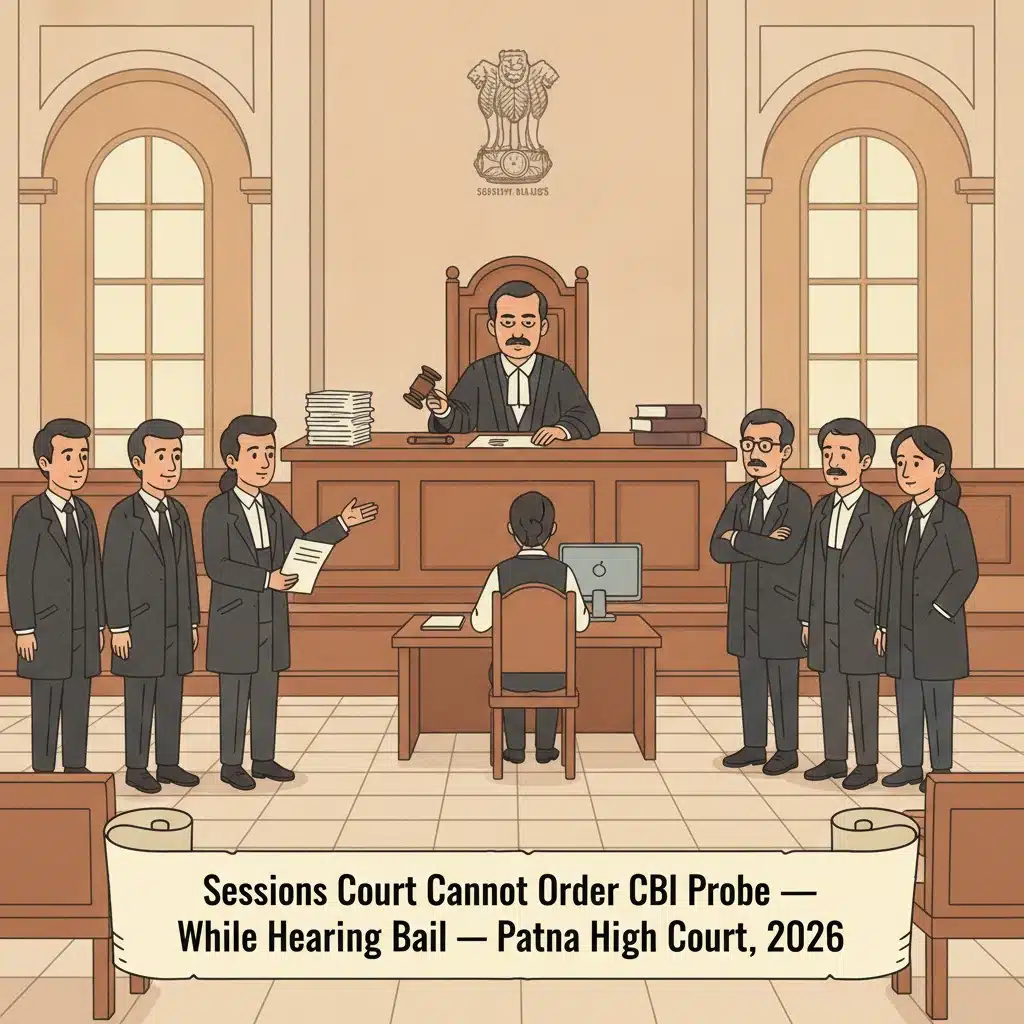
On 04.09.2017, while hearing that anticipatory bail petition, the Sessions Judge passed an order directing the Intelligence Bureau, Government of India, to investigate the matter and submit a preliminary investigation report by 06.10.2017.
The Intelligence Bureau wrote back to the Sessions Court stating that it had no jurisdiction to conduct investigation in any criminal matter and requested modification of the 04.09.2017 order.
Acting on this, the Sessions Judge modified the order on 26.09.2017. This time, instead of the Intelligence Bureau, the Court directed the Central Bureau of Investigation (CBI) to conduct an independent investigation and submit a preliminary report by 30.10.2017.
Feeling aggrieved by this direction, the CBI approached the Patna High Court through the present Criminal Writ Jurisdiction Case No. 239 of 2018 under Articles 226 and 227 of the Constitution, seeking to quash the order dated 26.09.2017 of the Sessions Judge, Kishanganj.
What the Court Examined and Decided
The central question before the Patna High Court was whether a Sessions Court, while hearing an anticipatory bail petition, can direct the CBI to conduct an independent investigation into a crime registered in a police station within the State.
On behalf of the CBI, senior counsel argued that under the constitutional scheme and the Delhi Special Police Establishment Act, 1946, only the Supreme Court and High Courts can order a CBI investigation. District Courts, including Sessions Courts and Magistrates, have no such power.
The CBI’s counsel explained that the CBI is constituted under the Delhi Special Police Establishment Act to investigate certain offences in Union Territories. Under Section 5, the Central Government can extend the powers and jurisdiction of the CBI to areas in a State, but Section 6 clearly requires the consent of the State Government for CBI officers to exercise powers in that State.
Therefore, according to the CBI, a Sessions Court cannot on its own direct the CBI to enter a State and investigate a crime. Such directions can only flow from constitutional powers of the Supreme Court under Article 32 and the High Courts under Article 226, and even then this is done sparingly.
The CBI relied on the Supreme Court judgment in CBI, Jaipur v. State of Rajasthan, (2001) 3 SCC 333. In that decision, the Supreme Court had clearly held that even when a State Government gives consent to CBI investigation, a Judicial Magistrate cannot direct the CBI to investigate using powers under Section 156(3) CrPC. The power to ask the CBI to probe lies with the constitutional courts.
The CBI also contended that the Sessions Court had passed the impugned order while hearing only an anticipatory bail application. Bail jurisdiction is narrow and confined to deciding whether an accused should be granted bail; it does not extend to changing the investigating agency.
On the other side, the State’s Government Advocate (G.A.-11) defended the Sessions Court’s order. He submitted that Sessions Courts and Magistrates also have power to direct the CBI to investigate cognizable offences. However, no detailed reasoning from the State side is recorded in the judgment.
Justice Jitendra Kumar, writing the judgment, examined in detail the constitutional position and a long line of Supreme Court precedents.
He noted that under the Seventh Schedule of the Constitution, “police” is a State subject under Entry 2 of List II (State List). Entry 80 of List I (Union List) allows Parliament to extend the powers and jurisdiction of a police force from one State to another, but only with consent of the concerned State Government.
Section 6 of the Delhi Special Police Establishment Act reinforces this by mandating State consent for CBI officers to exercise powers in that State. This shows that a police force of one State or a Union Territory cannot function in another State as police without that State’s consent.
However, the High Court emphasised that constitutional courts—namely the Supreme Court and High Courts—stand on a different footing. As guardians of fundamental rights and vested with the power of judicial review under Articles 32 and 226, they can, in rare and exceptional cases, direct the CBI or any other agency to investigate a matter to protect fundamental rights and ensure fair and impartial investigation.
Relying on several Supreme Court decisions—CBI v. State of Rajasthan (2001) 3 SCC 333, Sakiri Vasu v. State of U.P. (2008) 2 SCC 409, State of W.B. v. Committee for Protection of Democratic Rights (2010) 3 SCC 571, Vinay Tyagi v. Irshad Ali (2013) 5 SCC 762, K.V. Rajendran v. Superintendent of Police (2013) 12 SCC 480, Chandra Babu @ Moses v. State (2015) 8 SCC 774, and Dharam Pal v. State of Haryana (2016) 4 SCC 160—the Court collected a consistent principle:
Only constitutional courts can order transfer of investigation or CBI investigation; Magistrates and Sessions Courts, functioning within statutory limits, cannot change the investigating agency or direct CBI to investigate.
The judgment also noted that the Karnataka High Court, following Chandra Babu and Vinay Tyagi, has recently held that a Magistrate under Section 156(3) CrPC has no power to direct investigation by another agency such as CID.
The Court acknowledged that the Gujarat High Court in Ashok Devendra Goyal v. State of Gujarat (order dated 03.09.2019) had taken a contrary view, saying that a Magistrate could recommend change of Investigation Officer to ensure proper investigation. However, Justice Jitendra Kumar found that order to be cryptic, not in conformity with binding Supreme Court judgments, and not adequately discussing the constitutional and statutory scheme.
The Patna High Court also pointed out that the Gujarat matter is now pending before the Supreme Court in Special Leave Petition (Crl.) No. 9442 of 2019, and therefore the law as laid down by the Supreme Court in earlier cases remains binding.
After settling this legal position, the Court turned back to the facts of the present case.
It noted that the Sessions Judge’s direction to the CBI was issued in an anticipatory bail proceeding (A.B.P. No. 306 of 2017). This was clearly beyond the jurisdiction of the Sessions Court, whose power in a bail matter is limited to considering whether the accused person deserves anticipatory bail or not.
To reinforce this, the High Court referred to recent Supreme Court decisions where High Court orders passed beyond the scope of bail jurisdiction had been set aside: Rambalak v. State of U.P., 2026 INSC 511 (order dated 19.05.2026), State of Uttar Pradesh v. Anurudh and Anr. (AIROnline 2026 SC 105; 2026 SCC OnLine SC 40), and Union of India v. Man Singh Verma (2025 SCC OnLine SC 456).
In those cases, the Supreme Court held that while High Courts possess both statutory and constitutional powers, one cannot overshadow or enlarge the other outside what the law provides, especially in bail proceedings. Directions about summons, age determination, or compensation cannot be issued while deciding bail.
Applying the same logic here, the Patna High Court held that the Sessions Court, acting in bail jurisdiction, could not issue directions affecting the choice of investigating agency, much less direct the CBI to conduct an independent investigation.
Thus, Justice Jitendra Kumar concluded that the Sessions Judge’s order dated 26.09.2017 directing CBI investigation was:
- contrary to the constitutional scheme of separation of powers and federalism,
- inconsistent with Section 6 of the Delhi Special Police Establishment Act,
- in violation of binding Supreme Court precedents, and
- beyond the limited scope of anticipatory bail jurisdiction.
Accordingly, the Patna High Court set aside the impugned order, thereby allowing the CBI’s writ petition.
Importantly, the Court clarified that the victim’s legal representatives are free to pursue appropriate legal remedies for change of investigating agency or for further/re‑investigation, but such steps must be taken “as per law” before a competent court, meaning mainly through the constitutional courts or by seeking action from the State Government.
Why This Judgment Matters
This judgment has practical significance for victims’ families, accused persons, lawyers, and trial judges in Bihar and beyond.
First, it clearly states that a Sessions Court or Magistrate cannot order a CBI investigation. If a victim or their family feels the local police investigation is biased or weak, they cannot expect a trial court to hand over the case directly to the CBI. They must approach the High Court or Supreme Court, or request the State Government, for such relief.
Second, it restricts what can be done during bail hearings. While deciding bail, a court should focus on whether the accused should be in jail or free on bail, not on changing investigators, awarding compensation, or issuing wide‑ranging directions. This protects both sides from surprises in bail orders.
Third, for the police and investigating agencies, the decision reaffirms that only the State Government or constitutional courts can change the investigating agency. District Courts must work within the existing statutory framework.
Finally, for people who feel helpless when investigations are slow or unfair, the judgment points towards the correct doors to knock on: writ petitions before the High Court, or representations to the State Government, rather than applications before Magistrates or Sessions Courts asking for CBI probe.
Legal Issues and Answers
- Issue: Can a Sessions Court, while hearing an anticipatory bail application, direct the CBI to conduct an independent investigation into a case registered within the State?
Answer: No. The Patna High Court held that only constitutional courts (Supreme Court and High Courts) can direct CBI or change of investigating agency. Sessions and Magistrate Courts, functioning under statutory powers, cannot order CBI investigation, especially while exercising limited bail jurisdiction. - Issue: Is the Sessions Court’s order directing CBI investigation in this case legally sustainable?
Answer: No. The Court held the order unsustainable as it violated the constitutional scheme, Section 6 of the Delhi Special Police Establishment Act, and binding Supreme Court precedents, and also exceeded the scope of bail jurisdiction. - Issue: Do the victim’s family members lose the right to seek a fresh or higher‑level investigation because this CBI direction is quashed?
Answer: No. The High Court expressly left it open for the legal representatives of the victim to pursue appropriate legal remedies for change of investigating agency or further/re‑investigation by approaching a competent court as per law.
Cases Cited by the Court
- CBI, Jaipur v. State of Rajasthan, (2001) 3 SCC 333
- Sakiri Vasu v. State of U.P., (2008) 2 SCC 409
- State of W.B. v. Committee for Protection of Democratic Rights, (2010) 3 SCC 571
- Vinay Tyagi v. Irshad Ali, (2013) 5 SCC 762
- K.V. Rajendran v. Superintendent of Police, (2013) 12 SCC 480
- Chandra Babu @ Moses v. State through Inspector of Police & Ors., (2015) 8 SCC 774
- Dharam Pal v. State of Haryana, (2016) 4 SCC 160
- State v. Smt. Padmavathamma C. @ Padmavathi, Karnataka High Court, Crl.P. No. 7813 of 2024, order dated 08.08.2024
- Ashok Devendra Goyal v. State of Gujarat, Gujarat High Court, R/SCR.A/8268 of 2019, order dated 03.09.2019
- Rambalak v. State of U.P., 2026 INSC 511, Supreme Court, decided on 19.05.2026
- State of Uttar Pradesh v. Anurudh and Anr., AIROnline 2026 SC 105; 2026 SCC OnLine SC 40
- Union of India v. Man Singh Verma, 2025 SCC OnLine SC 456
Case Details
Case Number: Criminal Writ Jurisdiction Case No. 239 of 2018 (arising out of Kishanganj P.S. Case No. 257 of 2015)
Case Title: The Central Bureau of Investigation through H.O.B., Anti Corruption Branch, C.B.I., Patna v. The State of Bihar & Ors.
Coram: Hon’ble Mr. Justice Jitendra Kumar
Date of Judgment: 15.06.2026
Nature of the Case: Criminal writ petition under Articles 226 and 227 of the Constitution challenging an order of the Sessions Judge passed in an anticipatory bail proceeding directing CBI investigation.
Advocates:
- For the Petitioner/CBI: Mr. Satyabir Bharti, Senior Advocate; Mr. Shivaditya Dhari Sinha, Advocate; Mr. Bipin Kumar Sinha, Advocate; Mr. Sanjay Kumar, Standing Counsel, CBI.
- For Respondent Nos. 1 to 5/State and State Officials: Mr. Raghwanand, Government Advocate‑11; Mr. Sanjay Kumar Tiwari, Assistant Counsel to G.A.-11.
- For Respondent No. 6 (Informant/Father of Deceased): None appeared.
Link to Judgment: https://patnahighcourt.gov.in/viewjudgment/MTYjMjM5IzIwMTgjMSNO-qkNLG30lc3g=
If you found this explanation helpful and wish to stay informed about how legal developments may affect your rights in Bihar, you may consider following Samvida Law Associates for more updates.




