

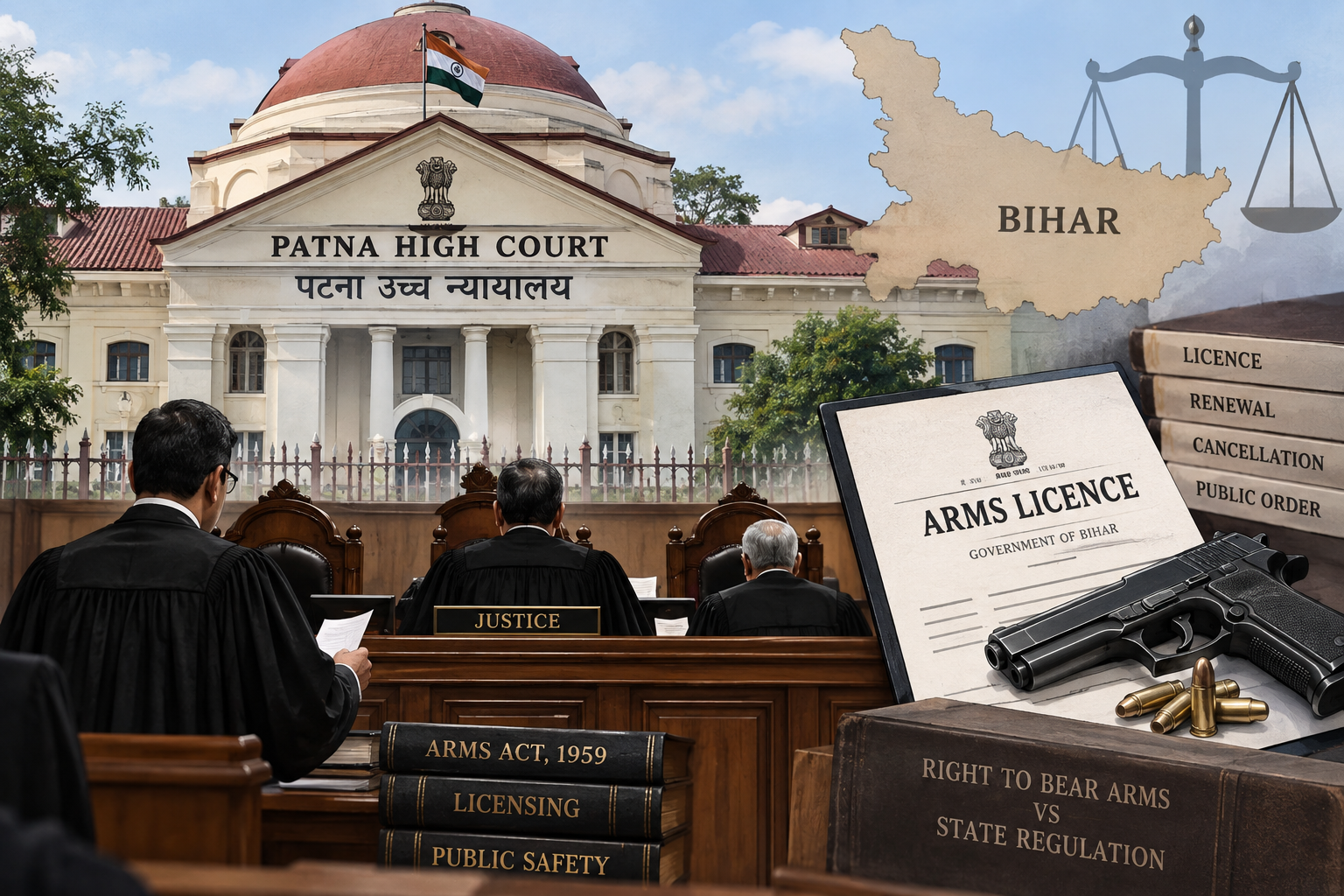
You applied for an arms licence and the District Magistrate refused it, saying you have no “threat perception.” Or you already hold a licence, and it was suspended or cancelled after an FIR was filed against you — sometimes over a dispute that has nothing to do with your weapon. Or your gun was seized during a case, and you simply want it back. These are the most common arms licence problems people in Bihar bring to a lawyer, and the Patna High Court has decided a long line of cases on exactly these questions. This guide explains, in plain language, how the law actually works and what the Court has consistently said.
Table of Contents
- What Is an Arms Licence, and Who Needs One
- Who Can Apply, and What “Genuine Need” Means
- Documents and Police Verification
- How the Application Is Decided, Step by Step
- “Threat Perception” Why Most Refusals Happen, and Why Courts Reject Them
- When Can a Licence Be Cancelled or Suspended
- You Are Entitled to a Fair Hearing Before Cancellation
- A Criminal Case Against You Does Not Automatically End Your Licence
- Getting a Seized Weapon Back During Trial
- Arms Dealers and Ammunition Quota
- What the Patna High Court Has Said
- Common Mistakes Applicants Make
- Realistic Timelines in Bihar
- Frequently Asked Questions
- How a Lawyer Can Help
- Related Judgment Summaries
What Is an Arms Licence, and Who Needs One
An arms licence is a document issued under the Arms Act, 1959 and the Arms Rules, 2016, permitting a person to possess, carry or deal in a firearm. Without one, keeping even a country-made pistol or a licensed-category weapon without authorisation is a criminal offence under Sections 25 and 26 of the Arms Act, punishable with imprisonment.
In Bihar, the District Magistrate of the district is the licensing authority. Appeals against the District Magistrate’s decision go to the Divisional Commissioner of that division — for example, Patna Division, Saran Division, Tirhut Division, Koshi Division or Magadh Division, depending on where you live. If the Divisional Commissioner also rejects your case, the next step is a writ petition before the Patna High Court under Article 226 of the Constitution.
Who Can Apply, and What “Genuine Need” Means
Anyone who is not disqualified under Section 14 of the Arms Act — for reasons such as being of unsound mind, having certain criminal convictions, or being considered unfit to be entrusted with a firearm — can apply. But eligibility alone does not guarantee a licence. The licensing authority still has to be satisfied that you have a genuine reason.
Under Rule 12(3)(a) of the Arms Rules, 2016, this genuine reason can come from the nature of your business, profession, job, or other circumstances that create a real need to protect your life or property. A farmer who regularly carries cash after selling produce, a trader who handles valuables, an ex-serviceman, or a person who has actually received threats can all show genuine need — and none of these routes require you to prove an ongoing, specific threat.
Documents and Police Verification
When you apply, in Form A of Schedule III of the Arms Rules, you must state your profession and the specific reason you need the licence — for example, “protection of life and property while carrying cash for agricultural trade,” not just “personal safety.” A vague reason invites a vague rejection.
Your application is sent for police verification. The local police station first reports on your character and antecedents, and this is forwarded through the Superintendent of Police to the District Magistrate. This report typically covers whether you have any criminal record, your residence, and your stated occupation. A clean, detailed report supporting your case matters enormously — the Patna High Court has repeatedly criticised District Magistrates who ignore favourable police reports.
How the Application Is Decided, Step by Step
- You file Form A with the District Magistrate of your district, stating your profession and the precise reason for the licence.
- The application is sent to the local police station and the Superintendent of Police for verification and comment.
- The District Magistrate examines the police report together with your stated reason under Rule 12(3)(a), and either grants or refuses the licence by a reasoned order.
- If refused, you can appeal to the Divisional Commissioner within the prescribed period.
- If the appeal also fails, you can file a writ petition before the Patna High Court, challenging both orders.
In practice, this process in Bihar can take years rather than months, particularly where police verification is delayed or where an applicant has to go through two rounds of rejection and appeal before reaching the High Court.
“Threat Perception” — Why Most Refusals Happen, and Why Courts Reject Them
By far the most common reason District Magistrates give for refusing an arms licence in Bihar is that the applicant has “no threat perception” — meaning no proof of an immediate, specific danger to life. The Patna High Court has, in case after case, held that this reasoning is legally wrong.
Neither Section 14 of the Arms Act, which lists the actual grounds for refusal, nor Rule 12 of the 2016 Rules, makes “threat perception” a standalone requirement. The correct legal test is whether the applicant’s profession, business or circumstances show a genuine need for protection — proof of an existing, specific threat is only one way of showing that need, not the only way.
When Can a Licence Be Cancelled or Suspended
Once granted, a licence is not permanent or unconditional, but it also cannot be taken away casually. Under Section 17 of the Arms Act, the licensing authority can vary, suspend or revoke a licence only on specific grounds listed in the section — for example, where it is necessary for public peace or public safety, or where the holder has breached a condition of the licence. Section 17(5) requires the authority to record its reasons in writing.
The Patna High Court has repeatedly held that a licence can be cancelled only if the holder has actually contravened the terms and conditions of the licence itself, or where one of the specific statutory grounds is genuinely made out with supporting material — not on vague suspicion, old addresses that were already verified, or technical delays in paperwork.
You Are Entitled to a Fair Hearing Before Cancellation
Before your licence is suspended or cancelled, you must be given a real opportunity to respond — this includes being shown the materials the authority intends to rely on, such as an FIR or a police report, rather than having your licence taken away on the basis of documents you never even saw. An order that relies on unsupplied material, or reverses the burden of proof by expecting you to prove a negative, does not survive judicial scrutiny.
A Criminal Case Against You Does Not Automatically End Your Licence
This is one of the most important protections the Patna High Court has spelled out. Being named in an FIR, even a serious one, does not by itself justify suspending or cancelling your arms licence — particularly where the licensed weapon has no connection with the alleged offence and there is no finding that you pose a threat to public peace. Registration of an FIR is not the same as a “pending criminal case” in law; that generally requires a charge-sheet and the court actually taking cognizance.
Getting a Seized Weapon Back During Trial
If your licensed weapon has been seized in connection with a criminal case but not confiscated, and your licence has not been cancelled, you can apply under Section 451 of the Code of Criminal Procedure (interim custody of property) for its release, usually subject to a bond, verification of the licence, and an undertaking to produce the weapon in court whenever required.
Arms Dealers and Ammunition Quota
Licensed arms and ammunition dealers in Bihar also face their own disputes — most often about the quantity of stock or ammunition quota the State permits them to hold. Where the District Magistrate and Divisional Commissioner have, after enquiry, recommended an enhancement, the State cannot reject it on vague, generalised grounds without engaging with those recommendations, and unequal treatment compared to dealers in other districts can also be challenged.
What the Patna High Court Has Said
The judgments below fall into a few clear categories. Read together, they show a consistent theme: authorities in Bihar must give real, evidence-based reasons at every stage — for refusal, for cancellation, and for prosecution — rather than relying on formulas.
Refusal on grounds of “no threat perception”
In a 2026 case from Buxar, the Patna High Court quashed the District Magistrate’s rejection of a farmer’s licence application even though two separate police reports had supported him, holding that “public peace” and “public safety” cannot be used as vague, catch-all grounds, and directing fresh consideration within two months. The Court also noted National Crime Records Bureau data showing that, in Bihar, licensed arms accounted for a negligible share of arms-related offences compared to illegal weapons.
A similar pattern appears in the case of an ex-army petrol pump owner from Khagaria, whose application had been recommended by both the Sub-Divisional Officer and the local police, yet was still rejected by the District Magistrate for lack of threat perception; the Court quashed the rejection and remanded the matter for fresh consideration under Rule 12. The Court reached the same result for a jaggery trader from Saran district, holding that his business dealings alone could justify the need for a licence, and that a rejection based only on the absence of a “threat report” was contrary to the statute.
Where the State itself has appealed against orders favouring applicants, the Patna High Court has still insisted that the licensing authority properly apply Rule 12 rather than ignore threat and need altogether. In a Letters Patent Appeal concerning a licence applicant from Munger district, the Division Bench upheld a fresh remand but clarified that the licensing authority must assess the applicant’s profession and circumstances under the 2016 Rules, rather than mechanically ignoring the question of need.
Bureaucratic delay has also drawn strong criticism. In a case involving a Rohtas district applicant who had been pursuing his application since 2001, the Court held it unfair to reject him for not completing a training requirement that the government itself had never made operational, imposed costs on the District Magistrate personally, and directed disciplinary examination of the officers responsible for the delay.
Cancellation and suspension of existing licences
Fair hearing came under direct scrutiny in a case from Saran district, where the licence holder’s weapon was linked to a land dispute; the Court found that neither the FIR nor the police report relied upon had ever been supplied to him, and that the case against him rested on conjecture rather than concrete material, so it directed restoration of both the licence and the weapon.
The requirement that cancellation be based on an actual breach of licence conditions was set out clearly in the case of a Supaul district licence holder, whose licence had been cancelled on five technical grounds — including a pending FIR with no charge-sheet and a delay in paying renewal fees — none of which the Court found legally sufficient (a fuller analysis of this same ruling walks through each of the five charges individually).
The principle that a pending criminal case is not, by itself, grounds for suspension was applied firmly in a Letters Patent Appeal from Vaishali district, where a licence holder’s arm had been suspended purely because he was accused in a liquor prohibition case, even though the licensed pistol had no connection to that case; the Division Bench restored the licence, holding that indefinite “precautionary” suspension without concrete material is arbitrary.
Criminal prosecution connected to licensing decisions
Not every challenge succeeds, and the Court has been equally firm where genuine irregularity is shown. In a case concerning a former District Magistrate of Saharsa accused of issuing arms licences without mandatory police verification, the Court declined to quash the prosecution, holding that departmental leniency does not bar a criminal trial where the case-diary material discloses a prima facie case, and directed the trial to be completed within six months given its age.
Release of a seized licensed weapon
Where a licence has not actually been cancelled and the weapon has not been confiscated, courts will generally allow interim release. In a 2025 decision concerning a rifle seized in a 2018 Patna Kotwali case, the High Court held that a mere proposal to cancel a licence, without an actual cancellation order, cannot justify withholding a validly licensed weapon indefinitely, and ordered its release on a bond along with verification conditions.
Ammunition quota for licensed dealers
For dealers rather than individual holders, a Patna-based arms dealer’s challenge to a State refusal to enhance her ammunition quota succeeded where the District Magistrate and Divisional Commissioner had both recommended enhancement, but the Home Department relied on vague concerns like “celebratory firing” without engaging with those recommendations or explaining unequal treatment compared to dealers in smaller districts.
Criminal convictions for illegal possession of arms
Where the prosecution’s evidence is internally consistent, the Court does not disturb a conviction merely because independent witnesses were unavailable. In a Lakhisarai district case arising from a night-time police raid, the Court upheld a conviction under the Arms Act, holding that consistent police testimony, supported by a ballistic report and proper sanction, was sufficient even without independent civilian witnesses.
But where the prosecution’s own documents contradict its oral evidence, convictions do not survive. In a case from Rohtas district, the Court set aside a conviction after finding that seizure witnesses admitted signing blank papers, no ballistic expert had examined the weapons, and the sanction order was a bare printed form with no case-specific reasoning. A similar result followed in a juvenile’s case from West Champaran, where the seizure witness did not support the prosecution and all seized items had been sealed together in one sack, making it impossible to link a specific weapon to the accused — the Court also held that the Juvenile Justice Board had failed to apply the Act’s rehabilitative principles before ordering institutionalisation. And in a Jehanabad district case, the Court acquitted the accused after finding that the seizure list, the FIR and the witnesses gave conflicting accounts of both where the weapon was found and what type of cartridge was recovered.
Common Mistakes Applicants Make
- Stating only “personal safety” as the reason, instead of linking the need to a specific profession, business or circumstance as Form A requires.
- Assuming a threat report is mandatory. It is not; genuine need arising from your occupation is enough.
- Not preserving the police verification report. A favourable report is often decisive on appeal or in a writ petition.
- Ignoring a show-cause notice, or replying without addressing each specific charge — as seen in cases where a poor or absent response weakened the applicant’s position on appeal.
- Assuming an FIR automatically means the end of the licence. Registration alone is not the same as a pending case in law.
- Missing appeal deadlines to the Divisional Commissioner, which can force a fresh writ petition later.
Realistic Timelines in Bihar
A first-time application, if uncontested and with a clean police report, can be decided within a few months. In practice, however, contested cases — refusals on threat-perception grounds, or cancellations followed by appeal — commonly take one to three years to resolve through the District Magistrate and Divisional Commissioner, and a further one to two years if a writ petition becomes necessary before the Patna High Court. Cases involving old FIRs, disputed addresses, or transfer of licence between districts tend to take longer.
Frequently Asked Questions
Can my arms licence be rejected just because I don’t have a threat to my life?
No. Courts have repeatedly held that “threat perception” alone is not a valid ground for refusal. What matters is whether your profession, business or circumstances show a genuine need for protection.
Can the police cancel my gun licence because an FIR was lodged against me?
Not automatically. Mere registration of an FIR, without a charge-sheet and the court taking cognizance, and without any link between the alleged offence and misuse of the weapon, is generally not enough by itself.
What documents do I need for an arms licence in Bihar?
You need Form A with your stated profession and reason, identity and address proof, and you must go through police verification arranged by the licensing authority you do not submit the police report yourself.
How long does an arms licence take to get approved in Bihar?
An uncontested first application can take a few months once police verification is complete. Contested or appealed cases commonly take much longer.
Can I get my seized weapon back while my case is still going on?
If your licence has not been cancelled and the weapon has not been confiscated, you can apply for interim custody under Section 451 CrPC, usually with a bond and conditions.
Can I transfer my arms licence from one district in Bihar to another?
Yes, if the licence is valid for the whole state, you can apply to transfer it, provided you properly inform the licensing authority of your change of residence.
Does the District Magistrate have to give reasons for refusing or cancelling my licence?
Yes. The authority must pass a reasoned order and, particularly for cancellation, must record its reasons in writing and base them on real evidence, not suspicion.
Can an arms licence be cancelled without giving me a hearing?
No. You are entitled to a fair opportunity to respond, including being shown the material the authority relies on, before any cancellation.
What can I do if the Divisional Commissioner also rejects my appeal?
You can file a writ petition under Article 226 of the Constitution before the Patna High Court challenging both the original order and the appellate order.
Is holding an arms licence a fundamental right in India?
No. It is a statutory right and privilege under the Arms Act, not a fundamental right, though courts have recognised that the way it is regulated must still be fair, reasoned and consistent with constitutional values.
How a Lawyer Can Help
An arms licence matter usually turns on documents — the exact wording of your Form A application, the police verification report, the show-cause notice, and the reasoning in the rejection or cancellation order. A lawyer can help frame your original application so the “genuine need” is clearly and properly stated, respond to a show-cause notice within time and on the correct legal grounds, file a timely appeal before the Divisional Commissioner, or take the matter to the Patna High Court by way of writ petition if departmental remedies have been exhausted. Outcomes always depend on the specific facts and evidence in each case.
Related Judgment Summaries
- Arms licence rejection set aside for ignoring police reports — Patna High Court, 2026 — Buxar farmer’s licence wrongly refused despite two favourable police reports.
- Arms licence refusal sent back for fresh decision — Patna High Court, 2022 — Munger district case clarifying that threat perception must still be assessed under the 2016 Rules.
- Arms licence cancellation set aside for lack of fair hearing — Patna High Court, 2021 — Saran district licence restored after FIR and police report were never supplied to the holder.
- Arms licence cancellation set aside for lack of valid grounds — Patna High Court, 2024 — Supaul district case on the five charges a licensing authority must actually prove.
- Justice Served: A Clear Analysis of the Sunil Kumar Sinha Arms License Case — a detailed walk-through of the same Supaul cancellation case.
- Arms licence suspension for liquor case set aside — Patna High Court, 2026 — Vaishali district suspension over an unrelated prohibition case struck down.
- Quashing of arms licence prosecution refused — Patna High Court, 2025 — Saharsa case where a former District Magistrate’s prosecution for irregular licences was allowed to proceed.
- Arms License Cannot Be Denied Solely for Lack of Threat Perception — Patna High Court — Khagaria ex-serviceman’s licence wrongly refused despite favourable recommendations.
- Patna High Court Orders Reconsideration of Arms License Application Denied for Lack of Threat Perception (2022) — Saran jaggery trader’s case on business-based genuine need.
- Patna High Court Criticizes Bureaucratic Delay in Arms Licence Processing Under Arms Rules, 2016 — Rohtas applicant’s decades-long wait and the Court’s directions against delay.
- Revision against conviction for illegal arms dismissed — Patna High Court, 2023 — Lakhisarai conviction upheld on consistent police and ballistic evidence.
- Arms Act conviction set aside for lack of proof — Patna High Court, 2025 — Rohtas conviction overturned for doubtful seizure and an invalid sanction order.
- Conviction of juvenile under Arms Act set aside — Patna High Court, 2025 — West Champaran juvenile acquitted after doubtful seizure and disregard of rehabilitative principles.
- Quota denial to Patna arms dealer set aside — Patna High Court, 2025 — Patna dealer’s ammunition quota enhancement wrongly refused on vague grounds.
- Patna High Court Allows Release of Licensed Firearm Seized During 2018 Kotwali Case (2025) — interim release of a licensed rifle under Section 451 CrPC.
- कमजोर साक्ष्य के आधार पर शस्त्र अधिनियम के तहत दोषसिद्धि रद्द — पटना उच्च न्यायालय, 2025 — Jehanabad conviction set aside over contradictions in the seizure account.
Disclaimer
This article is for general information only and does not constitute legal advice. It does not create an advocate-client relationship. The outcome of any arms licence or Arms Act matter depends on its own specific facts, evidence and the court or authority before which it is placed. For advice on a specific matter, please consult a qualified advocate.




