

Case Background
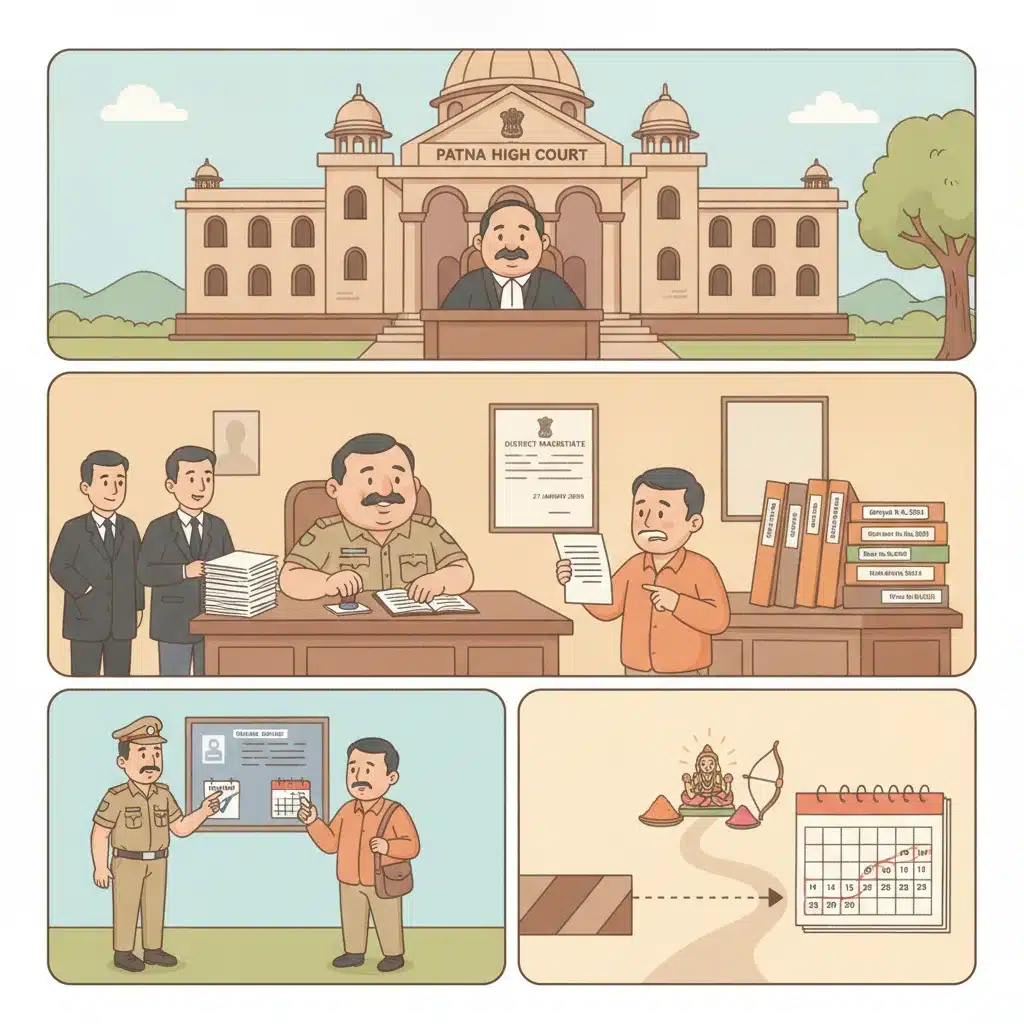
The case arose from an order dated 20 March 2026 passed by the District Magistrate, Nalanda in BCCA Case No. 06/2026 under the Bihar Control of Crimes Act, 2024 (BCC Act).
On 27 January 2026, the District Magistrate issued a notice to the petitioner. He was asked to appear on 6 February 2026 and show cause why an order under Section 3(3) of the BCC Act should not be passed against him.
The notice stated that six criminal cases and one Sanha were pending against him, and that his free movement could lead to breach of law and order. In response, the petitioner appeared before the District Magistrate on 6 February 2026 and filed a show-cause reply.
Despite this, on 20 March 2026, the District Magistrate declared the petitioner to be an “anti-social element” and directed him to mark attendance at Silao Police Station every Monday and Friday for one month. He was also told to inform the station whenever he went outside its jurisdiction.
The externment-like order was based on the following cases: two prohibition cases, one theft case, one case under Sections 406/420/379/34 IPC, one case under Section 7 of the Essential Commodities Act, one under Section 11 of the Gambling Act and Giriyak P.S. Sanha No. 805/2026 dated 19 January 2026.
The petitioner, who resides within the jurisdiction of Giriyak Police Station, challenged this order before the Patna High Court in Criminal Writ Jurisdiction Case No. 1019 of 2026. He also complained that Silao Police Station is far from his village and that the order had caused him hardship and stigma.
What the Court Examined and Decided
The Division Bench of the Patna High Court, consisting of Hon’ble Mr. Justice Rajeev Ranjan Prasad and Hon’ble Mr. Justice Kumar Manish, heard the matter. The main challenge was to the District Magistrate’s order dated 20 March 2026 passed under Section 3(3) of the BCC Act.
On behalf of the petitioner, it was argued that:
- His reply dated 6 February 2026 to the show-cause notice was not considered.
- No criminal case had been registered against him after 2021, so the legal requirement of recent cases under the BCC Act was not satisfied.
- He had not been convicted in any of the pending cases.
- Being branded as an “anti-social element” without basis violated his fundamental rights.
- Requiring him to report at Silao Police Station, about 20 km away from his village under Giriyak P.S., caused unnecessary hardship.
The State, through learned counsel, defended the order. It was submitted that:
- The proceeding under Section 3 of the BCC Act was initiated on the proposal of the Superintendent of Police, Nalanda, based on a recommendation from the SDPO, Rajgir.
- The petitioner had criminal antecedents involving storage and transportation of illicit liquor, theft, forgery and other offences, and he was on bail in those cases.
- Due to apprehension of breach of peace and communal harmony on the eve of Holi and Ram Navami, Giriyak P.S. Sanha No. 805/2026 was registered on 19 January 2026.
- The petitioner’s conduct gave reasonable cause to believe that he could disturb law and order during upcoming festivals, making action under Section 3 necessary.
- The writ petition should not be entertained because the petitioner had an appellate remedy against the externment order and the one-month period had already expired.
The Court first considered whether the writ petition had become infructuous, since the externment period ended on 19 April 2026. The petition, however, had been filed on 3 April 2026 while the order was still in force.
The Bench held that it could not ignore an order which affected fundamental rights, merely because the period had run out. The Court emphasised that it is a constitutional court bound to protect citizens’ life and liberty under Article 21. Since the impugned order allegedly violated statutory safeguards and fundamental rights, the Court chose to examine its legality instead of relegating the petitioner to an appeal.
The Court then closely examined the BCC Act. It reproduced the full definition of “anti-social element” in Section 2(b), and the meanings of “commits an offence” in Section 2(f) and “abet” in Section 2(g).
From Section 2(f), the Court highlighted a key requirement: to say that a person “commits an offence” as an anti-social element under this Act, there must be at least two cases in which police reports have been filed in court within the 24 months immediately before the start of action under the Act.
This meant that for a person to be declared an anti-social element based on past cases, there must be at least two recent cases within the last two years before the notice. In the petitioner’s case, all the cited cases were between 2016 and 2021. The last one was in 2021. No case after 2021 was shown.
Thus, on the notice date 27 January 2026, the legal condition in Section 2(f) was not satisfied. The State also did not claim that police reports had been filed in at least two cases within the 24 months just before the notice.
The Court noted that Section 3(3) of the BCC Act allows the District Magistrate to pass an externment-type order only if he is satisfied that:
- The person is an “anti-social element” under Section 2(b), and
- His movements or acts cause or may cause alarm, danger or harm to persons or property, and such activities cannot be prevented without removing him or restricting his movements.
Therefore, the first question was whether the petitioner legally fitted the definition of an “anti-social element”. The Court held that he did not, because there were no two or more qualifying cases within the preceding 24 months.
The Court also looked at the District Magistrate’s reasons. The order stated that the petitioner was charge-sheeted in many cases and on bail, and that if allowed to move freely, he might disturb law and order, public peace and social tranquillity during festivals.
However, the Court observed that:
- There was no allegation that the petitioner had ever breached bail conditions.
- No application for cancellation of bail had been filed.
- The order did not show that the petitioner had actually disturbed public order or social tranquillity at any time.
- No recent incident was mentioned in the order.
The only fresh material referred to was Giriyak P.S. Sanha No. 805/2026 dated 19 January 2026. But the Court found that the notice and the order did not disclose any facts or incidents behind this Sanha. On what basis the Sanha was recorded, or how it could show the petitioner as a threat to public order, was left unexplained. The Court called it a “mystery”.
To understand the meaning of “public order” and the proper use of such preventive measures, the Court relied on the Supreme Court’s decision in Arjun v. State of Maharashtra, 2024 INSC 968. That judgment in turn had referred to classic Supreme Court rulings such as Ram Manohar Lohia v. State of Bihar, Ameena Begum v. State of Telangana, Arun Ghosh v. State of West Bengal and Kuso Sah v. State of Bihar.
From these cases, the Court summarised the law: every breach of peace or ordinary crime does not amount to disturbance of “public order”. Preventive action like externment or detention is a harsh, exceptional power and can be used only when acts affect the community at large and disturb the even tempo of life, not for stray or unorganised crimes.
The Court also referred to Shiv Prasad Bhatnagar v. State of M.P., (1981) 2 SCC 456, to underline that grounds for preventive action must be proximate, not stale. Old incidents cannot be used without live, immediate threat.
In the present case, the earlier criminal cases were several years old and separated by long intervals. There was no evidence of continuing criminal activity or recent offences. Hence, using them to brand the petitioner an “anti-social element” was legally unsustainable.
The Bench stressed that the legality of an administrative order must be tested on the reasons recorded in the order itself. It cannot be improved or supplemented later through affidavits. Since the impugned order did not deal with the petitioner’s explanations and ignored crucial statutory conditions, it showed non-application of mind.
The Court also examined whether requiring the petitioner to report at Silao Police Station was proper. Referring to Rule 6 of the Bihar Control of Crime Rules, 1978 and an earlier decision of the Patna High Court in Rakesh Kumar Yadav @ Rakesh Yadav v. State of Bihar, 2025 SCC OnLine Pat 3563, the Court noted that a person should ordinarily be required to notify his movements or report to the officer-in-charge of the police station nearest to his residence, and not more than once a day.
Here, the petitioner was made to report twice a week at Silao Police Station, not at his local Giriyak P.S., without any stated reason. This was found to be another illegality.
The Court was critical of the manner in which the police machinery acted. The entire chain of reports—from the SHO, Giriyak P.S., to the Circle Inspector, to the SDPO, Rajgir, to the Superintendent of Police, and finally to the District Magistrate—was completed on a single day, 19 January 2026. Each officer merely repeated the previous officer’s vague allegations without independent verification or material. No witness statement or specific incident was recorded.
The Bench remarked that such “act in haste” smacked of malafide in law and showed total lack of application of mind. Allowing such use of the BCC Act based on “a mere desire or wish of a police officer” could destroy a citizen’s reputation and liberty.
In his concurring opinion, Hon’ble Mr. Justice Rajeev Ranjan Prasad further stressed that declaring a person an anti-social element carries a heavy social stigma and directly impacts his right to reputation, which is part of life and personal liberty under Article 21. He cited Supreme Court decisions in Subramanian Swamy v. Union of India, State of Bihar v. Lal Krishna Advani and Port of Bombay v. Dilipkumar Nadkarni to emphasise that reputation is constitutionally protected and that drastic powers must be exercised with great care and credible material.
In the end, the Court held that the basic conditions for invoking Section 3 of the BCC Act were absent. Therefore, the externment order was a nullity in law, violated Article 21, and could not be saved by the plea of alternative remedy or the fact that its period had expired.
The Bench set aside the order dated 20 March 2026, expunged the aspersions cast on the petitioner, and allowed the writ petition.
Recognising that the petitioner’s liberty had been curtailed illegally for a month and that he suffered continuous hardship, the Court awarded him compensation of Rs. 1,00,000 and litigation costs of Rs. 10,000, payable by the State Government within one month of production of the judgment.
Importantly, following its earlier decision in K.K. Pathak @ Keshav Kumar Pathak v. Ravi Shankar Prasad & Others, (2019) 1 PLJR 1051 (which had been upheld by the Supreme Court), the Court directed the State Government to recover this compensation and costs from the erring officials within six months in accordance with law and to report compliance to the Court.
Why This Judgment Matters
This judgment is significant for ordinary citizens in Bihar, particularly those who may face police action under the Bihar Control of Crimes Act, 2024.
First, the Patna High Court has made clear that a person cannot be casually labelled an “anti-social element” on the basis of old or stray criminal cases. For action under the BCC Act, there must be at least two qualifying cases with police reports filed within the last 24 months before initiation of action. Without this, any externment order is illegal.
Second, the Court has stressed that preventive measures like externment, which limit a person’s movement and damage his reputation, can only be used when there is credible evidence of a real threat to public order. Mere suspicion, vague Sanha entries, or unverified police reports are not enough.
Third, the judgment protects the right to reputation and dignity. Once a person is officially called an “anti-social element”, the stigma can follow him for life. The Court has reminded authorities that such labels must pass strict legal tests under Article 21 of the Constitution.
Fourth, the judgment shows that even if the period of an externment order is over, courts can still examine its legality and award compensation for wrongful curtailment of liberty.
Finally, by directing the State to recover compensation from the officials whose illegal actions caused this violation, the Court has sent a strong message: misuse of preventive laws will have personal consequences for responsible officers. This is likely to deter casual or politically motivated use of the BCC Act.
Legal Issues and Answers
- Issue: Could the District Magistrate lawfully declare the petitioner an “anti-social element” and pass an externment-type order under Section 3 of the BCC Act, 2024 based on cases registered between 2016 and 2021 and a vague Sanha of 2026?
Answer: No. The Court held that Section 2(f) of the BCC Act requires at least two qualifying cases within the 24 months immediately preceding initiation of action. No such recent cases existed, and there was no credible material showing disturbance of public order. Hence the legal preconditions for Section 3 were not met and the order was a nullity. - Issue: Did the availability of an appeal or the expiry of the one-month externment period bar the High Court from entertaining the writ petition?
Answer: No. Since the impugned order was passed in violation of statutory safeguards and infringed fundamental rights under Article 21, the High Court, as a constitutional court, was obliged to examine its legality and grant relief, including compensation, despite the existence of an alternative remedy or expiry of the order. - Issue: Was directing the petitioner to mark attendance at Silao Police Station rather than his local Giriyak P.S. legally valid?
Answer: No. Referring to Rule 6 of the Bihar Control of Crime Rules, 1978 and earlier precedent, the Court held that ordinarily a person should report to the police station nearest his residence. Asking him to go elsewhere without justification was another illegality contributing to the finding that the order was arbitrary.
Cases Cited by the Court
- Arjun v. State of Maharashtra and Others, 2024 INSC 968
- Ram Manohar Lohia v. State of Bihar and Another, (1966) 1 SCR 709
- Ameena Begum v. State of Telangana and Others, (2023) 9 SCC 587
- Arun Ghosh v. State of West Bengal, (1970) 1 SCC 98 : 1970 SCC (Cri) 67
- Kuso Sah v. State of Bihar, (1974) 1 SCC 185 : 1974 SCC (Cri) 84
- Shiv Prasad Bhatnagar v. State of M.P. and Another, (1981) 2 SCC 456
- Rakesh Kumar Yadav @ Rakesh Yadav v. State of Bihar and Others, 2025 SCC OnLine Pat 3563
- K.K. Pathak @ Keshav Kumar Pathak v. Ravi Shankar Prasad & Other, (2019) 1 PLJR 1051
- Subramanian Swamy v. Union of India, (2016) 7 SCC 221
- State of Bihar v. Lal Krishna Advani, (2003) 8 SCC 361
- Port of Bombay v. Dilipkumar Raghavendranath Nadkarni, (1983) 1 SCC 124
- Plato Films Ltd. v. Speidel, 1961 AC 1090 : (1961) 2 WLR 470 : (1961) 1 All ER 876 (quoted)
Case Details
Case Number: Criminal Writ Jurisdiction Case No. 1019 of 2026
Case Title: Rajesh Kumar v. The State of Bihar & Others
Citation: 2026 (4) PLJR 564
Court: High Court of Judicature at Patna
Coram: Hon’ble Mr. Justice Rajeev Ranjan Prasad; Hon’ble Mr. Justice Kumar Manish
Date of Judgment: 17 July 2026
Advocates:
- For the petitioner: Mr. Priya Ranjan, Advocate
- For the respondents/State: Mr. Kinkar Kumar, SC-9; Ms. Sushmita Sharma, AC to SC-9; Ms. Vagisha Pragya Vacaknavi, AC to SC-9
Nature of the Case: Criminal writ petition challenging an externment-type order and declaration as “anti-social element” under Section 3 of the Bihar Control of Crimes Act, 2024, passed by the District Magistrate, Nalanda.
Impugned Order: Order dated 20 March 2026 in BCCA Case No. 06/2026, passed by the District Magistrate, Nalanda.
Result: Writ petition allowed; impugned order set aside; aspersions expunged; compensation of Rs. 1,00,000 and costs of Rs. 10,000 awarded; State directed to recover these amounts from erring officials.
Link to Judgment: https://patnahighcourt.gov.in/viewjudgment/MTYjMTAxOSMyMDI2IzEjTg==-TY7Sp0Vi1x0=
If you found this explanation helpful and wish to stay informed about
how legal developments may affect your rights in Bihar,
you may consider following Samvida Law Associates for more updates.




