

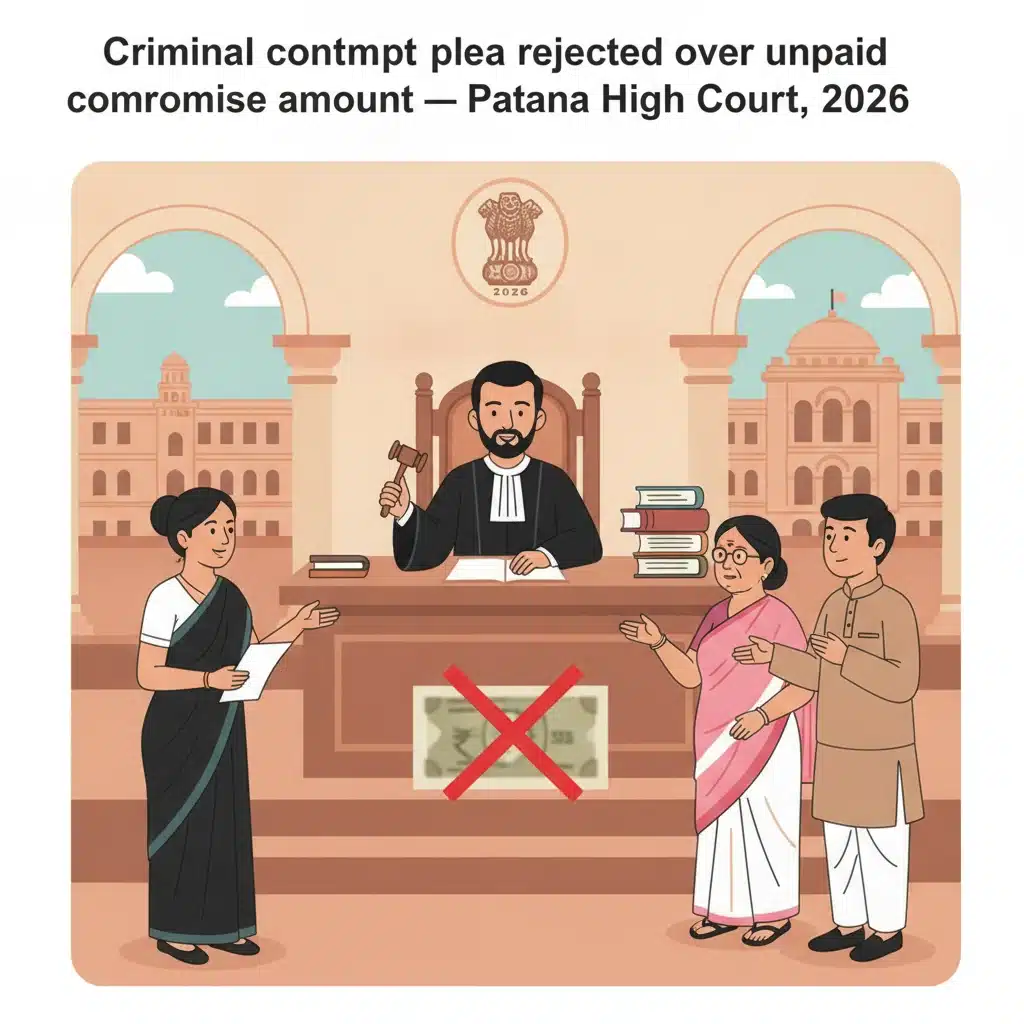
She asked the Court to start criminal contempt proceedings against the opposite parties for non‑payment of Rs. 2 lakhs.
The Court held that this situation, if anything, amounts to civil contempt, not criminal contempt, and that the petition filed was not maintainable.
The petitioner has been allowed to withdraw this case and is free to file a proper civil contempt petition.
Case Background
The dispute traces back to Criminal Revision No. 521 of 2018 before the Patna High Court. In that case, there was a compromise between the petitioner and opposite parties nos. 2 to 4, who are private respondents.
On 05.09.2019, a Coordinate Bench of the Patna High Court disposed of the criminal revision in terms of this compromise. The Bench directed opposite parties nos. 2 to 4 to pay Rs. 2 lakhs to the petitioner, either in one go or in instalments, but in any case by 30.04.2020. They were also required to file an affidavit by 10.05.2020, showing proof of this payment.
Other connected directions were also issued. Till then, the husband was not to press his divorce case and the petitioner was not to press her maintenance case. After full payment of Rs. 2 lakhs by 30.04.2020, the petitioner was to file a petition in the divorce case stating that she would not oppose the divorce. The trial court was to pass appropriate orders within one month of such compromise petition. The petitioner was also to withdraw her maintenance case within one month of receiving Rs. 2 lakhs.
According to the present petitioner, opposite parties nos. 2 to 4 did not pay the Rs. 2 lakhs by the deadline. Feeling that the High Court’s compromise order had been disobeyed, she approached the Patna High Court again.
In 2023 she filed Original Criminal Miscellaneous No. 4 of 2023, seeking initiation of contempt proceedings against the private opposite parties for alleged willful and deliberate disobedience of the 05.09.2019 order. The matter came before Hon’ble Mr. Justice Dr. Anshuman.
What the Court Examined and Decided
The first issue arose even before the merits: the office noted defects in the filing. The Stamp Reporter recorded that the learned Advocate General had refused to grant consent for filing this criminal contempt petition. There was also an objection that the provision of law mentioned on the first page needed verification and correction.
Counsel for the petitioner argued that, because the original order had been passed in a criminal revision, a criminal contempt petition was the correct remedy. On that basis, they had filed this Original Criminal Miscellaneous case, treating it as criminal contempt.
On the question of the Advocate General’s refusal, petitioner’s counsel clearly stated that he had nothing to say against the opinion given by the learned Advocate General. He only pressed that the petition was filed due to disobedience of an order passed by the Court in its criminal jurisdiction.
The Court identified two important legal questions that had to be answered:
First, where an order passed in criminal jurisdiction is not complied with, should the aggrieved person file a civil contempt petition or a criminal contempt petition?
Second, once the Advocate General, acting under Section 15(1)(b) of the Contempt of Courts Act, 1971, has opined that no case of criminal contempt is made out, can the High Court still take cognizance of criminal contempt on a motion by a private person?
To address the first question, the Court reproduced and analysed the statutory definitions of “civil contempt” and “criminal contempt” under Sections 2(b) and 2(c) of the Contempt of Courts Act, 1971.
Section 2(b) defines civil contempt as willful disobedience to any judgment, decree, direction, order, writ or other process of a Court, or willful breach of an undertaking given to a Court. The Court listed out the several situations covered—ranging from disobedience to judgments and decrees to breach of undertakings.
Section 2(c) defines criminal contempt. It covers publication or acts that scandalise or tend to scandalise the Court, lower its authority, prejudice or interfere with judicial proceedings, or obstruct the administration of justice in any other manner. The Court carefully broke down the ingredients into several possible ways criminal contempt can occur.
Against this legal background, the Court examined what had actually happened in the petitioner’s case. In the criminal revision, the opposite parties had undertaken to pay Rs. 2 lakhs by 30.04.2020 and to bring proof of payment on record through an interlocutory application. The order also linked this payment to the petitioner’s conduct in the divorce and maintenance cases.
It was not disputed before the Court that this amount of Rs. 2 lakhs had not been paid. Because of this non‑payment, the petitioner had filed the present Original Criminal Miscellaneous application treating it as a criminal contempt proceeding.
The Court then compared these facts with the definition of criminal contempt. It found that the alleged conduct of the opposite parties—failure to pay compromise money—did not “scandalise” the Court, did not lower its authority, and did not interfere with the due course of any judicial proceeding or the administration of justice in the sense required by Section 2(c).
On the other hand, the Court observed that the case might fall within the scope of civil contempt. It could be seen as willful disobedience of an order or willful breach of the undertaking given at the time of compromise in the criminal revision. Thus, even if the original order was passed in a criminal case, the nature of contempt arising from non‑payment was civil in character, not criminal.
The Court emphasised that disobedience of a court order can arise in both criminal and civil proceedings. However, whether the contempt is “civil” or “criminal” depends not on the type of case where the order was passed, but on the nature of the act complained of and the statutory definitions.
Consequently, the Court refused to accept the petitioner’s argument that merely because the disobeyed order was passed in exercise of criminal jurisdiction, the contempt must automatically be treated as criminal contempt.
Next, the Court addressed the second question about the role of the Advocate General’s consent under Section 15 of the Contempt of Courts Act, 1971. It reproduced Section 15 in detail. This provision governs how the Supreme Court and High Courts can take cognizance of criminal contempt in cases other than those covered by Section 14.
The law allows the Supreme Court or High Court to act either on its own motion (suo motu) or on a motion made by the Advocate General, or by any other person with the written consent of the Advocate General. For criminal contempt of a subordinate court, the High Court can also act on a reference by that subordinate court.
In this case, the petitioner had filed the Original Criminal Miscellaneous application as “any other person” under Section 15(1)(b). Therefore, written consent from the Advocate General was mandatory. However, the Advocate General, after examining the petition, had given a written opinion that no case of criminal contempt was made out and refused consent. This opinion was quoted by the Court.
The Court then explained that it is still always open to the Supreme Court or the High Court to act on its own motion in criminal contempt matters. If the Court decides to ignore the Advocate General’s negative opinion and still proceed, that would effectively mean the Court is treating the matter as one taken up on its own motion. Thus, the answer to the second question was that the Court can proceed suo motu despite the Advocate General’s view, but that would be a different mode of taking cognizance.
To clarify the procedural confusion further, the Court referred to its earlier decision in Anand Kumar Singh v. The State of Bihar & Ors., decided on 05.04.2023 in MJC No. 26 of 2023 (arising out of Cr.WJC No. 723 of 2022). In that case, the Stamp Reporter had suggested that the matter should be filed as an Original Criminal Miscellaneous case under the Patna High Court Rules. The Coordinate Bench had rejected that suggestion, holding that when the grievance relates to willful disobedience of a High Court order, the Court, as a Court of Record under Article 215 of the Constitution, is empowered to initiate contempt proceedings and that such matters need not be filed as criminal contempt under Section 15 in every situation.
Building on that reasoning, the present Court held that it is not necessary to file an Original Criminal Miscellaneous case merely because the disobeyed order came from a criminal writ jurisdiction. Instead, the correct approach is to first decide whether the alleged conduct amounts to civil contempt or criminal contempt by applying Sections 2(b) and 2(c).
Given this, petitioner’s counsel requested permission to convert the present Original Criminal Miscellaneous petition into an MJC petition and to treat it as such, which is the usual format for civil contempt applications.
The Court declined to order such conversion at this stage. It reasoned that converting the case might actually harm the petitioner. While sitting in Original Criminal Miscellaneous jurisdiction, the Court could not properly examine whether a future MJC petition would be maintainable or whether the pleadings in this case already contained all the ingredients necessary for civil contempt.
The Court also noted that counsel was unable to show that the present petition, as filed, contained all the necessary material to establish civil contempt. Therefore, instead of converting the case, the Court preferred to leave the question open and permit the petitioner to file a fresh, properly framed civil contempt petition, if she was so advised and if the ingredients of civil contempt were indeed available.
In the end, the Patna High Court held that the present Original Criminal Miscellaneous application seeking criminal contempt was not maintainable. It allowed the petitioner to withdraw the petition, with liberty to file a civil contempt petition.
The Court also took a fair view on limitation. It directed that the period during which this Original Criminal Miscellaneous case remained pending since 2023 would not be counted for limitation purposes, if and when a fresh civil contempt petition is filed.
With these observations, the Court dismissed the Original Criminal Miscellaneous No. 4 of 2023 as not maintainable.
Why This Judgment Matters
This judgment is important for anyone who has obtained an order from the Patna High Court in a criminal case, especially orders based on compromise, and later faces non‑compliance.
It clarifies that if the problem is simple non‑obedience of a court direction—such as failure to pay agreed money—that situation normally falls under civil contempt, even if the order arose in a criminal proceeding. Labeling it “criminal contempt” will not make it so.
The judgment also explains the role of the Advocate General. A private person cannot directly set the criminal contempt process in motion without his written consent. If the Advocate General refuses consent, the High Court may still act on its own motion, but it is not bound to do so.
For litigants, the decision gives a practical route: if an order is disobeyed, they should focus first on whether the conduct meets the ingredients of civil contempt and file an MJC or appropriate civil contempt proceeding, rather than rushing into criminal contempt.
By excluding the pendency period from limitation, the Court also protects the petitioner from being penalised for choosing the wrong procedural path in good faith.
Legal Issues and Answers
- Issue: If an order passed in criminal jurisdiction is not followed, should the complainant file a civil contempt case or a criminal contempt case?
Answer: Non‑compliance with such an order, like failure to pay compromise money, is a matter of civil contempt if it amounts to willful disobedience of a court order or breach of an undertaking. It does not automatically become criminal contempt merely because the original case was criminal. - Issue: Can the Patna High Court take cognizance of criminal contempt when the Advocate General has refused written consent under Section 15(1)(b) of the Contempt of Courts Act, 1971?
Answer: A private person’s motion for criminal contempt requires the Advocate General’s written consent. The Court may still proceed on its own motion (suo motu) under Section 15(1), but that is treated as the Court acting on its own, not on the private person’s motion. - Issue: Was the present Original Criminal Miscellaneous petition for criminal contempt maintainable on the facts of this case?
Answer: No. The alleged conduct did not fit within the definition of criminal contempt in Section 2(c), and the petition lacked the Advocate General’s consent. The Court dismissed it as not maintainable, leaving the petitioner free to pursue civil contempt if advised.
Cases Cited by the Court
- Anand Kumar Singh v. The State of Bihar & Ors., order dated 05.04.2023 in MJC No. 26 of 2023 arising out of Cr.WJC No. 723 of 2022.
Case Details
Case Number: Original Criminal Miscellaneous No. 4 of 2023, arising out of PS Case No. 10 of 2012, Mahila PS, District Buxar.
Case Title: Sakina Begum v. The State of Bihar & Ors.
Coram: Hon’ble Mr. Justice Dr. Anshuman.
Citation: 2026 (4) PLJR 387
Advocates: Mr. Bachan Jee Ojha, Advocate, for the petitioner; Mr. Jagdhar Prasad, APP, for the State.
Nature of the Case: Original Criminal Miscellaneous petition seeking initiation of criminal contempt proceedings; ultimately dismissed as not maintainable, with liberty to file civil contempt.
Link: https://patnahighcourt.gov.in/viewjudgment/MjMjNCMyMDIzIzEjTg==-tbtFggIltsc=
If you found this explanation helpful and wish to stay informed about
how legal developments may affect your rights in Bihar,
you may consider following Samvida Law Associates for more updates.




