

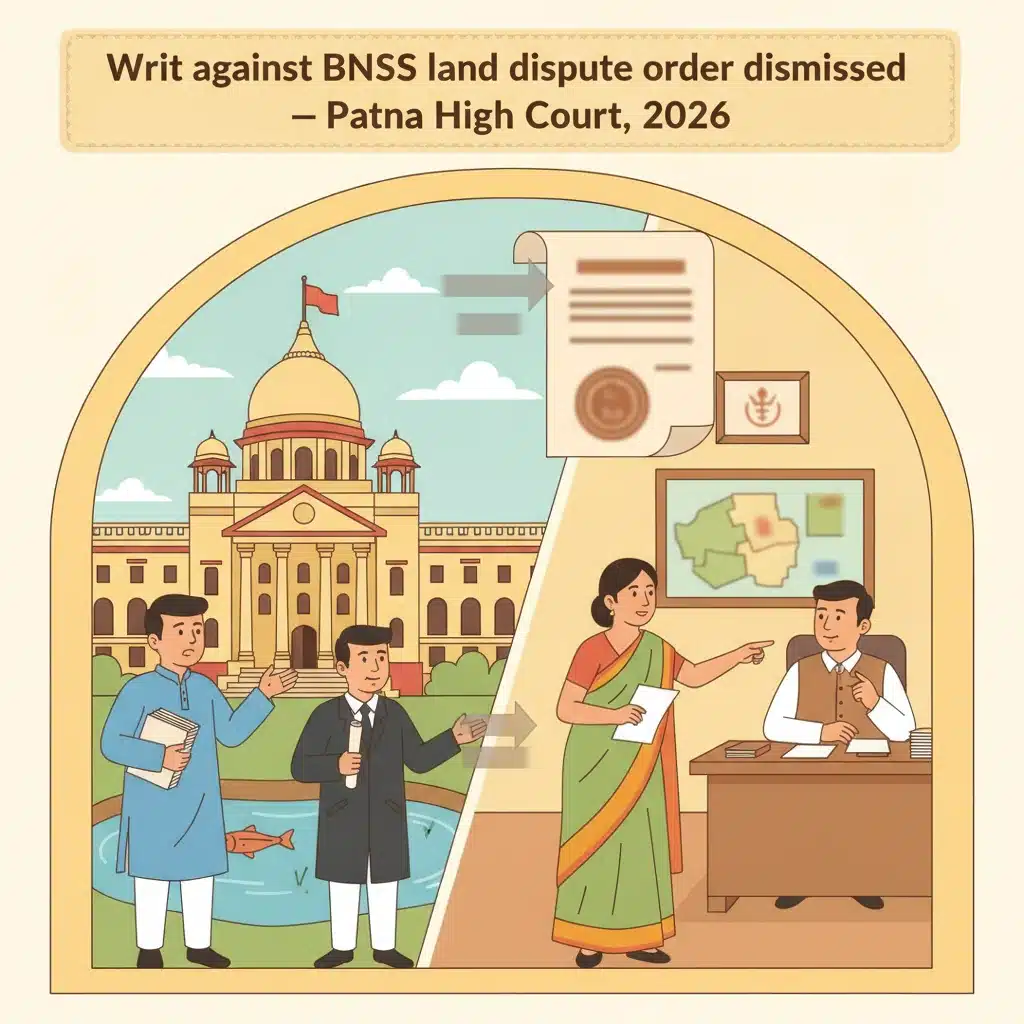
Case Background
The case arose from a dispute over 4.4 acres of land being used as a fishery in Aurangabad district, Bihar. The petitioner claimed to have taken this land on lease for 20 years from one Ranjeet Kumar Singh. He stated that he had taken a loan, dug a pond on the land and was running a fishing business, which was his livelihood.
According to the petitioner, he entered into the lease after confirming that a partition by metes and bounds had taken place between the co-sharers more than 50 years earlier. He claimed that, since then, there had been no dispute over the land.
However, respondent no. 6, one of the co-sharers, approached the Sub-Divisional Magistrate (SDM), Daudnagar, by filing a proceeding under Section 163 of the Bharatiya Nagarik Suraksha Sanhita (BNSS). This led to Criminal Case No. 153 of 2025 before the SDM.
On 18.07.2025, the SDM, Daudnagar, passed a prohibitory order under Section 163 BNSS. By this order, the SDM restrained both sides from going to the land in question, in view of apprehension of breach of peace.
The petitioner appeared before the SDM, placed his version of events and filed supporting documents. Despite this, the SDM recorded that there was a dispute over right, title and possession between the parties and that there was likelihood of breach of peace. The SDM further recorded that proper evidence was required for adjudication, which could not be done within the short span permitted under Section 163 BNSS.
On this basis, by order dated 10.09.2025, the SDM converted the proceeding from Section 163 BNSS to Section 164 BNSS, and fixed a further date, but the Section 164 proceeding remained pending.
Later, respondent no. 6 again moved the SDM for initiation of a fresh proceeding under Section 163 BNSS regarding the same land. The SDM registered Case No. 263 of 2025. In this second proceeding, the Station House Officer, Uphara, reported that another report was being sent for initiation of a proceeding under Section 126 BNSS and that in the earlier Section 163 BNSS case both parties had already been restrained regarding the disputed land.
Feeling aggrieved, the petitioner filed the present Criminal Writ Jurisdiction Case No. 333 of 2026 before the Patna High Court. He challenged the SDM’s order dated 10.09.2025 converting the proceedings, questioned the alleged “covert conversion” from Section 163 to Section 164 BNSS, and also complained that he continued to be prevented from entering the fishery land, thereby harming his livelihood.
What the Court Examined and Decided
The petitioner asked the Patna High Court for several reliefs. He sought quashing of the SDM’s order dated 10.09.2025 in Case No. 153 of 2025 under Section 163 BNSS, along with all consequential orders, including the conversion to Section 164 BNSS. He also sought a declaration that this order was non est in law, alleging non-application of mind and “procedural fraud” as it was passed prior to and independent of an investigation report dated 09.12.2025.
He further prayed for a writ of mandamus directing the respondents to grant compensation for alleged illegal deprivation of his fishery business and livelihood, which he claimed violated Articles 14, 19(1)(g) and 21 of the Constitution of India.
The petitioner also asked the Court to declare the conversion from Section 163 BNSS to Section 164 BNSS as illegal, null and void because, according to him, it was done without notice and opportunity of hearing. He requested restoration of status quo ante by removal of restraints on his 4.4 acres of fishery land and permission to continue his occupation without hindrance.
Before the High Court, the petitioner’s counsel argued that the lease in favour of the petitioner was from Ranjeet Kumar Singh alone, that the land specifically belonged to Ranjeet Kumar Singh, and that other co-sharers had no share. He claimed that a partition had taken place more than 50 years earlier and that there had been no dispute since then.
Counsel submitted that despite recording the petitioner’s submissions, the SDM wrongly held that there was a dispute over right, title and possession and that there was likelihood of breach of peace, and then converted the case to Section 164 BNSS. It was argued that this conversion order violated the petitioner’s right to livelihood because the fish in the pond would die if not attended. Counsel urged that under Article 226 of the Constitution, the High Court should intervene. He relied on the Supreme Court decision in Gulam Abbas & Ors vs. State of U.P., (1982) 1 SCC 71, specifically paragraphs 23 and 24, to support the contention that the High Court can step in where orders impact civil rights and public peace.
The petitioner also complained that, even after conversion to Section 164 BNSS, he was still being prevented from entering the land using the earlier Section 163 order dated 18.07.2025. He pointed out that respondent no. 6 had again filed a fresh Section 163 BNSS application leading to Case No. 263 of 2025, which he viewed as abuse of process when a Section 164 BNSS proceeding was already pending.
On examining the record, the Patna High Court noted that respondent no. 6 had claimed the land as ancestral property. She asserted that the mutation stood in the name of her grandfather. She also relied on certain observations made by the Deputy Collector Land Reforms (DCLR) in Land Dispute Resolution Case No. 51/2022-23, where the agreement entered by the petitioner was said to be illegal and ineffective and the petitioner had been restrained from going to the disputed land.
The Court thus found that there were competing claims. On one side, the petitioner was asserting rights through a lease from Ranjeet Kumar Singh. On the other side, respondent no. 6 was claiming ancestral rights and earlier administrative findings against the petitioner’s lease.
In this background, the SDM had converted the Section 163 proceeding into one under Section 164 BNSS. The High Court characterised the SDM’s order dated 10.09.2025 as a “revisable order.” It held that such an order should be challenged before the revisional court rather than directly before the High Court in its writ jurisdiction.
To support this conclusion, the Court referred to Section 397 of the Code of Criminal Procedure (CrPC) and the corresponding Section 438 BNSS, which deal with “calling for records to exercise powers of revision.” The provision allows the High Court or Sessions Judge to call for and examine the record of any proceeding before an inferior criminal court to check the correctness, legality or propriety of any finding, sentence or order and the regularity of proceedings.
The Court read Section 397 CrPC/438 BNSS to emphasise that all Magistrates, whether Executive or Judicial and whether exercising original or appellate jurisdiction, are inferior to the Sessions Judge for the purpose of revision. It also noted that the power of revision cannot be exercised over purely interlocutory orders.
The Patna High Court then observed that the SDM’s order dated 10.09.2025, which converted the proceeding from Section 163 BNSS to Section 164 BNSS, was a final order on that aspect and that no appeal lay against it. Therefore, the proper remedy was to file a criminal revision in terms of Section 397 CrPC/438 BNSS. Because this alternative and equally efficacious remedy existed, the High Court held that the writ petition under Article 226 of the Constitution was not maintainable.
On the petitioner’s grievance that he was still under restraint from entering the land due to the prohibitory order dated 18.07.2025 in Case No. 153 of 2025, the Court gave an important clarification. It noted that, under Section 163 BNSS, an order passed under that section cannot remain in force for more than two months from the date of making. Therefore, by operation of law, the prohibitory order dated 18.07.2025 had already lapsed. As a result, as on the date of hearing, there was no subsisting prohibitory order against the petitioner under Section 163 BNSS.
With this observation, the High Court disposed of the writ petition. At the same time, it directed the SDM to take note that, for the same land, an earlier Section 163 BNSS proceeding had already been converted into a Section 164 BNSS case by order dated 10.09.2025, with the next date fixed as 30.12.2025, but that the Section 164 proceeding had not been concluded.
The Court asked the SDM to take steps for disposal of the pending Section 164 BNSS proceeding. It also recorded the submission of State counsel that, in case of any future dispute, any party was free to approach the administration for maintenance of peace.
Finally, the Patna High Court clarified that it had not passed any order preventing any party from approaching the authorities in case of breach of peace. It simply clarified that the order dated 18.07.2025 under Section 163 BNSS had lost effect under Section 163(4) BNSS, and indicated that the parties were at liberty to raise all issues before the SDM to establish their respective cases.
Why This Judgment Matters
This judgment is important for people involved in local land disputes where magistrate proceedings under BNSS are started. It shows that when an order of a Sub-Divisional Magistrate can be challenged by filing a revision under criminal procedure, the High Court is unlikely to entertain a writ petition directly.
The decision also clarifies that prohibitory orders under Section 163 BNSS are temporary. They automatically lapse after two months unless continued under law. Parties cannot indefinitely use an old Section 163 order to keep someone out of land.
For small farmers, tenants and people running fisheries or other small businesses, this judgment underlines two things. First, if they are unhappy with an SDM’s order in such proceedings, they must promptly use the revision remedy before the Sessions Judge or High Court. Second, even if there was a previous prohibitory order, they should check whether it is still legally in force, because the law itself fixes a time limit.
The judgment also nudges local authorities like the SDM to promptly conclude pending proceedings under Section 164 BNSS, instead of letting them linger while fresh applications on the same land are filed again and again.
Legal Issues and Answers
- Issue: Can the Patna High Court, in writ jurisdiction, quash the SDM’s order converting a proceeding from Section 163 BNSS to Section 164 BNSS when a statutory revision remedy exists?
Answer: No. The Court held that the conversion order dated 10.09.2025 is a revisable order under Section 397 CrPC/438 BNSS, and since an alternative and equally efficacious remedy by way of revision is available, the writ petition cannot be entertained. - Issue: Does the prohibitory order dated 18.07.2025 under Section 163 BNSS still restrain the petitioner from going to the land?
Answer: No. The Court held that an order under Section 163 BNSS cannot remain in force for more than two months from its date, so the order dated 18.07.2025 has already lost effect and there is no current prohibitory order against the petitioner. - Issue: Has the High Court restricted the parties from approaching authorities in case of future breach of peace?
Answer: No. The Court expressly stated that it has not prevented any party from approaching the administration in case of any future dispute or breach of peace.
Cases Cited by the Court
- The petitioner relied on Gulam Abbas & Ors vs. State of U.P., (1982) 1 SCC 71, paragraphs 23 and 24. The Patna High Court’s reasoning in the present order, however, rests mainly on Section 397 CrPC/438 BNSS regarding revision.
Case Details
Case Number: Criminal Writ Jurisdiction Case No. 333 of 2026
Case Title: Arvind Singh vs. The State of Bihar & Ors
Court: High Court of Judicature at Patna
Coram: Hon’ble Mr. Justice Arun Kumar Jha
Date of Judgment: 19-06-2026
Citation: 2026 (5) PLJR 184
Advocates for Petitioner: Mr. Prince Kumar Mishra, Advocate; Mr. Ujjwal Kant Panday, Advocate; Mr. Utkarsh Pathak, Advocate
Advocates for Respondents (State): Mr. Subhash Pd. Singh, GA-3; Mrs. Kiran Kumari, AC to GA-3
Respondent Authorities: State of Bihar through Chief Secretary; Principal Secretary, Department of Revenue and Land Reforms; District Magistrate, Aurangabad; Sub-Divisional Magistrate, Daudnagar; Circle Officer, Goh Circle; private respondents including respondent no. 6 and respondent no. 7
Nature of Case: Criminal writ petition challenging SDM’s order under Sections 163 and 164 BNSS in a land and fishery-related dispute
Final Outcome: Writ petition disposed of as not maintainable in view of alternative remedy of revision; Court clarified that the earlier Section 163 BNSS prohibitory order has lapsed and directed SDM to proceed with disposal of the pending Section 164 BNSS case.
Link: To read the judgement, click here.
If you found this explanation helpful and wish to stay informed about
how legal developments may affect your rights in Bihar,
you may consider following Samvida Law Associates for more updates.




