

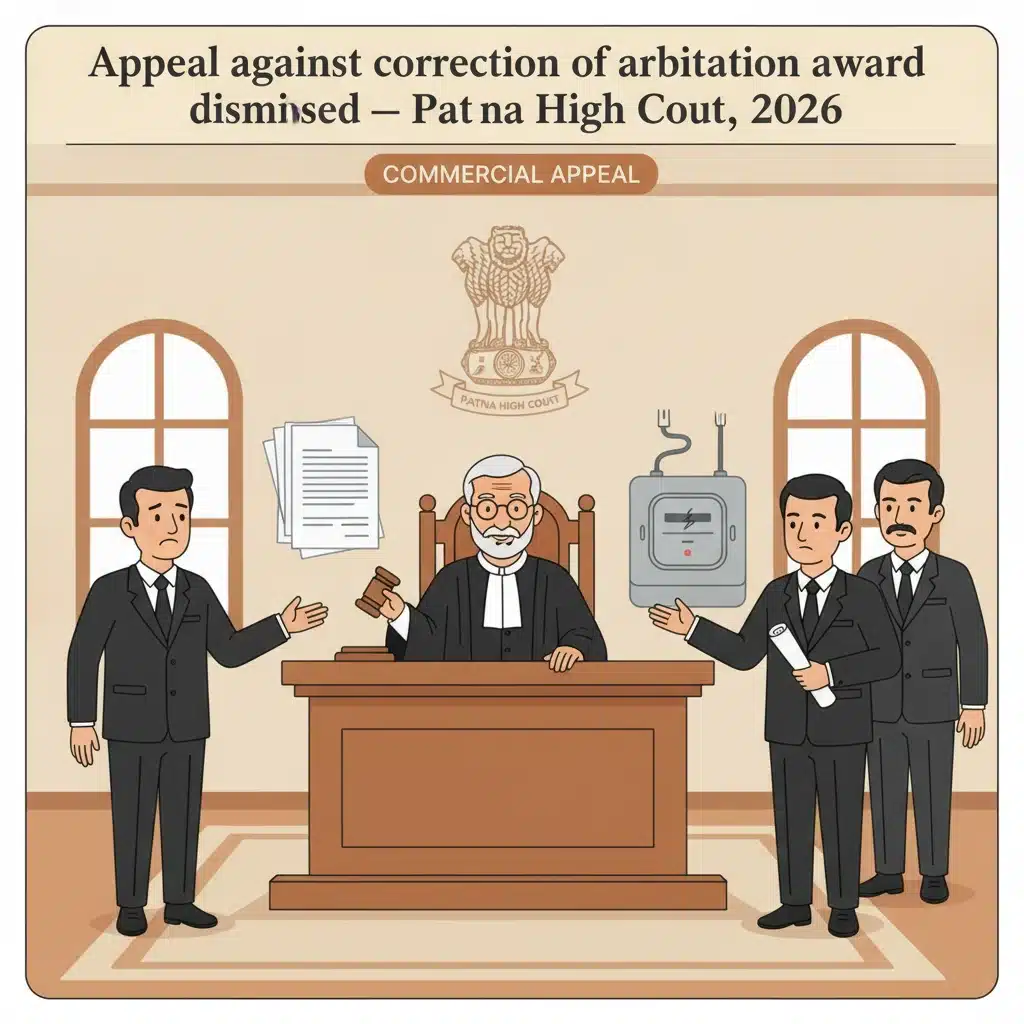
Case Background
The appellant is a public limited company engaged in producing iron and steel ingots, billets and rods in Muzaffarpur. To run its factory, it took an electricity connection from the then Bihar State Electricity Board with a contract demand of 1500 KVA, effective from 02.04.1990.
Officers of the electricity authorities later conducted a surprise inspection at the factory. According to them, various irregularities were noticed and there was alleged theft of electricity. Supply to the factory was immediately disconnected and a First Information Report (FIR) alleging theft of electricity was lodged. The company approached the Patna High Court in CWJC No. 6175 of 1995, mainly seeking restoration of its electricity connection.
By order dated 22.01.1996 in CWJC No. 6175 of 1995, the High Court remanded the matter back to the Board to look into billing and restoration of supply. On 28.02.1996, the Court further directed the Chairman of the Board to take a decision within a fixed time. The Chairman then passed an order on 15.05.1996 after considering reports of two experts, and a supplementary energy bill dated 13.09.1995 for Rs. 39,41,61,040/- was raised.
The Board still refused to restore electricity, so the company filed another writ petition, CWJC No. 5812 of 1996, challenging the Chairman’s order dated 15.05.1996.
In this third round of litigation, the High Court, with consent of both sides, referred the subject matter of CWJC No. 5812 of 1996 to an Arbitral Tribunal. The sole arbitrator was a former Judge of the Patna High Court, assisted by two technical experts: one nominated by the company and one by the Board. The parties agreed that the Arbitration and Conciliation Act, 1996 would govern the proceedings.
The Arbitral Tribunal framed six issues, mainly about transformer capacity, whether excess load affected tariff calculation, which tariff clause applied, for what period the Board could raise bills, and whether disconnection was justified. After considering the record and the two technical reports, the Tribunal passed an award on 04.10.1998 (referred to as the original award).
In the concluding part of this original award, the Tribunal, among other directions, held that:
- 1500 KVA would be chargeable from 02.04.1990 to 31.07.1995,
- 2500 KVA would be chargeable from 01.08.1995 to 03.08.1995,
- additional demand of 2676 KVA would be chargeable for 177 days,
- additional demand of 1676 KVA would be chargeable for the last three days,
- energy would be calculated as per clause 15.2(b)(ii) of the tariff on special terms, and
- the Board could charge any other amount unpaid as per the applicable tariff.
The company accepted this original award and did not file any challenge under Section 34 of the Act of 1996.
What the Court Examined and Decided
Though the company accepted the original award, the electricity authorities were not satisfied with one part of it. On 05.11.1998, they filed an application before the arbitrator under Section 33 of the Arbitration and Conciliation Act, 1996. They claimed that the last operative direction of the award did not match the earlier findings and had led to a computation error.
In their application (Annexure P-2), the Board pointed out that on pages 29 and 30 of the award, the arbitrator had clearly held that clause 16.9 of the tariff applied. The arbitrator had accepted the report of the Board’s technical expert, Mr. B.P. Singha, who had calculated additional chargeable demand on the basis of total transformer capacity found by independent test laboratories (MIT and CRITL) after the raid.
According to the Board, the arbitrator had accepted that the term “Load (L)” of 86.9, used in clause 16.9, should be treated as the total transformer capacity tested and found, and that excess capacity amounted to theft of electricity. However, in the last portion of the award, on page 32, direction (i) instructed the Board to prepare a fresh bill for 177 days on the maximum transformer capacity of 2500 KVA and for three days on 3750 KVA.
The Board argued that this direction contradicted the clear findings at pages 29–30, where the arbitrator had accepted that tariff should be assessed on the total KVA of 6265 based on test reports, and the specific additional KVA figures (2676 KVA and 1676 KVA) derived by Mr. Singha. Because of this mismatch, the Board said an error in computation had arisen and needed correction or clarification under Section 33.
The company opposed the Section 33 application. It said the petition went beyond the narrow scope of Section 33(1), which, in its view, allowed only correction of clerical, typographical and simple computational errors, not substantive reinterpretation of an award. The company argued that there was no real contradiction in the award, that the arbitrator had already based his conclusions on the two experts’ reports, and that the original award was complete and binding.
The Arbitral Tribunal considered the rival submissions and, by additional award dated 01.12.1998 (Annexure P-4), allowed the Section 33 application. The Tribunal modified the direction given at page 32 of the original award. The arbitrator recorded that a mistake regarding figures had crept into the award at two places and was causing difficulty in preparing the bill.
In the additional award, the arbitrator clarified that the earlier direction at page 32 should be read as:
(1) The Board shall prepare a fresh bill for the period of 177 days upto 31.07.95 and 3 days from 1.8.95 on the basis of total KVAs, that is 6265, as given in the two test reports and accepted by me.
This modification aligned the operative direction with the earlier reasoning where the arbitrator had unequivocally accepted the test reports and Mr. Singha’s calculations based on total transformer capacity of 6265 KVA.
The company then challenged this additional award under Section 34 of the Act of 1996 before the Principal District Judge, Patna, acting as the Commercial Court. It argued that:
- Section 33 was limited to correction of minor clerical or typographical errors and did not allow such substantive modification,
- no ambiguity existed in the original award,
- the additional award was non-speaking and did not take technical experts’ assistance, and
- there was “patent illegality” in using Section 33 in this way.
The Commercial Court rejected these arguments and dismissed the Section 34 petition on 20.05.2025. It held that:
- the arbitrator had decided the dispute strictly on the basis of the agreement, tariff clauses and technical reports,
- the correction made through the additional award did not alter the substantive findings but only removed an apparent inconsistency,
- no ground under Section 34(2) or 34(2A) (such as patent illegality, perversity or violation of public policy) had been made out.
Against this order, the company filed the present Commercial Appeal No. 6 of 2025 before the Patna High Court. The challenge in the appeal was again focused on whether the Board’s Section 33 application was maintainable and whether the additional award went beyond the permitted scope of correction.
On behalf of the appellant, counsel argued that the Supreme Court has recognised the power of courts under Sections 34 and 37 to interfere with awards suffering from patent illegality and, in some cases, to modify severable parts of an award. Reliance was placed on the Supreme Court decision in Gayatri Balasamy vs. ISG Novasoft Technologies Limited, (2025) 7 SCC 1. However, the High Court’s judgment records that the main grievance remained that Section 33 had been wrongly used to “reinterpret” or “clarify” the award, which, according to the appellant, was impermissible.
The Board, defending the appeal, reiterated that:
- the original award had been accepted by the company and had attained finality,
- only a mistake in the nature of a clerical/computational error had occurred in the last portion of the award,
- earlier findings clearly directed assessment on total KVA of 6265, and
- Section 33 allowed correction of such an apparent inconsistency without reopening the entire matter.
The Division Bench of the Patna High Court closely examined the original award, especially pages 29 and 30, and the relevant tariff clauses 16.4, 16.5 and 16.9. Clause 16.9, dealing with detection of unauthorised load and theft of energy, laid down a formula for assessment of units when the consumer exceeded contracted load without permission.
The Court noted that the arbitrator had, after discussing both expert reports, expressly recorded that he was in “complete agreement” with Mr. Singha and that calculation had to be done under clause 16.9 for a total period of 180 days, split into:
- 177 days prior to 31.07.1995 with sanctioned load of 1500 KVA and transformer capacity 2250 KVA, and
- 3 days from 01.08.1995 to 04.08.1995 with sanctioned load of 2500 KVA and transformer capacity 3750 KVA.
He also rejected the contrary view of the company’s expert, Mr. Verma, and again concluded that the Board was entitled to assess tariff for the two periods “on the total KVA found in the test reports”, directing the Board to prepare a fresh bill “on the basis of the findings and directions given above”.
In this context, the High Court found that the later sentence in the last portion of the award, restricting billing to maximum transformer capacities of 2500 KVA and 3750 KVA, was plainly inconsistent with the earlier accepted figure of total 6265 KVA from test reports and Mr. Singha’s calculations. This inconsistency was apparent on the face of the award and created a computational error.
Turning to Section 33, the Court reproduced the full provision and observed that the expression “any computation errors, any clerical or typographical errors or any other errors of a similar nature” had to be given a purposive interpretation. In commercial disputes, the section must be interpreted so that it serves its object: allowing correction of mistakes that otherwise defeat the intent of the award.
On this reasoning, the Court held that the Board’s request, and the arbitrator’s subsequent clarification, fell within Section 33. The Arbitral Tribunal had merely corrected an obvious error in the final operative direction so that it matched the earlier reasoning and the accepted technical evidence.
The Court therefore agreed with the Commercial Court that there was no patent illegality, absurdity, or perversity in the additional award. The arbitrator had not reopened findings or changed his mind on substantive issues; he had only aligned the operative part with his original conclusions.
Consequently, the Patna High Court found “no merit” in the commercial appeal and dismissed it, affirming both the additional arbitral award dated 01.12.1998 and the Commercial Court’s order dated 20.05.2025.
Why This Judgment Matters
This judgment is important for both businesses and electricity consumers who enter into arbitration with power utilities. It shows that once an arbitration award is accepted and not challenged, parties cannot later use court proceedings to indirectly attack it by labelling a permitted correction as “illegal”.
The Patna High Court clarifies that Section 33 of the Arbitration and Conciliation Act, 1996 is not confined to spelling mistakes alone. If there is a clear mismatch between the reasoning part of the award and its final operative direction, the arbitrator can correct that inconsistency, treating it as a computation or clerical-type error.
For consumers, the decision is a reminder that in cases of alleged unauthorised electricity use, technical test reports and tariff clauses like 16.9 can lead to very high assessments based on transformer capacity and assumed usage over a period like 180 days. Once such findings are accepted before an arbitrator, it becomes difficult to walk them back.
For the electricity board and other commercial bodies, the ruling strengthens their ability to seek limited corrections in arbitral awards, so that bills and financial calculations match the arbitrator’s actual findings. It also reinforces the narrow, hands-off approach courts take when asked to set aside or interfere with arbitral awards under Section 34.
Legal Issues and Answers
Issue: Could the electricity board validly use Section 33 of the Arbitration and Conciliation Act, 1996 to seek correction of the last operative direction in the arbitral award, which conflicted with earlier findings based on clause 16.9 of the tariff and technical reports?
Answer: Yes. The Patna High Court held that the inconsistency between the reasoning and the final direction created a computation/clerical-type error. Correcting this under Section 33 by clarifying that billing must be based on total KVA of 6265 was permissible.
Issue: Did the additional award dated 01.12.1998 suffer from patent illegality or excess of jurisdiction so as to be set aside under Section 34 of the Act of 1996?
Answer: No. The Court found that the arbitrator did not change his substantive findings but only rectified an evident mistake so that the operative part matched his accepted reasoning. Therefore, no ground under Section 34(2) or 34(2A) was made out, and the Commercial Court rightly refused to interfere.
Cases Cited by the Court
On the side of the appellant, reliance was placed on the Supreme Court decision in Gayatri Balasamy vs. ISG Novasoft Technologies Limited, (2025) 7 SCC 1. The Patna High Court’s reasoning, however, turns mainly on interpretation of Section 33 and the arbitral record itself.
Case Details
Case Number: Commercial Appeal No. 6 of 2025
Case Title: M/s. Ganesh Foundry and Castings Limited vs. The Bihar State Electricity Board (now Bihar State Power (Holding) Company Limited) & Ors.
Citation: 2026 (5) PLJR 229
Court: High Court of Judicature at Patna
Bench (Coram): Hon’ble Mr. Justice Rajeev Ranjan Prasad and Hon’ble Mr. Justice Kumar Manish
Date of Judgment: 22.06.2026
Advocates for Appellant: Mr. Suraj Samdarshi, Advocate; Mr. Avinash Shekhar, Advocate; Ms. Simran Kumari, Advocate; Ms. Abhilasha Jha, Advocate
Advocates for Respondents: Mr. Kunal Tiwary, Advocate; Mr. Vivek Prasad, Advocate
Nature of Case: Commercial appeal under the Arbitration and Conciliation Act, 1996, challenging dismissal of a Section 34 application against an additional arbitral award passed under Section 33.
Impugned Orders: Additional arbitral award dated 01.12.1998 under Section 33; Order dated 20.05.2025 of the Principal District Judge, Patna (Commercial Court) in Miscellaneous (Arbitration) Case No. 08 of 1999.
Link: https://patnahighcourt.gov.in/viewjudgment/NTAjNiMyMDI1IzEjTg==-H2Se7sZQDak=
If you found this explanation helpful and wish to stay informed about
how legal developments may affect your rights in Bihar,
you may consider following Samvida Law Associates for more updates.




