

Case Background
The case began with Complaint Case No. 813 of 2014, filed on 04.06.2014 by Opposite Party No. 2 before the Chief Judicial Magistrate, Nawada.
In her complaint, she said that she had married the petitioner and, after marriage, the petitioner and his family members started demanding Rs. 1,00,000 as dowry.
She alleged that she was subjected to physical and mental cruelty for not meeting this demand. According to her, in September 2013, she was assaulted and driven out of her matrimonial home.
After being ousted, she started living in a rented house at Village Beldariya. She claimed that even there the petitioner continued to harass her.
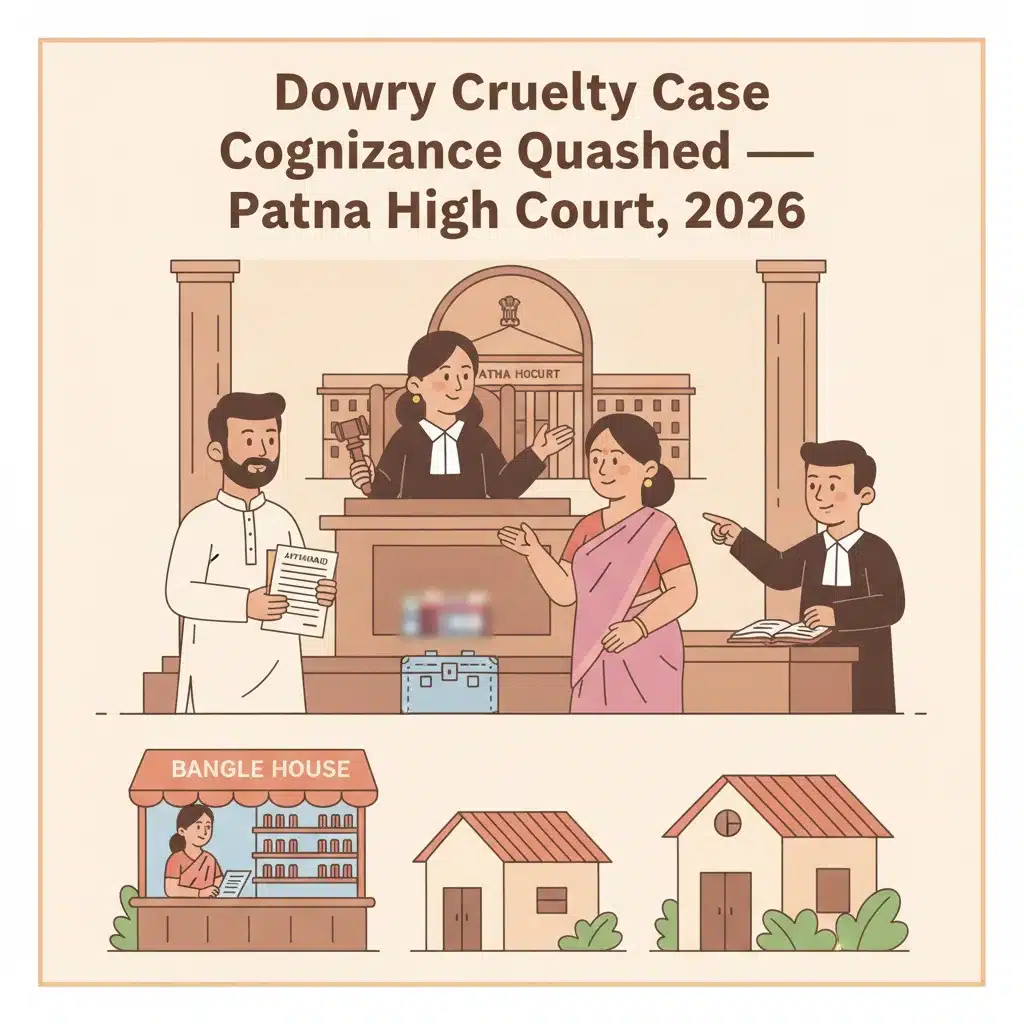
She further alleged that she ran a bangle shop, and the petitioner used to snatch away her earnings. She also stated that on 24.05.2014, the petitioner broke into her rented house and stole a steel box containing Rs. 60,000.
The Magistrate referred the complaint under Section 156(3) of the Code of Criminal Procedure for registration of an FIR. On this basis, Mahila P.S. Case No. 19 of 2014, District Nawada, was registered.
During investigation, the Investigating Officer finally submitted charge-sheet No. 68/15 dated 31.12.2015 only against the petitioner under Section 498A of the Indian Penal Code. All other persons named as co-accused were exonerated.
On 02.06.2016, the Additional Chief Judicial Magistrate-III, Nawada, took cognizance of the offence under Section 498A IPC and issued summons against the petitioner.
The husband (petitioner) then approached the Patna High Court in Criminal Miscellaneous No. 7610 of 2017, seeking quashing of this cognizance order and the criminal prosecution.
What the Court Examined and Decided
The matter came before Hon’ble Mr. Justice Praveen Kumar of the Patna High Court. Notice had been validly served on Opposite Party No. 2, but she chose not to appear. The Court heard the learned counsel for the petitioner and the learned Additional Public Prosecutor for the State.
The petitioner’s counsel argued that he had been falsely implicated. He stated that Opposite Party No. 2 was already married to one Shankar Sao in 1997. According to him, she had filed Complaint Case No. 622 of 1998 against that earlier husband and his family members, and that case was still pending before the Trial Court.
The petitioner’s side further asserted that the earlier husband, Shankar Sao, had sworn an affidavit. This affidavit was produced in the anticipatory bail application filed by the present petitioner in the court below. On the strength of this material, the petitioner argued that the marriage between the informant and Shankar Sao was still in existence.
The petitioner emphasised that, despite this earlier subsisting marriage, the 2014 complaint was filed alleging a marriage with the petitioner “2 to 3 years ago”, without giving any specific date, time or place of this alleged marriage.
It was also submitted that notices sent to the informant in the present proceedings, as well as in mediation proceedings, were ignored by her and she never appeared. Counsel pointed to this conduct to suggest that she was avoiding scrutiny of her allegations.
On this basis, the petitioner claimed that the prosecution was driven by malice, personal vendetta and personal score. He described the case as vexatious and malicious in nature, not a genuine attempt to seek justice.
The petitioner’s counsel supported his arguments by citing two Supreme Court decisions.
First, he relied on Achin Gupta vs. State of Haryana & Anr, reported in [2024] 6 S.C.R. 129. On the strength of this judgment, he argued that the FIR against him was completely vexatious and the Magistrate’s order taking cognizance deserved to be quashed.
Second, he referred to the well-known judgment in State of Haryana vs. Bhajan Lal, reported in 1992 Supp (1) SCC 335. He argued that categories 1, 7 and 11, as discussed in Bhajan Lal, applied to his case, meaning that the High Court should exercise its inherent powers to prevent abuse of the process of court where the criminal proceeding appears malicious or inherently improbable.
He also argued that the investigation had been perfunctory. According to him, the Investigating Officer did not properly ascertain the true facts before filing the charge-sheet. He contended that the Magistrate had taken cognizance mechanically, simply accepting the charge-sheet without proper judicial consideration.
The State, through the learned A.P.P., opposed the petitioner’s prayer. However, the judgment does not record any detailed counter-argument from the State beyond its opposition.
After considering the rival submissions and the record, the Patna High Court focused on the nature and background of the complaint lodged by Opposite Party No. 2.
The Court specifically referred to “the suspicious nature of the complainant/informant in lodging the F.I.R.” It also noted what it described as the “vexatious and malicious intent of the informant”. These observations show that the Court was not convinced about the genuineness of the allegations made in the complaint.
In this context, the Court applied the principle that criminal law should not be used as a weapon for personal vendetta. When the Court finds that a criminal proceeding is clearly being misused, it can step in to prevent abuse of its process.
The Court concluded that allowing the prosecution to continue, in the given facts and circumstances, would amount to an abuse of the process of the Court.
Once the Court reached this satisfaction, the next step was to consider the impugned order dated 02.06.2016 by which cognizance under Section 498A IPC had been taken against the petitioner in Mahila P.S. Case No. 19 of 2014, arising out of Complaint Case No. 813 of 2014.
Holding that continuation of the present case would be unjustified, the High Court quashed that cognizance order. As a result, the criminal proceedings under Section 498A IPC against the petitioner based on that order stood terminated.
The Court then formally allowed the criminal miscellaneous application filed by the petitioner.
Why This Judgment Matters
This judgment is significant for people involved in marital and dowry-related disputes, especially where criminal cases under Section 498A IPC are filed.
It shows that the Patna High Court is willing to carefully examine the background of a complaint. If the Court finds that a case appears suspicious, malicious or filed with personal vendetta, it can intervene and quash the proceedings.
For genuine victims of cruelty, the case underlines the need to present clear, consistent facts and to cooperate with court processes, such as appearing when notices are served.
For persons accused in dowry or marital cruelty cases, the decision reinforces that they can approach the High Court if they believe the case is clearly false, vexatious or filed only to harass them. However, this protection is applied only after close scrutiny of the facts, not automatically.
Legal Issues and Answers
- Issue: Should the criminal proceedings under Section 498A IPC, based on Mahila P.S. Case No. 19 of 2014 and Complaint Case No. 813 of 2014, be allowed to continue against the petitioner?
Answer: No. The Patna High Court held that, considering the suspicious nature of the complaint and the vexatious and malicious intent of the informant, continuation of the case would be an abuse of the process of Court and therefore quashed the cognizance order.
Cases Cited by the Court
- Achin Gupta vs. State of Haryana & Anr, [2024] 6 S.C.R. 129 (relied on by the petitioner to show the FIR was vexatious).
- State of Haryana vs. Bhajan Lal, 1992 Supp (1) SCC 335 (relied on by the petitioner for the categories in which criminal proceedings may be quashed; categories 1, 7 and 11 were argued to apply).
Case Details
Case Number: Criminal Miscellaneous No. 7610 of 2017; arising out of Mahila P.S. Case No. 19 of 2014, District Nawada; originating from Complaint Case No. 813 of 2014.
Case Title: Gopal Sao vs. State of Bihar & Guriya
Coram: Hon’ble Mr. Justice Praveen Kumar
Citation: 2026 (5) PLJR 322
Advocates: Mr. Sanjay Kumar Sinha, Advocate for the petitioner; Mr. Murlidhar, Additional Public Prosecutor for the State.
Nature of the Case: Criminal miscellaneous petition seeking quashing of the cognizance order under Section 498A IPC.
Link: https://patnahighcourt.gov.in/viewjudgment/NiM3NjEwIzIwMTcjMSNO-YQ–ak1–5YqHTgU4=
If you found this explanation helpful and wish to stay informed about how legal developments may affect your rights in Bihar, you may consider following Samvida Law Associates for more updates.




