
Case Background
The dispute concerns a small piece of land measuring five decimals out of Plot No. 603, Khata No. 15, in village Itwan, District Aurangabad. The land originally formed part of a larger area of 1.63 acres purchased in 1969 by two brothers, Panchu Singh and Bhikhar Singh, through a registered sale deed from one Nanaku (also spelt Nanhak) Singh.
After this purchase, Panchu Singh died leaving behind two sons, Karamdeo Singh and Dharamdeo (also spelt Dharamadeo/Dharamdeo) Singh. The plaintiff is one of the daughters of Dharamdeo Singh (defendant no. 3 before the trial court). Defendants nos. 1 and 2 are the sons of Karamdeo Singh and thus cousins of the plaintiff. Defendant no. 4, Basant Singh, is the son of Bhikhar Singh.
According to the plaintiff, there had been an amicable family partition many years earlier between Bhikhar Singh, Karamdeo Singh and Dharamdeo Singh. Under this arrangement, each of them got 54⅓ decimals out of the 1.63 acres from Plot No. 603, and they started living and possessing their portions separately.
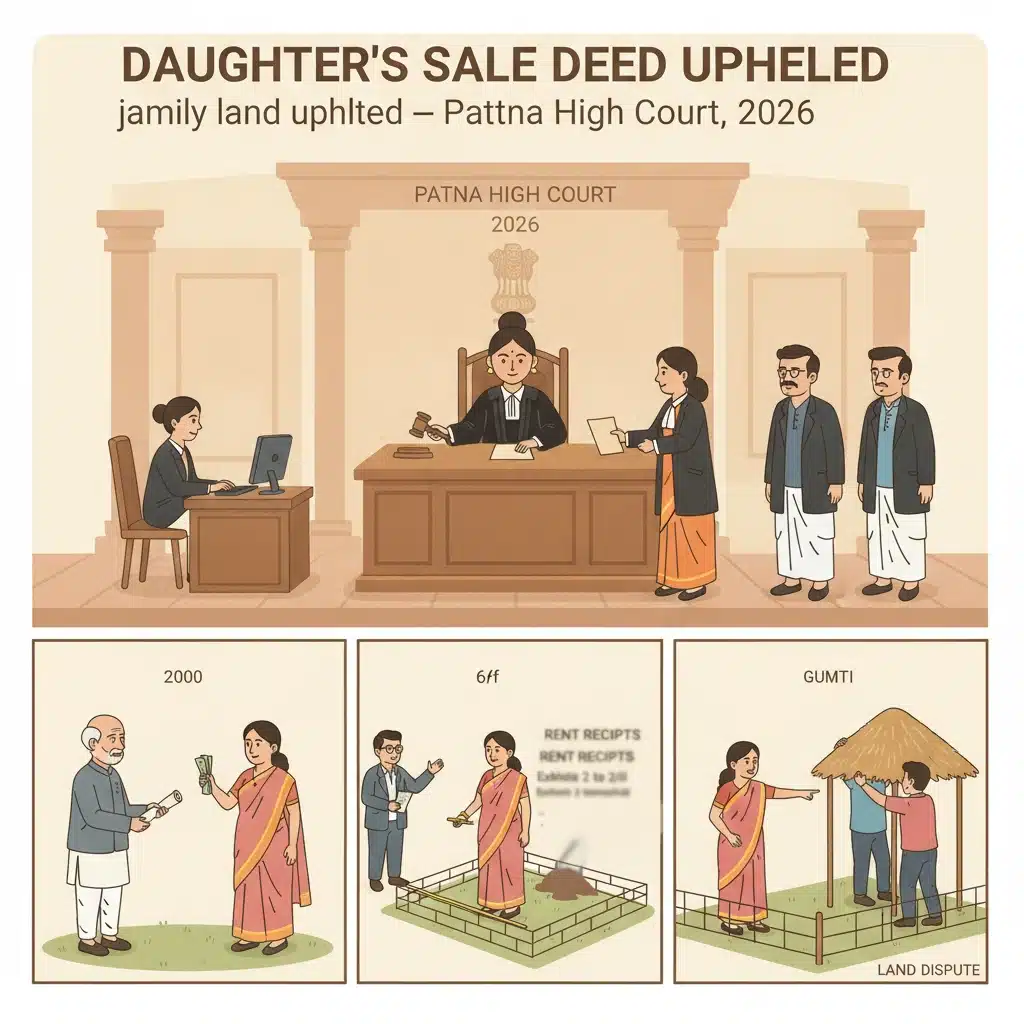
On 06.06.2000, the plaintiff’s father, Dharamdeo Singh, executed a registered sale deed (Exhibit-1) in her favour. By this deed he sold five decimals from his share in Plot No. 603 for Rs. 2,000, so that she could build her own residential house. The plaintiff claims that after the purchase she got her name mutated, rent receipts were issued (Exhibits 2 to 2/ii), and she constructed a six-feet-high boundary wall around this portion. She says she remained in peaceful possession.
The plaintiff alleges that during the mutation proceeding, the Anchal Amin measured the land and at that time no thatched roof (phus-chhapar) or shop structure (gumti) existed on her plot. According to her, on 31.12.2002 defendants nos. 1 and 2 forcibly put a thatched roof and gumti over her land to grab all five decimals, which compelled her to go to court.
She filed Title Suit No. 21 of 2003 before the Munsif, Aurangabad, seeking declaration of her right, title, interest and possession over the suit land, removal of the thatched roof and gumti, and a permanent injunction against defendants nos. 1 and 2.
Defendants nos. 1 and 2 denied her claim. They asserted that Plot No. 603 was still joint ancestral property of the entire family and that no valid partition had taken place. They further alleged that the sale deed in favour of the plaintiff was a sham document that never came into operation and that Dharamdeo Singh had not in fact executed any such deed. They also claimed to be in long and peaceful possession, running a fair price shop from the gumti with the consent of Dharamdeo Singh.
Defendant no. 3, the plaintiff’s father, supported his daughter’s case fully. He accepted executing the registered sale deed and asserted that there had been earlier partition and separate possession.
The trial court, after framing issues and recording evidence of both sides, decreed the suit on 28.08.2012. It accepted that there had been earlier partition, that the sale deed in favour of the plaintiff was valid, and that she had acquired right, title, interest and possession over the five decimals. It also granted permanent injunction against the defendants.
The heirs of defendants nos. 1 and 2 challenged this decision in Title Appeal No. 57 of 2012/09 of 2015 before the Additional District Judge-VII, Aurangabad. No appeal was filed by the heirs of defendant no. 4 (Bhikhar Singh’s side). On 31.05.2017, the first appellate court allowed the appeal, set aside the trial court decree and dismissed the plaintiff’s suit, mainly on the grounds of alleged non-joinder of necessary parties and failure to prove partition and exclusive share.
Aggrieved by this reversal, the plaintiff came to the Patna High Court in Second Appeal No. 366 of 2017. The High Court admitted the appeal on 20.04.2023, framing three substantial questions of law related to non-joinder of parties, proof of partition, and validity of sale from joint family property.
What the Court Examined and Decided
Hon’ble Mr. Justice Khatim Reza heard arguments from both sides and carefully examined the trial court and first appellate court judgments, along with the evidence on record.
The High Court first noted the nature of the suit. The plaintiff had sought only three kinds of relief: declaration of title, confirmation of possession and permanent injunction. She had not asked the court to conduct a partition or to divide the whole ancestral property among all family members. The focus was limited to her five-decimal plot said to be purchased from her father.
On the history of the property, the High Court recorded that it was not in dispute that Panchu Singh and Bhikhar Singh had purchased 1.63 acres in Plot No. 603, Khata No. 15 by a registered deed dated 26.05.1969. From the admitted genealogy, Dharamdeo Singh (defendant no. 3) was the son of Panchu Singh, while defendants nos. 1 and 2 were the sons of Karamdeo Singh, another son of Panchu Singh. The plaintiff was one of Dharamdeo Singh’s daughters.
The crucial question was whether there had been an earlier partition among these co-sharers and whether Dharamdeo’s sale of five decimals to his daughter could be treated as from his own share.
The plaintiff relied on several pieces of evidence:
- The registered sale deed dated 06.06.2000 (Exhibit-1) executed by Dharamdeo Singh in her favour for five decimals out of Plot No. 603.
- Rent receipts (Exhibit 2 series and Exhibit A to A/1) showing separate mutation and payment of rent by the co-sharers.
- A separate sale deed dated 03.12.1990 (Exhibit-4) executed by Karamdeo Singh, father of defendants nos. 1 and 2, in favour of his wife, with specific boundaries. In this deed Karamdeo clearly recited that he had got the land under “Deorhbandi partition”.
- Oral evidence of defence witnesses themselves, especially DW-2, DW-3, DW-6 and DW-7 (who was defendant no. 2), acknowledging separate houses, mess and mutation.
The trial court had treated these pieces of evidence as strong proof of partition and of separate shares. The first appellate court, however, downplayed them, reasoning that there was no detailed pleading about which exact portion went to which co-sharer and that the sons of Dharamdeo were not made parties.
Before the High Court, the plaintiff argued that her father had 54⅓ decimals out of Plot No. 603 after partition, that he and his three sons each got 13¼ decimals, and that by selling only five decimals he did not affect anyone else’s share. She pointed out that by order dated 02.11.2007, her brothers’ names were at least inserted by way of amendment in paragraph 8 of the plaint, and in any case no relief was claimed against them. Therefore, they were not necessary parties.
The defendants, on the other hand, maintained that the land remained joint ancestral property and that any dispute about such property should be taken up in a partition suit, not in a simple title suit. They said there was no documentary proof of partition besides the oral statements. They also relied on the fact that, according to them, bataidars were cultivating the land and distributing grains jointly to show continuing jointness.
After considering these rival stands, the Patna High Court came to a clear conclusion that the first appellate court had committed serious error.
Firstly, on the question of partition, the High Court gave great weight to Exhibit-4, the sale deed executed by Karamdeo Singh in favour of his wife in 1990. In this document Karamdeo himself admitted that he had obtained the land “through Deorhbandi partition.” This admission by one branch of the family, recorded in a registered document with specific boundaries, strongly supported the plaintiff’s case that partition had in fact taken place among defendants nos. 1, 2 and 3.
The Court also took note that Dharamdeo Singh had executed a registered sale deed (Exhibit-1) in favour of his daughter asserting that the five decimals were from his share. No co-sharer had challenged this sale deed for years. The transaction remained unquestioned until the suit, and even the heirs of Dharamdeo (defendant no. 3) never raised objections regarding his right to sell this part to the plaintiff.
The High Court further observed that the plaintiff’s father’s alleged share of 54⅓ decimals was significantly larger than the five decimals transferred to her. It emphasised that none of the heirs of defendant no. 3 had claimed that their share was reduced or adversely affected by this sale. Their silence and lack of challenge to the mutation in the plaintiff’s name were important factors.
It also found that the trial court had correctly relied on the depositions of defence witnesses themselves. DW-2 had accepted that separate houses of Karamdeo and Dharamdeo existed and that there was vacant land (parti land) to the north of Dharamdeo’s house. DW-3 had admitted that Dharamdeo and Krishna Singh were living separately with separate mess for the last 10 to 15 years. DW-7 (defendant no. 2) had admitted mutation and issuance of rent receipt in favour of the plaintiff.
In the High Court’s view, these admissions, coupled with Exhibits-1, 2 series, A to A/1 and 4, made out a strong and cogent case of prior partition and of the plaintiff’s valid title on the basis of the sale deed.
On the issue of non-joinder of necessary parties, the Court stressed that the relief sought in the suit was confined only against defendants nos. 1 and 2, who were alleged to have encroached by putting the thatched roof and gumti. The suit did not seek any declaration against the sons or other heirs of defendant no. 3, nor did it ask the court to disturb their shares. As no adverse impact was shown on them, and as they had not objected to the plaintiff’s purchase or possession, the Court held that they could not be treated as “necessary parties” whose absence would defeat the suit.
The High Court therefore ruled that the first appellate court’s finding that the suit was bad for non-joinder of necessary parties was contrary to the evidence on record and could not stand.
Summing up, the Court held that:
- A previous partition of the ancestral property had in fact taken place among the co-sharers.
- Dharamdeo Singh had a definite share from which he could validly sell five decimals to his daughter.
- The sale deed (Exhibit-1) in favour of the plaintiff was a valid transaction, giving her right, title, interest and possession over the suit land.
- The sons of defendant no. 3 were not necessary parties to the title suit as no relief was claimed against them and no prejudice to them was shown.
- The first appellate court erred in reversing the well-reasoned trial court judgment.
Consequently, the substantial questions of law were answered in favour of the plaintiff. The Patna High Court allowed the second appeal, set aside the first appellate court’s judgment and restored the trial court’s decree in her favour. The plaintiff thus retains legal title and protection over the five-decimal plot, and the permanent injunction against defendants nos. 1 and 2 stands revived.
Why This Judgment Matters
This judgment is important for families in Bihar and elsewhere who own ancestral land together. Many such families have informal or oral partitions, but later disputes arise when one branch sells part of its share or when other relatives try to encroach.
The Patna High Court has shown that such a purchaser, even if she is a daughter buying from her father, can be protected if there is credible evidence of earlier partition and if the sale is clearly from the seller’s own share. Registered sale deeds mentioning partition, rent receipts, separate houses and admissions by relatives can all help prove such partition.
The Court has also clarified that not every family member must be made a party in such a suit. If the plaintiff is only asking for declaration and injunction against specific persons who encroached and if other relatives are not affected, then their absence will not make the case fail.
Practically, this decision reassures women and other family members who buy small pieces of ancestral land from their parents. It confirms that a valid registered sale deed from a co-sharer, backed by proof of share and partition, can stand even against resistance from other branches of the family.
Legal Issues and Answers
- Issue: Are the three sons of defendant no. 3 necessary parties to the plaintiff’s title suit when no adverse impact to their share is shown?
Answer: No. The High Court held they are not necessary parties because no relief was sought against them, no prejudice to them was proved, and the suit relief was confined to defendants nos. 1 and 2. - Issue: Was there sufficient evidence on record to prove earlier partition between Dharamdeo Singh and the branch of Karamdeo Singh?
Answer: Yes. The Court relied on Exhibit-4 (reciting Deorhbandi partition), the conduct of parties, separate mutation and rent receipts, and defence witnesses’ admissions to hold that a previous partition had already taken place. - Issue: Can a member of a joint family validly sell a piece of land out of joint family property to the extent of his share, and did such right, title and interest pass to the plaintiff through Exhibit-1?
Answer: Yes. Once partition and separate share were established, Dharamdeo Singh could transfer from his allotted share. The Court held that the registered sale deed dated 06.06.2000 (Exhibit-1) validly conferred right, title and interest in five decimals of the suit land on the plaintiff.
Cases Cited by the Court
The High Court’s judgment itself does not reproduce or discuss earlier case law in detail, though the plaintiff’s counsel referred to:
- C. Venkata Swamy v. H.N. Shivanna (D) by L.R. & Ors., 2018 (1) PLJR 87 (SC)
- Ganesh Sahu and Anr. v. Dwarika Sao & Ors., AIR 1991 Patna 1
- Arjun Mahto & Others v. Monda Mahatain & Others, AIR 1971 Patna 215 (DB)
These were cited in argument to support the proposition that a family member can sell from joint family property to the extent of his share. The judgment mainly rests on the evidence and facts of this case.
Case Details
Case Number: Second Appeal No. 366 of 2017 (arising out of Title Appeal No. 57 of 2012/09 of 2015 and Title Suit No. 21 of 2003)
Case Title: Smt. Kalawati Devi v. Mostt. Ful Kumari Devi & Others
Citation: 2026 (5) PLJR 172
Court: High Court of Judicature at Patna
Bench/Coram: Hon’ble Mr. Justice Khatim Reza
Date of High Court Judgment: 19.06.2026
Trial Court: Munsif, Aurangabad (Title Suit No. 21 of 2003, judgment dated 28.08.2012)
First Appellate Court: Additional District Judge-VII, Aurangabad (Title Appeal No. 57 of 2012/09 of 2015, judgment dated 31.05.2017)
Advocates:
- For the Appellant (plaintiff before the trial court): Mr. Vidya Sagar, Advocate
- For the Respondents (defendants): Mr. Shailesh Kumar Singh, Advocate
Nature of Case: Second appeal in a title suit seeking declaration of right, title, interest and possession over ancestral land and permanent injunction.
Link: https://patnahighcourt.gov.in/viewjudgment/OSMzNjYjMjAxNyMxI04=-WGV5nJx–ak1–D0I=
If you found this explanation helpful and wish to stay informed about
how legal developments may affect your rights in Bihar,
you may consider following Samvida Law Associates for more updates.




