

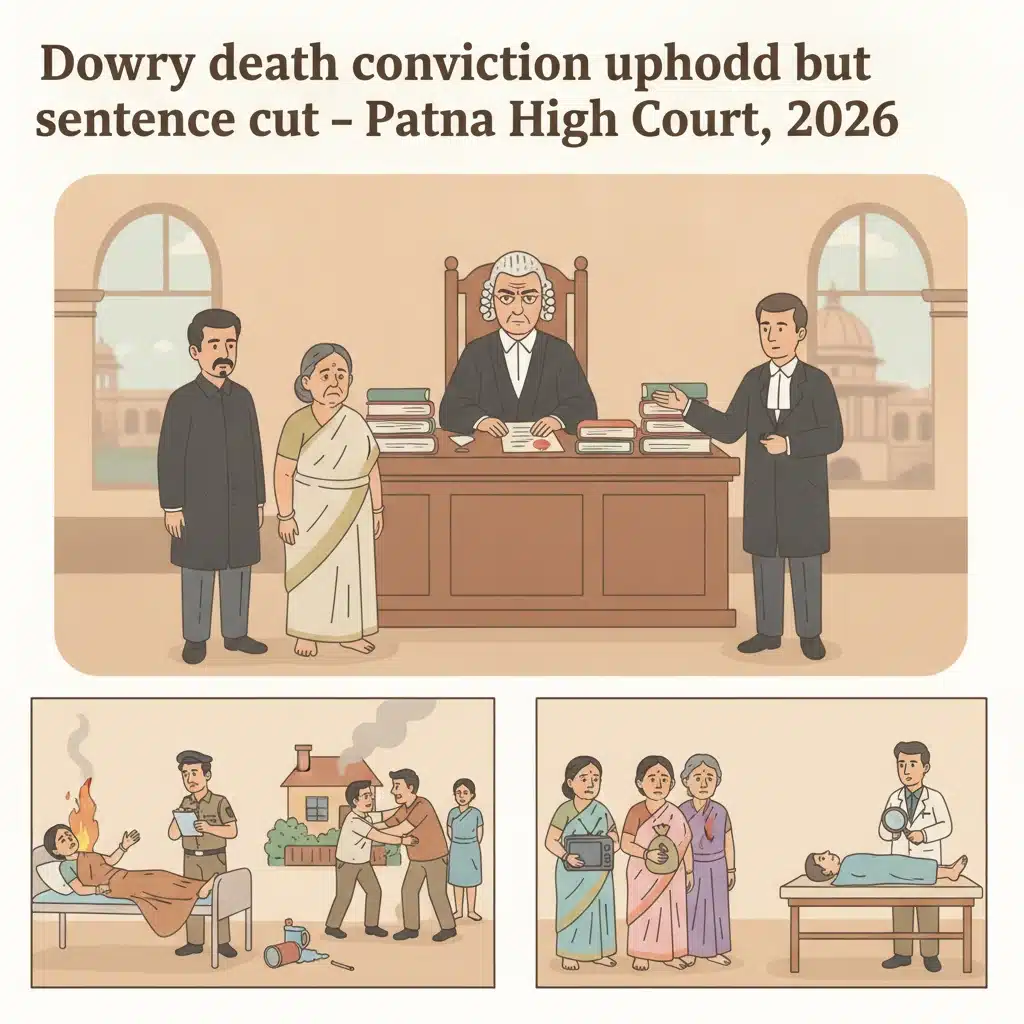
Case Background
This case arises from the death of a young married woman, Bindu Devi, in Nawada district, Bihar.
Bindu Devi was married to appellant Vikash Kumar Saw on 18.02.2009. According to the police statement (fardbeyan) later treated as her dying declaration, she was harassed for dowry by her husband, her mother-in-law Krishni Devi, and other in-laws after marriage. The alleged demands included a television, bed and cash.
On 05.04.2010, Bindu was admitted to Sadar Hospital, Nawada, with severe burn injuries said to have been caused one day earlier on 04.04.2010. At the hospital, the police recorded her fardbeyan. She stated that her husband had poured kerosene on her and set her on fire after a discussion in the family about dowry demands. She also said her father-in-law tried to save her. She was referred to PMCH, Patna, but died on the way.
On the basis of this statement, Kadirganj (Town) P.S. Case No. 143 of 2010 dated 05.04.2010 was registered, first under Section 498-A/34 IPC. After investigation and considering her death, police submitted charge-sheet for offences under Sections 498-A/34 and 304-B/34 IPC. Cognizance was taken and the case was committed for Sessions Trial No. 600 of 2010/116 of 2010 before the Additional Sessions Judge (Ad hoc)-IV, Nawada.
By judgment dated 26.02.2014 and order dated 28.02.2014, the trial court convicted Vikash Kumar Saw and his mother Krishni Devi under Section 498-A/34 IPC and sentenced them to three years’ rigorous imprisonment with fine of Rs. 2,000/-. They were also convicted under Section 304-B/34 IPC (dowry death) and sentenced to seven years’ rigorous imprisonment with fine of Rs. 1,000/-. In default of each fine, 15 days’ further imprisonment was ordered.
Both convicts filed separate criminal appeals (SJ) Nos. 134 of 2014 and 164 of 2014 before the Patna High Court. Mrs. Rishika Jha was appointed Amicus Curiae to represent them. The appeals were finally decided by Hon’ble Mr. Justice Purnendu Singh on 01.07.2026.
What the Court Examined and Decided
The Patna High Court carefully went through the entire trial record, including oral evidence of seven prosecution witnesses, the postmortem report and the inquest papers. It also considered the rival arguments of the Amicus Curiae for the appellants and the Additional Public Prosecutors for the State.
The central questions were whether Bindu’s death was homicidal or accidental, whether there was reliable proof of dowry-related cruelty, and whether the dying declaration could be trusted as the main basis of conviction.
Arguments by the defence (Amicus Curiae)
The Amicus Curiae attacked the conviction on several grounds. She argued that there was no eyewitness to the burning. The only direct version of the incident was the alleged dying declaration, which she said suffered from serious defects.
First, she pointed out that neither the doctor who was attending Bindu at Sadar Hospital nor the police officer who actually wrote down her fardbeyan were examined as witnesses. No certificate of the doctor about her mental fitness at the time of giving the statement was taken. On the contrary, P.W.-4 (mother) and P.W.-7 (father) admitted in cross-examination that Bindu was unconscious at the hospital.
She further argued that the statement was recorded in the presence of close relatives, so tutoring could not be ruled out. Because of these factors, she contended, the dying declaration alone should not have been used to convict.
Second, she relied on the postmortem report and the evidence of P.W.-6, the doctor who conducted the autopsy. Although he found more than 80% burns, he did not notice any smell of kerosene from the body and admitted such burns could occur during cooking. This, the defence said, supported their stand that the incident was an accident in the kitchen.
The Amicus also highlighted the defence version that the husband tried to extinguish the fire, took Bindu to hospital and helped her with studies, showing a normal relationship. P.W.-7 admitted that Bindu continued her studies after marriage, appeared for her B.A. exams with her husband’s assistance, and had voluntarily gone back to her matrimonial home after staying at her parents’ house.
On dowry demand, the Amicus Curiae contended that the alleged payment of Rs. 35,000/- by the father was not mentioned in the original fardbeyan and was introduced later by P.W.-3, P.W.-4 and P.W.-7. There was no date, place or independent witness for this alleged payment. No prior complaint was ever lodged before any authority regarding dowry demand or cruelty. She described the witnesses’ statements as vague and omnibus, coming from close relatives, and argued that without independent corroboration such evidence should not be the basis for conviction.
According to her, the prosecution could not prove either the ingredients of Section 304-B IPC (dowry death) or of Section 498-A IPC (cruelty for dowry) “beyond reasonable doubt”. Therefore, the presumption of dowry death under Section 113-B of the Evidence Act should not apply and the appellants deserved acquittal.
Arguments by the State
The State supported the trial court’s findings. The APP argued that Bindu died an unnatural death due to extensive burns within seven years of her marriage. Prosecution witnesses P.W.-3 (uncle), P.W.-4 (mother) and P.W.-7 (father) all stated that the husband and his family had been demanding television, bed, refrigerator and cash, and despite getting Rs. 35,000/-, they continued to torture her for dowry.
The APP stressed that the witnesses said Bindu had told them about the continued dowry demand and threats shortly before her death. Therefore, the basic conditions for Section 304-B IPC and the legal presumption under Section 113-B of the Evidence Act were fully met.
He placed strong reliance on the fardbeyan recorded at Sadar Hospital. In that statement, Bindu named her husband and mother-in-law as the persons who poured kerosene and set her ablaze, but clearly stated that her father-in-law tried to save her. The APP argued that because she even spared one in-law, this added to the reliability of her statement.
P.W.-6, the doctor, had also clarified that a person with 80% burns might still be able to speak in the initial stage. Therefore, according to the State, the defence argument that she could not have given any statement did not hold water. Viewed with the other evidence, the dying declaration, in the State’s view, safely justified conviction.
Evidence evaluated by the High Court
The Court noted that P.W.-1 and P.W.-2 did not support the prosecution and their evidence had no value for the case. The conviction rested mainly on the testimonies of P.W.-3, P.W.-4, P.W.-7, the Investigating Officer (P.W.-5) and the doctor (P.W.-6), along with the dying declaration.
P.W.-3, the uncle, described consistent dowry demands from the accused for television, bed, refrigerator and other items, coupled with threats that Bindu would be killed if demands were not met. He spoke about the payment of Rs. 35,000/- by Bindu’s father, and about Bindu’s oral statement at the hospital that her husband and mother-in-law had poured kerosene and set her on fire.
P.W.-4, the mother, gave a similar account of dowry demands, the Rs. 35,000/- payment, continued harassment and insecurity of her daughter. She too said that at Sadar Hospital her daughter told the police that husband and mother-in-law had burnt her, and that Bindu affixed her thumb impression on the fardbeyan as her hands were burnt.
P.W.-7, the father, explained how after about fifteen days of one visit, Bindu told him at her matrimonial house about dowry demands for television, bed, refrigerator and cash and torture for non-fulfilment. He said he paid Rs. 35,000/- but the harassment continued, with threats to kill her if the remaining demand was not fulfilled. After getting information on 04.04.2010 that she had been burnt, he reached Sadar Hospital and found her in burnt condition and saw her statement being recorded.
P.W.-5, the Investigating Officer, inspected the place of occurrence and found smell of kerosene in the room, which had already been washed. He did not find burnt articles but corroborated presence of kerosene smell.
P.W.-6, the doctor, conducted the postmortem on 05.04.2010 at 4:30 p.m. He found more than 80% dermo-epidermal burns except on the lower abdomen, buttocks and soles. He gave opinion that death was due to shock from dry heat burn injuries and confirmed they were ante-mortem. In cross-examination he did not find smell from the dead body but accepted that a person with 80% burns may initially speak.
Application of dowry death and cruelty law
The Court carefully reproduced and discussed Sections 304-B and 498-A IPC and the Supreme Court’s guidance in Rajinder Singh v. State of Punjab (2015) 6 SCC 477, Surinder Singh v. State of Haryana, Kans Raj v. State of Punjab, and State of Madhya Pradesh v. Jogendra (2022) 5 SCC 401. It stressed that:
- For Section 304-B IPC, death must be unnatural within seven years of marriage.
- The woman must have faced cruelty or harassment “soon before her death”.
- Such cruelty must be in connection with a dowry demand.
- Once these foundational facts are proved, Section 113-B of the Evidence Act raises a presumption against the husband or relatives.
The Court underlined that “soon before” is a relative term and there must be a live and proximate link between dowry-related cruelty and the death. General or old allegations, without such link, would not be enough.
Finding of the Court
After weighing all evidence, the High Court concluded that the prosecution had successfully proved its case.
It noted that Bindu’s death was clearly unnatural, due to 80% ante-mortem burns, and occurred within seven years of marriage. The consistent testimonies of P.W.-3, P.W.-4 and P.W.-7 about persistent dowry demands, payment of Rs. 35,000/-, continued harassment and threats were accepted. Their account was supported by the Investigating Officer’s finding of kerosene smell at the scene and the medical evidence of burn injuries.
The Court treated the fardbeyan recorded at Sadar Hospital as a dying declaration. Although the recording officer and attending doctor were not examined, the Court relied on the evidence that Bindu had signed with thumb impression and that, medically, a person with such burns could speak initially. It also considered significant that in her statement Bindu blamed only her husband and mother-in-law but cleared her father-in-law who tried to save her, indicating that she was giving a truthful account rather than blindly accusing all in-laws.
The Court held that together, the oral, medical and documentary evidence showed that Bindu had been subjected to cruelty and harassment for dowry soon before her death, and that her husband and mother-in-law poured kerosene and set her ablaze. Thus, the legal presumption under Section 113-B of the Evidence Act clearly applied, and the defence failed to rebut it.
Accordingly, the High Court found that the trial court had “erred no mistake” in holding the appellants guilty under Sections 498-A/34 and 304-B/34 IPC. The conviction was upheld.
Modification of sentence
While confirming guilt, the Patna High Court considered the period the appellants had already spent in custody during investigation, trial and appeal, and other mitigating circumstances.
Appellant no. 1 had undergone about 1.7 years and appellant no. 2 about 4.5 years in custody. The Court held that the “ends of justice” would be served by reducing the sentence to the period already undergone, instead of the original three and seven years’ rigorous imprisonment.
Therefore, while maintaining the conviction, the Court:
-
- Reduced the substantive sentence for both offences to the period already undergone.
- Directed that, as the appellants were on bail, they were discharged from the liabilities of their bail bonds.
- Ordered refund of the fine amount, if already deposited, after verification.
- Partly allowed the appeals to this limited extent.
The Court also directed payment of Rs. 10,000/- by the Patna High Court Legal Services Committee to Amicus Curiae Mrs. Rishika Jha for her professional assistance.
Why This Judgment Matters
This judgment is important for families dealing with dowry harassment and suspicious deaths of married daughters.
First, the Patna High Court confirms that even when some witnesses turn hostile and there is no independent neighbour witness, consistent evidence from close relatives, supported by medical and investigation records, can still prove a dowry death.
Second, the Court shows that a dying declaration recorded as a fardbeyan can be relied upon if it appears natural and is supported by other evidence, even if the doctor does not formally certify mental fitness and the recording officer is not examined. The fact that the victim spared one in-law by saying he tried to save her was treated as a sign of truthfulness.
Third, the judgment underlines that once a woman dies an unnatural death within seven years of marriage and there is credible evidence of dowry-related cruelty “soon before” the death, the law presumes that the husband or his relatives caused the death. The accused must then bring convincing material to break this presumption; mere claims of accidental burn are not enough.
At the same time, the Court shows a balancing approach on punishment. Even for grave offences like dowry death, it considered the long passage of time and period already spent in jail, and reduced the remaining sentence, while not disturbing the finding of guilt. This indicates that higher courts may show some leniency in sentencing, but only after confirming that the crime is legally proved.
For ordinary readers in Bihar, this decision sends a clear message: continuous dowry harassment that ends in a young woman’s unnatural death will be treated seriously as dowry death. Families should document and report dowry demands early. At the same time, accused persons should know that courts will closely examine all evidence, including medical and forensic details, before upholding such serious convictions.
Legal Issues and Answers
-
-
- Issue: Was Bindu Devi’s burning death within seven years of marriage a dowry death under Section 304-B IPC, backed by the presumption under Section 113-B of the Evidence Act?
Answer: Yes. The Court held that she died an unnatural death within seven years of marriage after being subjected to dowry-related cruelty “soon before” her death, attracting Section 304-B IPC and the statutory presumption, which the defence failed to rebut. - Issue: Were the husband and mother-in-law guilty of cruelty for dowry under Section 498-A/34 IPC?
Answer: Yes. Consistent evidence from close relatives about persistent demands for television, bed, refrigerator and cash, payment of Rs. 35,000/- and continued harassment established the ingredients of Section 498-A IPC. - Issue: Should the sentence of three and seven years’ rigorous imprisonment imposed by the trial court be maintained?
Answer: No. While upholding conviction, the High Court reduced the sentence for both offences to the period already undergone in custody, considering overall facts and mitigating circumstances.
- Issue: Was Bindu Devi’s burning death within seven years of marriage a dowry death under Section 304-B IPC, backed by the presumption under Section 113-B of the Evidence Act?
-
Cases Cited by the Court
-
-
- Rajinder Singh v. State of Punjab, (2015) 6 SCC 477
- Surinder Singh v. State of Haryana, (2014) 4 SCC 129 : (2014) 4 SCC (Cri) 769
- Kans Raj v. State of Punjab, (2000) 5 SCC 207 : 2000 SCC (Cri) 935
- State of Madhya Pradesh v. Jogendra and Anr., (2022) 5 SCC 401
-
Case Details
Case Numbers: Criminal Appeal (SJ) No. 134 of 2014 with Criminal Appeal (SJ) No. 164 of 2014; arising out of Nawada P.S. Case No. 143 of 2010 (G.R. No. 590 of 2010), Sessions Trial No. 600 of 2010/116 of 2010.
Case Title: Krishni Devi vs. The State of Bihar (Criminal Appeal (SJ) No. 134 of 2014); Vikash Kumar Saw vs. The State of Bihar (Criminal Appeal (SJ) No. 164 of 2014).
Citation: 2026 (5) PLJR 56
Coram: Hon’ble Mr. Justice Purnendu Singh.
Advocates: For the appellants (in both appeals): Mrs. Rishika Jha, Amicus Curiae. For the State in Criminal Appeal (SJ) No. 134 of 2014: Mr. S.N. Prasad, APP. For the State in Criminal Appeal (SJ) No. 164 of 2014: Mr. Z. Hoda, APP.
Nature of the Case: Criminal appeals (single judge) against judgment of conviction and order of sentence passed by the Additional Sessions Judge (Ad hoc)-IV, Nawada, in a dowry death and cruelty case.
Date of High Court Judgment: 01.07.2026 (CAV; CAV date 15.06.2026).
Result: Conviction under Sections 498-A/34 and 304-B/34 IPC upheld; sentence modified to period already undergone; fines to be refunded; appeals partly allowed.
Link to Judgment: https://patnahighcourt.gov.in/viewjudgment/MjQjMTM0IzIwMTQjMSNO-aP45JAgkgNI=
If you found this explanation helpful and wish to stay informed about how legal developments may affect your rights in Bihar, you may consider following Samvida Law Associates for more updates.




