

Case Background
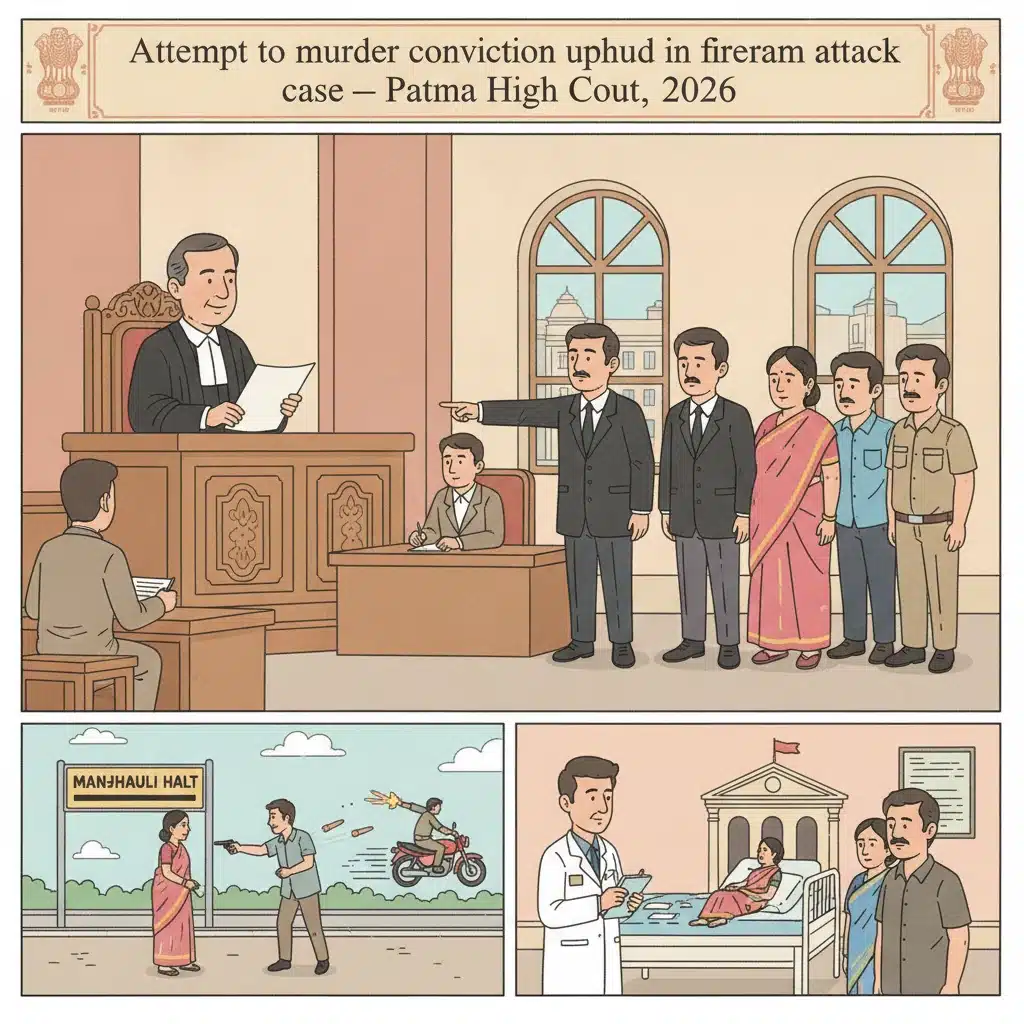
This case arises from a daytime firing incident on 23 November 2020 near Manjhauli Halt under Salimpur Police Station, District Patna.
The woman informant stated that around 12 noon she was returning from Khusrupur Bazaar after buying medicines. When she reached near the house of one Gurudeo Singh, close to Manjhauli Halt, three men, including the two appellants, allegedly stopped her.
According to her, one appellant, Ranjeet Singh, caught hold of her and then ordered the other appellant, Vicky Singh @ Ajit Kumar, to shoot her. Vicky allegedly fired at her with a pistol, hitting her on the back. When she raised an alarm, he allegedly fired again, and the second shot also hit her back.
She further alleged that a third co-accused, Roshan Kumar, reached the spot on a motorcycle, abused her family members, and fired in the air. When villagers protested, all the accused fled towards the west while firing and threatened to kill her husband.
On the basis of her fardbeyan, recorded on 25 November 2020 at 5 pm at PMCH, Patna, Salimpur P.S. Case No. 320 of 2020 was registered for offences under Sections 341, 323, 354, 504, 506 and 307/34 of the Indian Penal Code and Section 27 of the Arms Act.
After investigation, the police submitted a charge-sheet against all FIR-named accused for the same set of offences. The case was committed to the Court of Session and registered as Sessions Trial No. 782 of 2021 before the Additional District & Sessions Judge-V, Barh, Patna.
The trial court framed charges under Sections 341, 323/34, 307/34, 354/34, 504/34, 506/34 IPC and Section 27 Arms Act. The accused pleaded not guilty and faced trial.
By judgment dated 5 April 2023, followed by order of sentence dated 16 May 2023, the trial court convicted both appellants under Section 307/34 IPC. Vicky Singh @ Ajit Kumar was also convicted under Section 27 of the Arms Act. Each appellant was sentenced to ten years’ rigorous imprisonment and a fine of Rs. 50,000 for the Section 307/34 offence, with one year’s simple imprisonment in default. Vicky received an additional three years’ rigorous imprisonment and a fine of Rs. 10,000 under Section 27 Arms Act, with three months’ simple imprisonment in default. His sentences were directed to run concurrently.
Aggrieved, both convicts filed this criminal appeal (SJ) No. 3104 of 2023 before the Patna High Court.
What the Court Examined and Decided
The Patna High Court, presided over by Hon’ble Mr. Justice Shailendra Singh, heard the appeal. The Court examined the trial court record, the evidence of witnesses, documentary exhibits, and the arguments from both sides.
The prosecution had examined six witnesses:
- PW-1: the victim, who was also the informant and injured witness
- PW-2: her father-in-law (claimed eyewitness)
- PW-3: Dr. Mridul Rai, who examined the victim
- PW-4: Shambhu Singh, brother of PW-2 (claimed eyewitness)
- PW-5: the victim’s husband
- PW-6: the Investigating Officer, Kamleshwar Ram
Key documents like the fardbeyan, formal FIR and injury report were exhibited.
Victim’s testimony
The High Court treated PW-1, the victim, as the most important witness. In her examination-in-chief she repeated the core allegations from her fardbeyan: the appellants lying in wait near Gurudeo Singh’s house, stopping her, Ranjeet catching hold of her and directing Vicky to shoot, and Vicky firing twice, both bullets hitting her back.
During cross-examination, defence tried to show contradictions about the distance of the shooters and the position of her body when she was shot. She stated that the appellants were about 4 to 5 feet (2 “deg”) away at the time of firing. She also stated that she fell down after the second shot, though this detail was not in the fardbeyan.
The Court held that such minor variation did not shake her credibility. The fardbeyan was recorded in hospital while she was under treatment; the Court found it unreasonable to expect precise description of body movements at that stage.
On motive, the victim said the accused had earlier harassed her by using vulgar words, and she had complained to their family members about six months before the incident. The Court also noted that there had been a land dispute between the families which had been resolved, but cordial relations had not fully returned.
The Court observed that the manner in which the accused waited near the spot, stopped her, abused her, and then fired, showed a pre-planned attack.
Medical evidence
The injury report (Ext.-2) prepared by PW-3 recorded three injuries:
- an entry wound (3 cm x 1 cm, depth not assessed) over mid-back at L3-L4 level
- an exit wound (1 cm x 1 cm, depth not assessed) over the left inguinal region
- an abrasion (2.5 cm x 2 cm) over mid-back below the left infra-scapular area
The report showed that she was managed operatively on 23 November 2020, had hemoperitoneum with minor laceration of the spleen, and was discharged in good condition on 3 December 2020. The doctor opined that the injuries were caused by a “penetrating projecting object” and were grievous in nature.
The defence argued that this report did not support the claim of two gunshot injuries to the back. According to them, if two bullets had hit her back there should have been two entry wounds; however, only one entry wound was recorded. They also argued that the exit wound being smaller than the entry wound was medically doubtful and created suspicion. They relied on an earlier Division Bench decision (Cr. APP (DB) No. 358 of 1993) to highlight the importance of consistency between ocular and medical evidence.
The Court analysed this objection carefully. It accepted the informant’s argument that exit wounds are not always larger than entry wounds; the size depends on many factors such as tissue and bones hit by the bullet and its path through the body. In this case, X-ray plates and reports were not available to the doctor when he gave his opinion, which limited the clarity of his assessment.
PW-3, in his oral evidence, stated that injury no. 3 (abrasion) was not a firearm injury, but in Ext.-2 he had only described the cause as a penetrating and projecting object without clarifying this point. The Court treated this as some contradiction between his report and testimony. It noted that abrasions can also result from gunshot injuries as per medical jurisprudence.
Balancing these aspects, the Court held that while there was some mismatch between medical and oral versions, the law is that consistent and reliable eye-witness account, especially from an injured witness, has greater weight than medical opinion, unless the medical evidence completely rules out the occurrence. That was not the case here. Hence, the Court refused to give benefit of doubt to the appellants on this ground.
Investigation lapses
The defence further attacked the quality of investigation. They pointed out that:
- the alleged weapon was never recovered
- blood-stained clothes of the victim and blood-stained soil from the spot were not seized
- the FIR reached the court after a delay of ten days without explanation
- Uday Kumar, the ASI who recorded the fardbeyan, was not examined at trial
The Court accepted that these were lapses on the part of the investigating agency. However, it found that such shortcomings did not go to the root of the case because the victim’s evidence was of “sterling quality” and was supported by her injury report. Therefore, it declined to overturn the conviction merely due to poor investigation.
Delay in FIR
The defence argued that the incident occurred on 23 November 2020 whereas the FIR was registered on 25 November 2020, and no family member approached the police in between, which made the prosecution story doubtful.
The Court rejected this argument. It noted that the victim suffered gunshot injuries, was first taken to a local hospital, and then referred to PMCH, Patna. She remained under treatment and regained consciousness on 25 November 2020, when her fardbeyan was recorded immediately. The evidence of PW-1 and PW-6 supported this explanation. Thus, the delay was held to be justified.
Lack of independent witnesses
Another objection was that no independent witness from the neighbourhood, including residents of Gurudeo Singh’s house, had been examined. Only family members of the victim came forward, making the case dependent on interested witnesses.
The Court observed that the FIR itself did not mention any independent person at the place of occurrence at the time of firing. It agreed that the Investigating Officer should have attempted to examine nearby residents and termed this a careless approach, but held that it did not weaken the case in light of reliable evidence already available.
Liability of Ranjeet Singh under Section 34 IPC
A main legal contention was that Ranjeet Singh (appellant no. 2) had not fired any shot and was convicted only with the help of Section 34 IPC (common intention). Defence argued that his acts, even as per PW-1, did not prove he shared common intention to commit attempt to murder.
The Court disagreed. It relied on the sequence in the fardbeyan and evidence: both appellants, along with co-accused Roshan Kumar, were waiting together; they stopped the victim; Ranjeet caught hold of her; he abused her and openly ordered Vicky to kill her with a pistol; only thereafter did Vicky fire two shots at her back. From these facts the Court concluded that Ranjeet shared the intention to kill and actively facilitated the attack. Thus, his conviction with the aid of Section 34 IPC was held proper.
Role of other witnesses
The Court reviewed the evidence of PW-2, PW-4 and PW-5, who claimed to be eyewitnesses. In light of the victim’s own testimony, the Court felt that they were not eyewitnesses to the main shooting, and that the trial court had erred in treating them as such.
However, their statements about what they saw immediately after the occurrence — the injured condition of the victim, the place of occurrence, and the steps taken to take her to hospital — were treated as relevant and somewhat supportive of the prosecution version.
Final outcome
After considering all arguments, the High Court held that the victim’s consistent account, coupled with her injury report, was sufficient to uphold the conviction. It found no ground to interfere with the findings of the trial court.
The criminal appeal was dismissed. The conviction of both appellants under Section 307/34 IPC and of Vicky Singh @ Ajit Kumar under Section 27 Arms Act, together with the sentences imposed, were affirmed.
The Court noted that appellant no. 2, Ranjeet Singh, was on bail and directed him to surrender before the trial court within four weeks, failing which coercive steps were to be taken to secure his custody so he could serve the remaining sentence. The trial court records were ordered to be sent back with a copy of the judgment.
Why This Judgment Matters
This judgment is important for victims of violent crime, especially women in rural areas, because it shows that courts place strong weight on the direct statement of an injured victim.
Even though there were clear gaps in police investigation, such as non-recovery of the weapon or blood-stained articles, the Patna High Court held that a truthful and consistent eye-witness account, backed by medical evidence of gunshot injuries, is enough to sustain a conviction for attempt to murder.
The ruling also clarifies that someone who does not pull the trigger can still be punished for attempt to murder if he shares the intention and encourages the firing, as Ranjeet Singh did by catching hold of the victim and ordering the shooting.
For families facing similar situations, the case underlines that delay in lodging the FIR due to hospitalization and unconsciousness of the victim will not automatically weaken their case if there is a proper explanation.
Legal Issues and Answers
- Issue: Whether contradictions between the victim’s account and medical report, and investigation lapses, made the prosecution case unreliable in this attempt to murder case.
Answer: No. The Court held that the injured victim’s consistent and credible testimony prevailed over minor medical discrepancies and investigation lapses, and was sufficient to uphold conviction under Section 307/34 IPC and Section 27 Arms Act. - Issue: Whether appellant Ranjeet Singh, who did not fire the pistol, could be convicted for attempt to murder with the aid of Section 34 IPC.
Answer: Yes. Because he was part of the pre-planned attack, caught hold of the victim, and explicitly instigated the co-accused to shoot her, the Court held that he shared common intention to kill and his conviction under Section 307/34 IPC was proper. - Issue: Whether the delay of about two days in registration of the FIR weakened the prosecution case.
Answer: No. The delay was satisfactorily explained as the victim was under treatment for gunshot injuries and her fardbeyan was recorded soon after she regained consciousness.
Cases Cited by the Court
- The Court referred to a Division Bench judgment in Cr. APP (DB) No. 358 of 1993, particularly paragraph 33, on the value of medical evidence and contradictions in prosecution evidence.
Case Details
Case Number: Criminal Appeal (SJ) No. 3104 of 2023; arising out of Salimpur P.S. Case No. 320 of 2020; Sessions Trial No. 782 of 2021.
Case Title: Vicky Singh @ Ajit Kumar & Anr. v. The State of Bihar
Court: High Court of Judicature at Patna
Coram: Hon’ble Mr. Justice Shailendra Singh
Date of Patna High Court Judgment: 18.06.2026
Citation: 2026 (4) PLJR 405
Advocates:
- For the Appellants: Ms. Deepshikha, Advocate; Mr. Jai Prakash Singh, Advocate; Mr. Dharmendra Kumar Paswan, Advocate; Mr. Suraj Kumar, Advocate; Mr. Amar Kumar, Advocate
- For the Informant: Mr. Saroj Kumar Choudhary, Advocate
- For the State: Mrs. Abha Singh, Additional Public Prosecutor
Nature of the Case: Criminal appeal (single judge) against conviction and sentence for attempt to murder and Arms Act offence.
Link to Judgment: https://patnahighcourt.gov.in/viewjudgment/MjQjMzEwNCMyMDIzIzEjTg==-OH–ak1–3Dd74OUE=
If you found this explanation helpful and wish to stay informed about
how legal developments may affect your rights in Bihar,
you may consider following Samvida Law Associates for more updates.




