

Case Background
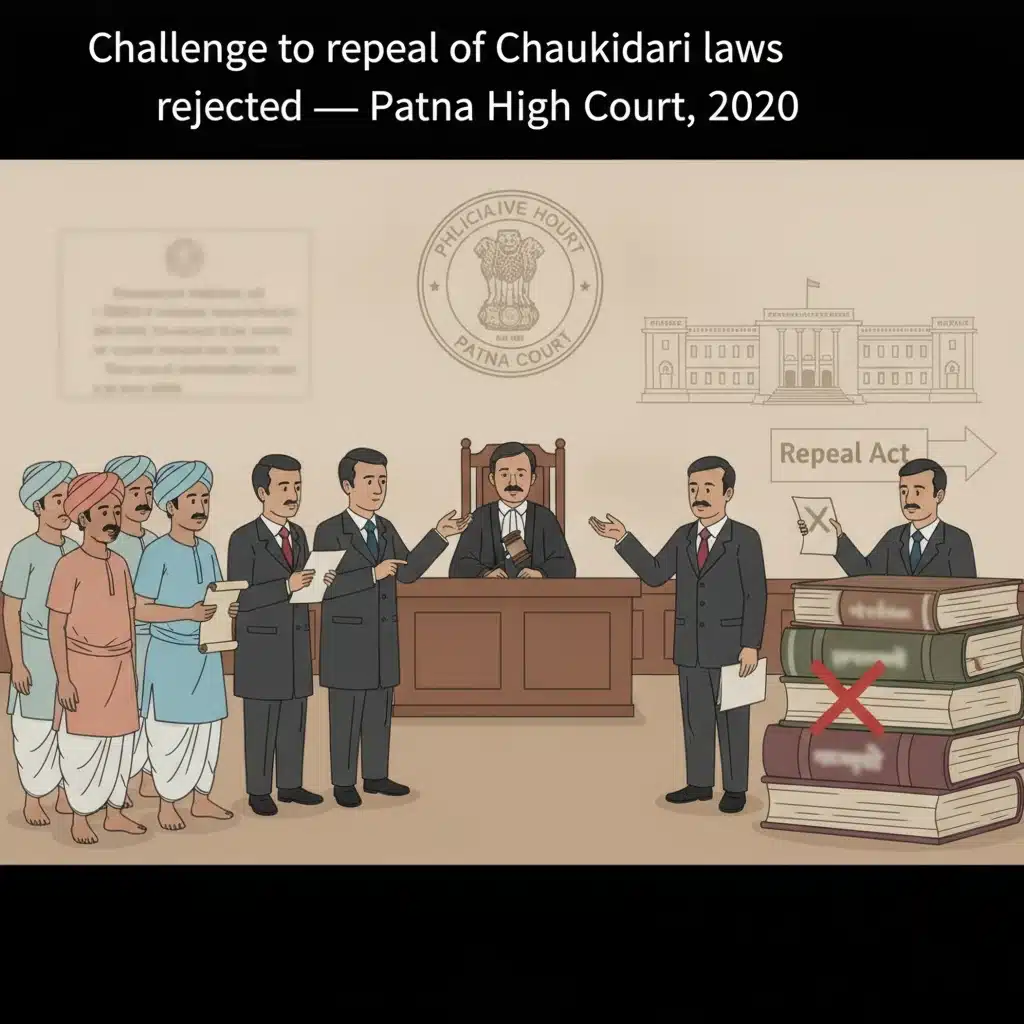
The dispute started from the service conditions of village Chaukidars working under two very old laws: the Village Chaukidari Act, 1870 and the Bengal Village Chaukidari Act, 1871. These Acts allowed the appointment and removal of Chaukidars and fixed their duties and emoluments.
Chaukidars appointed under these Acts felt discriminated against. They claimed that Chaukidars working in the Chotanagpur division under the Chotanagpur Rural Police Act, 1914 were getting better pay scales. To protest this disparity, they formed a union named Bihar Rajya Chaukidari Tahsildar Sangh and approached the Patna High Court.
The first writ petition, CWJC No.4943 of 1983, was decided on 3 May 1988. The Court did not decide the pay dispute finally. Instead, it directed the State Government to reconsider the matter, keeping in mind Article 39(d) of the Constitution (equal pay for equal work) and the nature of duties of both sets of Chaukidars. The State was asked to take a decision preferably within three months.
The State Government later rejected the demand. The union again approached the High Court in CWJC No.7339 of 1981. On 29 March 1996, the Court quashed the State’s order dated 29 April 1991 and again told the State to decide the matter afresh by a reasoned order within six months. Even in this second round, the Court did not grant any final relief on pay parity.
The State then took a fresh decision on 28 April 1997. The Commissioner-cum-Secretary, Department of Revenue and Land Reforms, rejected the union’s claim, noting that the Government had in principle decided to abolish collection of tax under the Chaukidari system.
This 1997 decision was again challenged in CWJC No.1989 of 2015 (Raj Kumar Thakur v. State of Bihar) and CWJC No.19318 of 2013 (Bihar Rajya Chaukidari Tahsildar Sangh v. State of Bihar). On 5 July 2016, the High Court held that the State could not abolish the Chaukidari system or repeal the Chaukidari Acts by mere executive decision. It ruled that only the Legislature could do so by passing an appropriate law, and quashed the government decision (Annexure-1).
After this, the State Legislature enacted the Bihar Repeal of Laws (which are no longer needed or relevant) Act, 2016. Under this Act, both the Village Chaukidari Act, 1870 and the Bengal Village Chaukidari Act, 1871 were repealed. The Repeal Act came into force on 16 August 2016.
The union then filed a contempt petition (MJC No.03 of 2017) alleging non-compliance of the 2016 High Court judgment. On 24 January 2018, the Court recorded that the Bihar Chaukidari Act had been repealed by a notification annexed as Annexure-B. The Court closed the contempt case but specifically observed that if the repeal Act was vulnerable, it could be challenged in a separate proceeding.
Acting on this liberty, the union filed the present writ petition (CWJC No.6026 of 2018) on 30 March 2018, challenging the constitutional validity of the Bihar Repeal of Laws Act, 2016 insofar as it repealed the two Chaukidari Acts.
What the Court Examined and Decided
The Division Bench, led by Hon’ble the Chief Justice, identified three legal questions. First, whether the Bihar Repeal of Laws Act, 2016 had been enacted to undo earlier judicial pronouncements of the Patna High Court. Second, whether this amounted to judicial overreach by the Legislature, interfering with the independence of the judiciary. Third, whether the repeal Act was unconstitutional.
The Court first noted what was not being argued. The petitioners did not claim that the Repeal Act violated Article 13 of the Constitution. On the contrary, the Court stated that the repeal aligned with the spirit of Article 372, which allows continuation of pre-Constitution laws until altered or repealed by a competent Legislature. The petitioners also did not allege any lack of legislative competence.
The Court therefore limited itself to examining whether the Repeal Act violated any fundamental rights under Part III of the Constitution, particularly Articles 14, 16 and 19.
The Court recalled that under the 1870 Act, the appointment and dismissal of Chaukidars and their duties were governed by Sections 35 and 39, while their emoluments were covered by Section 13. However, the Court emphasised a settled position of law: there is no fundamental right to Government employment. Government service must arise from a statute and must follow constitutional provisions in Parts III and XIV.
The Preamble of the Repeal Act was considered significant. It showed that the listed Acts, including the two Chaukidari Acts, were being repealed because a new and comprehensive law, the Bihar Panchayat Raj Act, 2006, had been enacted and was being applied uniformly across the State.
The Court found that the Panchayat Raj Act covered the same field: it dealt with appointment of officers and collection of revenue at the village level. There was nothing on record to suggest, even prima facie, that any member of the petitioner union had lost employment because of the Repeal Act.
Importantly, from 16 August 2016, when the Repeal Act came into force, up to 30 March 2018, when the writ petition was filed, the petitioners had never claimed that they had been removed from service due to the repeal. Their long-standing demand had only been parity of pay with Chaukidars of the Chotanagpur division, not protection against loss of jobs.
The Court therefore held that the Repeal Act did not violate Articles 16 or 19. At most, it might mean that Chaukidars or their heirs may not receive certain benefits that were available under the old Acts, but no specific incident of loss of employment was pleaded or proved.
On the main argument of “judicial overreach by the Legislature”, the Court examined the earlier writ cases. In CWJC No.4943 of 1983 and CWJC No.7339 of 1981, the Court had only directed the State Government to reconsider the petitioners’ pay claims. It had not granted any substantive right or decided the validity of the Chaukidari Acts. The writ petitions had been treated effectively as representations.
Similarly, in CWJC No.1989 of 2015 and CWJC No.19318 of 2013, the Court had not ruled on the rights of the parties under the old Acts. It had only held that an executive order could not repeal legislation. The matter had been remitted for reconsideration, and all substantive issues were left open.
Thus, according to the Bench, no rights had crystallised in favour of the petitioners from these earlier judgments. There was no final decision granting them pay parity or protecting the Chaukidari system. Therefore, the Repeal Act could not be said to have wiped out any judicially declared right.
The Court also noted that the petitioners were not seeking to enforce any rights preserved in the saving clause of the Repeal Act. Instead, they attacked the Act as such.
To deal with the broader constitutional argument, the Court relied heavily on Supreme Court precedents about separation of powers and legislative power to change the basis of a judgment. It cited the Constitution Bench decision in State of Tamil Nadu v. State of Kerala, (2014) 12 SCC 696, which laid down detailed principles on how legislatures may enact validating laws or amendments without directly setting aside court judgments.
From this and later cases such as State of Karnataka v. Karnataka Pawn Brokers Association, (2018) 6 SCC 363, the Court extracted key points: the Legislature cannot simply declare a court judgment to be void, but it can change the law and remove the basis on which that judgment was given, provided it has competence over the subject. A judicial decision remains binding unless the underlying legal conditions are fundamentally altered.
The Bench applied these principles and concluded that the Bihar Repeal of Laws Act, 2016 did not try to overturn or nullify any specific Patna High Court judgment. Instead, it was a general law repealing old statutes that had lost their utility because a new, comprehensive Panchayat Raj framework had been introduced. It was an “umbrella legislation” in line with constitutional goals of agrarian reform and decentralised governance.
The Court then examined whether the Repeal Act was arbitrary or discriminatory under Article 14. Referring to leading decisions such as Ram Krishna Dalmia v. Justice S.R. Tendolkar, Maneka Gandhi v. Union of India, Nikesh Tarachand Shah v. Union of India, Shayara Bano v. Union of India and others, the Court summarised the settled principles: there is a presumption of constitutionality; reasonable classification is permitted so long as there is an intelligible differentia with a rational relation to the object of the law; and legislation can be struck down only when it is manifestly arbitrary, capricious or irrational.
Applying these tests, the Bench held that the repealed Acts had clearly outlived their purpose. The Repeal Act was consistent with the Constitutional mandate and synchronised with modern democratic governance under the Panchayat Raj Act. There was no element of manifest arbitrariness and no violation of equality principles under Article 14.
Finally, the Court directly answered the three questions framed at the beginning. It held that the Repeal Act was not enacted to set aside earlier judicial pronouncements, did not amount to legislative interference with judicial independence, and was not ultra vires the Constitution. The writ petition was therefore dismissed, with no order as to costs.
Why This Judgment Matters
This judgment is important for workers and unions who rely on very old service laws. It shows that if the State passes a new, comprehensive law in the same field, it can repeal the old law, even if unions have been litigating under that old law for many years.
For Chaukidars and similar village-level workers in Bihar, the decision clarifies that there is no automatic fundamental right to continue under a particular statute or system. The key question is whether rights were finally recognised by a court, and whether the new law directly attacks those rights. Here, the earlier cases had only ordered reconsideration and had not granted pay parity.
For lawyers and policy makers, the judgment underlines that the Patna High Court will respect the Legislature’s power to repeal and replace outdated laws, so long as the repeal does not directly overrule a final judgment or violate fundamental rights through manifest arbitrariness.
Legal Issues and Answers
Issue: Did the Bihar Repeal of Laws (which are no longer needed or relevant) Act, 2016 attempt to undo Patna High Court judgments on the Chaukidari system and interfere with judicial independence?
Answer: No. The Court held that earlier writ petitions had not crystallised any rights or decided the validity of the old Acts. The Repeal Act was a general legislative measure replacing outdated laws with the Panchayat Raj Act, and did not target or nullify specific judgments.
Issue: Was the Repeal Act unconstitutional as violating Articles 14, 16 or 19 of the Constitution of India?
Answer: No. The Court found no evidence that any Chaukidar lost employment due to the repeal and reiterated that there is no fundamental right to Government employment. The repeal was held to be non-arbitrary, consistent with Article 14 and within the constitutional scheme.
Issue: Could the Repeal Act be struck down as manifestly arbitrary under Article 14?
Answer: No. Relying on several Supreme Court decisions, the Court held that the repealed Acts had outlived their utility and the new Panchayat Raj regime covered the field. The Repeal Act had a rational basis and was not capricious, excessive or disproportionate.
Cases Cited by the Court
- State of Tamilnadu v. State of Kerala and another, (2014) 12 SCC 696
- State of Karnataka and others v. Karnataka Pawn Brokers Association and others, (2018) 6 SCC 363
- Ram Krishna Dalmia v. Justice S.R. Tendolkar and others, 1959 SCR 279
- Mrs. Maneka Gandhi v. Union of India and another, (1978) 1 SCC 248
- Nikesh Tarachand Shah v. Union of India and another, (2018) 11 SCC 1
- Shayara Bano v. Union of India, (2017) 9 SCC 1
- Indian Express Newspapers (Bombay) (P) Ltd. v. Union of India, (1985) 1 SCC 641
- Joseph Shine v. Union of India, (2019) 3 SCC 39
- Reliance Infrastructure Limited v. State of Maharashtra and others, (2019) 3 SCC 352
- Indian Hotel and Restaurant Association (Ahar) and another v. State of Maharashtra and others, (2019) 3 SCC 429
- Swiss Ribbons Private Limited and another v. Union of India and others, (2019) 4 SCC 17
- Pioneer Urban Land and Infrastructure Limited and another v. Union of India and others, (2019) 8 SCC 416
- Kerala State Beverages (M and M) Corporation Limited v. P.P. Suresh and others, (2019) 9 SCC 710
- Municipal Council, Neemuch v. Mahadeo Real Estate and others, (2019) 10 SCC 738
- Budhan Choudhry v. State of Bihar, (1955) 1 SCR 1045 : AIR 1955 SC 191
- State of Bombay v. F.N. Balsara, 1951 SCR 682 : AIR 1951 SC 318
- CWJC No.4543 of 2020, Ashok Kumar Singh v. Union of India and others (Patna High Court, 3 March 2020) – referred to
Case Details
Case Number: Civil Writ Jurisdiction Case No.6026 of 2018
Case Title: Bihar Rajya Chaukidari Tahsildar Sangh through its President Md. Junaid Ahmad v. The State of Bihar & others
Coram: Hon’ble the Chief Justice; Hon’ble Mr. Justice S. Kumar
Date of Judgment: 28-04-2020
Citation: 2022 (3) PLJR 166
Advocates:
- For the petitioner: Mr. A. B. Ojha, Senior Advocate; Mr. Mrityunjay Kumar, Advocate; Mr. Umesh Prasad, Advocate; Mr. Amardeep, Advocate
- For the respondents (State of Bihar and others): Mr. Md. Khurshid Alam, AAG-12; Mrs. Nutan Sahay, AC to AAG-12
Nature of the Case: Writ petition under civil writ jurisdiction challenging the constitutional validity of a State repeal Act and alleging legislative overreach of prior High Court judgments.
Link to Judgment: Click here to view the official Patna High Court judgment
If you found this explanation helpful and wish to stay informed about how legal developments may affect your rights in Bihar, you may consider following Samvida Law Associates for more updates.




