

Case Background
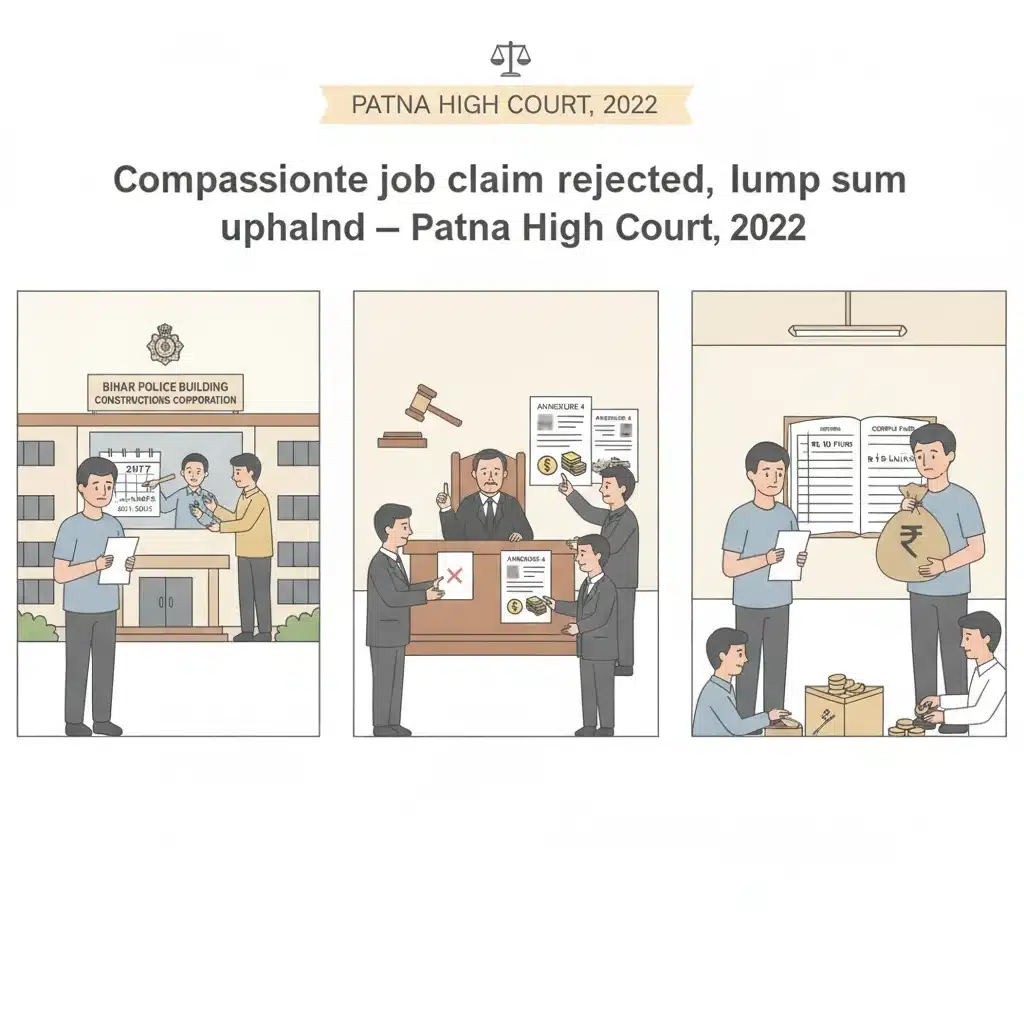
The writ petition was filed before the Patna High Court by the son of a deceased Class IV employee of the Bihar Police Building Constructions Corporation, a Government of Bihar undertaking.
The petitioner’s father died in harness on 24.06.2017 while serving in the Corporation. After his death, the petitioner applied for compassionate appointment in the Corporation.
That application was rejected through an order referred to in the writ case as Annexure 2. The petitioner then approached the Patna High Court under its civil writ jurisdiction, seeking quashing of Annexure 2 and claiming that he was entitled to appointment on compassionate grounds and other monetary benefits.
What the Court Examined and Decided
Hon’ble Mr Justice Madhuresh Prasad heard the matter. The State counsel clarified at the outset that the real contesting parties in this writ case were Respondents 3 to 6, namely the Bihar Police Building Constructions Corporation and its senior officers. These respondents had already filed a counter affidavit and were represented by their own counsel.
The central dispute was about the nature and extent of benefit that a dependent can claim when an employee of the Corporation dies in harness. The petitioner wanted a compassionate appointment and argued that he had not received all the benefits legally due to him under the Corporation’s own office orders.
On the other side, the Corporation relied upon two office orders, both dated 31.03.2015, to justify its stand. These documents were marked in the record as Annexure 3 and Annexure 4.
Annexure 4 is Office Order bearing Memo No. HQ 1885. From the pleadings, the Court noted that by this order the Corporation considered the fact that many applications for compassionate appointment were lying pending for long periods. The Corporation also took into account that it was facing financial crunch and other administrative difficulties, and therefore was not in a position to offer jobs on compassionate grounds.
Keeping these constraints in mind, the Corporation, through Annexure 4, decided to change its approach. Instead of providing compassionate appointments to dependents of employees who died in harness, the Corporation decided to provide a lump sum monetary payment to such dependents.
On the same date, i.e., 31.03.2015, the Corporation issued another Office Order bearing Memo No. HQ 1890, which was placed on record as Annexure 3. By this second order, the Corporation established a corpus fund of Rs 10 lakhs.
This corpus fund was to be maintained through a monthly contribution of Rs 100 from each employee, which would be deducted from their salaries. The purpose of this fund was to ensure that when an employee died in harness, his or her dependents would receive a one-time lump sum amount from this corpus.
In the counter affidavit filed before the Court, the Corporation clearly stated that, in accordance with these two office orders, it had paid an amount of Rs 10 lakhs to the petitioner because of the death of his father while in service.
Importantly, the petitioner did not deny or dispute having received this amount of Rs 10 lakhs. The dispute raised before the Court was not about the payment itself, but about the interpretation of the two office orders of 31.03.2015.
The petitioner’s counsel argued that Annexure 4, the Office Order with Memo No. HQ 1885, provided a benefit that was separate and distinct from the corpus fund payment under Annexure 3. According to him, Annexure 4 created an entitlement in favour of dependents for some monetary benefit over and above the Rs 10 lakhs provided under the corpus fund.
In substance, the petitioner was asking the Court to read Annexure 4 as an independent source of additional benefit, apart from what was paid through the corpus fund under Annexure 3. That is how he attempted to support his challenge to the rejection of compassionate appointment and to claim more benefits.
The Court examined this contention closely. It noted that both Annexure 3 and Annexure 4 are office orders of the same Corporation, issued on the same date, and dealing with the same subject: relief to dependents of employees who die in harness.
The Court observed that Annexure 4 talks about granting lump sum payment to dependents of employees who have died or may die in harness, instead of offering them compassionate appointments, because of the Corporation’s financial crunch and other limitations.
Annexure 3, issued on the same date, sets up a corpus fund of Rs 10 lakhs and provides that an amount from this fund will be paid to the dependents of employees who die in harness. It also lays down how the corpus will be created, i.e., through monthly contributions of Rs 100 from all employees.
From a plain reading of the two office orders together, the Court found that they are not separate schemes offering two different kinds of benefits. Instead, they are complementary parts of one single policy decision.
The policy decision was: since the Corporation is not in a position to provide compassionate appointments, it will instead provide one-time financial assistance in the form of a lump sum payment to dependents. Annexure 4 expresses this decision in principle, and Annexure 3 sets out the mechanism and amount for implementing that decision, namely the Rs 10 lakh corpus fund.
The Court therefore held that these two orders must be read harmoniously. When read together, they clearly show that the Corporation’s intention was to provide only one lump sum financial benefit in place of compassionate appointment.
The Court categorically rejected the petitioner’s attempt to treat Annexure 4 as creating a separate, additional entitlement. It held that Annexure 4 cannot be read so as to confer any other benefit beyond the payment of Rs 10 lakhs from the corpus fund created under Annexure 3, i.e., Office Order No. HQ 1890.
Having already received the Rs 10 lakh amount from the corpus fund, the petitioner was found to have no further claim under that policy. There was, therefore, no basis for challenging the rejection of his claim for compassionate appointment or for demanding any further financial benefit.
On this reasoning, the Court concluded that the petitioner’s claim was legally untenable. The intent of the Corporation’s policy, as revealed by a harmonious reading of the two office orders, was to provide a single lump sum payment and not to continue or revive compassionate appointment as a matter of right.
Accordingly, the Court held that the writ application was devoid of merit. The petition was dismissed, and no further relief was granted to the petitioner.
Why This Judgment Matters
This judgment is important for employees and their families working in government undertakings like the Bihar Police Building Constructions Corporation.
It clarifies that if an employer has formally replaced compassionate appointments with a one-time lump sum financial benefit, dependents cannot insist on both a job and an additional cash benefit unless the policy itself clearly provides for it.
The Patna High Court has shown that where two office orders are issued on the same date and deal with the same subject, they must be read together. If the combined reading reveals a single, clear policy, the Court will not allow dependents to claim extra benefits by isolating one order from the other.
For families of deceased employees, this decision underlines the need to carefully understand the exact policy of their employer regarding death-in-service benefits, and not to assume that compassionate appointment remains available if the employer has moved to a lump sum scheme.
Legal Issues and Answers
Issue: Whether the petitioner, as a dependent of an employee who died in harness, was entitled to compassionate appointment or any additional benefit beyond the lump sum amount of Rs 10 lakhs already paid from the corpus fund created by the Corporation’s office orders dated 31.03.2015.
Answer: No. The Patna High Court held that the two office orders dated 31.03.2015 are complementary and form a single policy providing only a one-time lump sum payment of Rs 10 lakhs in place of compassionate appointment, and the petitioner, having received this amount, had no further enforceable claim.
Cases Cited by the Court
- No prior judgments are cited or relied upon in the text of this decision.
Case Details
Case Number: Civil Writ Jurisdiction Case No. 9650 of 2021
Case Title: Lalit Ranjan Das v. The State of Bihar & Ors.
Coram: Hon’ble Mr Justice Madhuresh Prasad
Citation: 2022 (4) PLJR 493
Advocates: For the petitioner: M/s Pramod Kr Sinha, Chetan Kr, Advocates. For the State: Mr Manoj Kr, AC to GP IV. For Respondents 3 to 6 (Bihar Police Building Constructions Corporation and its officers): M/s K K Upadhyay, C B Das, Advocates.
Nature of the Case: Writ petition under civil writ jurisdiction challenging rejection of application for compassionate appointment and related benefits after death in harness of a Corporation employee.
Court: High Court of Judicature at Patna
Date of Judgment: 23.06.2022
Link to Judgment: Click here to access the official Patna High Court judgment
If you found this explanation helpful and wish to stay informed about
how legal developments may affect your rights in Bihar,
you may consider following Samvida Law Associates for more updates.




