

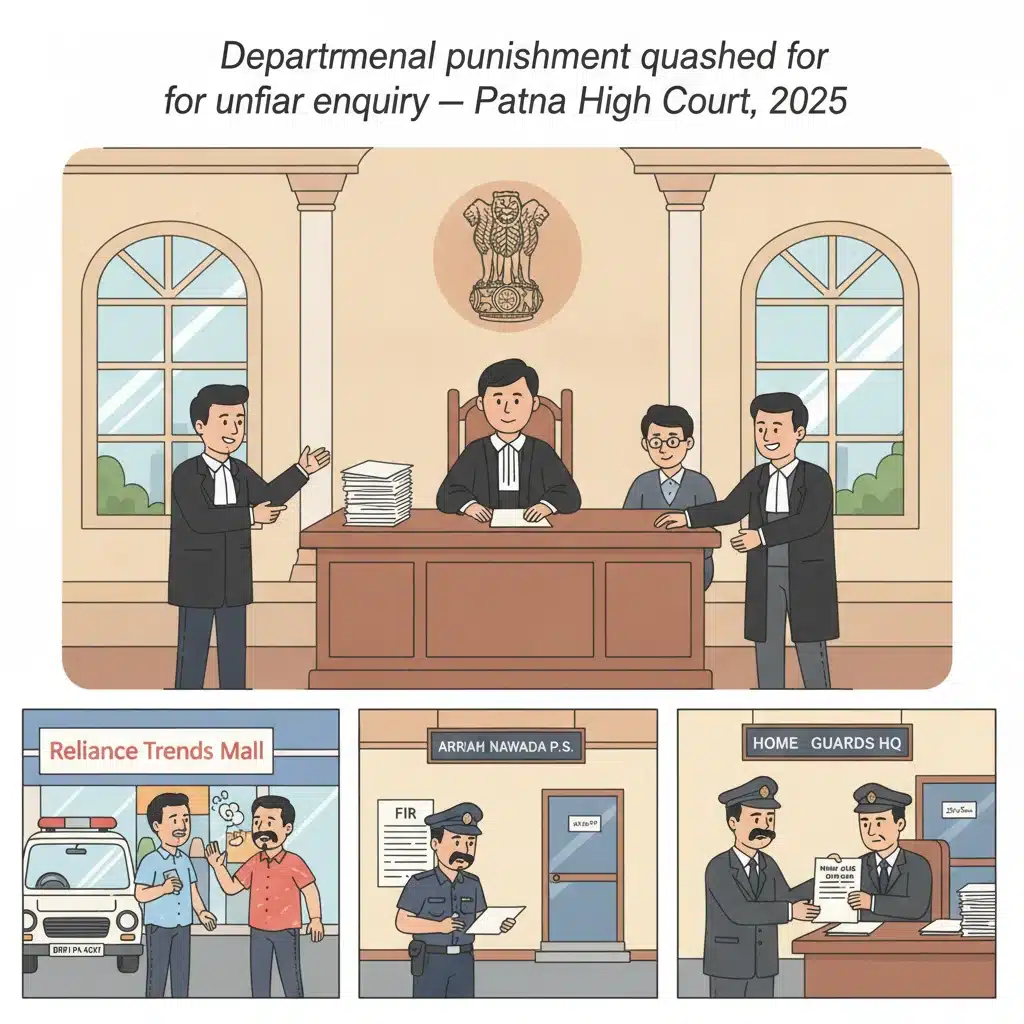
Case Background
The case arose from departmental action against a government servant serving under the Home (Special Branch) Department, State of Bihar. He was accused of leaving his headquarters without permission, taking a departmental vehicle to his home district Bhojpur, and misbehaving at a Reliance Trends Mall in an allegedly drunken state.
An FIR was lodged regarding the alleged incident at the mall, leading to Excise Case No. 370 of 2017 arising out of Arrah Nawada P.S. Case No. 104 of 2017. The case involved allegations of consumption of liquor and verbal abuse under the Bihar Prohibition and Excise Act, 2016.
Parallel to the criminal case, the departmental authorities suspended the petitioner and started a departmental enquiry on the recommendation of the Deputy Inspector General of Police-cum-Deputy Commandant General, Home Guard and Fire Services, Bihar.
After the enquiry, the Additional Chief Secretary, Home (Special Branch) passed order dated 03.07.2019 contained in Memo No. 7006. The petitioner was punished with withholding of five annual increments with cumulative effect and was denied any salary beyond subsistence allowance for the suspension period.
The petitioner filed an appeal which was treated as a review. By order dated 18.10.2019, the Additional Chief Secretary rejected the review and upheld the punishment, mentioning that the criminal court had not issued any direction to the department.
Aggrieved, the petitioner approached the Patna High Court under its civil writ jurisdiction in CWJC No. 3062 of 2020, challenging both the punishment order dated 03.07.2019 and the review order dated 18.10.2019, as well as the entire departmental proceeding.
What the Court Examined and Decided
The petitioner’s counsel made a focused attack on the fairness and legality of the departmental enquiry. The first point was that the memo of charge itself was defective because it did not include any list of witnesses, though Rule 17(3) of the Bihar Government Servants (Classification, Control and Appeal) Rules, 2005 requires this.
According to the petitioner, no material witness was examined at all to support the charges. The entire enquiry was allegedly conducted in a single day without giving him a proper opportunity to defend himself or cross-examine any witness. This, it was argued, showed mala fide and lack of fairness in the process.
The petitioner also argued that apart from the allegation of unauthorised use of a government vehicle, the allegations related to verbal abuse of an employee of Reliance Trends Mall under the influence of liquor were not proved in the criminal trial. He relied on the acquittal order dated 13.02.2019 in Excise Case No. 370 of 2017, where the trial court held that no evidence of drinking wine or abusive words had been proved against him and therefore the prosecution had failed under Section 37 of the Bihar Prohibition and Excise Act, 2016.
Another major argument was that the finding of alcohol consumption was based only on a breath analyser test. The petitioner, relying on the Supreme Court judgment in Bachubhai Hassanalli Karyani v. State of Maharashtra [(1971) 3 SCC 930] and a Division Bench decision of the Patna High Court in Manju Devi v. The State of Bihar and Others [2024 SCC Online Pat 2324], contended that without blood and urine tests, a breath analyser report alone cannot conclusively prove consumption of liquor.
To challenge the mode of proof in the departmental enquiry, he relied on Roop Singh Negi v. Punjab National Bank & Others [(2009) 2 SCC 570]. The Supreme Court in that case had held that charges in departmental proceedings must be established through oral evidence and that documents not proved by witnesses cannot be treated as evidence. He argued that Rule 17(3) and (4) of the Rules, 2005 had been violated because there was no proper list of documents and witnesses and no oral evidence was recorded.
He further relied on Capt. M. Paul Anthony v. Bharat Gold Mines Ltd. and Another [(1993) 3 SCC 679], G.M. Tank v. State of Gujarat and Others [(2006) 5 SCC 446] and Ram Lal v. State of Rajasthan and Others [(2024) 1 SCC 175]. These decisions, he claimed, show that when criminal and departmental proceedings are based on identical charges, evidence, witnesses and circumstances, and when the criminal court has fully evaluated the evidence and acquitted the accused because the prosecution failed, the court in judicial review can interfere with the disciplinary authority’s findings if those findings are unjust, unfair and oppressive.
The State’s counsel responded that the petitioner had indeed violated the Bihar Government Servant Conduct Rules by leaving headquarters without permission with the departmental vehicle and that he had allegedly abused an employee of Reliance Trends Mall under the influence of alcohol, which led to the FIR. The State argued that a proper memo of charge was served, his defence was considered, and three out of four charges were found proved by the Enquiry Officer. The disciplinary authority examined the record and imposed a proportionate punishment. The review was rejected as having no merit.
The State further submitted that criminal acquittal does not automatically control departmental proceedings, as departmental charges are proved on the standard of “preponderance of probabilities” and not “beyond reasonable doubt”. Therefore, the High Court, while exercising judicial review, should not re-appreciate evidence like an appellate court.
The Patna High Court began by analysing Rule 17 of the Rules, 2005. It recorded that Rule 17 provides a complete scheme for departmental enquiries. Rule 17(3) requires the disciplinary authority to furnish a list of documents and a list of witnesses by whom the charges are proposed to be proved. Rule 17(4) requires that a copy of the articles of charge, the statement of imputations, and the list of documents and witnesses must be delivered to the charged officer, who should then be asked to submit his written defence.
Rule 17(14) further mandates that on the date fixed for enquiry, the oral and documentary evidence must be produced by or on behalf of the disciplinary authority and that witnesses must be examined by the Presenting Officer, with rights of cross-examination and re-examination. After completion of the enquiry, Rule 17(23) requires the Enquiry Officer to submit a report to the disciplinary authority.
The Court found that these mandatory provisions had not been followed. The memo of charge did not contain any list of witnesses. As documentary evidence, only two documents were relied upon: a letter dated 17.04.2016 from the Superintendent of Police, Bhojpur, and an application dated 16.04.2017 filed by Pintu Kumar, an employee of Reliance Trends Mall. No oral evidence was recorded to prove the contents of these documents. The Court observed that without oral testimony, the mere filing of documents cannot prove their contents.
The Court noted from the record that the enquiry was concluded in a single day. This, according to the Court, clearly showed that the petitioner was not given a proper opportunity of hearing and that no witnesses were examined. As a result, he was deprived of his right to cross-examine, which is central to a fair enquiry.
Relying on Roop Singh Negi, the Court held that the charges must be found proved on the basis of evidence duly brought on record. The Supreme Court had emphasised that documents tendered without examination of witnesses cannot be treated as evidence. The Court also cited State of Uttar Pradesh and Others v. Saroj Kumar Sinha [(2010) 2 SCC 772], where the Supreme Court described the role of the Enquiry Officer as a quasi-judicial authority, emphasised that even in ex parte enquiries the department must lead oral evidence, and reiterated that natural justice requires a reasonable opportunity to the employee.
Quoting extensively from Saroj Kumar Sinha, the Court stressed that an enquiry officer is not a representative of the department but an independent adjudicator, that enquiries cannot be casual, and that justice must not only be done but be seen to be done. The Court concluded that the departmental enquiry in this case, completed in a single day without oral evidence, was neither reasonable nor fair.
On the alcohol-related charge, the Court examined the reliance on the breath analyser test. Referring to the legal position emerging from Bachubhai Hassanalli Karyani and Manju Devi, the Court reiterated that unless blood and urine tests are carried out, mere breath analyser readings or outward signs like smell of alcohol, unsteady gait, dilated pupils or incoherent speech are not sufficient to conclusively establish consumption of liquor. In this case, there was no urine or blood report at all, so the conclusion that the petitioner had consumed alcohol and acted under its influence could not stand.
The Court then considered the effect of the petitioner’s acquittal in the criminal case. It carefully noted that generally an acquittal in criminal proceedings does not give an automatic right to claim relief in departmental proceedings, because the standards of proof differ. However, it also acknowledged the line of Supreme Court decisions in Capt. M. Paul Anthony, G.M. Tank and Ram Lal, which hold that when departmental and criminal proceedings are based on identical charges, evidence and circumstances and when the criminal court has examined the prosecution case fully and acquitted the accused due to complete failure of proof, a writ court can interfere if the disciplinary findings are unjust, unfair or oppressive.
Referring to the trial court’s judgment, the High Court noted that the criminal court had clearly held that there was no evidence of drinking wine or of any abusive words by the petitioner and therefore acquitted him. This added weight to the petitioner’s contention that the departmental findings on intoxication and abuse were unsustainable.
The Court also examined the orders passed by the disciplinary authority and the reviewing authority. It found that these orders did not deal with the petitioner’s detailed reply to the second show cause notice or the grounds raised in the review. The authorities merely stated that no new facts were raised and mechanically reiterated the Enquiry Officer’s findings.
The Court referred to its earlier decision in Shekhar Chandra Verma v. The State of Bihar and Others [(2014) 1 PLJR 532], which held that giving reasons is part of natural justice in quasi-judicial orders. Citing Supreme Court decisions in Siemens Engineer & Manufacturing Co. of India Ltd. v. Union of India [AIR 1976 SC 1785] and S.N. Mukherjee v. Union of India [1990 SC 1984], the Court reiterated that reasoned orders are mandatory.
On this analysis, the Court concluded that there were serious violations of the statutory Rules, 2005, lack of fair opportunity, absence of oral evidence, improper reliance on breath analyser results, non-consideration of the petitioner’s defence, and non-speaking punishment and review orders. It held that the proceedings were actuated by mala fide and unfairness and that the memo of charge itself stood vitiated due to infraction of statutory provisions.
Accordingly, the Court set aside the punishment order dated 03.07.2019 (Memo No. 7006), the review order dated 18.10.2019, and the entire departmental proceedings. It directed the respondents to reinstate the petitioner with all consequential benefits. At the same time, the Court clarified that the authorities were not barred from initiating a fresh proceeding in accordance with law, if so advised.
Why This Judgment Matters
This judgment is important for government employees and uniformed services staff in Bihar and beyond. It shows that even when the government alleges serious misconduct, including misuse of official vehicles or intoxication, the enquiry must strictly follow the service rules and principles of natural justice.
The Patna High Court has made it clear that an enquiry completed in one day without examining witnesses and without giving the delinquent officer a real chance to defend himself will not be upheld. Documentary material cannot be treated as proof unless supported by witness testimony.
The ruling also highlights that breath analyser results alone, without supporting medical evidence like blood or urine tests, are not sufficient to conclusively prove consumption of liquor, especially when a criminal court has already found that the prosecution failed to prove such charge.
Finally, the judgment underlines that disciplinary and reviewing authorities must pass reasoned, speaking orders. Simply copying the Enquiry Officer’s report or saying “no new facts” is not enough. This protects employees from arbitrary decisions and guides departments on how to conduct fair enquiries.
Legal Issues and Answers
- Issue: Whether the departmental enquiry and punishment imposed on the petitioner complied with Rule 17 of the Bihar Government Servants (Classification, Control and Appeal) Rules, 2005 and principles of natural justice.
Answer: No. The Patna High Court held that there were serious violations of Rule 17, including absence of a witness list, no oral evidence, conclusion of enquiry in a single day, and denial of fair opportunity, which vitiated the entire proceeding. - Issue: Whether reliance on a breath analyser test alone was sufficient to prove consumption of alcohol and misconduct in the departmental proceeding.
Answer: No. The Court held that without blood and urine test reports and in light of the petitioner’s acquittal in the criminal case, the finding of alcohol consumption based solely on breath analyser was not convincing or sustainable in law. - Issue: Whether the punishment and review orders were legally sustainable in the absence of reasoned consideration of the petitioner’s defence and grounds.
Answer: No. The Court found that both orders suffered from non-application of mind and lacked discussion of the petitioner’s reply and review grounds, rendering them illegal and liable to be set aside.
Cases Cited by the Court
- Bachubhai Hassanalli Karyani v. State of Maharashtra [(1971) 3 SCC 930]
- Manju Devi v. The State of Bihar and Others [2024 SCC Online Pat 2324]
- Roop Singh Negi v. Punjab National Bank and Others [(2009) 2 SCC 570]
- State of Uttar Pradesh and Others v. Saroj Kumar Sinha [(2010) 2 SCC 772]
- Capt. M. Paul Anthony v. Bharat Gold Mines Ltd. and Another [(1993) 3 SCC 679]
- G.M. Tank v. State of Gujarat and Others [(2006) 5 SCC 446]
- Ram Lal v. State of Rajasthan and Others [(2024) 1 SCC 175]
- Shekhar Chandra Verma v. The State of Bihar and Others [(2014) 1 PLJR 532]
- Siemens Engineer & Manufacturing Co. of India Ltd. v. Union of India [AIR 1976 SC 1785]
- S.N. Mukherjee v. Union of India [1990 SC 1984]
Case Details
Case Number: Civil Writ Jurisdiction Case No. 3062 of 2020
Case Title: Harendra Kumar Singh v. The State of Bihar & Others
Court: High Court of Judicature at Patna
Coram: Hon’ble Mr. Justice Harish Kumar
Date of Judgment: 05-05-2025
Advocates for Petitioner: Mr. Arvind Kumar Tiwary, Advocate; Mr. Sunil Singh, Advocate; Ms. Akansha Verma, Advocate
Advocates for Respondents: Md. N.H. Khan, SC-1; Md. Fazle Karim, AC to SC-1
Respondents: State of Bihar and departmental authorities of Home (Special Branch) and Home Guards
Nature of Case: Writ petition challenging departmental punishment and related orders arising out of disciplinary proceeding.
Link to Judgment: https://patnahighcourt.gov.in/viewjudgment/MTUjMzA2MiMyMDIwIzEjTg==-xxlxzKvR0W4=
If you found this explanation helpful and wish to stay informed about
how legal developments may affect your rights in Bihar,
you may consider following Samvida Law Associates for more updates.




