

Case Background
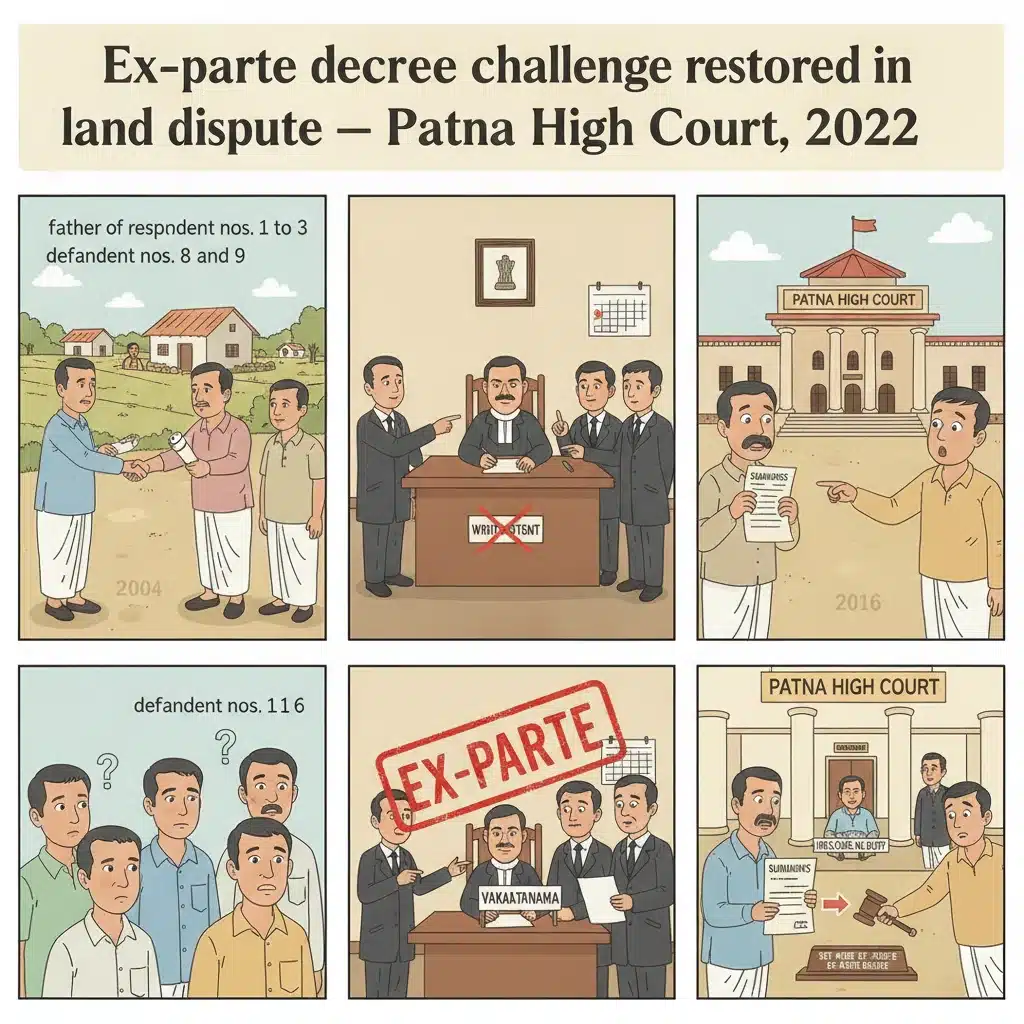
The dispute started with Title Suit No. 557 of 2004 filed by the father of respondent nos. 1 to 3 as plaintiff in the court of the Sub Judge-I, Gopalganj.
The plaintiff asked the civil court to declare his right and title over certain suit land in village Bhitbherwa, P.S. Gopalganj, District Gopalganj. He also requested a declaration that the defendants had no right to interfere with his possession, and added a prayer for recovery of possession.
The plaintiff’s claim was based on registered sale deeds dated 02.12.1988 executed by defendant no. 7 in his favour. There were nine defendants in the suit, divided as defendant nos. 1 to 6 (the present petitioners) and defendant nos. 7 to 9.
Defendant nos. 1 to 6 first appeared on 02.02.2005 through a vakalatnama and sought time to file their written statement. Defendant nos. 7 to 9 appeared on 10.02.2005 and filed a written statement that supported the plaintiff’s case. Further time was again sought for filing written statement on behalf of defendant nos. 1 to 6.
On 04.04.2005, as no written statement came from defendant nos. 1 to 6, the trial court debarred them from filing written statement and fixed the matter for ex-parte hearing against them.
On 24.08.2006, the Sub Judge-I, Gopalganj decreed the suit. Defendant nos. 1 to 6 were directed to hand over possession of the suit property to the plaintiff within 30 days. The decree was ex-parte against defendant nos. 1 to 6 and on contest against defendant nos. 7 to 9.
After about ten years, the plaintiff-decree holder filed Execution Case No. 26 of 2016 to execute this decree. Summons were then issued to the judgment debtors, including the present petitioners.
According to the petitioners, it was only when they received these execution summons that they first came to know about the ex-parte judgment and decree passed in 2006.
What the Court Examined and Decided
On learning of the decree, the petitioners filed Misc. Case No. 02 of 2017 under Order IX Rule 13 of the Code of Civil Procedure, 1908 (CPC). They sought setting aside of the ex-parte judgment and decree of 24.08.2006.
Their key grounds were: first, that the summons in the title suit had never been served upon them; and second, that on inspection of the records they discovered a vakalatnama filed on their behalf by one Advocate Vijay Kumar Prasad, which they claimed they had never executed nor authorised.
The Sub Judge-I, Gopalganj dismissed Misc. Case No. 02 of 2017 at the very stage of admission by order dated 13.01.2017. The court held that an application under Order IX Rule 13 CPC was not maintainable, because the petitioners had appeared through vakalatnama, had taken time to file written statement, and were therefore aware of the suit but chose not to contest it.
Against this, the petitioners filed Misc. Appeal No. 02 of 2017 before the Additional District Judge-V, Gopalganj. On 18.12.2017, the appellate court dismissed the appeal, again on the reasoning that the application itself was not maintainable.
The petitioners then approached the Patna High Court in Civil Miscellaneous Jurisdiction No. 339 of 2018 challenging these two orders.
Before the High Court, their counsel argued in simple terms that even if it is assumed that vakalatnama was filed and then they stopped appearing, the decree against them is an ex-parte decree within the meaning of the CPC. Therefore, a petition under Order IX Rule 13 is fully maintainable and cannot be rejected at the threshold.
He relied upon Order IX Rule 6(1)(a) CPC, which deals with the situation where the plaintiff appears but the defendant does not when the suit is called on for hearing. In such a case, if summons has been duly served, the court may order that the suit be heard ex-parte.
Counsel then read this along with Order XVII Rule 2 CPC. This provision empowers the court, when parties fail to appear on an adjourned date, to dispose of the suit in one of the modes provided in Order IX. The argument was that once the trial court itself treated the matter as ex-parte against defendant nos. 1 to 6, the decree must be treated as an ex-parte decree, and therefore the remedy under Order IX Rule 13 was naturally available.
In support, he cited three decisions: Prakash Chander Manchanda and Another v. Smt. Janki Manchanda (AIR 1987 SC 42), G. Ratna Raj (D) by L.Rs. v. Sri Muthukumarasamy Permanent Fund Ltd. and Another (2019 (1) PLJR (SC) 596), and Ahmadi Khatoon and Another v. Md. Taslim and Others (2004 (4) PLJR 193).
The petitioners’ counsel also pointed out that their Misc. Case had not been rejected on the ground that they failed to show sufficient cause, but solely on the technical ground that such a petition was not maintainable at all.
On the other hand, the respondents’ senior counsel defended the orders of the courts below. He argued that both courts had looked into the records and found that summons had in fact been validly served on defendant nos. 1 to 6. After service, they filed vakalatnama, sought time to file written statement, and later left the case unattended.
According to the respondents, the petitioners were making a false and misleading statement by claiming non-service of summons. This was, in their view, only an attempt to misuse Order IX Rule 13 CPC, which allows setting aside of an ex-parte decree if summons were not duly served, or if the defendant was prevented by sufficient cause from appearing when the suit was called for hearing.
The respondents stressed that the petitioners had elected to rely only on the first limb, i.e. non-service of summons, which was factually incorrect. Because of this, they argued, the petition was rightly rejected.
The respondents further pointed to the second proviso to Order IX Rule 13 CPC, which states that any irregularity in service of summons shall not by itself be a ground to set aside an ex-parte decree.
They also raised a limitation objection under Article 123 of the Limitation Act. This article provides a period of 30 days for filing an application to set aside an ex-parte decree, from the date of decree, or where summons were not served, from the date when the applicant had knowledge of the decree. Since the decree was of 24.08.2006 and the application was filed in 2017, the respondents contended that it was hopelessly time-barred, and that the plea of non-service was being taken only to avoid limitation.
For these propositions, the respondents relied on Firoz Khan and Others v. Bibi Hasina Khanam and Others (AIR 1994 PATNA 103), Kamlesh Kohli (SMT) and Another v. Escotrac Finance and Investment Ltd. and Others ((2000) 1 SCC 324), Bharat Petroleum Corporation Limited and Another v. N. R. Vairamani and Another (AIR 2004 SC 4778) and Sunil Poddar and Others v. Union Bank of India ((2008) 2 SCC 326).
Justice Anil Kumar Sinha of the Patna High Court examined the legal position in detail.
The Court first analysed the Supreme Court decision in Prakash Chander Manchanda. There, it had been held that if on the date of hearing one party is absent and no evidence has been examined up to that date, the court must proceed under Order XVII Rule 2 CPC and dispose of the suit in one of the modes provided in Order IX. This leads to an ex-parte decree when the absent party is the defendant.
The Court then considered the later Supreme Court ruling in G. Ratna Raj (D) by L.Rs., where it was held that if defendants are proceeded ex-parte and have not led any evidence, the court can only proceed under Order XVII Rule 3(b) read with Rule 2, again resulting in an ex-parte decree under Order IX Rule 6(a). The Supreme Court had clearly characterised such a decree as an “ex-parte decree” which could be set aside under Order IX Rule 13 on sufficient grounds.
The Patna High Court also referred to its own earlier decision in Ahmadi Khatoon, which held that mere prior appearance of defendants at some stage does not automatically convert a decree into a contested one. If, at the stage of hearing, the suit proceeds ex-parte, the decree remains ex-parte.
Applying these principles, the High Court turned to the record of Title Suit No. 557 of 2004. From paragraph 3 of the trial court’s judgment, it noted that defendant nos. 1 to 6 had been debarred from filing written statement, and the suit was specifically “fixed for ex-parte hearing” against them. The suit was decreed on contest against defendant nos. 7 to 9 but ex-parte against defendant nos. 1 to 6.
It was also clear that the evidence of the petitioners had never been recorded. Therefore, the Explanation to Order XVII Rule 2, which allows the court to proceed as if a party were present where substantial evidence had already been recorded, did not apply.
On these facts, the Court held that the trial court had indeed proceeded ex-parte against defendant nos. 1 to 6 under Order IX Rule 6(1)(a) read with Order XVII Rule 2 CPC. The resulting decree, so far as they were concerned, was an ex-parte decree.
From this, the High Court drew the key legal conclusion: when a decree is ex-parte, a petition under Order IX Rule 13 CPC is clearly maintainable. The fact that defendants had once appeared and then stopped contesting does not turn the decree into a contested one.
Justice Sinha further observed that the courts below had rejected the petitioners’ Misc. Case and Misc. Appeal solely on maintainability, without going into the factual questions of service of summons, genuineness of vakalatnama, sufficient cause for absence, or limitation. Those issues required proper enquiry and appreciation of evidence, which had not been done.
Therefore, the High Court found the decisions cited by the respondents inapplicable at this stage and declined to uphold the rejection on limitation, since the application had never been examined on merits.
The Court noted that in Misc. Case No. 02 of 2017, the petitioners had actually taken both possible grounds under Order IX Rule 13: non-service of summons and being prevented by sufficient cause from appearing. They also claimed that any vakalatnama on record was not executed by them and that they only came to know of the decree after receiving execution summons in 2016.
These are all questions of fact which, the Court held, must be tested by the trial court through proper procedure under Order IX Rule 13 read with Section 141 CPC. Summary rejection at the admission stage was not justified.
On this reasoning, the Patna High Court set aside the order dated 18.12.2017 in Misc. Appeal No. 02 of 2017 and the order dated 13.01.2017 in Misc. Case No. 02 of 2017. The matter has been remanded to the Sub Judge-I, Gopalganj.
The trial court has been directed to consider the petitioners’ application under Order IX Rule 13 CPC on its merits, follow the proper procedure, and also consider and decide any objections which the respondents may raise. The civil miscellaneous application before the High Court was allowed, with no order as to costs.
Why This Judgment Matters
This judgment is important for anyone against whom a civil court has passed an ex-parte decree, especially in land and property disputes.
First, the Patna High Court has reaffirmed that if a trial court itself fixes a case for ex-parte hearing and passes a decree against a defendant who is absent, the decree is an ex-parte decree. This is so even if that defendant had earlier appeared or filed a vakalatnama but later stopped coming.
Second, when a decree is ex-parte, the remedy under Order IX Rule 13 CPC is available. Lower courts cannot refuse to even hear such an application by calling it “not maintainable”. They must hold proper enquiry on facts like service of summons, genuineness of vakalatnama, and sufficient cause for absence.
Third, the High Court has made it clear that limitation and other factual objections should be considered by the trial court on evidence, not used as a shortcut to reject the case without hearing.
For villagers and small landholders, this means that if a decree is passed against them without their participation, they can move the court under Order IX Rule 13, and the court is bound to examine their grievance in detail.
Legal Issues and Answers
-
Issue: When a suit is decreed after the court fixes it for ex-parte hearing against certain defendants, is the decree against them an ex-parte decree, even if they had earlier appeared through vakalatnama?
Answer: Yes. The Patna High Court held that once defendants are debarred from filing written statement and the suit is fixed and heard ex-parte against them, the decree is an ex-parte decree within the meaning of Order IX Rule 6(1)(a) CPC. -
Issue: Is an application under Order IX Rule 13 CPC maintainable against such an ex-parte decree, or can it be rejected at the threshold as “not maintainable” on the ground that defendants had earlier appeared?
Answer: The application is maintainable. The Court ruled that where the decree is ex-parte, a petition under Order IX Rule 13 CPC must be entertained and decided on merits, including enquiry into service of summons and sufficient cause for absence. -
Issue: Could the lower courts dismiss the petitioners’ application and appeal without examining factual questions like service of summons, genuineness of vakalatnama, and limitation?
Answer: No. The High Court held that both courts below erred in rejecting the matter at admission stage on maintainability without going into these factual aspects. It set aside their orders and remanded the matter for a full merits examination.
Cases Cited by the Court
- Prakash Chander Manchanda and Another v. Smt. Janki Manchanda, AIR 1987 SC 42.
- G. Ratna Raj (D) by L.Rs. v. Sri Muthukumarasamy Permanent Fund Ltd. and Another, 2019 (1) PLJR (SC) 596.
- Ahmadi Khatoon and Another v. Md. Taslim and Others, 2004 (4) PLJR 193.
- Firoz Khan and Others v. Bibi Hasina Khanam and Others, AIR 1994 PATNA 103.
- Kamlesh Kohli (SMT) and Another v. Escotrac Finance and Investment Ltd. and Others, (2000) 1 SCC 324.
- Bharat Petroleum Corporation Limited and Another v. N. R. Vairamani and Another, AIR 2004 SC 4778.
- Sunil Poddar and Others v. Union Bank of India, (2008) 2 SCC 326.
Case Details
Case Number: Civil Miscellaneous Jurisdiction No. 339 of 2018
Case Title: Mahesh Manjhi & Ors v. Pama Devi & Ors
Coram: Hon’ble Mr. Justice Anil Kumar Sinha
Citation: 2022 (4) PLJR 724
Advocates:
- For the petitioners: Mr. Chandra Kant, Mr. Pankaj Kumar Dubey
- For the respondents: Mr. Rajendra Narayan, Senior Advocate; Mr. Satya Ranjan Sinha; Ms. Seema Kumari
Nature of the case: Civil miscellaneous application under Article 227 CPC challenging orders in Misc. Case and Misc. Appeal regarding maintainability of an application under Order IX Rule 13 CPC to set aside an ex-parte decree in a title suit.
Date of Patna High Court judgment: 24.11.2022
Link to the judgment: NDQjMzM5IzIwMTgjMSNO-2yXnu88HLYY=
If you found this explanation helpful and wish to stay informed about
how legal developments may affect your rights in Bihar,
you may consider following Samvida Law Associates for more updates.




