

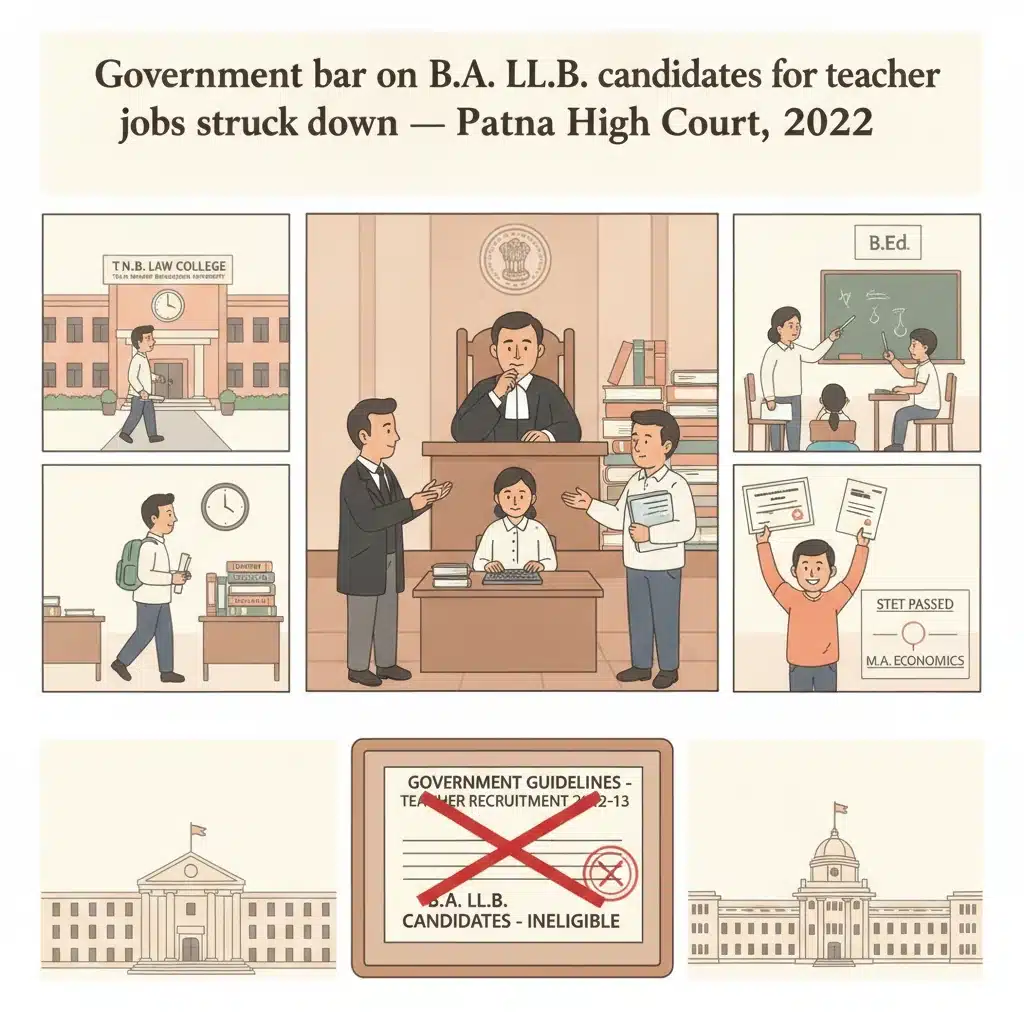
Case Background
The petitioner had completed a five-year integrated B.A. LL.B. course from T.N.B. Law College under Tilka Manjhi Bhagalpur University. In the first two years, known as the Pre-Law stage, he studied Arts subjects like History, Economics and Sociology. Thereafter he completed the remaining three years of law papers and obtained the B.A. LL.B. degree.
After finishing the integrated law course, he chose to move towards teaching. He cleared the Secondary Teacher Eligibility Test (STET). He then completed a B.Ed course in the 2012-13 session from Tilka Manjhi Bhagalpur University with teaching subjects Economics and Political Science. He also obtained a Master’s degree (M.A.) in Economics.
Despite all these qualifications, the petitioner was stopped from participating in the selection process for the post of Assistant Teacher in the Education Department, Government of Bihar. The bar was based on a government decision dated 25.08.2012 and related guidelines dated 07.07.2012.
These guidelines, circulated through departmental letters, treated candidates with integrated five-year B.A. LL.B. or similar degrees as ineligible for appointment as teachers, despite their higher qualifications. Feeling aggrieved, the petitioner approached the Patna High Court through this writ petition (Civil Writ Jurisdiction Case No. 528 of 2016).
What the Court Examined and Decided
The core dispute before the Patna High Court was simple but important: can the State of Bihar deny teaching jobs to candidates who have completed a five-year integrated B.A. LL.B. course, even though they have also completed B.Ed and passed STET?
The petitioner argued that his B.A. LL.B. course gave him graduation-level knowledge in Arts subjects for three years, along with law subjects. On that basis he was rightly admitted to the B.Ed programme, which itself requires two teaching subjects at the graduate level. He successfully completed B.Ed with Economics and Political Science as teaching subjects, and later did an M.A. in Economics.
According to him, he therefore had both the academic qualification in relevant school subjects and the professional teacher training required by the Education Department and the National Council for Teacher Education (NCTE). Yet, due to the State Government’s decision of 25.08.2012 and the related FAQ and guidelines of 07.07.2012, he was treated as ineligible simply because his graduation was in the integrated B.A. LL.B. form.
The petitioner’s counsel submitted that this exclusion was illegal and unjust. The guidelines themselves recognised that for joining B.A. courses one must have two teaching subjects at the graduate level. The petitioner satisfied this requirement through his integrated course and then through B.Ed. Despite having “much higher qualification than the qualification required for the post,” he was being pushed out solely due to the form of his degree.
On the other hand, counsel for the State relied on NCTE guidelines. He argued that, under those norms, a candidate for teacher recruitment must have studied the relevant school subject at the graduate level. The State sought to justify the ouster of B.A. LL.B. degree holders by suggesting that they had not studied the required teaching subjects as regular graduates.
To explain his educational background, the petitioner placed a detailed supplementary affidavit on record. He stated that he took admission in the five-year law course in T.N.B. Law College, Bhagalpur in the 2002-2003 session as a regular student. In the first two years, called Pre-Law Sessions, he studied:
- History – 200 marks (100 marks each year)
- Economics – 100 marks (50 marks each year)
- Sociology – 100 marks (50 marks each year)
He annexed photocopies of mark sheets, admit cards and identity cards to show that he had in fact studied these subjects in the first two years. He also produced the Pre-Law syllabus of T.N.B. Law College and Bishwanath Singh Institute of Legal Studies, both under T.M. Bhagalpur University, to show the chapters and subjects like History, Political Science, Sociology, Economics and English taught at the Pre-Law stage.
The affidavit also explained the delay in completion of his course. Although he had taken admission in 2002-2003, his examinations and results were delayed due to the college and university. His Pre-Law first term result was published in 2004, second term in 2005, LL.B. first term result in 2007, LL.B. Part 2 in 2007 and LL.B. Part 3 final in 2010. The petitioner stated that, but for these delays, he would have completed the five-year LL.B. course in 2007.
The State’s legal submission, however, went beyond the individual facts. It claimed that whether a B.A. LL.B. degree should be treated as equivalent to a standard graduation in Arts was a matter of government policy, not for the court to interfere in. For this, the State relied on a judgment of the Patna High Court in Dara Singh Rabbani vs. Vijay Bank (C.W.J.C. No. 16870 of 2015, decided on 05.05.2016), to argue that the State could set its own standards.
Justice Sanjeev Prakash Sharma, speaking for the Court, carefully examined the nature of integrated law courses in India. He noted that the LL.B. course, being a Bachelor in Law, is taught in universities recognised by the Bar Council of India (BCI). The BCI has framed rules governing all law courses. Originally, LL.B. was a three-year course pursued only after completing graduation in any stream.
Later, based on recommendations of the Directorate of Legal Education and Legal Studies, the BCI introduced a five-year dual degree integrated course. Under this regime, a student who has completed 12th class can directly join an integrated under-graduate course which blends graduation with law. This includes combinations such as:
- B.A. LL.B. (Arts + Law)
- B.Sc. LL.B. (Science + Law)
- BBA LL.B. (Business Management + Law)
- B.Com LL.B. (Commerce + Law)
These subjects and law papers are all part of BCI Rules. After five years, students are conferred a joint degree, for example B.A. LL.B. The Court observed that, after passing this integrated course, a student is free to pursue further studies either in the streams of Arts, Science or Commerce, or in Law.
In the present case, the petitioner chose to continue in the field of Economics and Social Sciences. He obtained B.Ed with Economics and Political Science as teaching subjects and passed the STET examination, which is a precondition for appointment as Assistant Teacher.
On these facts, the Court held that it could not be said that the petitioner lacked knowledge of the relevant subjects at graduate level. He had studied Arts subjects during the integrated course, then further specialised through B.Ed and M.A. The State Government’s decision to treat him and similarly placed B.A. LL.B. degree holders as ineligible for teacher selection was, therefore, unsustainable.
Justice Sharma found that this exclusion was contrary to the Bar Council of India Rules framed under the Advocates Act, 1961. These rules recognise the integrated five-year law courses and treat them as proper under-graduate degrees combined with law. An administrative decision of the State Government, which has no statutory backing, cannot override such statutory rules.
The Court also noted that there was no decision of the National Council for Teacher Education (NCTE) that disqualified candidates with integrated B.A. LL.B. degrees from teacher recruitment. On the contrary, the petitioner had been allowed to pursue and complete a B.Ed course recognised by NCTE. Therefore, it was incorrect for the State to take shelter under NCTE guidelines to deny recognition to his integrated degree.
In view of all this, the Court held that the State Government’s decision dated 25.08.2012, as communicated through the FAQ, was “bad in law” and deserved to be set aside. It declared that students who have passed B.A. LL.B. or similar under-graduate five-year integrated courses are entitled to participate in the selection process for teacher posts, provided they also possess B.Ed and have passed the Teacher Eligibility Test.
Specifically, the Court directed that the petitioner’s candidature must now be considered accordingly. If he is found to be within the zone of merit, the respondents must consider him for appointment as Assistant Teacher. With these directions, the writ petition was allowed.
Why This Judgment Matters
This judgment has a direct impact on candidates in Bihar who have completed integrated five-year B.A. LL.B. or similar courses and want to become school teachers. Earlier, a government decision had closed the door on them, regardless of their B.Ed and TET qualifications.
The Patna High Court has now made it clear that such integrated graduates cannot be discarded merely because their degree combines Arts or Science with Law. If they have the prescribed teacher training (B.Ed) and pass the Teacher Eligibility Test, they must be allowed to compete for Assistant Teacher posts.
The judgment also reinforces that administrative circulars and FAQs issued by departments cannot override statutory rules framed by bodies like the Bar Council of India. Where a professional course like B.A. LL.B. is recognised under law, the State cannot ignore that recognition while drafting recruitment rules.
For aspirants across Bihar, especially those from integrated law courses, this decision opens up an additional career path in school teaching that had been blocked by the 2012 policy.
Legal Issues and Answers
- Issue: Can the State Government, by an administrative decision, declare candidates with five-year integrated B.A. LL.B. degrees ineligible for Assistant Teacher posts, even when they have B.Ed and have passed the Teacher Eligibility Test?
Answer: No. The Patna High Court held that such a decision is contrary to Bar Council of India Rules framed under the Advocates Act, 1961, has no statutory force, and is therefore bad in law. - Issue: Does a five-year integrated B.A. LL.B. degree count as graduation in relevant subjects for the purpose of teacher recruitment?
Answer: Yes. The Court treated the integrated course as providing graduation-level study in Arts, Science, Commerce or related streams, and held that candidates who have also completed B.Ed and TET cannot be denied participation in teacher selection. - Issue: Is there any NCTE bar on B.A. LL.B. integrated graduates participating in teacher recruitment?
Answer: No. The Court found no such NCTE decision and noted that the petitioner had been allowed to pursue a recognised B.Ed course, undermining the State’s claim that NCTE did not recognise his integrated degree.
Cases Cited by the Court
- The State relied on the Patna High Court decision in Dara Singh Rabbani vs. Vijay Bank, C.W.J.C. No. 16870 of 2015, decided on 05.05.2016, to argue that equivalence of degrees is a policy matter. The present judgment notes this citation but ultimately does not follow it to uphold the State’s position.
Case Details
Case Number: Civil Writ Jurisdiction Case No. 528 of 2016
Case Title: Hemant Kumar vs. The State of Bihar & Others
Coram: Hon’ble Mr. Justice Sanjeev Prakash Sharma
Citation: 2022 (4) PLJR 775
Nature of the Case: Writ petition challenging State Government decision and recruitment guidelines regarding eligibility for Assistant Teacher posts
Advocates:
- For the Petitioner: Mr. Rajesh Ranjan, Advocate
- For the State/Respondents: Mr. Sheo Shankar Prasad, SC-8
- For the University: Mr. Diwakar Yadav, Advocate
Date of Judgment: 23-06-2022
Court: High Court of Judicature at Patna
Link to the Judgment: Click here to read the full Patna High Court judgment
If you found this explanation helpful and wish to stay informed about how legal developments may affect your rights in Bihar, you may consider following Samvida Law Associates for more updates.




