

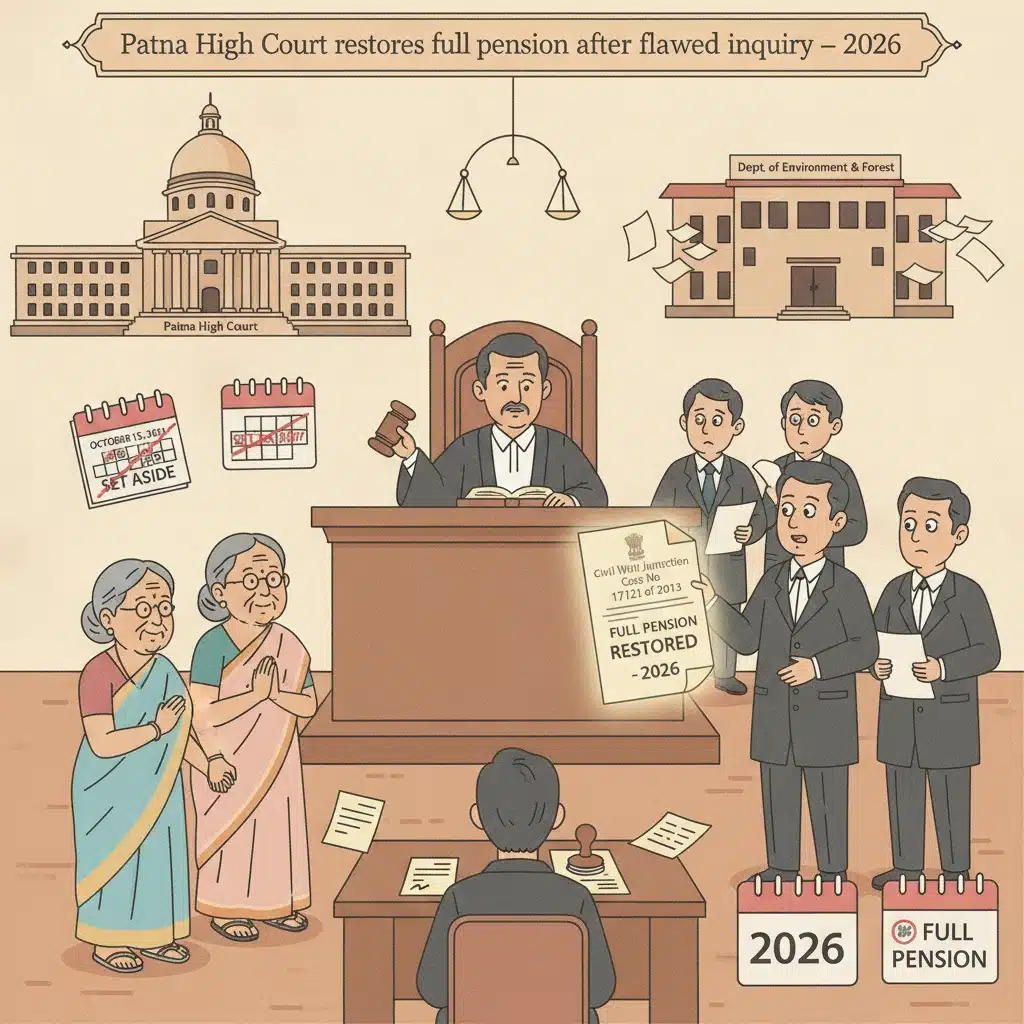
Case Background
The case began with a departmental proceeding against a Bihar Forest Service officer, who later became the deceased writ petitioner. He was serving as Divisional Forest Officer, Social Forest Division, Dumka.
On 04.04.1996, he was placed under suspension by Memo No.1537. Shortly thereafter, on 24.04.1996, a departmental proceeding was initiated against him through Memo No.1852. Five charges, including financial irregularities and other allegations, were framed.
On 30.04.1996, he superannuated from service. After his retirement, the pending departmental proceeding was converted into a proceeding under Rule 43(b) of the Bihar Pension Rules, which governs withholding or reducing pension for misconduct in service.
An enquiry officer and a conducting officer were appointed. The retired officer was allowed to reply to the charges. After a detailed inquiry, the enquiry officer submitted his report to the disciplinary authority, clearly recommending that the officer be exonerated because the charges were not proved.
Despite this, on 02.06.1999, by Memo No.2025, the disciplinary authority imposed punishment by ordering a deduction of 20% of his pension, without giving him a second show-cause notice on the proposed punishment or on the disagreement with the enquiry report.
The retired officer challenged this punishment in C.W.J.C. No.9684 of 2001 before the Patna High Court. On 15.10.2001, a Single Judge set aside the punishment order and remitted the matter to the authorities to give him a fresh opportunity. The authority was told to share the tentative reasons for differing from the enquiry report, invite his comments, and then pass a fresh, lawful order regarding his pension.
Following this, a second show-cause notice was issued on 21.12.2001 by Letter No.4076. The retired officer submitted his explanation on 04.01.2002. However, on 12.04.2002, by Memo No.1407, the disciplinary authority again reiterated the same punishment of 20% deduction of pension.
This second punishment order was challenged in C.W.J.C. No.8600 of 2002. On 25.07.2007, the Patna High Court again set aside the order dated 12.04.2002 and once more remitted the matter to the State Government. The Court directed that a fresh show-cause notice be issued, clearly spelling out the grounds of difference of opinion with the enquiry officer, and that a reasoned order be passed after considering the reply.
In compliance, a fresh show-cause notice was issued by Letter No.242 dated 22.01.2008. The retired officer replied on 03.04.2008, denying all charges and explaining each one, relying on the enquiry officer’s findings in his favour.
Despite this, the disciplinary authority again passed an order on 18.06.2010 (Memo No.1539), repeating the earlier punishment of 20% deduction in pension. This final order of punishment became the subject of the present writ petition, C.W.J.C. No.17121 of 2013.
During the pendency of this writ petition, the original writ petitioner died. By order dated 28.10.2024, his legal heirs were substituted as petitioners to continue the challenge to the cut in pension.
What the Court Examined and Decided
The substituted petitioners argued that the disciplinary authority acted with a pre-determined mindset. Even after the High Court had twice set aside earlier punishment orders, the authority kept reiterating the same 20% pension deduction.
They pointed out that the show-cause notice dated 22.01.2008 was almost identical to the earlier notices that had already been disapproved by the Court. Instead of sharing clear reasons for disagreeing with the enquiry officer’s report, the authority simply asked why the earlier 20% deduction should not be maintained “as it is”.
The petitioners further submitted that the reply dated 03.04.2008, where the deceased officer had explained and denied each charge, was not properly considered. Despite the enquiry officer’s clear recommendation for exoneration and the officer’s detailed defence, the same punishment was again imposed on 18.06.2010.
They also argued that, before imposing punishment on a Gazetted Officer, consultation with the Bihar Public Service Commission (B.P.S.C.) is mandatory. According to them, the final order dated 18.06.2010 was passed without proper consultation. They maintained that the disciplinary authority was determined to punish the officer “only to satisfy his ego”, and that no pecuniary loss to the State exchequer was proved in the enquiry, which is important when action is taken under Rule 43(b) of the Bihar Pension Rules.
On the other side, the State defended the action. Referring to the counter affidavit, the State counsel submitted that the Department of Environment and Forest had written to the B.P.S.C. on 28.09.1999 (Letter No.3731) seeking approval for 20% deduction of pension. The B.P.S.C. had sought clarification by Letter No.1671 dated 29.10.1999, and the officer was served a second show-cause notice on 02.12.1999, to which he replied on 16.12.1999.
According to the State, all documents were given to the B.P.S.C., but before a formal approval could be granted, the High Court’s order in C.W.J.C. No.9684 of 2001 made those proceedings infructuous. Thereafter, by Letter No.691 dated 22.02.2002, the B.P.S.C. was again approached, and by Letter No.45 dated 06.04.2002, the Commission formally approved the proposed 20% pension deduction, which led to the Resolution No.1407 dated 12.04.2002.
The State argued that, because the charges and quantum of punishment remained unchanged, the earlier consultation with the B.P.S.C. in 2002 covered the later order of 2010 as well. In its view, there was no need for a fresh consultation, as the matter was “identical in every material respect.” The State also claimed that the order dated 18.06.2010 was a reasoned, speaking order passed after applying an independent mind to the materials and the explanation filed by the deceased officer.
Justice Ritesh Kumar examined the record, including the history of two previous writ petitions, the enquiry report, the repeated show-cause notices, and the final impugned order of 2010.
The Court noted that the enquiry officer had clearly held that the five charges, including allegations of financial irregularity, were not proved. The officer was recommended for exoneration.
Despite this, each time the disciplinary authority issued a show-cause notice, it did so with a pre-determined approach, asking why the earlier 20% deduction should not be maintained. The Court found that this pattern continued even after specific High Court directions to clearly spell out the grounds of disagreement with the enquiry report and to pass a fresh, reasoned order.
In the show-cause notice dated 22.01.2008, the same defective language appeared again, merely repeating the earlier stance that 20% deduction should be kept “as it is”. The Court held that this clearly showed that the disciplinary authority remained fixed in its earlier view and had not truly applied its mind afresh as required by the earlier High Court orders.
Further, the Court noted that the reply submitted by the deceased petitioner on 03.04.2008, explaining charge by charge and relying on the enquiry officer’s findings, was not meaningfully addressed. Yet again, the disciplinary authority reiterated the previous punishment through Memo No.1539 dated 18.06.2010.
On the State’s defence about prior consultation with the B.P.S.C., the Court observed that earlier punishment orders had already been set aside twice by the High Court. Once those orders were quashed and the matter was remitted for a completely fresh consideration, the authority was required to genuinely reconsider the case and follow the directions. Simply repeating the old conclusion and treating earlier consultation as sufficient was not in line with the Court’s orders.
The Court also took note that the proceeding was under Rule 43(b) of the Bihar Pension Rules, yet the enquiry report did not record any finding that the officer had caused pecuniary loss to the State exchequer. In that backdrop, the punishment of reduction of pension under Rule 43(b) was held not fit to be sustained.
Going further, the Court discussed the scope of interference under Articles 226/227 of the Constitution in disciplinary matters. The High Court can interfere where findings are based on “no evidence”. If, in every such case, the matter is remanded, that would reward negligence of the disciplinary authority and the casual way in which some enquiries are conducted.
The judgment reminds that it is the disciplinary authority’s duty to appoint a competent enquiry officer and presenting officer, who must lay proper evidence to prove misconduct. While the standard of proof in departmental enquiries is only “preponderance of probability” (and not “beyond reasonable doubt” as in criminal trials), even this standard cannot be met if no valid evidence is presented. In such situations, the delinquent cannot be punished on peremptory findings.
Applying these principles, the Court concluded that the punishment orders, including the impugned Memo No.1539 dated 18.06.2010, were not supported by valid evidence and ignored the clear findings of the enquiry officer.
Since the original writ petitioner had died and his legal heirs had already been substituted, the Court saw “no justification” to once again remit the matter to the disciplinary authority. Instead, it directly set aside the punishment and granted relief.
The Court ordered that the legal heirs are entitled to payment of the entire amount that had been deducted from the deceased officer’s pension. This amount must be paid within four months from the date of receipt or production of the Court’s order. If payment is not made within this period, the legal heirs will be entitled to interest at 6% per annum from the date of filing of the writ petition until actual payment.
With these observations and directions, the writ petition was allowed, and all pending applications were disposed of.
Why This Judgment Matters
This Patna High Court judgment is important for retired government employees, especially those facing pension cuts after retirement because of old departmental cases.
First, it shows that even after retirement, the State cannot arbitrarily reduce pension. If an enquiry officer finds the charges “not proved”, the disciplinary authority must give clear reasons and a proper opportunity before disagreeing and punishing a retiree.
Second, the case warns departments against repeating the same defective orders after courts have set them aside. When the High Court remits a matter for fresh consideration, the authority must truly reconsider, not mechanically re-impose the same punishment.
Third, in proceedings under Rule 43(b) of the Bihar Pension Rules, if no pecuniary loss to the State is established and there is no valid evidence of misconduct, pension reduction cannot be justified.
Finally, the judgment offers practical relief. Legal heirs of deceased employees can challenge illegal pension cuts, and courts can order refund with interest instead of sending matters back to authorities when the enquiry has been fundamentally flawed.
Legal Issues and Answers
- Issue: Could the State validly continue deducting 20% of the retired officer’s pension under Rule 43(b) despite the enquiry officer’s exoneration and repeated High Court directions?
Answer: No. The Patna High Court held that the impugned punishment order dated 18.06.2010 was unsustainable, being based on no valid evidence, issued with a pre-determined mind, and in violation of earlier directions. The order was set aside. - Issue: Should the matter be remitted again to the disciplinary authority after the original petitioner’s death?
Answer: No. Given the history of repeated, defective orders and the petitioner’s death, the Court declined to remit the matter and instead granted direct relief to the legal heirs, ordering refund of the deducted pension with possible interest. - Issue: Can the High Court interfere in departmental findings under Articles 226/227 where there is no evidence on record?
Answer: Yes. The Court reiterated that it can interfere when findings of fact are based on no evidence. In such cases, remand is not necessary and would only reward negligence in conducting the enquiry.
Cases Cited by the Court
- The text of the judgment does not mention or rely on any specific reported case citations. None are expressly cited.
Case Details
Case Number: Civil Writ Jurisdiction Case No.17121 of 2013
Case Title: Jayanti Sinha & Ors. v. The State of Bihar & Ors.
Court: High Court of Judicature at Patna
Coram: Hon’ble Mr. Justice Ritesh Kumar
Date of Judgment: 15.06.2026
Advocates for Petitioners: Mr. Dhananjay Kashyap, Advocate; Mr. Nagadeo Choubey, Advocate
Advocates for the State: Mrs. Binita Singh, S.C.-28; Mr. Vivek Anand Amritesh, A.C. to S.C.-28
Advocate for the Accountant General: Mr. Arun Kumar Arun, Advocate
Nature of Case: Writ petition under Article 226/227 of the Constitution challenging an order reducing pension under Rule 43(b) of the Bihar Pension Rules
Impugned Order: Memo No.1539 dated 18.06.2010 issued by the Department of Environment and Forest, Government of Bihar, reducing pension by 20%
Link to Judgment: https://patnahighcourt.gov.in/viewjudgment/MTUjMTcxMjEjMjAxMyMxI04=-umFAiQVVQCw=
If you found this explanation helpful and wish to stay informed about
how legal developments may affect your rights in Bihar,
you may consider following Samvida Law Associates for more updates.




