

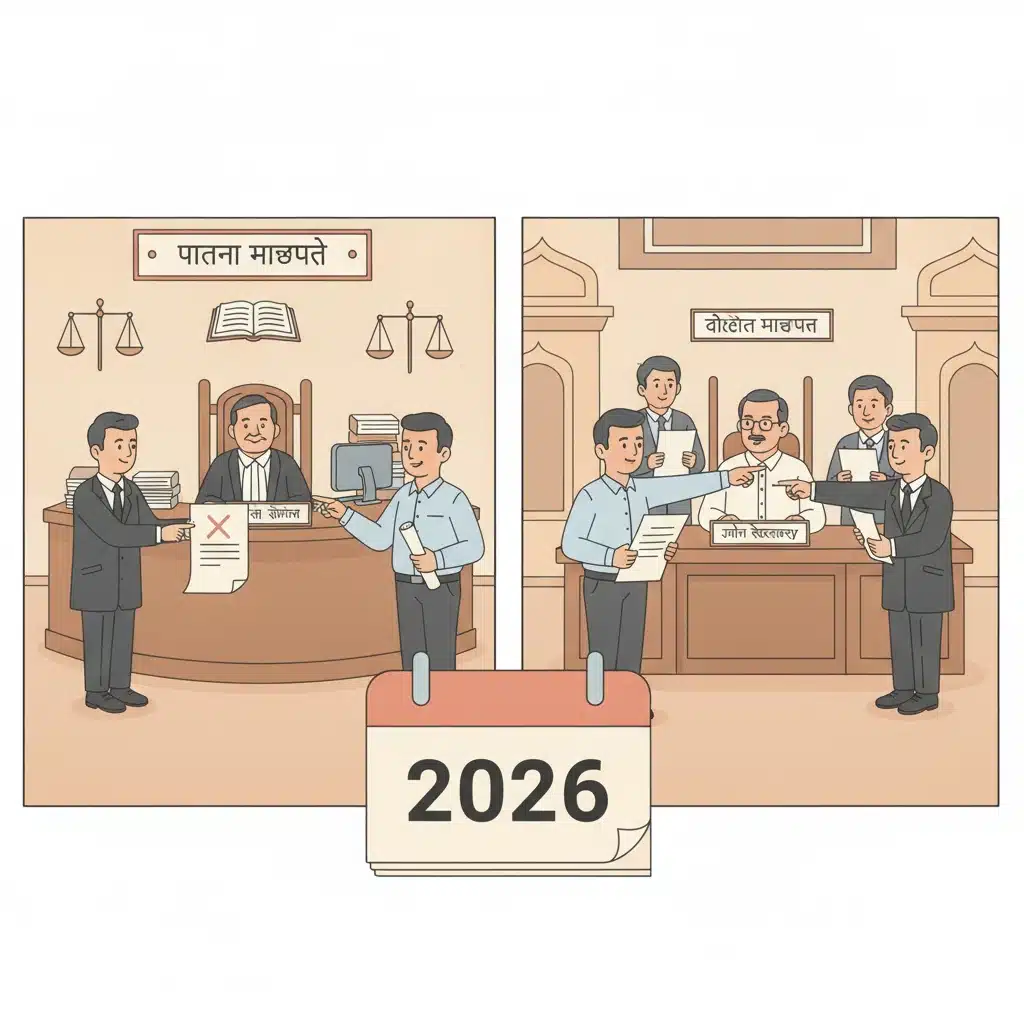
Case Background
The petitioner was a government employee in the Road Construction Department of Bihar. The dispute relates to the period 2006–07, when he was posted as Executive Engineer, Road Division, Samastipur.
On certain charges relating to that period, the department initiated a departmental proceeding against him. That proceeding ended in an order of punishment dated 15.05.2015, contained in memo no.4235(s). By that order, the authorities withheld two of his annual increments with cumulative effect.
The petitioner challenged this punishment before the Patna High Court in Civil Writ Jurisdiction Case No. 803 of 2016. On 04.01.2019, the High Court allowed that earlier writ petition. It quashed both the second show cause notice dated 09.12.2014 and the punishment order dated 15.05.2015.
The Court held that the enquiry report of the Enquiry Officer had been considered by a Technical Committee instead of the Disciplinary Authority, which was contrary to Rule 18 of the Bihar Government Servants (Classification, Control and Appeal) Rules, 2005 (CCA Rules). The Court also noted that there was no independent disagreement recorded by the Disciplinary Authority with the findings of the Enquiry Officer.
However, the Court gave liberty to the State authorities to proceed afresh against the petitioner from the stage of second show cause, in accordance with law and by the Disciplinary Authority.
After this liberty, the department issued a fresh second show cause notice on 30.07.2019, and later passed another punishment order on 05.08.2021, this time withholding one annual increment with cumulative effect. These fresh actions were again challenged by the petitioner in the present case, CWJC No. 407 of 2022.
What the Court Examined and Decided
Justice Partha Sarthy of the Patna High Court heard the matter. The petitioner challenged notification no.3883(s) dated 05.08.2021 read with memo no.3884(s) dated 06.08.2021, both issued under the signature of the Joint Secretary, Road Construction Department, Bihar, Patna. By these, the punishment of withholding one increment with cumulative effect was imposed.
The petitioner’s main grievance was that even after the earlier judgment of 04.01.2019, the authorities had once again failed to apply an independent mind. Instead, they simply reproduced the earlier recommendations of the Technical Committee in the new second show cause notice dated 30.07.2019.
The petitioner pointed out that paragraph numbers (i), (ii), (iii) and (iv) of the second show cause notice were identical and verbatim copies of the recommendations of the Technical Committee contained in Annexure P/3. It was this very reliance on the Technical Committee which had led the Court earlier to set aside the second show cause notice and the punishment order in CWJC No. 803 of 2016.
According to the petitioner, since the disciplinary authority had to independently consider the enquiry report under Rule 18 of the CCA Rules, it could not merely adopt the Technical Committee’s recommendations. The repeated failure to exercise independent judgment made the new second show cause notice and the punishment order legally unsustainable.
On the other hand, learned counsel for the respondents argued that they had complied with the liberty given by the Court in 2019. A second show cause notice was issued on 30.07.2019; the petitioner gave his reply, and thereafter a fresh punishment order was passed on 05.08.2021. The State contended that no procedural irregularity was shown.
The State’s counsel accepted that the contents of the second show cause notice and the earlier recommendations might appear similar, but argued that this was because they related to the same incident and facts. He maintained that the Disciplinary Authority had, in fact, applied his independent mind, and that the notice and punishment were validly issued.
The Court first recalled the key findings from its earlier judgment dated 04.01.2019 in CWJC No. 803 of 2016. In that judgment, the Court had clearly held that the CCA Rules do not provide for constitution of any Technical Committee to appreciate the findings of the Enquiry Officer. Rule 18 requires that the Enquiry Officer’s report be examined by the Disciplinary Authority itself.
The Court noted that, earlier, even the departmental minister had criticised the constitution of the Technical Committee. The High Court had held that there was no independent disagreement by the Disciplinary Authority with the Enquiry Officer’s findings, based on the evidence on record. Therefore, the second show cause notice dated 09.12.2014, which simply communicated the disagreement of the Technical Committee, had been held unsustainable. On that basis, the punishment order dated 15.05.2015 was also quashed.
In the present case, the Court examined the fresh second show cause notice dated 30.07.2019 and compared its contents with the recommendations of the Technical Committee recorded in Annexure P/3, particularly column no. 5 of that report. Four grounds, marked as (i) to (iv), were mentioned in the notice as reasons for differing with the Enquiry Officer.
After perusing the records, the Court found that these four grounds in the second show cause notice were “identical and verbatim copy” of the recommendations made by the Technical Committee. In other words, the Disciplinary Authority had lifted the text of the Technical Committee’s recommendations and used it as the reasons for disagreement with the Enquiry Officer.
This finding was crucial. The Court observed that its earlier decision had already made it clear that there was no provision for constitution of a Technical Committee to appreciate the enquiry report, and that the Disciplinary Authority had to act independently under Rule 18 of the CCA Rules. The entire point of remanding the matter in 2019 was to allow the Disciplinary Authority to consider the enquiry report afresh and issue a second show cause notice based on its own reasons.
By simply reproducing the Technical Committee’s recommendations word for word, the respondents had, in the opinion of the Court, repeated the same illegality. There was again a failure to exercise an independent mind. The procedure adopted on remand therefore remained contrary to Rule 18 of the CCA Rules.
In these circumstances, the Court held that neither the second show cause notice dated 30.07.2019 nor the consequential punishment order dated 05.08.2021 could be sustained in law. Notification no. 3883(s) dated 05.08.2021, issued by the Joint Secretary, Road Construction Department, Bihar, Patna, was specifically set aside.
As a result, the punishment of withholding one annual increment with cumulative effect imposed upon the petitioner stands quashed. The writ application, CWJC No. 407 of 2022, was allowed.
Why This Judgment Matters
This judgment is important for government employees facing departmental enquiries in Bihar and for departments conducting such enquiries. It reinforces that disciplinary authorities must personally examine the enquiry report and give their own reasons if they disagree with the Enquiry Officer.
The Patna High Court has made it clear that authorities cannot hide behind committees or outside opinions when deciding the fate of an employee. If they rely blindly on a committee’s recommendation, without independent reasoning, their decisions can be struck down.
For employees, this offers a safeguard against mechanical or biased punishments. For departments, it is a reminder to strictly follow Rule 18 of the CCA Rules and maintain proper records of how the Disciplinary Authority has applied its mind.
Legal Issues and Answers
- Issue: Whether the Disciplinary Authority lawfully issued the second show cause notice dated 30.07.2019 and punishment order dated 05.08.2021 after the earlier remand, by independently differing from the Enquiry Officer’s report as required under Rule 18 of the CCA Rules, 2005.
Answer: No. The Patna High Court held that the grounds in the second show cause notice were identical and verbatim copies of the Technical Committee’s recommendations, showing absence of independent application of mind by the Disciplinary Authority. Therefore, both the notice and the punishment order were quashed.
Cases Cited by the Court
- The judgment primarily relies on and reproduces portions of the earlier decision of the Patna High Court dated 04.01.2019 in CWJC No. 803 of 2016 involving the same petitioner and departmental proceedings.
Case Details
Case Number: Civil Writ Jurisdiction Case No. 407 of 2022
Case Title: Indrajeet Kumar v. The State of Bihar & Ors.
Court: High Court of Judicature at Patna
Coram: Hon’ble Mr. Justice Partha Sarthy
Date of Judgment: 22.06.2026
Nature of the Case: Writ petition under civil writ jurisdiction challenging departmental punishment orders (certiorari)
Citation: 2026 (5) PLJR 10
Advocates: Mr. Rupak Kumar, Advocate for the petitioner; Mr. Amit Prakash, GP-13 for the respondents
Impugned Orders: Notification no. 3883(s) dated 05.08.2021 and memo no. 3884(s) dated 06.08.2021, issued by the Joint Secretary, Road Construction Department, Bihar, Patna, imposing punishment of withholding one increment with cumulative effect
Earlier Connected Case: CWJC No. 803 of 2016, decided on 04.01.2019, quashing the earlier second show cause notice dated 09.12.2014 and punishment order dated 15.05.2015
Relevant Statutory Provision: Rule 18 of the Bihar Government Servants (Classification, Control and Appeal) Rules, 2005
Link: https://patnahighcourt.gov.in/viewjudgment/MTUjNDA3IzIwMjIjMSNO-dJyEdxksK5s=
If you found this explanation helpful and wish to stay informed about
how legal developments may affect your rights in Bihar,
you may consider following Samvida Law Associates for more updates.




