

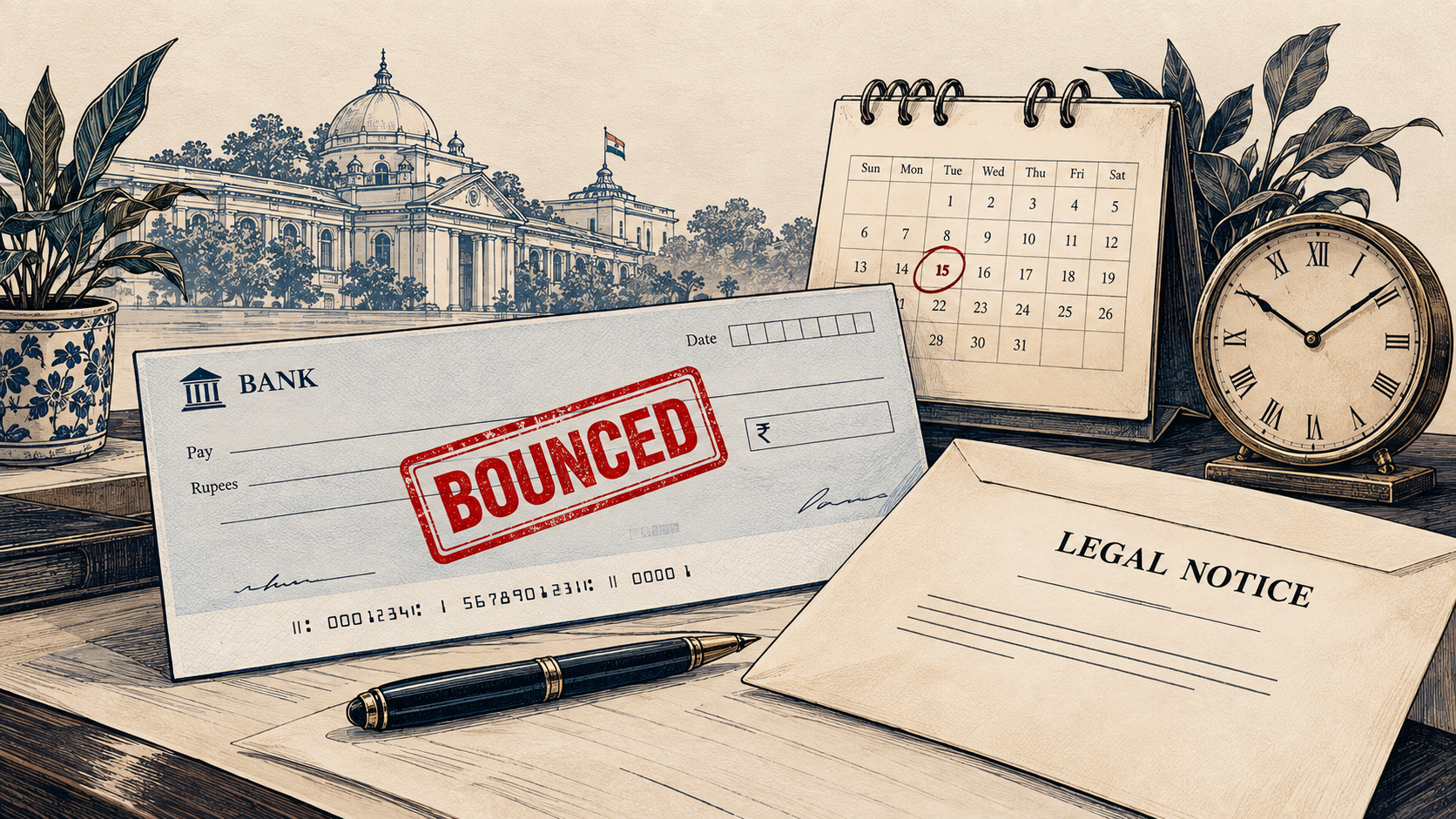
Someone has filed a Section 138 cheque bounce case against you, or a case you filed is stuck and you don’t understand why the accused is asking the Patna High Court to quash it. Cheque bounce law under the Negotiable Instruments Act looks simple cheque bounces, notice goes out, complaint gets filed but it is actually one of the most technical corners of criminal law in India. Missing a date by even a single day, on either side, can decide the whole case. This guide walks through exactly what the Patna High Court has said about when a Section 138 case can be quashed, using its own recent rulings.
What This Article Covers
- How a Cheque Bounce Case Is Supposed to Work
- Filing Too Early: The 15-Day Waiting Period
- The Notice Must Demand the Cheque Amount, Not a Mixed Figure
- Filing Too Late: The One-Month Complaint Deadline
- Presenting the Cheque Itself Too Late
- What the Patna High Court Has Said: Case by Case
- Common Mistakes People Make
- Realistic Timelines in Bihar
- Frequently Asked Questions
- How a Lawyer Can Help
- Related Judgment Summaries
How a Cheque Bounce Case Is Supposed to Work
Section 138 of the Negotiable Instruments Act, 1881 makes it a criminal offence to issue a cheque that bounces for insufficient funds, but only if the payee follows a precise sequence of steps. The cheque must be presented to the bank while it is still valid. Once it bounces, the payee must send a written notice demanding payment of the cheque amount within 30 days of learning of the dishonour. The person who issued the cheque then gets 15 days from receiving that notice to pay. Only if payment still isn’t made can a complaint be filed, and that complaint itself must be filed within one month of the 15-day period expiring. Every one of these steps is treated by the Patna High Court as mandatory, not a formality miss one, and the entire prosecution can collapse regardless of how genuine the underlying debt was.
Filing Too Early: The 15-Day Waiting Period
A payee cannot rush to file a complaint the moment the 15-day notice period has technically started running. The Supreme Court’s ruling in Yogendra Pratap Singh v. Savitri Pandey is the controlling authority here: a complaint filed before the drawer’s full 15 days (counted from the date the notice is actually received, not the date it is sent) have elapsed is legally “non-est” it does not exist in the eyes of law and cannot be cured later. The Patna High Court has applied this strictly, quashing complaints filed even a day or two early. Importantly, the Court has also protected genuine complainants who made this mistake honestly: where a complaint is quashed as premature, the payee can be given liberty to file a fresh complaint for the same cheque, and the Magistrate is directed not to reject that fresh complaint on limitation grounds, provided it is filed promptly (commonly within one month of the High Court’s order).
The Notice Must Demand the Cheque Amount, Not a Mixed Figure
The written notice under Section 138(b) has to demand payment of the specific cheque amount not a larger, combined figure that mixes in interest, damages, other outstanding dues, or notice charges. Following the Supreme Court’s decision in Upasana Mishra v. Trek Technology India Pvt. Ltd., the Patna High Court has held that an “omnibus” notice which never separately or clearly asks for the exact cheque amount fails to satisfy Section 138(b), and a cognizance order based on such a notice can be quashed. This is a common drafting mistake: complainants understandably want to recover everything owed to them in one notice, but doing so without clearly and separately demanding the cheque amount can be fatal to the criminal case, even if a civil recovery claim for the larger sum remains open.
Filing Too Late: The One-Month Complaint Deadline
Section 142 of the Act requires the complaint itself to be filed within one month of the cause of action arising that is, within one month of the 15-day payment window expiring. This deadline can be relaxed, but only if the complainant explains the delay and the Magistrate expressly records satisfaction that there was sufficient cause to condone it. The Patna High Court has held that if the complaint contains no explanation for delay, and the Magistrate’s cognizance order shows no application of mind to the question of delay at all, the Magistrate has exceeded his jurisdiction in taking cognizance, and the prosecution can be quashed on that ground alone independent of whatever the underlying facts of the money dispute might be.
Presenting the Cheque Itself Too Late
Separately from the notice and complaint deadlines, the cheque itself must be presented to the bank within its period of validity. The Patna High Court has treated timely presentation as a basic, non-negotiable ingredient of the offence, following the Supreme Court’s rulings that Section 138’s conditions are mandatory and that presentation within validity is a sine qua non for the complaint to survive. An explanation that the payee delayed presenting the cheque because the drawer asked for time, or promised to inform when funds were available, has been held insufficient to excuse late presentation the statutory clock does not stop for informal understandings between the parties.
What the Patna High Court Has Said Case by Case
A complaint filed even a little early is void, but a fresh complaint can follow
In a case from Nawada involving a business investment cheque also reported as a separate write-up of the same case a Rs. 11 lakh cheque had bounced, and the complaint was filed before the full 15 days from the date the accused received the demand notice had passed. The Patna High Court, applying Yogendra Pratap Singh v. Savitri Pandey, held the complaint was premature and quashed it along with the cognizance order and all consequential proceedings. But the Court did not leave the complainant without a remedy: it directed that if he filed a fresh complaint for the same cheque within one month of the judgment, the trial court must consider it on merits and not dismiss it merely on limitation grounds.
A notice demanding a bigger, mixed figure instead of the cheque amount is defective
In a Siwan district case involving a construction business partnership, a cheque for Rs. 35 lakh bounced, but the demand notice that followed asked for Rs. 80,20,000 the total amount said to be outstanding under the partnership, including interest without separately and specifically demanding the Rs. 35 lakh cheque amount or even describing the dishonoured cheque. Applying the Supreme Court’s ruling in Upasana Mishra v. Trek Technology India Pvt. Ltd., the Patna High Court held that such an omnibus notice does not satisfy the mandatory requirement of Section 138(b), and quashed the cognizance order against the petitioner.
A complaint filed beyond the one-month deadline, with no explanation and no recorded satisfaction, is without jurisdiction
In a Muzaffarpur case arising from an alleged friendly loan of Rs. 8 lakh, the cheque bounced, notice was sent, and the complaint was filed well beyond the one-month period from expiry of the 15-day notice window with no explanation offered for the delay anywhere in the complaint, and no indication in the Magistrate’s order that he had considered or condoned any delay. The Patna High Court held that Section 142 requires both an explanation from the complainant and a recorded satisfaction from the Magistrate before a delayed complaint can be entertained; in the absence of either, the Magistrate had exceeded his jurisdiction in taking cognizance, and the Court quashed the order.
Presenting the cheque more than a year after it was issued defeats the complaint
In a Saharsa district case involving a land purchase dispute, six cheques dated the same day were not presented to the bank until more than a year later, and were returned unpaid. The complainant explained the delay by saying he was waiting for the drawer to confirm that funds were available. The Patna High Court held that this explanation could not override the mandatory requirement that a cheque be presented within its period of validity, relying on the Supreme Court’s rulings that this timeline is a strict, essential ingredient of the Section 138 offence, not a mere formality. Since the cheques were presented after the statutory window had closed, the Court quashed the Magistrate’s cognizance order.
Common Mistakes People Make
- Filing the complaint the moment 15 days have technically begun, without counting from the date of actual receipt of notice. The clock starts when the drawer receives the notice, not when it is sent, and the complaint cannot be filed before those full 15 days are over.
- Drafting a demand notice that lumps the cheque amount together with interest, damages, or other dues. The notice must clearly and separately demand the exact cheque amount; a combined, “omnibus” figure can make the whole notice defective.
- Waiting too long to file the complaint after the 15-day period expires, without recording any reason for the delay. The one-month deadline under Section 142 is not automatically extended; delay must be explained, and the Magistrate must expressly record satisfaction that the delay is condoned.
- Sitting on a cheque for months based on informal assurances from the drawer. A cheque must be presented to the bank within its period of validity; waiting because the other side asked for more time does not extend this deadline.
- Assuming any technical defect can be fixed by simply continuing the same case. Courts have generally quashed the defective complaint itself, though they have sometimes preserved the complainant’s right to file a fresh, correctly timed complaint.
Realistic Timelines in Bihar
The statutory timeline itself is tight: 30 days to send notice after learning of dishonour, 15 days for the drawer to pay after receiving that notice, and one month thereafter to file the complaint if payment is not made. Trial courts in Bihar typically take several months to a year or more to reach the stage of taking cognizance and issuing summons after a complaint is filed, depending on the court’s workload. Where an accused challenges the cognizance order before the Patna High Court under Section 482 of the CrPC (now Section 528 BNSS), such petitions commonly take several months to a couple of years to be decided, depending on the bench and how contested the factual record is.
Frequently Asked Questions
How soon after my cheque bounces can I file a criminal complaint? Not immediately. You must first send a written notice demanding the cheque amount within 30 days of learning that the cheque bounced, then wait a full 15 days after the drawer actually receives that notice. Only if payment still isn’t made can you file a complaint, and that complaint must itself be filed within one month of the 15-day period ending.
What exactly should my demand notice say? It must clearly and specifically demand payment of the exact cheque amount. Avoid combining the cheque amount with interest, other outstanding dues, or damages into one lump sum figure without separately identifying what is owed under the cheque itself; courts have quashed cases where the notice failed to make this distinction.
I filed my complaint late is my case automatically over? Not necessarily, but you needed to explain the delay in your complaint and the Magistrate needed to expressly record that he was satisfied there was sufficient cause to condone it. If neither happened, courts have held the Magistrate had no jurisdiction to take cognizance at all.
The drawer asked me to wait before depositing the cheque can I still file a case later? This is risky. A cheque must be presented to the bank within its period of validity, and courts have held that informal assurances from the drawer do not extend this deadline. If you wait too long based on such assurances, your eventual complaint can be quashed even though you were only trying to be reasonable.
My earlier complaint was quashed as premature can I try again? Yes, in appropriate cases. Courts have allowed a fresh complaint for the same cheque where the earlier one was genuinely filed too early by mistake, directing that it be considered on merits without being dismissed on limitation, provided it is filed within a reasonable time (commonly one month) of the quashing order.
How a Lawyer Can Help
Cheque bounce cases turn almost entirely on a handful of exact dates: when the cheque was dated, when it was presented, when it bounced, when the notice was sent and received, and when the complaint was filed. A lawyer can map these dates against the statutory timeline before a complaint is even filed, to avoid the case failing on a technicality later, or can review an existing complaint or cognizance order to identify whether any of these mandatory steps was missed — a ground the Patna High Court has repeatedly accepted for quashing. Outcomes depend heavily on the exact record in each case.
Related Judgment Summaries
- Cheque bounce complaint quashed for early filing (2019) — Complaint filed before the 15-day notice period expired; quashed, with liberty to refile.
- Cheque bounce complaint quashed for being premature (2019) — Same underlying case reported separately.
- Cheque bounce cognizance quashed over defective notice (2025) — Notice demanding a combined, larger figure instead of the specific cheque amount held invalid.
- Cheque bounce case quashed for delayed complaint (2024) — Complaint filed beyond the one-month deadline, with no explanation or recorded satisfaction, held without jurisdiction.
- Cheque bounce case quashed for delay in presentation (2026) — Cheques presented more than a year after issue held to defeat the complaint.
Disclaimer
This article is for general information only and does not constitute legal advice. It does not create an advocate-client relationship. The outcome of any cheque bounce case depends on its own specific facts and the exact dates involved. For advice on a specific matter, please consult a qualified advocate.




