

Case Background
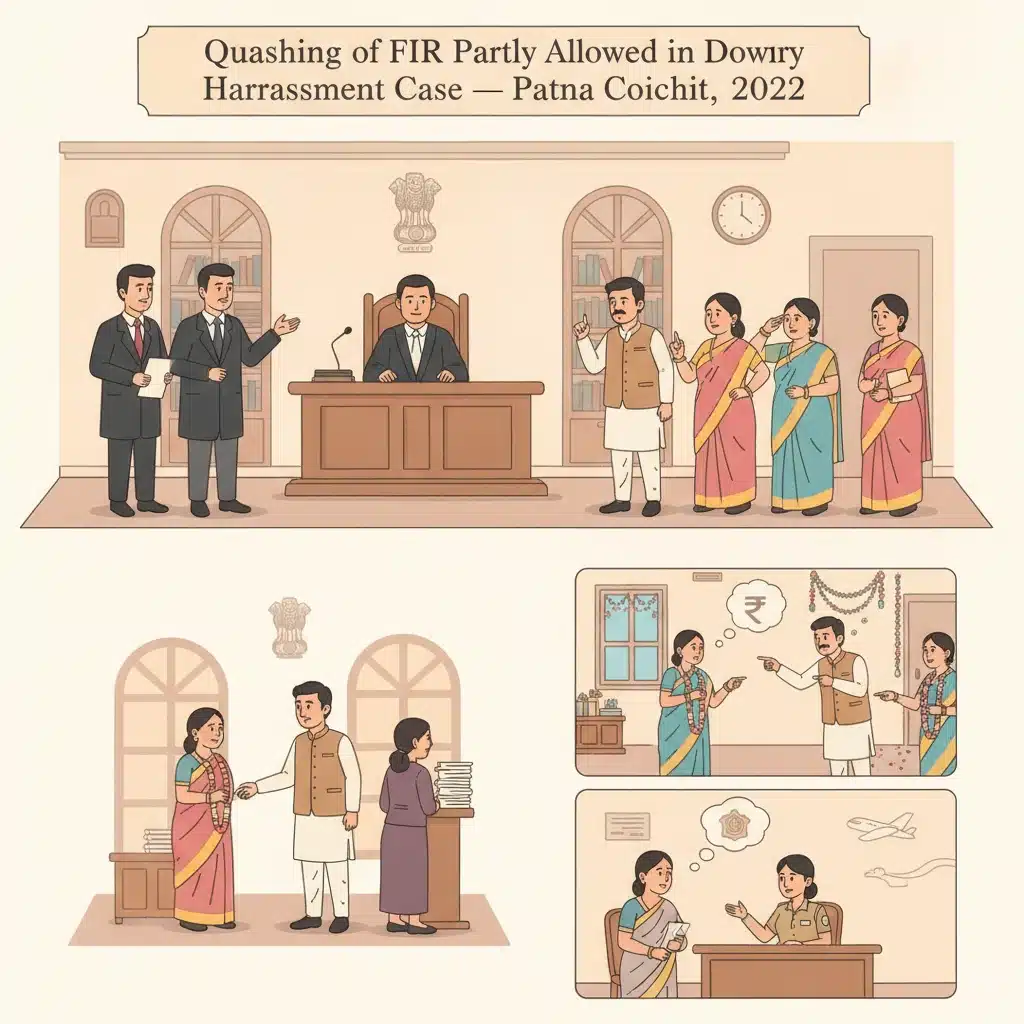
This case arose from a short-lived marriage between Ankita Kumari and petitioner no. 1, Varun @ Varun Kumar Arya.
According to the First Information Report (FIR), their marriage took place on 07.05.2021. The informant’s father allegedly gave ornaments, clothes and other articles during the marriage ceremony.
After the marriage, the husband is said to have taken the informant to her matrimonial home in Gujarat, where she stayed for about ten days. During this period, as per the FIR, her husband, mother-in-law, father-in-law and sister-in-law started torturing her mentally and physically.
The FIR alleges that the accused demanded Rs. 30,00,000 (thirty lakhs) as dowry. She was allegedly threatened that if the demand was not fulfilled, she would be thrown out, yet she was also forced to continue living in the matrimonial house.
On 11.06.2021, the informant’s father went to the matrimonial home to mediate. The FIR states that the accused misbehaved with him and repeated the dowry demand. Thereafter, petitioner no. 1 left for Dubai and, according to the informant, stopped contacting her and her family.
On 05.07.2021, the informant filed a complaint before the Station House Officer, Mahila Police Station, Banka. The police tried to mediate between the parties, but this also failed. The informant alleges that petitioner no. 1 abused her and demanded a house in Dubai and again demanded Rs. 30,00,000 and a flat in Dubai.
On these allegations, Banka Mahila P.S. Case No. 36 of 2021 was registered under sections 498A and 406/34 of the Indian Penal Code and sections 3/4 of the Dowry Prohibition Act.
The husband and his family then approached the Patna High Court under Criminal Miscellaneous No. 6146 of 2022 seeking quashing of this FIR.
What the Court Examined and Decided
Hon’ble Mr. Justice Sandeep Kumar heard counsel for the petitioners, the State, and counsel for the informant (opposite party no. 2).
The petitioners consisted of four persons: petitioner no. 1 (husband), petitioner no. 2 (mother-in-law), petitioner no. 3 (father-in-law) and petitioner no. 4 (married sister-in-law/Nanad).
The petitioners’ counsel put forward several points in support of quashing the FIR.
First, he submitted that the marriage was initially planned to be solemnised socially on 07.05.2021 at Kurseong, West Bengal. Due to the Covid-19 pandemic, the function was cancelled, and only the marriage was registered on the same date.
It was argued that, in their community, unless a social marriage as per Hindu rituals is held, the couple is generally not allowed by the families to live together as husband and wife. On this basis, counsel stated that the husband and wife never “stayed together” in the true sense.
He further argued that the informant had suffered from Covid-19, and although she stayed in the petitioners’ house for about ten days, she was later taken away by her family members after recovery, and the husband then joined his duty in Dubai.
The Court was told that petitioner no. 1 works as an Engineer in Dubai and the informant is an I.T. Engineer in Bangalore. The parties allegedly decided to part ways, and by private mediation the petitioners’ family returned the marriage gifts, gold jewellery and the balance amount allegedly given on the occasion of marriage. Counsel alleged that the informant did not return anything.
It was also brought to the Court’s notice that petitioner no. 1 had already filed an application for divorce/cancellation of marriage before the Family Judge, Vadodara. This divorce case had later been transferred to Banka by an order of the Supreme Court.
On these facts, counsel for the petitioners claimed that the entire criminal case was a result of a failed marriage and that the allegations, especially against all family members, were false and concocted. They sought quashing of the FIR for all four petitioners.
In response, counsel for the informant argued that she had in fact been tortured and thrown out of her matrimonial house. He emphasised that this was not the stage to go into the defence version of the accused. According to him, an FIR can only be quashed in exceptional situations, for example, if on a plain reading of the FIR no offence is made out or if it is clearly lodged only to take revenge.
The Court carefully considered the submissions of both sides and closely read the FIR.
Justice Sandeep Kumar noted that the main ground for seeking quashing was that the marriage had failed, that a divorce petition was already pending, and that the allegations were said to be false. The Court clearly stated that it would not examine the “truthfulness” of the allegations at this preliminary stage.
The Court relied on the Supreme Court decision in State of Bihar & another vs. P.P. Sharma, IAS and another, reported in 1992 Supp (1) SCC 222. In that case, the Supreme Court held that an FIR cannot be quashed on the basis of affidavits and disputed facts because that would amount to conducting a mini-trial at the stage of investigation.
Following this principle, the Patna High Court refused to test the correctness of the statements in the FIR or to accept the petitioners’ version as gospel truth. Instead, the Court asked whether, assuming the FIR allegations to be true on their face, the basic ingredients of the offences were present.
On a reading of the FIR, the Court found that there were clear allegations that:
(a) the informant was taken to her matrimonial home after marriage and stayed there for ten days,
(b) during this time she was subjected to mental and physical torture by the husband, mother-in-law, father-in-law and sister-in-law,
(c) there was a demand of Rs. 30,00,000 as dowry, later coupled with a demand for a house and flat in Dubai,
(d) when her father tried to mediate, the accused misbehaved and repeated the dowry demand,
(e) the husband departed for Dubai and did not contact her or her family.
From these allegations, the Court held that, prima facie, offences under section 498A and other provisions were made out against petitioner nos. 1 to 3 (husband, mother-in-law and father-in-law). Therefore, as far as these three petitioners were concerned, the FIR could not be quashed.
The position was different for petitioner no. 4, the married sister-in-law.
The Court referred to the Supreme Court judgment in Preeti Gupta and another vs. State of Jharkhand and another, reported in (2010) 7 SCC 667. In that decision, the Supreme Court had cautioned courts against casually implicating married sisters-in-law and other distant relatives in dowry and cruelty cases without specific and serious allegations.
Keeping that legal position in mind, and considering that petitioner no. 4 was a married sister-in-law, the Patna High Court allowed her application.
Accordingly, the Court quashed the entire criminal prosecution, including the FIR in Banka Mahila P.S. Case No. 36 of 2021, against petitioner no. 4 Swati Arya.
However, the Court rejected the prayer for quashing made by petitioner nos. 1, 2 and 3. It clarified that these petitioners would be free to raise all their objections regarding the allegations at the stage of framing of charge before the trial court, if the police ultimately submit a charge-sheet.
With these directions, the quashing application was partly allowed.
Why This Judgment Matters
This judgment is important for spouses and families involved in dowry harassment and matrimonial cruelty cases.
First, it shows that the Patna High Court will not lightly quash an FIR where there are specific allegations of dowry demand and cruelty by the husband and parents-in-law. The mere fact that a marriage has broken down or that a divorce case is pending is not enough to end the criminal case at the start.
Secondly, the decision offers some protection to married sisters-in-law and other relatives who may be living separately. Relying on Supreme Court precedent, the Court recognised that such relatives are often named in FIRs as a matter of routine and therefore examined their position more carefully.
By quashing the case only for the married sister-in-law, the Court has drawn a line: close family members like husband and parents-in-law will normally have to face investigation and trial if serious allegations exist, but distant or married-out relatives may receive relief if the law so permits.
For ordinary readers, this means that if they suffer dowry harassment, a detailed FIR with clear facts can move forward despite objections from the accused. At the same time, relatives who are less directly involved, especially those living separately, may seek protection if they are dragged in without strong allegations.
Legal Issues and Answers
- Issue: Can the Patna High Court quash an FIR alleging dowry demand and cruelty against the husband and his parents on the ground that the marriage has failed, a divorce case is pending, and the accused say the allegations are false?
Answer: No. The Court held that at the FIR stage it cannot test the truthfulness of allegations or rely on affidavits. Since the FIR, on its face, disclosed offences against the husband and parents-in-law, the quashing request for them was rejected. - Issue: Can the FIR be quashed against a married sister-in-law named as an accused in a dowry harassment case?
Answer: Yes, on the facts of this case. Relying on the Supreme Court’s direction in Preeti Gupta, the Court quashed the prosecution against the married sister-in-law, considering her distinct position as a married Nanad. - Issue: What remedy remains for the accused whose quashing plea has been rejected?
Answer: The Court granted liberty to the husband and parents-in-law to raise all legal and factual objections regarding the allegations at the stage of framing of charge before the trial court, if a charge-sheet is filed.
Cases Cited by the Court
- State of Bihar & another vs. P.P. Sharma, IAS and another, 1992 Supp (1) SCC 222.
- Preeti Gupta and another vs. State of Jharkhand and another, (2010) 7 SCC 667.
Case Details
Case Number: Criminal Miscellaneous No. 6146 of 2022, arising out of Banka Mahila P.S. Case No. 36 of 2021
Case Title: Varun @ Varun Kumar Arya & Ors. vs. The State of Bihar & Anr.
Coram: Hon’ble Mr. Justice Sandeep Kumar
Citation: 2022 (4) PLJR 632
Advocates:
For the Petitioners: Mr. Dhananjay Kumar Pandey, Advocate
For the State: Mr. Arun Kumar, APP; Mr. Jharkhandi Upadyay, APP
For Opposite Party No. 2: Mr. Prahlad Kumar Bhagat, Advocate
Nature of the Case: Criminal miscellaneous application seeking quashing of FIR under sections 498A and 406/34 IPC and sections 3/4 of the Dowry Prohibition Act
Link to Judgment: Patna High Court Judgment Link
If you found this explanation helpful and wish to stay informed about how legal developments may affect your rights in Bihar, you may consider following Samvida Law Associates for more updates.




