

Case Background
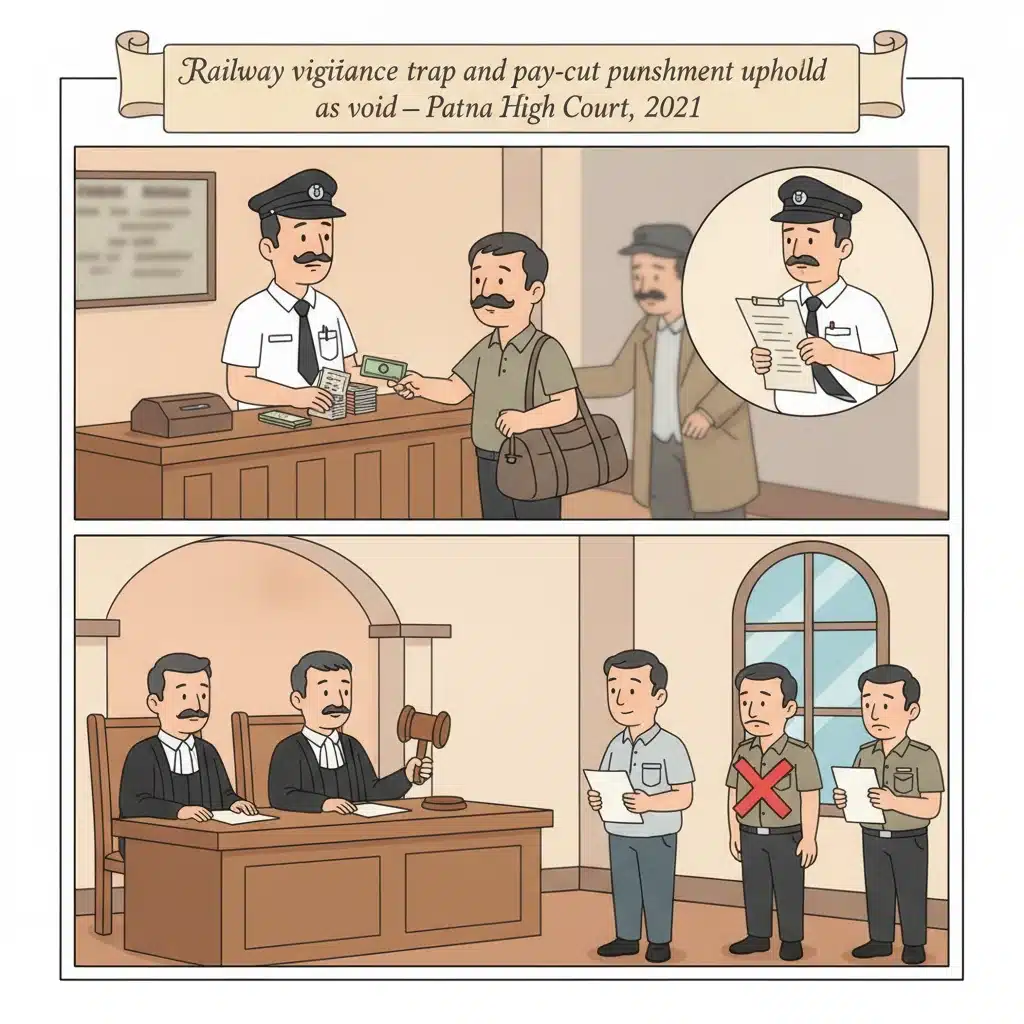
This case arose out of a departmental vigilance raid conducted by the East Central Railway against an Assistant Station Master posted at Tharbitiya, a small railway station under East Central Railway.
The respondent employee was not only performing the duties of Assistant Station Master, but also handling commercial duties, including selling tickets, because of the small size of the station.
On 12.10.2006, a departmental vigilance trap was laid. Following this raid, the railway administration initiated a departmental proceeding and issued a charge sheet to the respondent on 17.01.2007.
The main allegation was that the respondent demanded and accepted Rs 500/- for two train tickets which should have cost Rs 478/- in total (Rs 239/- each). It was alleged that he thus overcharged Rs 22/- from one Ashok Kumar Shah Gond, who was used as a decoy passenger during the trap.
Two further charges were levelled: that the respondent did not declare his personal cash, and that a shortage of Rs 45/- in “Government cash” was found.
On the basis of the enquiry, the Enquiring Authority held the charges to be proved. Accepting this report, the Disciplinary Authority, on 09.01.2009, imposed the punishment of reduction of pay to a lower stage, i.e. from Rs 13,610/- to Rs 13,090/-, along with postponement of further increments.
The respondent’s departmental appeal was rejected by the Appellate Authority on 19.11.2009, thereby affirming the punishment.
Aggrieved, the respondent approached the Central Administrative Tribunal, Patna Bench, by filing Original Application No. 666 of 2009 under Section 19 of the Administrative Tribunals Act, 1985. He challenged both the Disciplinary Authority’s order and the Appellate Authority’s order.
By judgment dated 23.07.2013, the Tribunal allowed the Original Application. The Tribunal set aside the punishment order and the appellate order, holding that the vigilance trap had not been conducted in accordance with the relevant rules, rendering the very foundation of the disciplinary action illegal.
The Union of India and concerned railway officials then filed the present Civil Writ Jurisdiction Case No. 15644 of 2014 before the Patna High Court under Article 226 of the Constitution of India, assailing the Tribunal’s order.
What the Court Examined and Decided
The Division Bench of the Patna High Court, consisting of Hon’ble Mr Justice Chakradhari Sharan Singh and Hon’ble Mr Justice Madhuresh Prasad, heard the writ petition and the rival submissions on 16.12.2021.
The core question before the Court was whether the Tribunal was right in holding the vigilance trap to be illegal on account of non-compliance with the Railway Vigilance Manual, and whether, despite any such violation, the punishment could still stand because witnesses in the inquiry had supported the allegations.
Counsel for the Union of India argued that the Tribunal erred in focusing on technical non-compliance with the Vigilance Manual. He emphasized that, during the departmental enquiry, witnesses were examined who supported the allegation that the respondent had demanded and accepted money in excess of the actual ticket fare.
According to the petitioners, once the enquiry had independent evidence on record, any lapse in following the trap procedure should not vitiate the entire disciplinary proceeding. The submission was that guidelines in the Vigilance Manual were only directory, not mandatory.
The petitioners’ counsel further contended that the particular guidelines relied upon by the Tribunal were not in force on the date of the raid on 12.10.2006. On that basis, he argued that the Tribunal’s reasoning, which heavily relied on such guidelines, could not be sustained. He therefore requested the High Court to set aside the Tribunal’s order.
To support this stand, the petitioners placed reliance on the Supreme Court judgment in Chief Commercial Manager, South Central Railway, Secunderabad and Others versus G. Ratnam and Others, reported in (2007) 8 Supreme Court Cases 212.
On the other hand, counsel for the respondent employee drew the Court’s attention to a prior Division Bench judgment of the Patna High Court in Union of India and Others versus Dilip Kumar Sinha, CWJC No. 5922 of 2014, decided on 23.12.2016.
In that earlier case, according to the respondent, the facts were identical. The Tribunal’s order had quashed departmental action based on a defective vigilance trap, and the High Court had refused to interfere, relying on the Supreme Court’s decision in Moni Shankar versus Union of India and Others, reported in (2008) 3 Supreme Court Cases 484.
The respondent’s counsel pointed out that the order of the Tribunal in the Dilip Kumar Sinha case had already been implemented by the railway authorities. In such a situation, he argued, the Union of India could not fairly deny the same treatment to the present respondent where the factual and legal situation was the same.
The High Court then examined the earlier Division Bench decision in Union of India and Others versus Dilip Kumar Sinha. Paragraphs 8, 9 and 10 of that decision were quoted in the judgment, as they laid down how the Court had applied the Moni Shankar ruling to similar facts.
In the Dilip Kumar Sinha case, the Court had noted that, although the decoy procedure might not be exactly the same as the trap procedure, the Supreme Court in Moni Shankar had applied paragraphs 704 and 705 of the Vigilance Manual to an identical factual situation.
On that basis, the earlier Division Bench held that the departmental proceedings were bad because the mandatory procedure in paragraphs 704 and 705 had not been followed. Once the proceedings were held bad for this reason, there was no need to examine other issues about the manner in which the disciplinary authority had acted.
In the present case, the Division Bench found “force” in the submissions made on behalf of the respondent employee by comparing the facts with those in the Dilip Kumar Sinha decision.
The High Court highlighted that in the previous case, despite an argument from the railway side that decoy procedure and trap procedure were different, the Court had followed the Supreme Court’s approach in Moni Shankar and accepted that the Vigilance Manual provisions applied. It had therefore upheld the Tribunal’s quashing of punishment.
The present Bench also took note that the Supreme Court’s judgment in G. Ratnam (relied upon by the Union of India) had already been considered by the Supreme Court itself in Moni Shankar. In other words, the Moni Shankar ruling was delivered with awareness of G. Ratnam, and still applied the Vigilance Manual rules strictly to railway trap cases.
Given this background, the Patna High Court concluded that the situation in the present case was “identical” to that in Dilip Kumar Sinha. Since a co-ordinate Division Bench had already taken a view in favour of the employee, relying on Moni Shankar and focusing on non-compliance with paragraphs 704 and 705 of the Vigilance Manual, the present Bench saw no reason to depart from that view.
The Court therefore accepted that the Tribunal was justified in holding the trap to be illegal because it had not been conducted in accordance with the rules prescribed in the Vigilance Manual. Once the trap itself was treated as invalid, the disciplinary action based on that trap could not be sustained.
As a result, the Patna High Court refused to interfere with the Tribunal’s judgment and order dated 23.07.2013, which had already set aside the Disciplinary Authority’s punishment order dated 09.01.2009 and the Appellate Authority’s order dated 19.11.2009.
In clear terms, the Court held that, considering the facts, circumstances and rival submissions, there was no ground to disturb the Tribunal’s decision. The writ application filed by the Union of India and the railway officials was therefore dismissed.
Why This Judgment Matters
This judgment is important for railway employees and other government servants who face departmental proceedings based on vigilance traps.
The Patna High Court reinforces that rules laid down in the Vigilance Manual for conducting traps are not empty formalities. If those procedures are not followed, the entire trap can be treated as illegal, and any punishment based mainly on such a trap may be struck down.
The case also signals that when a co-ordinate Bench of the Patna High Court has already taken a clear view on an identical situation, the Court will usually follow that view for consistency, especially when it is supported by a Supreme Court precedent like Moni Shankar.
For employees working in small stations or offices where they handle multiple roles, the judgment shows that, even if allegations of overcharging or cash shortage are made, the authorities must strictly follow prescribed procedures in order to sustain disciplinary action.
Legal Issues and Answers
Issue: Whether the Central Administrative Tribunal was justified in setting aside the disciplinary punishment imposed on the respondent railway employee on the ground that the vigilance trap was not conducted in accordance with the Railway Vigilance Manual.
Answer: Yes. The Patna High Court held that, following the Supreme Court’s decision in Moni Shankar and its own earlier Division Bench ruling in Union of India versus Dilip Kumar Sinha, non-compliance with the relevant Vigilance Manual provisions rendered the trap and consequent disciplinary proceedings bad, and there was no reason to interfere with the Tribunal’s order.
Issue: Whether the existence of supporting witness testimony in the departmental enquiry could cure procedural defects in conducting the vigilance trap.
Answer: No. The Court accepted the Tribunal’s approach that once the trap itself was illegal due to non-compliance with mandatory procedure, penalties based on such a trap could not be sustained, regardless of supporting evidence recorded later.
Issue: Whether the High Court should depart from its earlier co-ordinate Bench decision in an identical factual situation.
Answer: No. The Court expressly followed the earlier Division Bench decision in Union of India versus Dilip Kumar Sinha, which had applied the Supreme Court ruling in Moni Shankar to similar facts, and saw no reason to take a different view.
Cases Cited by the Court
- Moni Shankar versus Union of India and Others, (2008) 3 Supreme Court Cases 484.
- Chief Commercial Manager, South Central Railway, Secunderabad and Others versus G. Ratnam and Others, (2007) 8 Supreme Court Cases 212.
- Union of India and Others versus Dilip Kumar Sinha, CWJC No. 5922 of 2014, Patna High Court, judgment dated 23.12.2016.
Case Details
Case Number: Civil Writ Jurisdiction Case No. 15644 of 2014
Case Title: The Union of India and Others versus Surendra Mishra
Citation: 2022 (4) PLJR 186
Court: High Court of Judicature at Patna
Coram: Hon’ble Mr Justice Chakradhari Sharan Singh and Hon’ble Mr Justice Madhuresh Prasad
Date of Judgment: 16.12.2021
Advocates: For the petitioners: Mr Abbas Haider, Advocate. For the respondent: M/s M. P. Dixit, S. K. Dixit, S. K. Chaubey, Swastika, Advocates.
Nature of the Case: Writ petition under Article 226 of the Constitution of India challenging an order of the Central Administrative Tribunal in a service/disciplinary matter.
Link to Judgment:https://patnahighcourt.gov.in/viewjudgment/MTUjMTU2NDQjMjAxNCMxI04=-PUlEr–ak1–yOMzs=
If you found this explanation helpful and wish to stay informed about how legal developments may affect your rights in Bihar, you may consider following Samvida Law Associates for more updates.




