

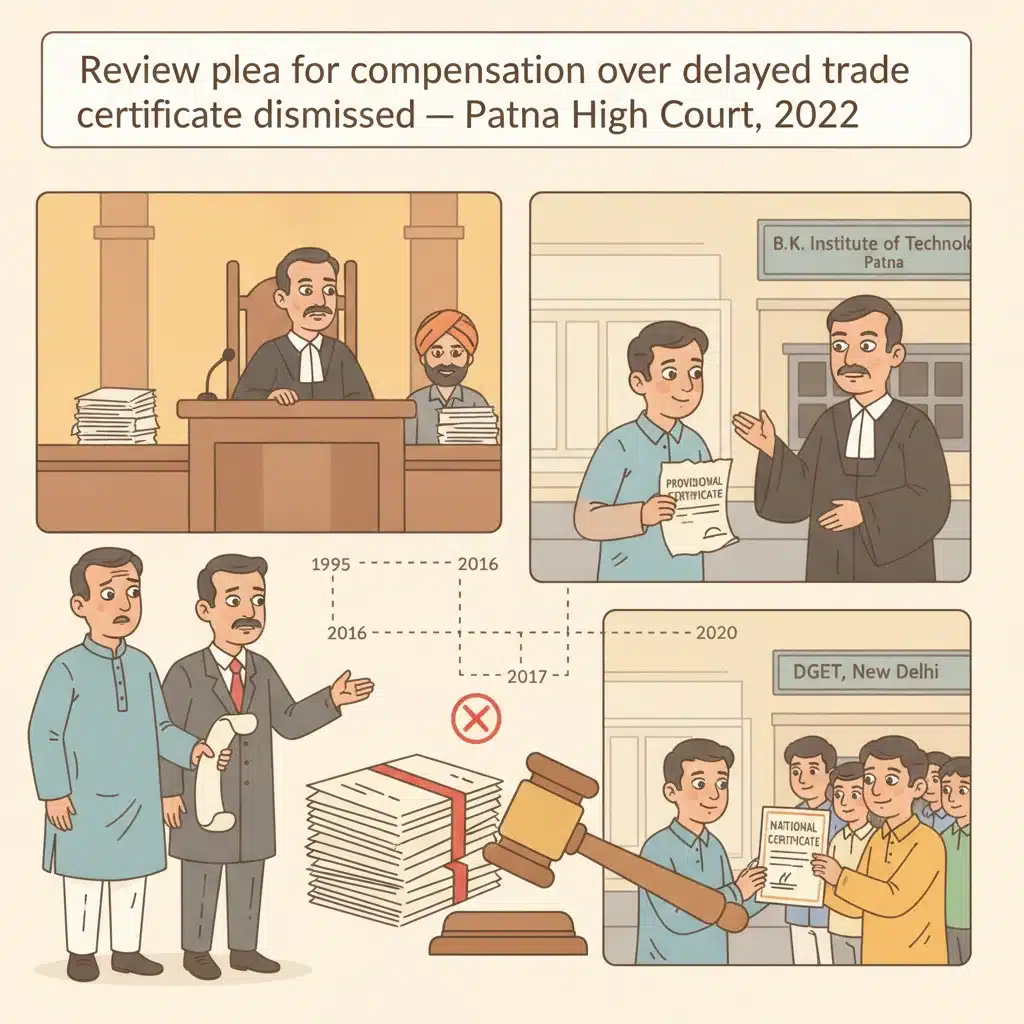
Case Background
The petitioner had studied in the Fitter trade for the 1993–1995 session at B.K. Institute of Technology, Patna. He appeared in the All India Trade Test (AITT) examination in July 1995.
According to him, though he passed the exam, he was given only a provisional certificate. The original National Trade Certificate (NTC) was not issued to him for many years, despite his representations to the authorities.
In 2016, about twenty years after he appeared in the examination, the petitioner approached the Patna High Court under Article 226 of the Constitution by filing CWJC No. 16224 of 2016. He asked for a direction to the authorities to issue his original NTC for the Fitter trade for the 1993–95 session, and also claimed cost and compensation for the alleged wrongful withholding of the certificate and for the impact on his career.
While this writ case was pending, the authorities issued the original National Trade Certificate in favour of the petitioner on 09.11.2017. On 14.11.2017, the High Court disposed of the writ petition as having become infructuous, because the main relief of issuance of the certificate had already been granted.
The petitioner then filed a Letters Patent Appeal (LPA No. 1746 of 2017) against the order dated 14.11.2017. A Division Bench of the Patna High Court, on 07.01.2020, observed that the issue raised in the appeal had not been considered by the learned Single Judge. The Division Bench said that the petitioner should pursue a review petition instead and protected him by directing that the period spent in the appeal would not be counted for limitation. The appeal was disposed of in these terms.
Relying on this observation, the petitioner filed Civil Review No. 44 of 2020 before the Patna High Court. He sought review of the earlier order dated 14.11.2017, mainly to press his claim for compensation for the delay in issuance of the NTC.
What the Court Examined and Decided
The review application came up before Hon’ble Mr. Justice Chakradhari Sharan Singh on 16.11.2022. The Court examined what had been argued earlier, what relief had been granted, and whether any error or ground existed to reopen the matter through review.
On behalf of the petitioner, learned counsel argued that when the Court disposed of the writ petition in 2017 as infructuous, it did not consider the specific prayer for compensation. The contention was that the order only took note of the prayer for issuance of the NTC, but ignored the claim for cost/compensation even though the delay had allegedly ruined the petitioner’s career.
The petitioner’s counsel further submitted that the petitioner had passed the AITT examination in July 1995 and that only a provisional certificate had been issued initially. According to him, the authorities illegally withheld the original certificate for many years, despite repeated representations.
To support the claim for compensation, the petitioner relied on a Division Bench judgment of the Patna High Court dated 25.01.2011 in LPA No. 96 of 2010, Amar Kumar Mahto and Another vs. The State of Bihar & Others. In that case, the Division Bench, dealing with candidates from the same B.K. Institute of Technology, had directed the State of Bihar to pay compensation of Rs. 10 lakhs each to the appellants because of failure to issue their certificates in time.
On this basis, it was argued that the petitioner’s case stood on the same footing as that of the appellants in Amar Kumar Mahto. Hence, he too should have been granted similar compensation. According to the petitioner, the learned Single Judge, when disposing of the writ petition in 2017, did not consider that binding Division Bench decision.
The State of Bihar filed a counter affidavit and a supplementary counter affidavit. The State’s stand was that B.K. Institute of Technology had permission from Respondent No. 3 (Union of India authority) to admit only forty students each year in the Fitter trade. However, the institute admitted fifty-nine students, including the petitioner, beyond the sanctioned strength.
Because of this excess admission, the Director General, Employment and Training, Government of India, did not issue original NTCs to these extra students, including the petitioner. Many of these affected candidates raised grievances. The State of Bihar then requested the Directorate General of Employment and Training (DGET), New Delhi, to examine the matter and consider it sympathetically.
The State pointed out that one similarly placed candidate, Sujit Kumar Sinha, had already approached the Patna High Court by filing CWJC No. 4962 of 2016 seeking issuance of the original certificate. During that writ case, a sympathetic decision was taken to issue original certificates to all such candidates, including the present petitioner. The answering respondent then sent the original certificates to the institute on 09.11.2017.
The State argued that even though the petitioner and others were admitted beyond the sanctioned intake, a sympathetic view led to issuance of their certificates. Therefore, their main grievance stood redressed.
The State also raised the important point of delay and laches. The petitioner had appeared in the examination in 1995 and filed the writ petition only on 23.09.2016, almost twenty years later. According to the State, the question whether such a delayed writ was maintainable had not been examined in 2017 because, at that time, the main relief had already been granted. If the Court had considered maintainability then, the writ could have been dismissed outright on the ground of delay alone.
Further, the State submitted that the petitioner had not made specific pleadings about actual loss or damage suffered by him due to non-issuance of the certificate. In the absence of concrete details of injury, no case was made out for compensation in a writ proceeding.
To support this line of argument, the State relied on two Supreme Court decisions: S.S. Balu & Others vs. State of Kerala & Others, reported in (2009) 2 SCC 479, and State of U.P. vs. Arvind Kumar Srivastava & Others, reported in (2015) 1 SCC 347. These authorities were cited to show that writ petitions filed after long delay without reasonable explanation should be rejected on the ground of delay and laches, and that similarly situated persons who sleep over their rights cannot automatically claim the benefit granted to active litigants.
After examining the pleadings and submissions, the Court first looked into the grounds taken in the review application itself. The petitioner had stated that only one of his writ prayers was considered in 2017 and that his request for cost and compensation was ignored. He also relied again on the Division Bench decisions in other LPAs and on dismissal of special leave petitions by the Supreme Court.
However, the Court noted that there was no specific ground in the review petition saying that the petitioner’s counsel had actually pressed the compensation prayer at the time when the writ was disposed of on 14.11.2017, or that the Court had rejected such an argued claim. The record showed that the petitioner’s counsel was present when the order was passed. But the review petition did not assert that the compensation issue was argued but left unaddressed.
The Court next considered the question of delay. It accepted the State’s submission that the petitioner had filed the original writ nearly twenty years after the cause of action arose, with no plausible explanation except that representations were made to the authorities. The Court observed that the petitioner now appeared to be trying to take undue advantage of the earlier order which had disposed of the writ as infructuous without testing its maintainability on the ground of delay and laches.
The Court stressed that this earlier leniency had been possible only because the main grievance—issuance of the certificate—had already been resolved. After obtaining that relief, the petitioner was now pursuing only the claim for compensation by way of review, which the Court viewed with suspicion.
The Court then compared the petitioner’s case with the decision in Amar Kumar Mahto relied on by him. From the 2011 order in that case, placed on record as Annexure-2, the Court noted a different timeline. The appellants in Amar Kumar Mahto had filed their writ petition in 2001. That writ was dismissed on 06.10.2001. They then filed a review petition, which was dismissed on 27.10.2009. This dismissal of the review provided them a fresh cause of action to file an LPA, in which the Division Bench on 25.01.2011 ordered the payment of compensation.
In contrast, the present petitioner filed his own writ only in 2016, fifteen years after Amar Kumar Mahto had gone to court. He also approached the Court more than five and a half years after the disposal of LPA No. 96 of 2010. The Court described him as a “fence sitter” who had not been proactive in asserting his rights.
Because of this, the Court held that the petitioner could not claim parity with the appellants in Amar Kumar Mahto. The factual and procedural situation was very different, particularly regarding delay and the petitioner’s own conduct.
Taking all these aspects together, the Court concluded that the review application was meritless. No ground was made out for reviewing the earlier order dated 14.11.2017 that had disposed of the writ petition as infructuous. The review petition was accordingly dismissed. The Court also clarified that there would be no order as to costs.
Why This Judgment Matters
This judgment is significant for students and trainees who face long delays in getting certificates from technical institutes or training authorities.
First, it shows that once the main relief—such as issuance of a certificate—has already been granted, courts may not entertain separate claims for compensation through a review petition, especially if those claims were not clearly pressed earlier.
Second, the Patna High Court emphasised that approaching the court after decades, without solid explanation, is risky. Delay and laches can block relief, and leniency shown once (for example, to secure issuance of a certificate) cannot be used later to seek money compensation.
Third, the Court drew a clear line between people who fight their cases promptly and those who wait on the sidelines hoping to benefit later. Persons who are “fence sitters” cannot demand the same benefits as those who have actively litigated from the beginning.
For similarly placed candidates, this judgment underlines the need to act in time, keep proper records, and clearly plead and prove actual loss if they want any monetary relief.
Legal Issues and Answers
Issue: Can the petitioner, after receiving his National Trade Certificate, seek review of the order disposing of his writ petition as infructuous to claim compensation for the earlier delay?
Answer: No. The Court held that no ground for review was made out, especially when the compensation claim was not shown to have been pressed earlier and the writ itself was filed after inordinate delay.
Issue: Is the petitioner entitled to the same compensation as granted in the earlier Division Bench judgment in Amar Kumar Mahto’s case?
Answer: No. The Court found that the petitioner, who approached the Court much later and after long silence, was a “fence sitter” and could not claim parity with the proactive appellants in that case.
Issue: Does prolonged delay of about twenty years in filing a writ petition, explained only by making representations, affect the claim for relief and compensation?
Answer: Yes. The Court accepted the State’s argument that such unexplained delay and laches would by itself justify dismissal and, in any case, did not support a claim for compensation.
Cases Cited by the Court
- LPA No. 96 of 2010, Amar Kumar Mahto and Another vs. The State of Bihar & Others (Division Bench, Patna High Court, order dated 25.01.2011).
- S.S. Balu & Others vs. State of Kerala & Others, (2009) 2 SCC 479.
- State of U.P. vs. Arvind Kumar Srivastava & Others, (2015) 1 SCC 347.
Case Details
Case Number: Civil Review No. 44 of 2020
Case Title: Adya Nand Prasad Gupta vs. The State of Bihar & Others
Court: High Court of Judicature at Patna
Coram: Hon’ble Mr. Justice Chakradhari Sharan Singh
Date of Judgment: 16.11.2022
Citation: 2022 (4) PLJR 927
Advocates:
For the Petitioner: Mr. Sanjay Kumar, Advocate; Mr. Anant Kumar 1, Advocate
For the Opposite Parties: Mr. Ajay Kumar Rastogi, AAG-10
Opposite Parties: State of Bihar authorities connected with Craftsman Training Scheme and Directorate of Employment and Training; Union of India through Directorate General, Employment and Training; Controller of Examination, Directorate of Employment and Training, Bihar.
Nature of the Case: Civil review petition seeking review of an order in a writ petition under Article 226 of the Constitution of India.
Link to Full Judgment: Click here to read the official Patna High Court judgment
If you found this explanation helpful and wish to stay informed about how legal developments may affect your rights in Bihar, you may consider following Samvida Law Associates for more updates.




