

Case Background
This case arises out of a government rooftop solar project in Bihar.
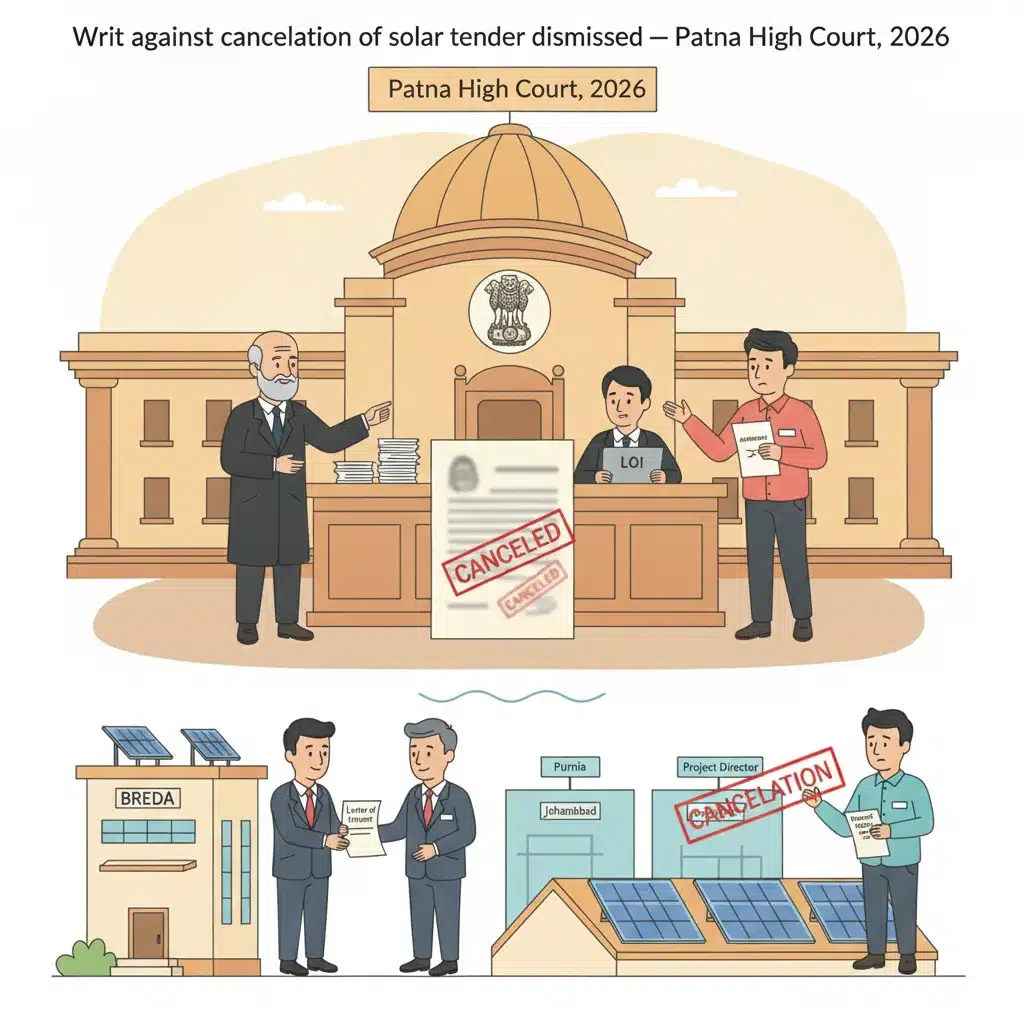
The Bihar Renewable Energy Development Agency (BREDA) issued an Expression of Interest (EOI) on 24.04.2024 bearing No. BREDA/Tender/SPV/GCRTPV/01kWp-500kWp/08/2023-24. The EOI was for empanelment of agencies to design, supply, erect, test and commission grid-connected rooftop solar power plants on various government buildings across the State.
The petitioner, M/s Energy United India Private Limited, participated in this bidding process. When the financial bids were opened, the petitioner was asked to match the L-1 (lowest) rate. After the petitioner agreed, BREDA issued a Letter of Intent (LOI) bearing Letter No. 320 dated 10.02.2025.
On 17.02.2025, an agreement was executed between the petitioner and BREDA, under which the petitioner was designated as an executing agency under the EOI.
On 11.04.2025, BREDA conducted a district distribution exercise. In this process, the petitioner was allotted the districts of Purnia, Jehanabad and Madhubani. The respondents then instructed the petitioner to undertake site assessments and other preparatory work in these districts.
According to the petitioner, it complied with these directions, completed questionnaires and carried out site surveys and related preparations. However, no specific work order was issued for installation or execution.
On 18.09.2025, the Project Director (respondent no. 6) issued an e-tender cancellation notice vide Letter No. 2263 dated 18.09.2025, received by the petitioner through email on 22.09.2025. This notice cancelled the EOI/tender with immediate effect.
Aggrieved by the cancellation after agreement and preparatory steps, the petitioner approached the Patna High Court by filing Civil Writ Jurisdiction Case No. 16154 of 2025.
What the Court Examined and Decided
The Division Bench of Hon’ble Mr. Justice Sudhir Singh and Hon’ble Mr. Justice Ranjan Kumar Jha heard the writ petition. The oral judgment was delivered on 17.06.2026 by Hon’ble Mr. Justice Sudhir Singh.
The petitioner sought multiple reliefs, including quashing of the cancellation notice dated 18.09.2025, production and quashing of the internal file notings behind that decision, restoration of the contract and issuance of specific work orders for the allotted districts.
Petitioner’s main arguments
The petitioner’s counsel argued that once the Letter of Intent dated 10.02.2025 was issued and the agreement dated 17.02.2025 was signed, the tender process had resulted in a concluded contract.
According to the petitioner, after a binding contract came into existence and both sides had acted upon it (through district allotment and site surveys), the respondents could not legally cancel the EOI itself. The cancellation, they argued, was unilateral and illegal.
The petitioner further contended that the cancellation notice only referred vaguely to “unavoidable circumstances” and did not spell out any concrete reasons. No material was disclosed to show any public interest or administrative necessity.
The petitioner also stressed that no show-cause notice was served upon it, nor was any opportunity of hearing given before cancelling the tender. On that basis, the petitioner alleged violation of principles of natural justice and argued that the action was arbitrary.
Respondents’ stand
On behalf of the State and BREDA, it was argued that the decision to cancel the EOI was neither arbitrary nor illegal, but was taken bona fide for administrative reasons.
The respondents relied on paragraphs 10 and 11 of their counter affidavit. These paragraphs showed that BREDA had repeatedly written to the Energy Department seeking budget approval and sanction for enhanced project capacity and funds, through letters dated 08.05.2024, 21.10.2024, 25.02.2025 and a detailed proposal dated 21.04.2025.
According to the respondents, the necessary approval and financial sanction for the enhanced capacity could not be obtained from the competent authority. Because of this, no work orders were issued to any of the empanelled agencies—not just the petitioner.
The respondents also emphasised clauses 3.15 and 3.15.1 of the EOI. These clauses expressly empowered BREDA to withdraw, cancel, modify or annul the EOI or reject any bid at any stage, without assigning reasons and without any liability. They argued that the petitioner had participated in the tender with full knowledge of these clauses, and cannot later challenge their exercise.
They further stated that cancelling the EOI was a policy decision taken in larger public interest in view of the absence of necessary approvals and budget. Since the decision applied uniformly to all empanelled agencies and not specifically against the petitioner, no enforceable right had accrued in favour of the petitioner to insist on continuation of the project.
Core issue before the Court
The Court framed the central question as whether the cancellation of EOI No. BREDA/Tender/SPV/GCRTPV/01kWp-500kWp/08/2023-24, through Letter No. 2263 dated 18.09.2025, was legally sustainable in light of the powers reserved to BREDA in clauses 3.15 and 3.15.1 of the EOI.
Analysis of EOI clauses and bidder’s rights
The Court first examined clauses 3.15 and 3.15.1. These clearly stated that the EOI could be withdrawn or cancelled by BREDA at any time without assigning reasons and that BREDA could reject any or all bids without reasons and without incurring any liability.
The Court noted that the petitioner had admittedly participated in the tender process after accepting these terms. It held that a bidder who consciously joins a tender process is bound by its conditions and cannot later attempt to escape their consequences.
Therefore, once the EOI itself reserved such a broad power of cancellation, the mere absence of detailed reasons in the cancellation notice could not invalidate the decision.
Administrative and financial reasons for cancellation
The Court then looked beyond the contract clauses to see if there was any real basis for the decision. Although BREDA was not required under the EOI to assign reasons, the counter affidavit disclosed the actual circumstances.
The Court noted that BREDA had repeatedly approached the Energy Department seeking approval for enhanced project capacity and the necessary funds. However, the competent authority did not grant the required approvals or financial sanction.
As a result, the project could not move forward, and no work orders could be issued to any empanelled agency. The Court treated this as an administrative and financial ground, not linked to any fault of the petitioner.
It also observed that the cancellation was uniform for all empanelled agencies and not aimed at the petitioner alone. Hence, it appeared to be a project-level administrative decision rather than a punitive step against a particular contractor.
No vested right without work order
The petitioner had argued that the agreement dated 17.02.2025 created an “indefeasible right” in its favour to have the project executed. The Court rejected this contention.
It referred to Article 7.0 of the agreement. Under this article, the contractor had to organise resources and complete work within 150 days from the date of issuance of a particular work order.
Thus, the Court held that issuance of a specific work order was the trigger for the execution phase. Without a work order, the contractual obligation to execute the project did not start.
In this case, it was admitted that no specific work order had ever been issued to the petitioner. Though the petitioner had participated in district allocation and conducted site surveys and other preparatory work, the stage of actual execution under the agreement had not begun.
Therefore, the Court concluded that no accrued or vested right had crystallised in favour of the petitioner that could force the State to go ahead with the project despite later financial or administrative difficulties.
Supreme Court guidance on tender rights
The Court relied on the judgment of the Hon’ble Supreme Court in Maa Binda Express Carrier & Anr. v. North-East Frontier Railway & Ors., reported in (2014) 3 SCC 760.
In that case, the Supreme Court held that bidders in a tender process have only a right to fair, equal and non-discriminatory treatment. They do not get a vested right to insist that a contract must be awarded to them simply because they have submitted a bid or even because they are the highest or lowest bidders.
The Patna High Court applied this principle to hold that the petitioner had no enforceable right to demand continuation of the EOI or grant of work orders.
Legitimate expectation and arbitrariness arguments
The petitioner had also invoked the doctrine of “legitimate expectation”, arguing that the execution of the agreement and subsequent actions created an expectation that the project would be implemented.
The Court accepted that legitimate expectation can entitle a party to fairness in decision making. However, it held that this doctrine cannot override clear contractual terms in the EOI, nor can it compel the State to run a project which lacks required approval and financial sanction.
On the plea of arbitrariness, the Court found no material showing mala fides, favouritism, colourable exercise of power or any attempt to give undue benefit to a third party. On the contrary, documents indicated that the decision followed the State’s inability to secure budget approval and sanction for the project.
Liberty to claim expenses and final outcome
The petitioner had stated that it incurred expenses on site surveys and preparatory work, supported by Annexures P/10 and P/11. The Court did not go into the correctness or quantum of such expenses in the writ proceeding.
Instead, it clarified that if so advised, the petitioner was free to pursue any such claim before a competent civil court in accordance with law.
Ultimately, considering that BREDA had expressly reserved a right to cancel the tender process under clauses 3.15 and 3.15.1, and that there was a rational and bona fide basis for the decision, the Court found no merit in the writ petition.
The writ application was dismissed, and all pending interlocutory applications were disposed of.
Why This Judgment Matters
This judgment is important for companies that participate in government tenders, especially for infrastructure and energy projects.
The Patna High Court has made it clear that when a tender notice itself reserves a wide power to cancel at any stage, bidders cannot later complain if that power is used, provided it is not done with mala fide intention or to favour someone.
The decision also shows that even after an agreement, district allocation and initial surveys, a contractor may still not have an enforceable right if no specific work order has been issued and the contract itself links execution to such work orders.
For bidders, especially smaller firms relying on government work, this case underlines the risk that projects may be dropped due to lack of budget or approvals. Their main remedy for preparatory expenses may lie in civil suits, not writ petitions.
Legal Issues and Answers
- Issue: Could BREDA legally cancel the rooftop solar EOI after issuing a Letter of Intent and executing an agreement with the petitioner?
Answer: Yes. The Court held that clauses 3.15 and 3.15.1 of the EOI expressly allowed BREDA to cancel the EOI at any time without reasons, and this power was exercised on bona fide administrative and financial grounds. - Issue: Did the petitioner acquire a vested right to continue the project or receive work orders once the agreement and district allocation were completed?
Answer: No. Since no specific work order was ever issued and Article 7.0 linked execution to issuance of such work orders, no accrued or indefeasible right arose in favour of the petitioner. - Issue: Was the cancellation arbitrary or violative of natural justice for want of prior notice or detailed reasons?
Answer: No. The Court found no mala fides or discrimination; the decision applied to all empanelled agencies and was based on non-availability of approval and funds. Given the clear cancellation clause, the absence of prior hearing or elaborate reasons did not render the action arbitrary.
Cases Cited by the Court
- Maa Binda Express Carrier & Anr. v. North-East Frontier Railway & Ors., (2014) 3 SCC 760.
Case Details
Case Number: Civil Writ Jurisdiction Case No. 16154 of 2025
Case Title: M/s Energy United India Private Limited v. The State of Bihar & Ors.
Court: High Court of Judicature at Patna
Date of Judgment: 17.06.2026
Coram: Hon’ble Mr. Justice Sudhir Singh; Hon’ble Mr. Justice Ranjan Kumar Jha
Advocates:
- For the petitioner: Mr. Nikhil Kumar Agrawal, Advocate; Ms. Aditi Hansaria, Advocate; Mr. Keshav Bhardwaj, Advocate
- For the State of Bihar: Mr. Advocate General; Mr. Yogendra Pd. Sinha, AAG-7
- For BREDA: Mr. Kunal Tiwary, Advocate
Nature of the case: Writ petition (civil) challenging cancellation of an Expression of Interest / tender and seeking restoration of contract and issuance of work orders.
If you found this explanation helpful and wish to stay informed about
how legal developments may affect your rights in Bihar,
you may consider following Samvida Law Associates for more updates.




