

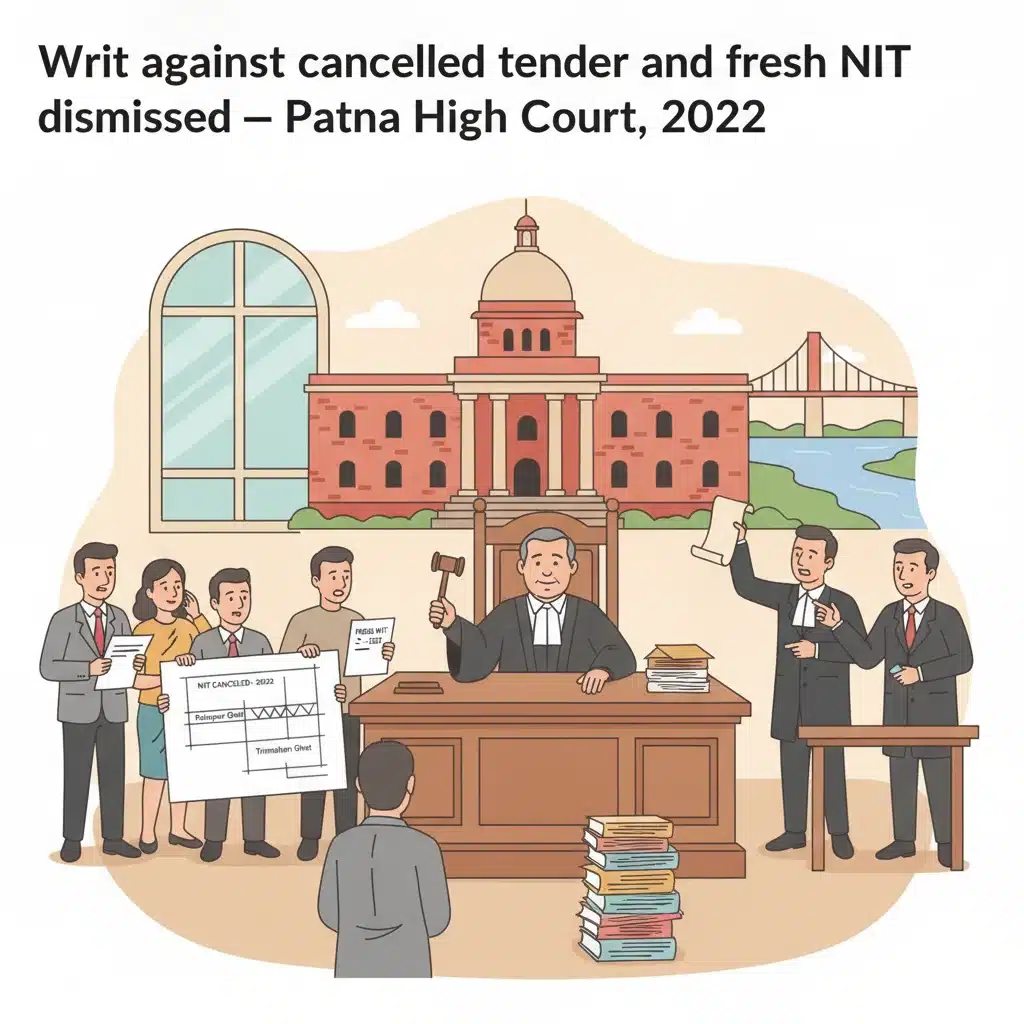
The Patna High Court refused to interfere once the earlier tender was cancelled.
The Court also noted the contractor chose not to bid in the fresh tender.
The writ petition and interim applications were dismissed.
Case Background
The case arose from a government tender issued by the Rural Works Department, Government of Bihar, for construction of a high level RCC bridge across the Bagmati river between Ratanpur Ghat and Trimuhan Ghat in Darbhanga.
The Notice Inviting Tender (NIT) was issued as NIT No. ET/RWD-DBG1/STATE SCHEME-06/2021-22 by the Executive Engineer, Rural Works Department. The petitioner, a construction firm, submitted its tender pursuant to this NIT.
At the first stage, the petitioner’s technical bid was found responsive. This meant that, initially, it met the eligibility and qualification criteria laid down in the Standard Bidding Document (SBD) and Instructions to Bidders (ITB). According to the petitioner, out of six bidders, it alone was found technically responsive.
Later, based on a complaint from one of the unsuccessful bidders, the Technical Bid Committee reconvened on 24-03-2022. In this re-meeting, the Committee revisited the technical bids.
As a result of this second scrutiny, the Committee rejected the petitioner’s technical bid by order dated 24-03-2022, citing disqualification with reference to Clause 4.8 of the ITB of the SBD. This rejection order became the central subject of the writ petition filed before the Patna High Court.
What the Court Examined and Decided
The Division Bench of the Patna High Court, comprising Hon’ble Mr. Justice Chakradhari Sharan Singh and Hon’ble Mr. Justice Madhuresh Prasad, heard the writ petition. The oral judgment was delivered on 17-05-2022 by Hon’ble Mr. Justice Chakradhari Sharan Singh.
Before dealing with the reliefs, the Court briefly recounted the sequence: the original NIT, initial acceptance of the petitioner’s technical bid, the later complaint by an unsuccessful bidder, the re-meeting on 24-03-2022, and the consequent rejection of the technical bid under Clause 4.8 of the ITB.
Clause 4.8 of the ITB, reproduced in the judgment, allowed the employer to disqualify a bidder even if basic qualifying criteria were met, in certain situations. These included cases where a bidder:
- made misleading or false representations in forms, statements, and attachments submitted as proof of qualification;
- had a record of poor performance such as abandoning works, not properly completing contracts, inordinate delays, litigation history, or financial failures; and/or
- had previously participated for the same work, quoted unreasonably high prices and failed to justify them.
According to the petitioner, soon after receiving the decision dated 24-03-2022 rejecting its technical bid, it made a representation on 26-03-2022 challenging that rejection. The petitioner argued that the rejection was arbitrary and violated principles of natural justice because no opportunity of hearing was given, especially when the bid had earlier been found responsive.
The petitioner also claimed that it was the sole bidder whose technical bid survived the first scrutiny. It alleged that rejection of its bid at a later stage was done merely to scuttle the tender process and prevent it from getting the contract for the bridge work.
However, the factual position changed after the rejection. The Technical Bid Committee rejected the technical bids of all bidders. Consequently, the NIT itself was cancelled. After cancelling this NIT, the authority issued a fresh NIT on 31-03-2022 for the same project.
The case record showed that the writ petition was filed online on 29-03-2022 and registered on 05-04-2022. Initially, the challenge was directed at the rejection of the petitioner’s technical bid under the first NIT. After the fresh NIT dated 31-03-2022 was issued, the petitioner sought to amend the writ petition through I.A. No. 1 of 2022 to challenge the fresh NIT as well.
The last date for submission of bids pursuant to the fresh NIT was 29-04-2022. It was an admitted fact before the Court that the petitioner did not submit any bid under this fresh NIT and thus chose not to participate in the new tender process.
Through I.A. No. 2 of 2022, the petitioner also sought a stay of the process under the fresh NIT dated 31-03-2022 (noted in the judgment that the date was incorrectly typed as 31-03-2021 in the interlocutory application).
During arguments, learned counsel for the petitioner repeated that the entire exercise of reopening the technical evaluation and rejecting the petitioner’s bid, based on a complaint by an unsuccessful bidder, was aimed at denying it the contract. The petitioner asserted that this conduct was violative of natural justice and that the manner of rejection indicated malice on the part of the authorities.
On the other hand, the respondent-State of Bihar filed a counter affidavit explaining why the technical bid had been rejected. The State stated that, on receiving the complaint from an unsuccessful bidder, the Technical Bid Committee reconvened and inquired into the allegations in light of Clause 4.8 of the ITB.
According to the counter affidavit, the inquiry revealed that the petitioner had already been allotted another work under the Works Division, Masaurhi. A letter of acceptance for that work had been issued in favour of the petitioner on 22-06-2021. This meant that on the last date of submission of bids for the present NIT, i.e. 15-07-2021, the petitioner was already holding a contract from the Works Division, Masaurhi.
The respondents stated that the petitioner had not disclosed this existing contractual commitment in the bid documents submitted for the bridge work. This non-disclosure of a material fact relating to its existing work and obligations formed the basis for invoking Clause 4.8 of the ITB and rejecting the technical bid.
The petitioner filed a rejoinder affidavit denying the averments in the State’s counter affidavit. However, the Court chose not to enter into a detailed examination of these disputed facts.
The Bench noted that the earlier NIT dated 12-06-2021 (relating to which the petitioner’s technical bid had been rejected) had already been cancelled. A fresh NIT had been issued on 31-03-2022 for the same project. In these circumstances, the Court considered whether any interference was still called for.
The Court held that once the earlier NIT was cancelled and a fresh NIT was issued, it was not inclined to go into the disputes relating to the earlier tender, including the challenge to the rejection of the technical bid. This conclusion was reinforced by the fact that the petitioner had chosen not to participate in the fresh tender process, even though it had the opportunity to do so before the last date of submission of bids on 29-04-2022.
In the Court’s considered opinion, under these circumstances, no interference was required with respect to the previous NIT or the rejection order dated 24-03-2022. The Court therefore dismissed the writ petition.
As a consequence, the interlocutory applications, including those seeking amendment and stay of the fresh NIT, were also disposed of.
Why This Judgment Matters
This judgment is significant for contractors and government departments involved in public works tenders in Bihar.
First, it shows that once an earlier tender is fully cancelled and a fresh NIT is issued, courts may decline to examine past disputes about the cancelled process, especially where the aggrieved bidder has the chance to participate afresh but does not do so.
Second, the case highlights that non-disclosure of existing contracts or commitments can attract scrutiny under clauses like Clause 4.8 of the ITB, which allow disqualification for misleading or incomplete information. Though the Court did not finally rule on this factual dispute, the State’s justification for rejection was recorded.
For bidders, the decision underlines the importance of making full and accurate disclosures in tender documents and also of participating in fresh tenders if they wish to keep their challenge alive. For authorities, it reinforces that once a tender is cancelled and a new one issued, the earlier tender process usually becomes academic in writ proceedings.
Legal Issues and Answers
Issue: Should the Patna High Court interfere with the rejection of the petitioner’s technical bid and the earlier NIT when the NIT itself has been cancelled and a fresh NIT issued?
Answer: No. The Court held that, since the earlier NIT was cancelled and a fresh NIT issued, and the petitioner chose not to participate in the fresh tender, no interference was required.
Issue: Was the Court required to examine allegations of arbitrariness and violation of natural justice in the rejection of the technical bid under Clause 4.8 of the ITB?
Answer: The Court declined to go into these disputes, considering them unnecessary once the earlier NIT had been cancelled and a new tender issued.
Cases Cited by the Court
- No prior judicial decisions are cited or relied upon in this judgment.
Case Details
Case Number: Civil Writ Jurisdiction Case No. 5248 of 2022
Case Title: M/s Amrit Raj Construction through its Proprietor Dilip Kumar v. The State of Bihar & Ors.
Citation: 2022 (3) PLJR 144
Court: High Court of Judicature at Patna
Coram: Hon’ble Mr. Justice Chakradhari Sharan Singh and Hon’ble Mr. Justice Madhuresh Prasad
Date of Judgment: 17-05-2022
Advocates: For the petitioner – Mr. Dhananjay Kumar, Advocate; For the respondents – Mr. Satya Vrat, AC to GP-10
Nature of the Case: Writ petition under civil writ jurisdiction challenging rejection of technical bid, cancellation of NIT, and issuance of fresh NIT in a public works tender.
Link to Judgment: Patna High Court Judgment CWJC No. 5248 of 2022
If you found this explanation helpful and wish to stay informed about
how legal developments may affect your rights in Bihar,
you may consider following Samvida Law Associates for more updates.




