

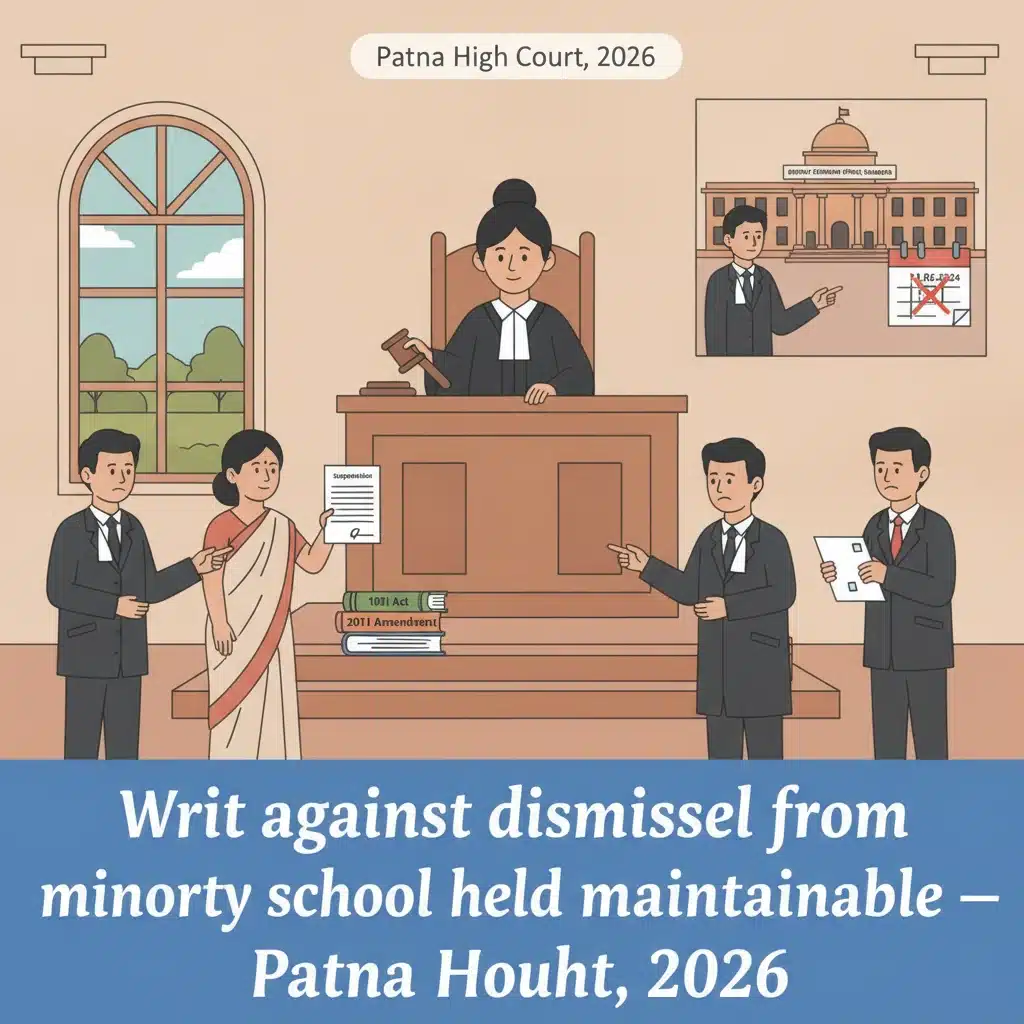
Case Background
The petitioner is an Assistant Teacher of Plus 2 Arya Kanya Uchaya Vidyalaya, Khagaria, a minority aided school imparting education up to Class 12. This school is referred to in the judgment as Respondent No. 7.
Under the Bihar Non-Government Secondary Schools (Taking over of Management and Control) Act, 1981 (the 1981 Act), as amended by the Bihar Non-Government Secondary Schools (Taking over of Management and Control) (Amendment) Act, 2011 (the 2011 Amendment Act), minority aided schools must frame service rules for their teaching and non-teaching staff and get them approved by the Education Department.
The Director, Secondary Education, Government of Bihar (Respondent No. 3) has regulatory control over minority schools and disciplinary control over their staff. The petitioner was appointed as an Assistant Teacher in 1987 by the school’s managing committee after a selection process. Her appointment was approved by the then Competent Service Board under Section 18(3)(b) of the 1981 Act.
According to the petitioner, she received all benefits extended to teaching staff of minority aided schools, including government scheme benefits and pay revisions, and there was no dispute with the managing committee during her long service.
Later, an internal dispute arose between rival managing committees of the school. The petitioner claims that, because of this dispute, she was unnecessarily targeted. On 05.04.2024, the Secretary of the present managing committee issued a suspension letter placing her under suspension. On 11.06.2024, the District Education Officer, Khagaria (Respondent No. 6) issued a letter directing her either to comply with the suspension or furnish an explanation. Her salary was also ordered to be withheld.
The petitioner filed the present writ petition challenging both the suspension order dated 05.04.2024 and the consequential letter dated 11.06.2024, mainly on the ground that statutory approval from the competent government authority, as allegedly required under the 1981 Act, had not been obtained.
During pendency of the writ petition, the Secretary of the managing committee passed a dismissal order dated 10.01.2026, terminating the petitioner’s services. This order was forwarded to the District Education Officer and the District Programme Officer (Establishment). The petitioner challenged the dismissal order by filing I.A. No. 01 of 2026, again on the ground that it had been issued without the mandatory approval of the Director, Secondary Education as required under Section 18(3)(d) of the 1981 Act as amended by the 2011 Amendment Act.
The school (Respondent No. 7) filed a detailed counter affidavit and a supplementary counter affidavit defending its actions. In paragraph 15 of the supplementary counter affidavit it raised a preliminary objection that the writ petition was not maintainable because the dispute arose out of an ordinary contract of service in a minority aided school.
What the Court Examined and Decided
The central question before the Patna High Court at this stage was limited: whether the writ petition itself was maintainable against a minority aided school in a service dispute, when the petitioner alleged violation of statutory provisions of the 1981 Act and the 2011 Amendment Act.
The school argued that orders of suspension and dismissal passed by the managing committee are matters of private contract between employer and employee, and that no writ would lie under Article 226 of the Constitution for enforcement of such contractual rights. It relied on several Supreme Court decisions, including Shri Vidya Ram Misra, Pradeep Kumar Biswas, Trigun Chand Thakur, St. Mary’s Education Society, Army Welfare Education Society, and Dileep Kumar Pandey.
The essence of the school’s objection was that the case involved only an “ordinary contract of service”. According to it, even if the school was performing a public function of imparting education, the termination of a teacher’s service had no direct nexus with that public duty and therefore fell outside writ jurisdiction.
The petitioner responded that her challenge was not confined to breach of contract. She specifically alleged breach of statutory provisions of the 1981 Act as amended in 2011. In particular, she pleaded that:
- her suspension had not been approved by the competent government authority, and
- her dismissal had been ordered by the Secretary without obtaining the mandatory approval of the Director, Secondary Education, who has disciplinary control over minority school staff.
She relied on decisions such as Andi Mukta, Ramakrishna Mission, Marwari Balika Vidyalaya, St. Mary’s Education Society, and a 2025 Patna High Court judgment in Shiv Shankar Singh, to argue that writs can be issued against private or minority institutions when a public duty or statutory obligation is violated.
The Court carefully examined the pleadings. It noted that the petitioner’s case was clearly grounded in the assertion that suspension and dismissal orders were passed without statutory approval required under the 1981 Act and the 2011 Amendment Act. She also pleaded that service rules for teachers and non-teaching staff of Respondent No. 7 school had been framed in terms of these Acts and that the Director, Secondary Education exercises regulatory and disciplinary control over the school and its staff.
Importantly, the Court observed that these factual assertions were not specifically denied by the school in its counter affidavit. In the supplementary counter affidavit, the school merely stated that the District Education Officer had approved the suspension order by letter dated 11.06.2024, but no document showing such approval was produced on record. There was also no denial of the allegation that the dismissal order had been issued without approval of the Director, Secondary Education.
Against this background, the Court analysed the case law cited by both sides in the limited context of the maintainability objection.
First, it held that Shri Vidya Ram Misra’s case did not apply. In that case, the dispute arose only from a contractual clause, without any statutory flavour, and the Supreme Court had therefore directed the aggrieved teacher to seek damages in a civil court. There was no allegation of breach of statute. In contrast, the present case involved alleged violation of statutory provisions of the 1981 Act.
Second, the Court found that Pradeep Kumar Biswas and Trigun Chand Thakur were decisions on when a body is “State” under Article 12 of the Constitution. In the present case, the school had not argued that it was not “State” under Article 12. Its objection was narrower: that the dispute related to an ordinary contract of service. Hence, those judgments did not answer the point in issue.
Third, the Court turned to St. Mary’s Education Society, heavily relied upon by the school. It acknowledged that St. Mary’s lays down that writ jurisdiction under Article 226 can be invoked against a body discharging public duties only when the act complained of has a public law element. Individual disputes rooted purely in private contracts are not ordinarily amenable to writ jurisdiction.
However, the Court emphasised that St. Mary’s itself recognised an important exception. In paragraph 75.4, the Supreme Court clarified that where removal of an employee is regulated by statutory provisions, violation of those provisions can be interfered with by the Court on the ground of breach of law, even in respect of private or unaided schools. In such situations, the matter goes beyond a purely private contract and enters the realm of public law because a statute is alleged to have been breached.
The Patna High Court noted that in the present case, the petitioner’s challenge was expressly based on the alleged violation of the 1981 Act and 2011 Amendment Act, which govern the recognition and functioning of minority secondary schools, including their power to appoint and remove teachers with approval of competent authorities.
The Court found support for this view in the Supreme Court’s decision in Marwari Balika Vidyalaya, where a private school’s action in dismissing a teacher without the mandatory approval of the District Inspector of Schools was held to be bad in law, and the writ petition was found maintainable. The Supreme Court in St. Mary’s itself distinguished Marwari Balika Vidyalaya on this very basis: there, appointment and removal of teachers required government approval, bringing the dispute within public law.
Further, the Court relied on Ramakrishna Mission, where the Supreme Court held that contracts of a purely private nature are not amenable to writ jurisdiction, but an exception exists where the contract of service is governed or regulated by statutory provisions. In such cases, writ jurisdiction can be invoked.
The Patna High Court also referred to its own earlier decision in Shiv Shankar Singh, dealing with the same 1981 Act. In that case, it had set aside the termination of a teacher appointed on a sanctioned post in a minority school, where approval from the Director, Secondary Education was pending and the termination was found to be without authority of law.
After surveying all these authorities, the Court drew a clear line:
• If an employee of a private or minority educational institution complains only of breach of an ordinary contract of service, without alleging breach of any statutory provision, the dispute is in the realm of private law and a writ petition would not lie.
• However, if the employee alleges that the employer has violated statutory provisions governing recruitment, suspension, or dismissal, then the cause of action involves breach of law. In such cases, even a private or minority institution performing public functions is amenable to writ jurisdiction.
Applying this principle, the Court held that the present writ petition is maintainable because the petitioner has alleged breach of the statutory scheme under the 1981 Act and 2011 Amendment Act. The school did not clearly rebut the claim that approval from the Director, Secondary Education was required and had not been obtained, at least so far as the dismissal order was concerned.
The Court therefore rejected Respondent No. 7’s preliminary objection regarding maintainability. At the same time, it limited the scope of the case going forward. It made it clear that, on merits, the petitioner will be permitted to challenge the suspension and dismissal orders only on the ground of alleged breach of statutory provisions of the 1981 Act as amended by the 2011 Amendment Act, and on no other ground.
The Court also cautioned that if, at the final hearing, the petitioner fails to establish any actual violation of these statutory provisions, the Court may not ultimately grant relief even though the writ is maintainable at this stage.
Finally, the Court directed that the case be listed after two weeks, on 20.07.2026, under the heading “Order on Petition” for disposal of I.A. No. 01 of 2026. In the meantime, the respondents were permitted to file their replies to the interlocutory application.
Why This Judgment Matters
This order is important for teachers and staff working in minority aided schools and other aided institutions in Bihar operating under the 1981 Act.
First, it clarifies that such staff are not helpless if they believe that suspension or dismissal orders violate the statutory protections built into the Act. They can approach the Patna High Court under Article 226, provided they clearly show that statutory provisions have been breached, and not merely that the school has acted unfairly under a private contract.
Second, the judgment emphasises that when the law requires approval of the Director, Secondary Education or other competent authority for suspension or dismissal, managing committees cannot bypass that requirement. If they do, their actions can be tested in writ proceedings.
Third, the Court strikes a balance: it does not open the doors of writ jurisdiction for every internal service dispute in private or minority schools; only those disputes that involve breach of statutory obligations will be entertained. This protects schools from excessive interference while safeguarding basic legal protections for teachers.
For stakeholders in Bihar’s education sector, including managing committees, teachers, and education officers, this decision highlights the need to strictly follow the procedure laid down in the 1981 Act and 2011 Amendment Act before taking serious actions like suspension and dismissal.
Legal Issues and Answers
- Issue: Is a writ petition maintainable against a minority aided school in relation to suspension and dismissal of a teacher when the action is alleged to violate statutory provisions of the Bihar Non-Government Secondary Schools (Taking over of Management and Control) Act, 1981 as amended in 2011?
Answer: Yes. The Patna High Court held that since the petitioner challenged the actions on the ground of breach of statutory provisions governing her service conditions, and the school performs a public function of imparting education, the writ petition is maintainable. The dispute is not confined to a mere private contract of service. - Issue: Does the teacher need to show a direct link between her dismissal and the school’s public duty of imparting education to invoke Article 226?
Answer: No, not where the complaint is of violation of statutory provisions regulating service conditions. In such a case, the interference is sought on the ground of breach of law, which is sufficient to attract writ jurisdiction even without establishing a direct nexus with the public duty. - Issue: On what grounds can the petitioner here continue to press her case on merits?
Answer: The Court has restricted the petitioner to grounds based strictly on alleged breach of statutory provisions of the 1981 Act as amended by the 2011 Amendment Act, particularly regarding the requirement of approval by competent authorities. No other non-statutory or purely contractual grounds will be entertained.
Cases Cited by the Court
- Shri Vidya Ram Misra v. Managing Committee, Shri Jai Narain College, (1972) 1 SCC 623
- Pradeep Kumar Biswas v. Indian Institute of Chemical Biology & Ors., (2002) 5 SCC 111
- Trigun Chand Thakur v. State of Bihar & Ors., (2019) 7 SCC 513
- St. Mary’s Education Society & Anr. v. Rajendra Prasad Bhargava & Ors., (2023) 4 SCC 498
- Army Welfare Education Society, New Delhi v. Sunil Kumar Sharma & Ors., (2024) 16 SCC 598
- Dileep Kumar Pandey v. Union of India & Ors., 2025 LiveLaw (SC) 629
- Andi Mukta Sadguru Shree Muktajee Vandas Swami Suvarna Jayanti Mahotsav Smarak Trust & Ors. v. V.R. Rudani & Ors., (1989) 2 SCC 691
- Ramakrishna Mission & Anr. v. Kago Kunya & Ors., (2019) 16 SCC 303
- Marwari Balika Vidyalaya v. Asha Srivastava & Ors., (2020) 14 SCC 449
- Shiv Shankar Singh v. State of Bihar & Ors., CWJC No. 5476 of 2020, judgment dated 08.05.2025 (Patna High Court)
Case Details
Case Number: Civil Writ Jurisdiction Case No. 12439 of 2025
Case Title: Abha Rani v. The State of Bihar & Ors.
Coram: Hon’ble Mr. Justice Alok Kumar Sinha
Date of Judgment (CAV): 02.07.2026
Advocates:
- For the Petitioner: Mr. Siddhartha Prasad, Advocate; Mr. Sumit Kumar, Advocate
- For the State (Respondent Nos. 1–6): Standing Counsel (20); Md. Zeeshan Kalim, AC to SC (20); Mr. Prasad Verma, AC to SC (20)
- For Respondent No. 7 (Plus 2 Arya Kanya Uchaya Vidyalaya, Khagaria): Mr. Sanjeev Ranjan, Advocate; Ms. Shristi Singh, Advocate; Mrs. Aditi Sahay, Advocate
Nature of the Case: Writ petition under Article 226 of the Constitution challenging suspension and dismissal of a teacher of a minority aided school, and seeking declaration that such actions without statutory approval are illegal.
Link to Judgment: https://patnahighcourt.gov.in/viewjudgment/MTUjMTI0MzkjMjAyNSMxI04=-22qvKHAaUBA=
If you found this explanation helpful and wish to stay informed about how legal developments may affect your rights in Bihar, you may consider following Samvida Law Associates for more updates.




