

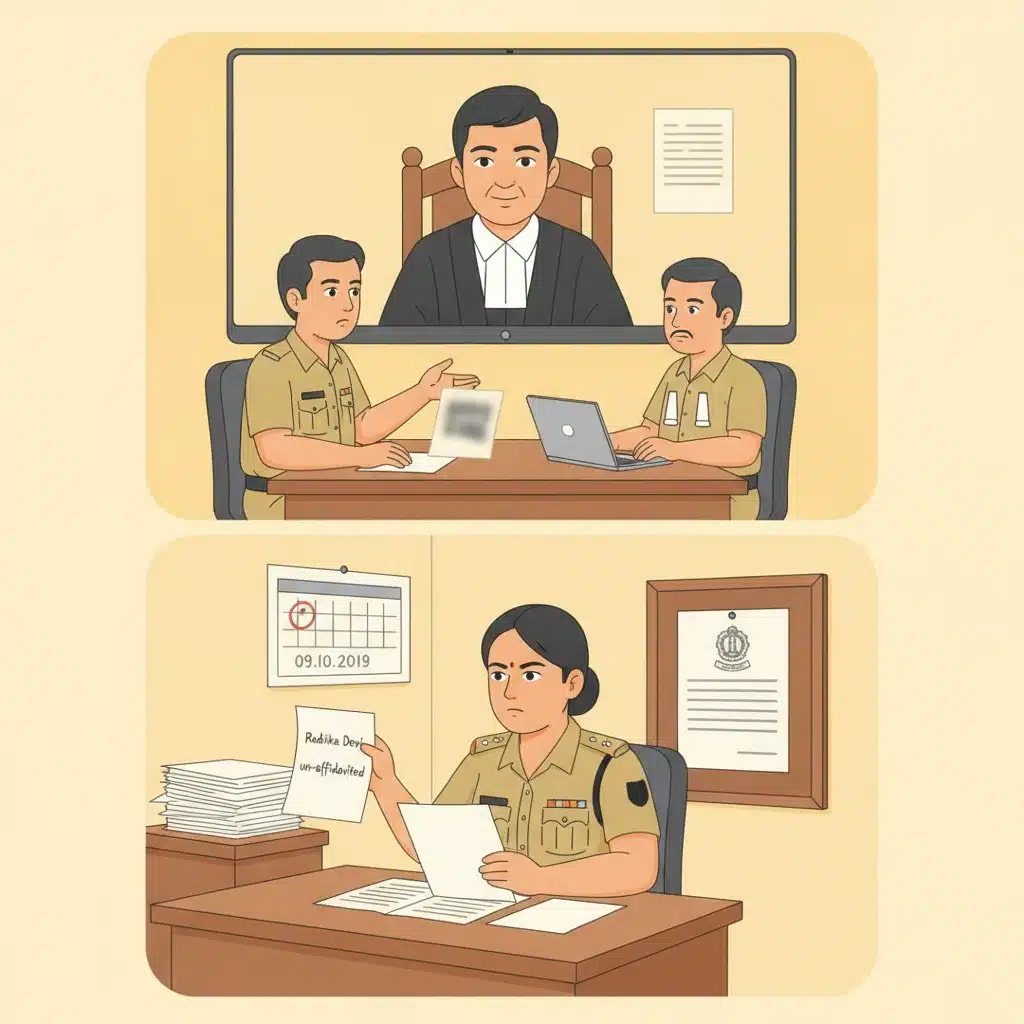
Case Background
The matter came before the Patna High Court in Civil Writ Jurisdiction Case No. 633 of 2021. The petitioner is a person serving in the police establishment, posted under the jurisdiction of Muzaffarpur.
An enquiry had been held against him by the then Assistant Superintendent of Police, East, Muzaffarpur. The enquiry report was issued under Memo No. 4129/East dated 09.10.2019.
According to the petitioner, this enquiry was conducted ex-parte, meaning it went on without giving him a proper opportunity to be heard. He claimed that the enquiry officer relied on an application filed by one Radhika Devi, which was not supported by an affidavit.
The petitioner argued that such an unaffidavited application should have been rejected at the outset, and no enquiry should have been initiated on its basis. He further relied on Resolution No. 3/M-7/2005/Ka 945 dated 24.06.2005 of the Personnel and Administrative Reforms Department, Government of Bihar, allegedly issued as per the direction of the then Chief Secretary, Bihar.
Feeling aggrieved by the enquiry report, the petitioner approached the Patna High Court under its writ jurisdiction. He sought to have the enquiry report set aside and to prevent the authorities from taking any action based upon it.
What the Court Examined and Decided
The writ petition was heard by Hon’ble Mr. Justice P. B. Bajanthri on 17.01.2022 through video conferencing due to the COVID-19 pandemic conditions.
The petitioner asked for three main reliefs. First, he wanted the Court to set aside the enquiry report contained in Memo No. 4129/East dated 09.10.2019. He stressed that the enquiry was held ex-parte and that he was not heard at all. Second, he asked that the respondent authorities be restrained from taking any action against him on the basis of that ex-parte enquiry report. Third, he sought any other relief the Court thought fit.
The central argument placed before the Court was that the enquiry was ex-parte and, therefore, unfair. The petitioner’s grievance was that the enquiry officer went ahead with the proceeding without giving him an opportunity to defend himself. He also questioned the very basis of the enquiry, saying that it rested on an unaffidavited application allegedly filed by Radhika Devi, which, in his view, should not have been acted upon under the government resolution mentioned in the petition.
However, the Patna High Court focused on a larger legal principle: when, and at what stage, the High Court should interfere with disciplinary proceedings under its writ jurisdiction.
For this, the Court relied on a leading judgment of the Supreme Court in Union of India and Another v. Kunisetty Satyanarayana, reported in (2006) 12 SCC 28. In that decision, the Supreme Court had clearly held that High Courts should not ordinarily interfere with disciplinary proceedings at an early or intermediate stage. Interference is normally considered only after the process has concluded and a final order has been passed.
The Supreme Court’s reasoning is that disciplinary proceedings are part of the internal process of the department. If courts begin to interfere at every step, it would disrupt administration and prevent the disciplinary authority from doing its job. Courts step in only when there is a final decision that is shown to be illegal, arbitrary, or in violation of principles of natural justice.
Applying this principle from the Supreme Court, the Patna High Court noted that the petitioner’s grievance was essentially about how the enquiry was conducted. It was about lack of hearing, ex-parte conduct, and reliance on an unaffidavited complaint.
But, as per the law laid down in Kunisetty Satyanarayana, such issues should first be raised before the departmental authorities themselves. The High Court should not be the first forum to examine whether the enquiry was fair or not, if the disciplinary process has not yet attained finality.
Therefore, instead of directly setting aside the enquiry report or stopping all further action based on it, the Patna High Court adopted a middle path. The Court protected the petitioner’s right to raise his objections but channelled that right through the proper disciplinary framework.
The Court granted liberty to the petitioner to approach the Disciplinary Authority by submitting a detailed representation. In that representation, the petitioner can set out all his grievances about the enquiry, including the complaint about ex-parte conduct and the use of an unaffidavited application.
To make this remedy effective, the Court fixed clear timelines. It directed that the petitioner must file his representation within eight weeks from the date he receives a copy of the Court’s order. Once such a representation is filed, the Disciplinary Authority is bound to examine the grievance.
The Court further directed the Disciplinary Authority to pass a reasoned order on the representation and to communicate that order to the petitioner. This entire exercise has to be completed within three months from the date the petitioner’s representation is received.
Thus, the Court ensured that the petitioner is not left remediless. At the same time, it respected the boundary laid down by the Supreme Court that courts should not prematurely interfere with disciplinary proceedings before they have reached their natural conclusion.
After issuing these directions, the Patna High Court disposed of the writ petition. It did not make any finding on the merits of the enquiry report itself. The question whether the enquiry was properly held or not is left open for the Disciplinary Authority to consider first.
Why This Judgment Matters
This judgment is important for government servants and police personnel who feel that an enquiry against them has been conducted unfairly or ex-parte.
The Patna High Court has made it clear that the first step in such cases is not to rush to the High Court. Instead, the proper course is to approach the Disciplinary Authority with a detailed written representation explaining all grievances.
The decision also shows that the High Court respects the law laid down by the Supreme Court in Kunisetty Satyanarayana. Disciplinary matters are primarily for the department to handle. Courts intervene only after the process is over and a final order has been made, or in rare circumstances where interference at an earlier stage is unavoidable.
For employees, the judgment underlines the importance of participating in the departmental process and putting their objections on record there. If they do so within the time allowed and the authorities still ignore their grievances, they can then approach the courts with a stronger case.
For departments, the judgment serves as a reminder that when an employee submits a detailed representation about the fairness of an enquiry, the Disciplinary Authority must examine it seriously, pass a speaking order, and communicate the decision within a reasonable time.
Legal Issues and Answers
Issue: Can the Patna High Court, in writ jurisdiction, set aside an ex-parte disciplinary enquiry report at an intermediate stage before final orders are passed by the department?
Answer: No. Following the Supreme Court’s ruling in (2006) 12 SCC 28, the Court declined to interfere at this preliminary stage and instead directed the petitioner to file a representation before the Disciplinary Authority.
Issue: What remedy is available to an employee alleging that an enquiry was conducted ex-parte and based on a defective complaint?
Answer: The employee may file a detailed representation to the Disciplinary Authority, which must consider the grievance and pass a reasoned order within a fixed time.
Cases Cited by the Court
- Union of India and Another v. Kunisetty Satyanarayana, (2006) 12 SCC 28.
Case Details
Case Number: Civil Writ Jurisdiction Case No. 633 of 2021
Case Title: Rajnish Kumar v. The State of Bihar & Others
Citation: 2022 (4) PLJR 120
Court: High Court of Judicature at Patna
Coram: Hon’ble Mr. Justice P. B. Bajanthri
Date of Judgment: 17.01.2022
Advocates: Mr. Kundan Kumar for the petitioner; Mr. Manish Kumar, GP 4, for the respondents
Nature of the Case: Writ petition (civil) challenging an ex-parte disciplinary enquiry report and seeking restraint on further action based on that report
Link to Judgment: https://patnahighcourt.gov.in/viewjudgment/MTUjNjMzIzIwMjEjMSNO-7hpMoc0709Q=
If you found this explanation helpful and wish to stay informed about
how legal developments may affect your rights in Bihar,
you may consider following Samvida Law Associates for more updates.




