

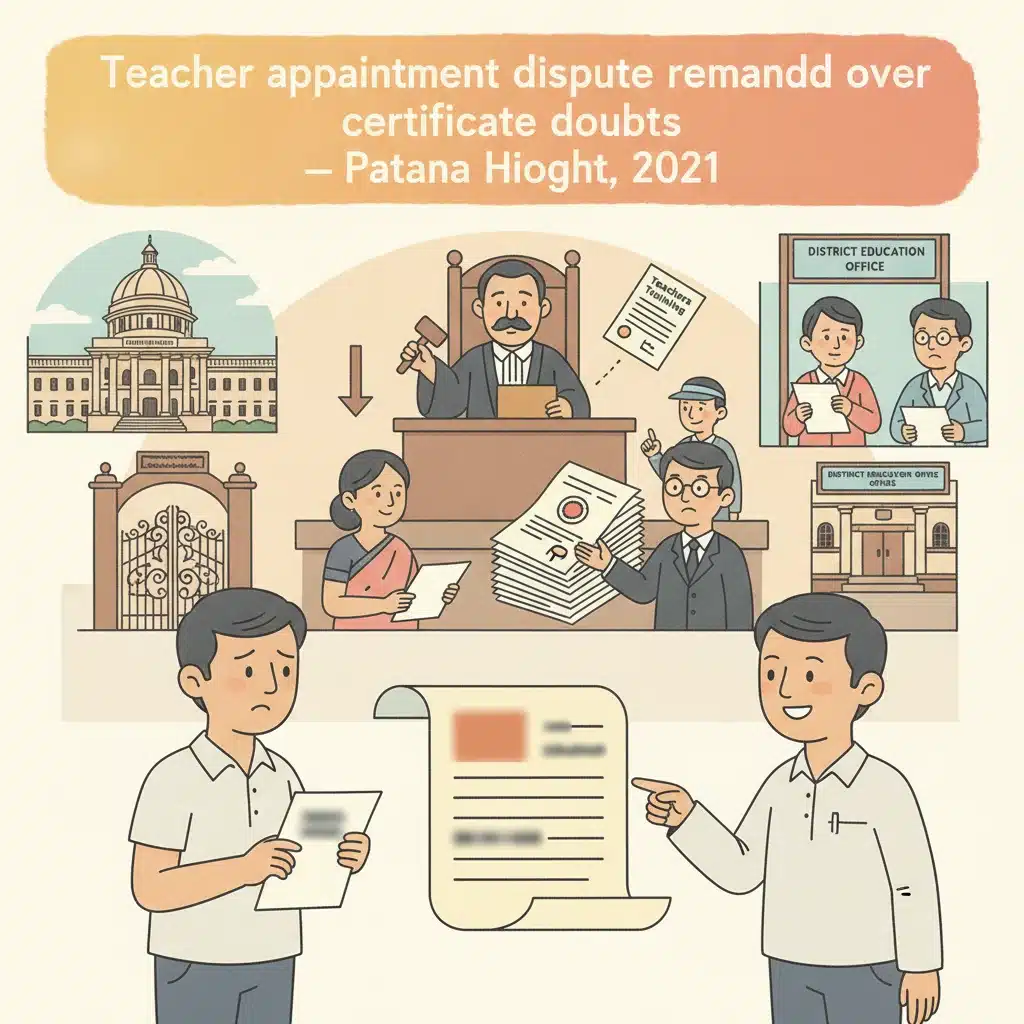
Case Background
The dispute arose from the appointment of respondent no. 10 as a Panchayat Teacher in district Supaul.
Later, doubts came up about his educational qualifications. It was alleged that his degree or training certificate was forged. Because of this, an enquiry was started into the genuineness of his certificates.
The matter reached the District Teacher Employment Appellate Authority, Supaul. That Authority examined the material and came to the conclusion that respondent no. 10 was not entitled to be appointed as a Panchayat Teacher.
Once the appointment of respondent no. 10 was annulled, the present petitioner, who was next in the merit list, was appointed on that post. The petitioner belongs to the B.C. category and had been placed second in the relevant merit list.
Respondent no. 10, being aggrieved by the order of the District Teacher Employment Appellate Authority, approached the State Appellate Authority, Niyojan Bhawan, Patna. He challenged the decision holding his appointment invalid and supporting the petitioner’s appointment.
The State Appellate Authority finally declared the certificate of respondent no. 10 to be genuine and directed the authorities to reinstate him in service as Panchayat Teacher. This order had the effect of displacing the petitioner’s appointment.
Feeling aggrieved, the petitioner filed the present writ petition before the Patna High Court under its civil writ jurisdiction, challenging the order of the State Appellate Authority.
What the Court Examined and Decided
The Patna High Court, through Hon’ble Mr. Justice Ashutosh Kumar, heard the writ petition on 29.11.2021. The Court heard counsel for the petitioner, for the State, and for respondent no. 10.
The core dispute before the Court was whether the State Appellate Authority had taken its decision on full and correct facts regarding the genuineness of the certificates of respondent no. 10. The High Court did not directly examine who finally had the better claim to the post. Instead, it focused on the process followed by the State Appellate Authority.
From the counter affidavit filed on behalf of the official respondents, the Court noted an important sequence of events.
First, respondent no. 10 himself requested that his training certificate be verified from the Bihar School Examination Board. Acting on this request, the authorities again sent his certificate for verification to the Board.
The Bihar School Examination Board then reported that the matriculation certificate of respondent no. 10 was genuine. However, it also reported that the certificate showing that he had passed the Teachers Training Examination was incorrect, because there was tampering in the certificate.
This new report differed from an earlier report obtained by the District Education Officer (D.E.O.), who had also verified the certificates by checking the records of the Bihar School Examination Board. Because of this conflict between the two reports, doubts remained about the true position.
Seeing this inconsistency, the District Programme Officer (Establishment), Supaul, considered it proper to get the matter re-verified once more from the Bihar School Examination Board. For this third verification, another officer, Shri Shiv Dayal Prasad, the then Programme Officer (Establishment), Supaul, was deputed.
This officer personally visited the office of the Bihar School Examination Board and got the certificates of respondent no. 10 rechecked from the original records. After this physical verification, he submitted his report dated 17.06.2014.
In that report, he confirmed that the matriculation certificate of respondent no. 10 was correct. But, importantly, he found that the training certificate was fake. The roll number mentioned in that certificate actually belonged to another candidate and not to respondent no. 10.
These findings were crucial because the training certificate was directly linked to the eligibility of respondent no. 10 for appointment as a Panchayat Teacher. If the training certificate was fake, he could not legally hold the post.
The High Court then examined whether these later verification reports, especially the report dated 17.06.2014, had been placed before the State Appellate Authority when it decided in favour of respondent no. 10.
The Court found that these later facts had not been disclosed before the State Appellate Authority. Only the initial report, which was in favour of respondent no. 10, had been placed before it. That initial report suggested that his certificate was correct, and on that basis, the State Appellate Authority held the certificate to be genuine and ordered his reinstatement.
From the counter affidavit filed by respondent no. 10, the Court also gathered that only the first favourable report was shown to the State Appellate Authority. The later two verification reports, which either raised doubts or clearly stated that the training certificate was fake, were kept out of consideration.
This meant that the State Appellate Authority took its decision without having all the material facts before it. It was misled into believing that there was no serious dispute about the genuineness of the training certificate.
In such a situation, the High Court concluded that it had no option but to interfere with the order of the State Appellate Authority. The Court held that the order had been passed on an incomplete and incorrect factual basis.
However, the High Court did not itself decide whether respondent no. 10’s training certificate was genuine or fake, or which candidate ultimately had a right to the post. Instead, the Court considered that these questions should be decided afresh by the competent authority, after looking at all the relevant reports and hearing both sides.
Accordingly, the High Court set aside the appellate order passed by the State Appellate Authority in favour of respondent no. 10. It remanded the matter back to the same Authority.
The Court directed the State Appellate Authority to pass a fresh order. This fresh decision must be taken after:
First, hearing both the parties, that is, the petitioner and respondent no. 10; and second, carefully studying the report or reports about the genuineness of the certificates of respondent no. 10, as well as the claim of the petitioner.
The High Court also requested the State Appellate Authority to pass the final order within three months from the date of receipt or production of a copy of the High Court’s order. This ensured that the dispute would not remain pending indefinitely.
Until the State Appellate Authority decides the matter afresh, the High Court directed that status quo should be maintained. In simple terms, the existing situation regarding the post and the service of the parties must remain as it is, and no party should be disturbed until the Authority gives its new decision.
With these directions and observations, the writ petition was disposed of. The judgment made it clear that the focus was on ensuring a fair and complete reconsideration by the State Appellate Authority, based on all available verification reports about the certificates.
Why This Judgment Matters
This judgment is important for all government job aspirants and serving employees in Bihar, especially those involved in Panchayat Teacher appointments.
First, it shows that if any authority decides a case without seeing all relevant documents, such a decision can be challenged and set aside. A person affected by that order can approach the Patna High Court to demand a fair hearing.
Second, the case highlights that educational and training certificates must be genuine. If there is any suspicion and multiple verification reports give different findings, the authorities must investigate thoroughly. They cannot rely only on one favourable report and ignore later reports pointing to tampering or forgery.
Third, the Court’s direction to maintain status quo protects both sides while the appeal is reconsidered. It prevents sudden changes in posting or removal until a proper, reasoned order is passed on full facts.
Finally, this judgment reinforces the duty of State Appellate Authorities dealing with teacher appointments and similar disputes to examine all verification reports and hear both parties properly. It sends a message that incomplete or one-sided consideration will not stand judicial scrutiny.
Legal Issues and Answers
Issue: Whether the State Appellate Authority’s order declaring respondent no. 10’s certificate genuine and directing his reinstatement could stand when later verification reports about the training certificate were not placed before it.
Answer: No. The Patna High Court held that since crucial later reports indicating that the training certificate was fake were not disclosed to the State Appellate Authority, its order was unsustainable and had to be set aside.
Issue: What course of action should be taken when an appellate authority has decided a service dispute on incomplete material?
Answer: The Court remanded the case to the same appellate authority with directions to hear both sides afresh, consider all verification reports regarding the certificates, and pass a final order within a fixed time.
Issue: What should happen in the meantime regarding the disputed post?
Answer: The Court directed that status quo be maintained till the State Appellate Authority passes its fresh order.
Cases Cited by the Court
- The judgment does not mention or rely on any other decided case. No prior judicial precedents are cited.
Case Details
Case Number: Civil Writ Jurisdiction Case No. 19833 of 2018
Case Title: Sanjay Kumar v. The State of Bihar & Ors.
Coram: Hon’ble Mr. Justice Ashutosh Kumar
Citation: 2022 (4) PLJR 134
Advocates:
- For the petitioner: Mr. Rajeev Kumar Singh, Advocate
- For the State (respondents 1 to 9): Mr. Jitendra Kumar Roy No. 1, Standing Counsel-13
- For respondent no. 10: Mr. Girijanand Prasad, Advocate
Nature of the Case: Writ petition under civil writ jurisdiction challenging an order of the State Appellate Authority in a Panchayat Teacher appointment dispute.
Link to Judgment: Click here to read the full judgment of the Patna High Court
If you found this explanation helpful and wish to stay informed about
how legal developments may affect your rights in Bihar,
you may consider following Samvida Law Associates for more updates.




