

Case Background
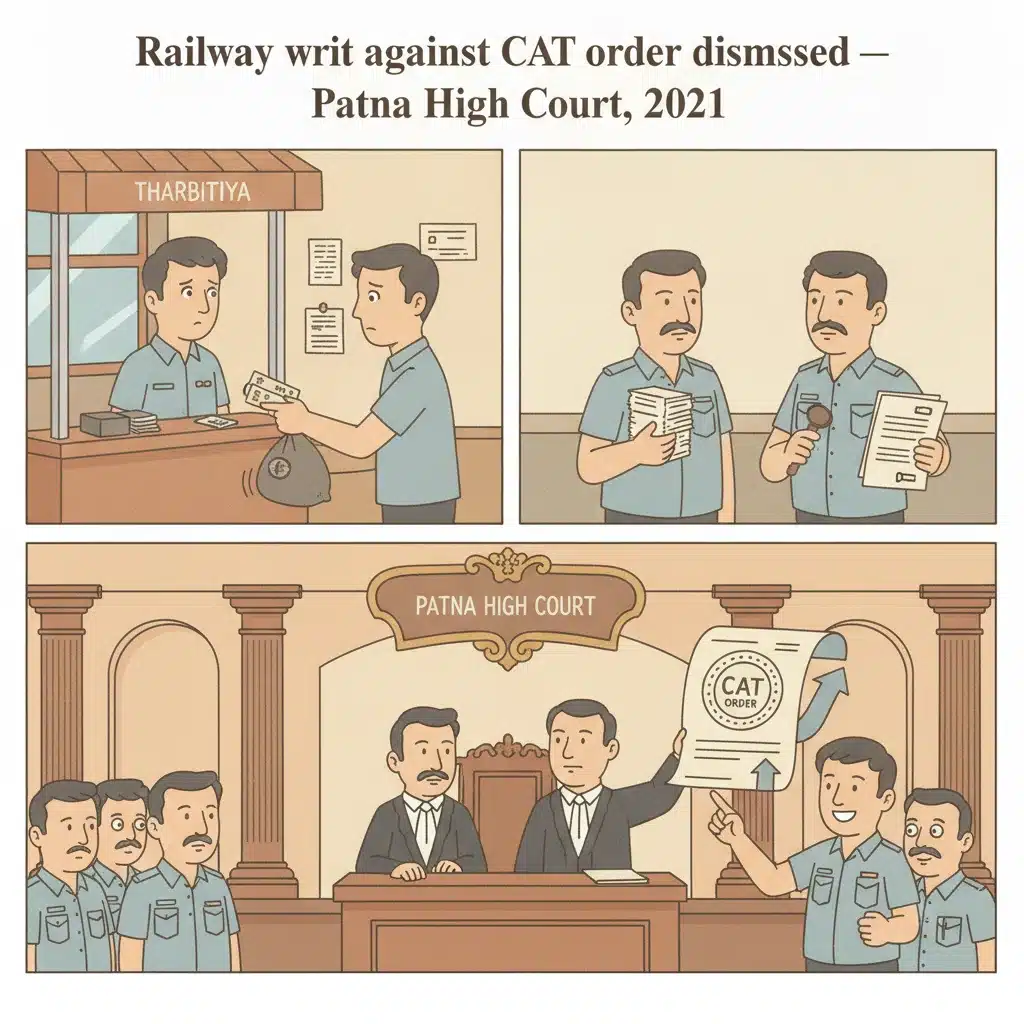
The dispute arose from a departmental vigilance trap conducted on 12.10.2006 at Tharbitiya railway station under East Central Railway. The respondent was posted there as an Assistant Station Master.
Because Tharbitiya was a small station, the respondent was not only handling train operations. He was also performing ticket selling and other commercial duties in addition to his regular work.
After the raid, the railway administration issued a charge sheet on 17.01.2007. The allegation was that the respondent had charged extra money while issuing tickets and had also mishandled cash.
According to the charge, he allegedly took Rs 500/- for two journey tickets whose actual fare was Rs 478/- (Rs 239/- each). The extra amount of Rs 22/- was said to have been taken from one Ashok Kumar Shah Gond, who was used as a decoy passenger in the vigilance trap.
The charge sheet further alleged that the respondent had not declared his personal cash and that there was a shortage of Rs 45/- in the “Government cash” under his charge.
A departmental enquiry followed. The Enquiring Authority held the charges proved. Accepting this report, the Disciplinary Authority passed an order on 09.01.2009 imposing punishment.
The punishment was reduction of pay to a lower stage, from Rs 13,610/- to Rs 13,090/-, along with postponement of further increment. The respondent’s appeal was dismissed by the Appellate Authority on 19.11.2009.
Aggrieved, the respondent approached the Central Administrative Tribunal, Patna Bench, by filing Original Application No. 666 of 2009 under Section 19 of the Administrative Tribunals Act, 1985. He challenged both the Disciplinary Authority’s order and the Appellate Authority’s order.
By judgment and order dated 23.07.2013, the Tribunal allowed the Original Application. It set aside the punishment order dated 09.01.2009 and the appellate order dated 19.11.2009, mainly on the ground that the vigilance trap had not been conducted in accordance with the Rules and the Vigilance Manual.
The Union of India and other railway officials then approached the Patna High Court by filing Civil Writ Jurisdiction Case No. 15644 of 2014 under Article 226 of the Constitution of India, challenging the Tribunal’s decision.
What the Court Examined and Decided
The Patna High Court heard arguments from both sides and examined whether the Tribunal was right in setting aside the departmental punishment on the basis of irregularities in the vigilance trap.
On behalf of the petitioners (Union of India and railway authorities), it was argued that the Tribunal had wrongly relied upon alleged non-compliance of the Vigilance Manual. Counsel submitted that during the departmental enquiry, witnesses were produced who supported the allegation of demand and acceptance of more money than the actual fare.
On this basis, the petitioners contended that even if there was some breach of guidelines regarding trap procedure, the enquiry findings could not be invalidated. According to them, once oral evidence supported the allegation, the Tribunal ought not to have treated the entire trap as illegal.
The petitioners also argued that the guidelines relied upon by the Tribunal were not in force on the date of the raid on 12.10.2006. Therefore, they claimed, the Tribunal had erred in applying those guidelines retrospectively and in setting aside the punishment.
To support their stand, the petitioners relied on the Supreme Court decision in Chief Commercial Manager, South Central Railway, Secunderabad & Others versus G. Ratnam & Others, reported in (2007) 8 Supreme Court Cases 212.
On the other hand, the respondent’s counsel drew the High Court’s attention to an earlier Division Bench judgment of the same Court in Union of India & Others versus Dilip Kumar Sinha (CWJC No. 5922 of 2014, decided on 23.12.2016).
In that case, the Patna High Court had refused to interfere with an order of the Central Administrative Tribunal where similar issues concerning a railway vigilance decoy procedure were involved. The Court in that earlier case had relied upon the Supreme Court judgment in Moni Shankar versus Union of India & Others, reported in (2008) 3 Supreme Court Cases 484.
The respondent’s counsel submitted that the facts in the present matter were identical. The Tribunal here had also relied on Moni Shankar (supra) to hold that the trap was not conducted in line with the Vigilance Manual and that such non-compliance rendered the entire proceedings bad.
He further argued that in the Dilip Kumar Sinha case, the Union of India had already implemented the Tribunal’s order after the High Court refused to interfere. Therefore, the authorities could not now deny similar relief to the present respondent in a case of the same nature.
The High Court carefully examined the earlier Division Bench decision in Union of India & Others versus Dilip Kumar Sinha. It particularly referred to paragraphs 8, 9 and 10 of that judgment, which it reproduced in its present decision.
In those paragraphs, the Division Bench in Dilip Kumar Sinha had accepted that although decoy procedures and trap procedures might differ in some ways, the Supreme Court in Moni Shankar (supra) had applied paragraphs 704 and 705 of the Vigilance Manual to a case on an identical footing.
On that basis, the earlier Division Bench held that it could not take a different view from the Supreme Court and that non-compliance of paragraphs 704 and 705 of the Manual rendered the departmental orders bad. The Court then observed that once the orders were held bad on that ground, other issues did not survive.
In the present case too, the Tribunal had recorded a clear finding that the trap at Tharbitiya station was not conducted in accordance with the prescribed Rules. Because of this procedural violation, the Tribunal held that the trap itself was illegal and that no penalty could be imposed on such a foundation. It relied upon Moni Shankar (supra) to reach this conclusion.
The Patna High Court in the present writ petition noted that the Supreme Court’s decision in G. Ratnam (supra), relied upon by the petitioners, had already been considered by the Supreme Court in Moni Shankar (supra). Thereafter, this very High Court, in the Dilip Kumar Sinha case, had applied Moni Shankar in a similar factual situation involving railway vigilance decoy proceedings.
Because a co-ordinate Bench had already decided the same question following Moni Shankar, the present Division Bench stated that it saw no reason to take a different view. The Court clearly expressed that, in identical circumstances, consistency required that it follow the reasoning adopted in the Dilip Kumar Sinha case.
Thus, the Court accepted the respondent’s submission that the matter was covered by the earlier Division Bench decision. Since the Tribunal had applied the same Supreme Court precedent and the same Vigilance Manual provisions, and since the facts were substantially similar, the High Court considered interference with the Tribunal’s order to be unwarranted.
In simple terms, the Court held that when a vigilance trap is not conducted as per the mandatory procedure laid down in the relevant Manual, the resulting departmental action cannot stand. This is particularly so when the Supreme Court has already interpreted those provisions and the High Court itself has previously followed that interpretation in a comparable case.
Accordingly, after considering the submissions of both parties and the binding precedents, the Patna High Court concluded that there was no reason to interfere with the judgment and order of the Central Administrative Tribunal, Patna Bench, dated 23.07.2013.
The writ application filed by the Union of India and other railway officials was therefore dismissed. As a result, the Tribunal’s decision setting aside the punishment imposed on the respondent continues to operate.
Why This Judgment Matters
This judgment is important for railway employees and other government servants who face departmental action arising from vigilance traps or decoy checks.
The Patna High Court has confirmed that if the authorities do not follow their own prescribed procedures under the Vigilance Manual, the entire disciplinary proceeding based on such a trap can be struck down.
It shows that even when witnesses support the allegation, the Court will still look at whether the basic safeguards and procedures were observed during the trap. If they were not, the punishment may not survive.
The decision also underlines that the Patna High Court will maintain consistency with its own earlier Division Bench rulings and with Supreme Court precedents like Moni Shankar. Employees in similar situations can therefore rely on these judgments when challenging irregular vigilance actions.
Legal Issues and Answers
Issue: Whether the Central Administrative Tribunal was justified in setting aside a railway employee’s punishment on the ground that the vigilance trap was not conducted in accordance with the Vigilance Manual and relevant Rules.
Answer: Yes. Following the Supreme Court decision in Moni Shankar and its own earlier Division Bench ruling in Union of India versus Dilip Kumar Sinha, the Patna High Court held that non-compliance with the prescribed trap procedure rendered the departmental proceedings bad, and there was no reason to interfere with the Tribunal’s order.
Cases Cited by the Court
- Moni Shankar versus Union of India & Others, (2008) 3 Supreme Court Cases 484.
- Chief Commercial Manager, South Central Railway, Secunderabad & Others versus G. Ratnam & Others, (2007) 8 Supreme Court Cases 212.
- Union of India & Others versus Dilip Kumar Sinha, CWJC No. 5922 of 2014, Patna High Court, judgment dated 23.12.2016.
Case Details
Case Number: Civil Writ Jurisdiction Case No. 15644 of 2014
Case Title: The Union of India through General Manager, East Central Railway, Hajipur & Others versus Surendra Mishra
Coram: Hon’ble Mr Justice Chakradhari Sharan Singh and Hon’ble Mr Justice Madhuresh Prasad
Date of Judgment: 16.12.2021
Citation: 2022 (4) PLJR 186
Advocates: For the petitioners: Mr Abbas Haider, Advocate. For the respondent: M/s M. P. Dixit, S. K. Dixit, S. K. Chaubey, Swastika, Advocates.
Nature of the Case: Writ petition under Article 226 of the Constitution of India challenging an order of the Central Administrative Tribunal in a service/disciplinary matter.
Link to Judgment: https://patnahighcourt.gov.in/viewjudgment/MTUjMTU2NDQjMjAxNCMxI04=-PUlEr–ak1–yOMzs=
If you found this explanation helpful and wish to stay informed about how legal developments may affect your rights in Bihar, you may consider following Samvida Law Associates for more updates.




