

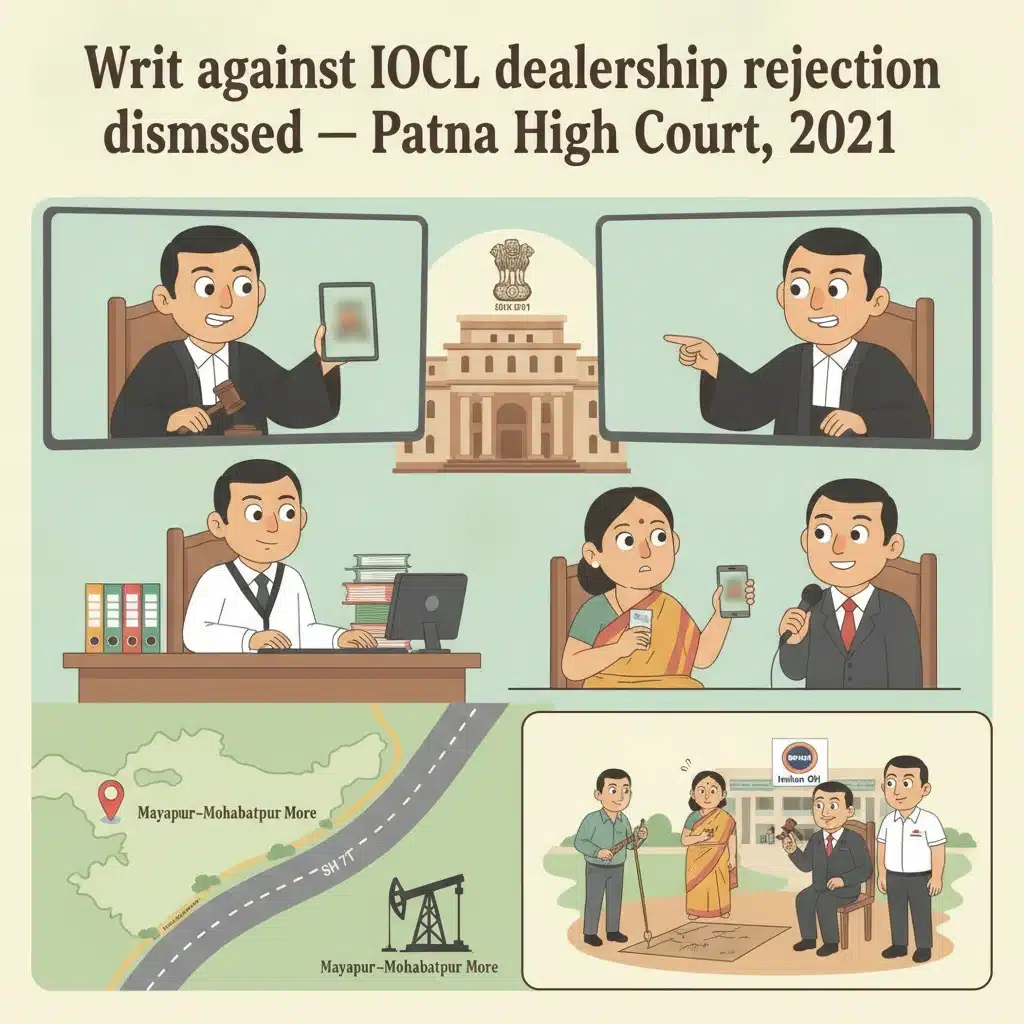
Case Background
The dispute arose from a selection process conducted by Indian Oil Corporation Limited for a Kisan Seva Kendra dealership in Nalanda district, Bihar.
Indian Oil Corporation invited applications for a dealership location within 5 kilometers from Mayapur–Mohabbatpur More towards Giriyak on State Highway 71 in Nalanda. The petitioner and respondent no. 5 both applied for this location.
Respondent no. 5 was selected through a draw of lots. After losing out in the draw, the petitioner used the grievance redressal mechanism provided under the dealership selection brochure. She approached the competent officers of the corporation, questioning the validity of the land offered by respondent no. 5 for setting up the outlet.
The petitioner’s complaint mainly raised two objections. First, she alleged that the title of the land offered by respondent no. 5 was not valid. Second, she claimed that the land did not meet the minimum size required under the advertisement. The advertisement itself was not produced before the High Court by the petitioner.
The General Manager-in-charge of Indian Oil Corporation rejected the petitioner’s complaint by an order dated 12.06.2020. The petitioner then filed a writ petition before the Patna High Court, challenging this order and seeking interference in the selection of respondent no. 5.
What the Court Examined and Decided
The Patna High Court, hearing the matter through video conference due to COVID-19 restrictions, focused on whether Indian Oil Corporation had correctly assessed the land offered by respondent no. 5 and whether the petitioner’s grievance had been properly dealt with.
At the very start, the Court noted a basic factual point from the impugned order of the corporation: the advertisement required land measuring 35 meters by 35 meters. This comes to 1225 square meters. In the local decimal measurement used in Bihar for land, this is equivalent to 30.270 decimals.
Although the petitioner had not brought the advertisement itself on record, the Court accepted the land requirement figure as recorded in the corporation’s order. This figure became crucial in deciding the case.
From the impugned order, the Court also recorded that an investigation had been carried out by Indian Oil Corporation after receiving the petitioner’s complaint. A joint measurement of the land offered by respondent no. 5 was conducted on 02.08.2019.
This joint measurement was carried out by the Anchal Amin and took place in the presence of the petitioner herself. Minutes of this exercise were prepared and signed by all those present, including the petitioner. The petitioner, in paragraph 6 of her writ petition, admitted that such a joint measurement had taken place.
Thus, there was no dispute that an official measurement of the land had already been conducted with both sides participating and that a written record existed.
The petitioner’s main argument in the High Court related to the actual area of land available. According to her, respondent no. 5 had initially offered 40 decimals of land for the dealership. However, she claimed that 9 decimals out of this 40 decimals had already been acquired by the State of Bihar for the construction of the State Highway.
On this basis, the petitioner argued that only 31 decimals remained with respondent no. 5. She contended that this remaining area fell short of the land requirement and, therefore, respondent no. 5’s selection for the dealership was invalid. The rejection of her complaint by order dated 12.06.2020 was said to be wrong.
Indian Oil Corporation, through its counsel, responded by relying on the figures recorded in the impugned order. The corporation reiterated that the requirement under the advertisement was 35 meters by 35 meters, i.e., 1225 square meters or approximately 30.270 decimals, not 40 decimals as claimed by the petitioner.
The corporation argued that even if, only for the sake of argument, the petitioner’s claim about acquisition of 9 decimals out of 40 decimals was accepted, the balance 31 decimals still exceeded the required 30.270 decimals. Therefore, the land actually available with respondent no. 5 continued to meet the corporation’s minimum requirement for the dealership.
In other words, accepting the petitioner’s own figures did not lead to the conclusion that the land was undersized. Instead, it showed that the land was still larger than the minimum size requirement.
The petitioner tried to support her allegation of partial acquisition by placing reliance on a report dated 08.02.2020 prepared by the Anchal Amin and addressed to the Circle Officer, Katrisarai, Nalanda. According to this report, 9 decimals of the land in question had been acquired for the construction of State Highway 71.
However, the Court noted a key gap. There was no material on record to show that this report of 08.02.2020 was ever brought to the notice of Indian Oil Corporation before it decided the petitioner’s complaint and passed the order dated 12.06.2020.
This point was important because the Court was examining whether the corporation acted correctly on the information before it at the relevant time. The Court found nothing to suggest that the corporation ignored any material document that had been duly presented to it during the grievance process.
The Court further emphasized that, independent of the later Anchal Amin report, there had already been a joint measurement of the land on 02.08.2019. That measurement had been carried out in the presence of the petitioner and clearly recorded the size of the land offered by respondent no. 5 as sufficient to meet the corporation’s requirement for the dealership. The minutes of that exercise were signed by all, including the petitioner.
On these facts, the High Court concluded that there was no basis to interfere with the findings of Indian Oil Corporation. The corporation had followed its procedure, conducted a joint measurement, and arrived at the conclusion that the land offered by respondent no. 5 satisfied the required parameters.
Once the minimum land requirement was met, the mere assertion that a part of the land had been acquired, especially without proof that this claim was placed before the corporation in time, could not justify upsetting the selection. The Court did not find any illegality or arbitrariness in the corporation’s decision-making process.
Regarding the petitioner’s allegation about invalid title of respondent no. 5, the judgment mainly records this as part of the petitioner’s complaint. The Court’s reasoning and final decision, however, turned on the question of land area and the adequacy of the corporation’s inquiry rather than on detailed examination of title documents. The Court found that, on the available material and the joint measurement, the corporation’s conclusion that the land met its requirement could not be faulted.
Finally, the Court held that no interference with the impugned order dated 12.06.2020 was called for. The writ application was dismissed as having no merit. As a result, the selection of respondent no. 5 for the Kisan Seva Kendra dealership remained intact.
Why This Judgment Matters
This decision is important for people participating in dealership and similar public selection processes. It shows that courts will closely look at whether the authority followed its own rules and investigated complaints properly.
Where a corporation like Indian Oil conducts a joint measurement in the presence of all parties, prepares minutes, and finds that the land meets its requirement, the High Court is slow to interfere. Candidates cannot succeed merely by raising new documents later, unless it is shown that those documents were placed before the authority at the correct time and were wrongly ignored.
For unsuccessful applicants, this judgment underlines the need to present all their objections and supporting papers during the official grievance process itself. For authorities, it reinforces that transparent procedures like joint measurement and written minutes provide strong defence if the selection is challenged later.
Legal Issues and Answers
Issue: Did Indian Oil Corporation wrongly reject the petitioner’s complaint by treating the land offered by the selected candidate as meeting the minimum area requirement?
Answer: No. The Patna High Court held that, based on the joint measurement and the recorded requirement of 35m x 35m (about 30.270 decimals), the land of respondent no. 5 satisfied the corporation’s requirement, and the rejection of the complaint was justified.
Issue: Did any later report about acquisition of part of the land justify interference with the dealership selection?
Answer: No. The Court found no material to show that the report dated 08.02.2020 was before the corporation when the complaint was decided, and in any case, even accepting the petitioner’s figures, the remaining land still exceeded the minimum required area.
Cases Cited by the Court
- No earlier judgments or case law are cited or relied upon in the text of this decision.
Case Details
Case Number: Civil Writ Jurisdiction Case No. 557 of 2021
Case Title: Nilu Sinha v. The Indian Oil Corporation Ltd. & Ors.
Coram: Hon’ble Mr Justice Chakradhari Sharan Singh and Hon’ble Mr Justice Madhuresh Prasad
Citation: 2022 (4) PLJR 185
Advocates: Mr Dhananjay Kumar Tiwary, Advocate for the petitioner; Mr Sanat Kumar Mishra, Advocate for the respondents
Nature of the Case: Writ petition challenging rejection of complaint against selection for Kisan Seva Kendra dealership
Date of Judgment: 17-12-2021
Link to Judgment: https://patnahighcourt.gov.in/viewjudgment/MTUjNTU3IzIwMjEjMSNO-inWr2w4QL4U=
If you found this explanation helpful and wish to stay informed about how legal developments may affect your rights in Bihar, you may consider following Samvida Law Associates for more updates.




