

Case Background
This criminal appeal came before the Patna High Court from Begusarai district. The appellant was the informant of Begusarai Muffasil P.S. Case No. 414 of 2019. He filed the appeal under Section 372 of the Code of Criminal Procedure.
He challenged the judgment and order dated 24.12.2021 passed in Sessions Trial No. 44 of 2020 (G.R. No. 2917 of 2019) by the Sessions Judge-IX, Begusarai. By that judgment, the trial court had acquitted respondent nos. 2 and 3 of the charges under Sections 302, 201, 120-B read with Section 34 of the Indian Penal Code.
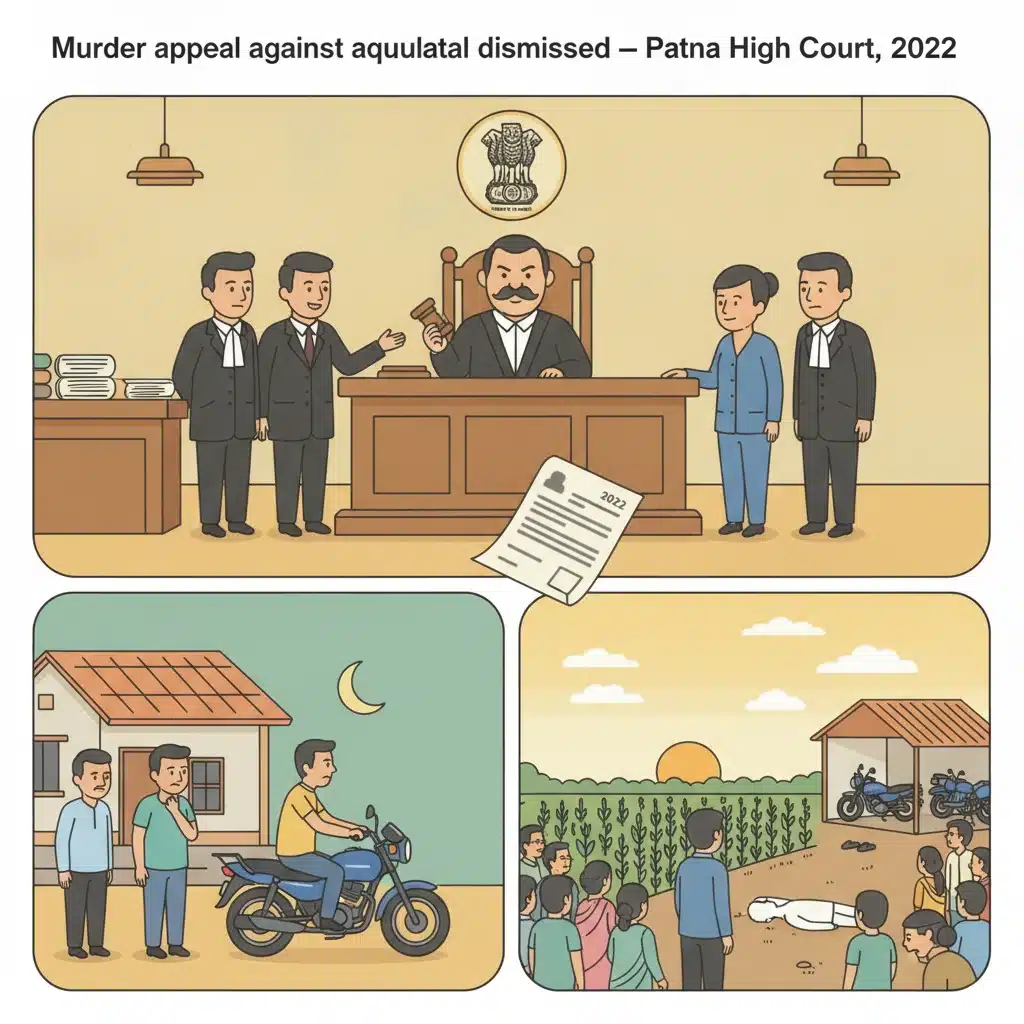
The prosecution story began on 09.08.2019. According to the written report given by the informant to the Station House Officer of Begusarai Muffasil Police Station on 11.08.2019 at 11:05 a.m., the two private respondents allegedly came to his house around 4:00 p.m. on 09.08.2019. They called his brother, Prakash Kumar, who later became the deceased.
The informant claimed that his brother left with them on a Pulsar motorcycle. When the brother did not return that night, the informant tried ringing his mobile phone. The phone rang but there was no response. On questioning the private respondents, they allegedly did not give any information.
On the morning of 11.08.2019 at about 7:00 a.m., villagers informed the appellant that a dead body was lying in the field of one Hanuman Singh, about 500 yards from the house of the private respondents. The informant went there with his mother and a neighbour, Bilo Singh. They saw Prakash Kumar’s body with several injuries, including a neck cut from the back.
It was further alleged that the Pulsar motorcycle and slippers of the deceased were found in the cowshed of respondent no. 3. On this basis, Begusarai Muffasil P.S. Case No. 414 of 2019 was registered.
After investigation, the police submitted charge-sheet against the two private respondents on 27.10.2019. Supplementary investigation was closed with a final form on 30.12.2019. The trial court took cognizance of the offences on 22.01.2020. Charges under Sections 302, 201, 120-B and 34 IPC were framed against them on 02.03.2020.
What the Court Examined and Decided
At the trial, the prosecution examined six witnesses. PW-1 was the mother of the informant and the deceased. PW-2 was a neighbour. PW-3 was another co-villager. PW-4 was the informant himself. PW-5 was the Medical Officer who performed the post-mortem. PW-6 was the Investigating Officer.
According to his deposition, PW-4 repeated what he had said in the FIR. He said that on 09.08.2019 his brother took out his Pulsar motorcycle, went with the private respondents, and was later found dead on 11.08.2019 at around 7:00 a.m. He also claimed that the Pulsar motorcycle and a pair of sandals of the deceased were recovered from the cowshed of respondent no. 3. He further stated that the private respondents were arrested from their homes.
The defence, however, put forward a different version. Their case, as noticed by the trial court and recounted by the High Court, was that the prosecution story about 4:00 p.m. on 09.08.2019 was false.
According to the defence, on 09.08.2019 at about 10:00 a.m., the deceased had come on his Pulsar motorcycle to the house of respondent no. 3. After some conversation, the deceased parked his motorcycle in respondent no. 3’s cowshed and walked towards the main road. The accused believed he was going to board public transport. They claimed that they only came to know about his dead body on the morning of 11.08.2019. The motorcycle was later seized by the police from the cowshed. As to the sandals, respondent no. 3 said they were his own, which he had bought from a shop.
PW-1, the mother, supported the prosecution’s claim that the deceased had gone with the private respondents on 09.08.2019. PW-2 stated in his examination-in-chief that he saw the deceased going on the motorcycle with the accused while he was standing on the road in front of his house.
However, the trial court noted a serious problem in PW-2’s evidence. During investigation, in his statement under Section 161 Cr.P.C., PW-2 had not claimed to be an eyewitness. He had said that he came to know these facts from the informant. Because of this contradiction, the trial court did not accept PW-2 as an eyewitness to the “last seen” circumstance.
PW-3, another co-villager, supported the prosecution about the dead body being found two kilometres from the deceased’s house. He also supported the claim that the motorcycle and a pair of sandals were recovered from respondent no. 3’s cowshed. He stated that he saw the recovery of the motorcycle from about 100 yards away.
The defence also produced 14 documents to show that the deceased had criminal antecedents and that there were at least five police cases against him. He had been charge-sheeted in a case under Sections 395/412 IPC. These documents were put on record to suggest that there might be other enemies and other possibilities, weakening the prosecution’s theory that only the private respondents were responsible.
The Investigating Officer, PW-6, gave an important piece of evidence. He said he did not find any blood or weapon of assault at the place of occurrence. He also could not identify the place where the deceased had actually been killed.
DW-1, a defence witness and co-villager of the accused, stated that he saw the deceased parking the Pulsar motorcycle in the cowshed of respondent no. 3 at 10:00 a.m. on 09.08.2019. This supported the defence version about the timing and manner in which the motorcycle came to be in the cowshed.
After examining all this material, the trial court held that the prosecution had failed to prove its case beyond reasonable doubt. It relied on the well-known Supreme Court decision in Sharad Birdhichand Sarda v. State of Maharashtra, (1984) 4 SCC 116, which lays down the rules for cases based entirely on circumstantial evidence.
The trial court closely analysed the medical evidence. The post-mortem report showed that the body was received at Sadar Hospital, Begusarai, at about 11:40 a.m. on 11.08.2019. The autopsy was completed at 12:02 p.m. the same day. The doctor (PW-5) opined that the time since death was within 48 to 72 hours.
From this, the trial court concluded that the death likely occurred between 12 noon on 08.08.2019 and 12 noon on 09.08.2019. This meant that the deceased had probably died before 4:00 p.m. on 09.08.2019. However, the prosecution story depended on the deceased being alive at 4:00 p.m. on 09.08.2019 and going out with the private respondents at that time.
This mismatch between the medical evidence and the prosecution version on the crucial question of timing created a major doubt. The prosecution could not explain it. The High Court noted this as a serious weakness.
The second main link relied on by the prosecution was the seizure of the pair of sandals alleged to belong to the deceased, said to have been found with the motorcycle in respondent no. 3’s cowshed.
The trial court examined this aspect in detail. It found that the sandals were seized based on information given by the informant (PW-4). PW-7, the Malkhana in-charge of Muffasil Police Station, produced a packet said to contain the sandals in court. But the packet did not bear the signature of any judicial or police officer. The sandals inside did not have any mark or identification number linking them to the seizure memo. The trial court concluded that the actual sandals seized from the cowshed were not properly produced before the court.
There was no independent witness to the search and seizure. The informant did not clearly state how or when he came to know that the sandals were lying in the cowshed. All this made the seizure evidence highly doubtful.
Another factor was that the cowshed of respondent no. 3, from where the motorcycle was recovered, was an open space. This reduced the strength of the prosecution’s attempt to connect the motorcycle’s presence there directly to the accused’s guilt.
Taking all these circumstances together, the trial court gave the benefit of doubt to the private respondents and acquitted them.
In the present appeal, the Patna High Court examined whether this acquittal should be disturbed. The Court referred to the Supreme Court judgment in Murugesan and others v. State through Inspector of Police, (2012) 10 SCC 383. In paragraph 34 of that case, the Supreme Court had explained what is meant by a “possible view” of the evidence.
The Supreme Court had held that even if a higher court may think a different view is more correct, an acquittal based on a reasonable possible view of the evidence should not be overturned. As long as the trial court’s view can be reasonably formed, the High Court should not replace it with its own view.
Applying this principle, the Patna High Court held that the trial court’s assessment was a “possible view”. The trial court had carefully scrutinised the evidence, noticed the contradictions about time of death, and the weaknesses in the seizure and “last seen” evidence.
On that basis, the High Court concluded that the acquittal could not be said to be perverse or unreasonable. Therefore, there was no ground to interfere in an appeal against acquittal under Section 372 CrPC.
As a result, the High Court dismissed the criminal appeal, maintaining the acquittal of the two private respondents.
Why This Judgment Matters
This decision is important for families and victims who bring appeals against acquittals in murder cases. It shows that the Patna High Court will not overturn a trial court’s acquittal unless the evidence was clearly misread or ignored.
The judgment underlines that in cases based only on circumstances, each link must be strong. Here, the “last seen together” story did not match the medical evidence of time of death. The supposed recovery of sandals was not properly proved. The cowshed was an open space.
Because of such gaps, the accused were given benefit of doubt. The Court made it clear that suspicion, even if strong, is not enough for conviction in law.
For ordinary readers, the message is that in criminal law, especially for serious charges like murder, courts look for solid, consistent proof. Weak investigation, doubtful seizure, or contradictions in witness statements can all help the accused gain acquittal. The appeal process cannot fix poor evidence.
Legal Issues and Answers
Issue: Whether the acquittal of the private respondents for offences under Sections 302, 201, 120-B read with Section 34 IPC should be set aside in an appeal by the informant under Section 372 CrPC.
Answer: No. The Patna High Court held that the trial court’s acquittal was based on a reasonable possible view of the evidence, including contradictions in the prosecution case and weak circumstantial links, and therefore did not warrant interference.
Issue: Whether the circumstantial evidence of “last seen together” and recovery of motorcycle and sandals was sufficient to prove guilt beyond reasonable doubt.
Answer: No. Medical evidence on time of death contradicted the “last seen” story, the key eyewitness’s earlier statement did not support his trial version, the seizure of sandals was not reliably proved, and the cowshed was an open space, all creating serious doubt.
Cases Cited by the Court
- Sharad Birdhichand Sarda v. State of Maharashtra, (1984) 4 SCC 116 – cited by the trial court on principles of circumstantial evidence, referred to in the High Court judgment.
- Murugesan and others v. State through Inspector of Police, (2012) 10 SCC 383 – relied upon by the Patna High Court for the concept of “possible view” in appeals against acquittal.
Case Details
Case Number: Criminal Appeal (DB) No. 134 of 2022; arising out of Begusarai Muffasil P.S. Case No. 414 of 2019; Sessions Trial No. 44 of 2020 (G.R. No. 2917 of 2019).
Case Title: Subodh Kumar v. The State of Bihar & Ors.
Coram: Hon’ble Mr. Justice Chakradhari Sharan Singh and Hon’ble Mr. Justice Chandra Prakash Singh.
Citation: 2022 (4) PLJR 639.
Advocates: For the appellant (informant): Mr. Aaruni Singh, Advocate; Mr. Sandip Kumar Gautam, Advocate. For the State (respondent no. 1): Mr. Ajay Mishra, Additional Public Prosecutor. Advocates, if any, for private respondents are not mentioned in the judgment text.
Nature of the Case: Criminal appeal (victim’s appeal under Section 372 CrPC) challenging an order of acquittal in a murder case under Sections 302, 201, 120-B read with Section 34 IPC.
Date of Judgment: 14.11.2022.
Link to Judgment: Click here to read the full Patna High Court judgment
If you found this explanation helpful and wish to stay informed about
how legal developments may affect your rights in Bihar,
you may consider following Samvida Law Associates for more updates.




