

Case Background
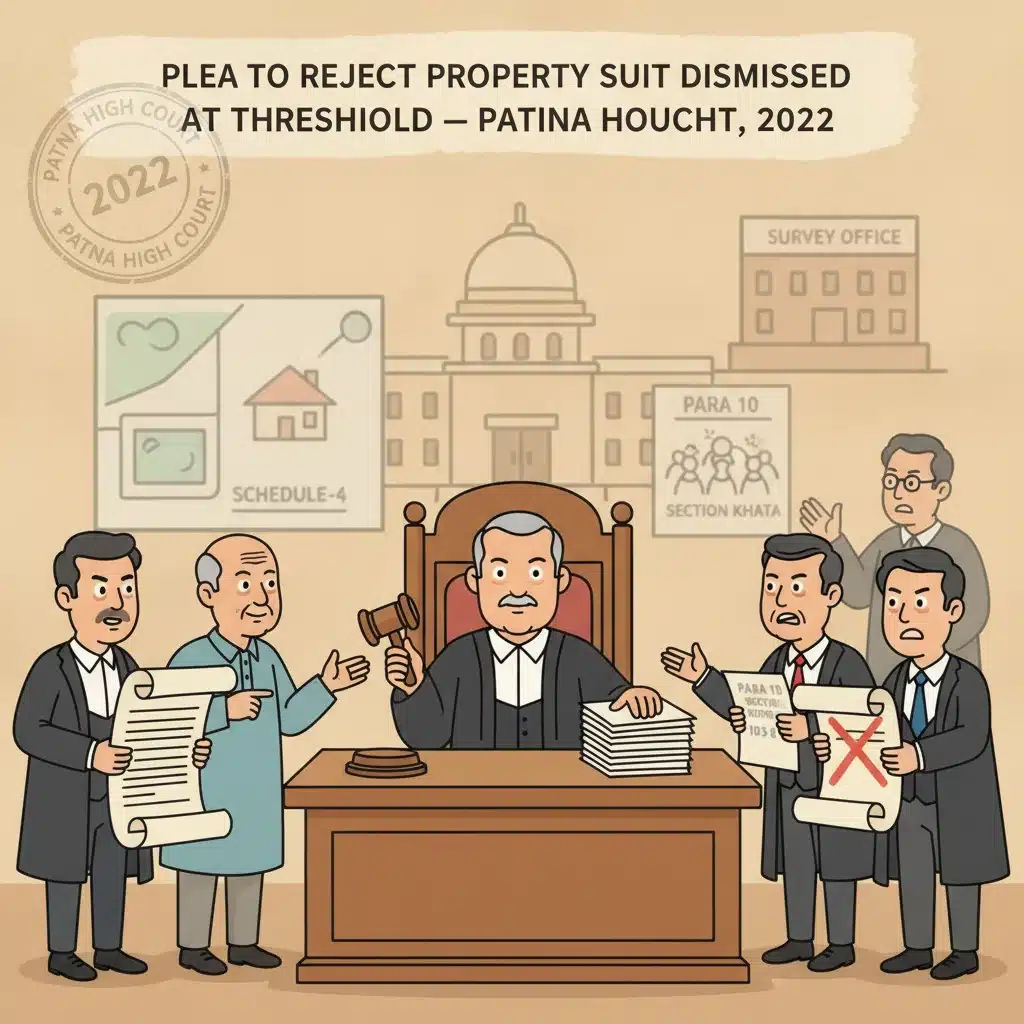
The dispute arises out of a property situated at Mohalla Jhilganj, under Gaya Municipal Corporation, within Kotwali Police Station, District Gaya. The respondent in the High Court is the original plaintiff before the trial court. The petitioners before the High Court are the original defendants.
According to the plaint, the plaintiff claims title over a portion of property described as schedule-4 of the plaint. The plaintiff asserts that he is in possession and enjoyment of this property. He alleges that the defendants are seeking to deny his title and disturb his possession.
On 07.02.2016, the alleged cause of action arose when, as pleaded in paragraph 14 of the plaint, the defendants of the first set tried to disown the plaintiff’s title over schedule-4. They allegedly attempted to infringe his rights by taking support from entries in the Revisional Municipal Survey Record of Rights.
The plaintiff further alleges that in the revisional survey, schedule-3 of the plaint had been renumbered and that in the Revisional Municipal Survey Record of Rights, a khata was opened in the joint names of all the brothers of late Chhattu Mahto. On this basis, the defendants allegedly threatened to dispossess the plaintiff and sell the land to local anti-social elements, thereby destroying the plaintiff’s property.
In this background, the plaintiff filed a civil suit seeking declaration of his title over schedule-4 and a permanent injunction to protect his possession and enjoyment of the property.
The defendants, however, did not want the trial to proceed. They filed an application under Order VII Rule 11(a) and (d) of the Code of Civil Procedure before the trial court, asking for the plaint to be rejected at the outset for want of cause of action. By order dated 05.02.2018, the trial court rejected that application and decided to proceed with the suit.
Aggrieved by that order, the defendants approached the Patna High Court by filing Civil Miscellaneous No. 559 of 2018, challenging the trial court’s refusal to reject the plaint.
What the Court Examined and Decided
The Patna High Court, presided over by Hon’ble Mr. Justice Anil Kumar Sinha, heard the matter on 28.07.2022. Only the learned counsel for the petitioners (defendants) was heard.
The core contention of the petitioners was that the suit did not disclose any cause of action, and therefore the plaint ought to have been rejected under Order VII Rule 11(a) and (d) of the Code of Civil Procedure.
The petitioners relied on paragraph 10 of the plaint, where the plaintiff had discussed the status of the Revisional Municipal Survey Record of Rights. From this, the petitioners argued that the Record of Rights had not yet been finally published. On that basis, they invoked Section 103-B of the Bihar Tenancy Act, 1885.
Section 103-B, as referred to by the petitioners, provides that the presumption of correctness of the final publication of Records of Rights arises only after such records are finally published. The petitioners stressed that, according to the plaint itself, the Revisional Municipal Survey Record of Rights had only undergone draft publication and had not reached final publication.
The petitioners pointed out that the plaintiff had appended schedule-4 to the plaint, which pertained to the Record of Rights that had not been finally published. Their argument was that, since the plaintiff’s own pleadings accepted that the relevant survey record was only at a draft stage, the presumption under Section 103-B could not apply.
Building on this, the petitioners argued that the plaint did not disclose a valid cause of action. To them, absence of final publication of the Record of Rights meant that the foundation of the plaintiff’s case was defective, and therefore the entire plaint should be rejected at the threshold.
The High Court, however, approached the issue by closely examining the plaint, particularly paragraphs 10 and 14, and the reliefs claimed. The Court noted that the crucial question under Order VII Rule 11 is whether, taking the plaint as it is, a cause of action is disclosed. At this stage, the court is not required to decide the correctness of the facts or weigh the evidence.
Looking at paragraph 14 of the plaint, the Court observed that the plaintiff had clearly stated when and how the cause of action arose. It was specifically pleaded that on 07.02.2016, the defendants of the first set tried to disown the plaintiff’s title over schedule-4 and attempted to infringe the plaintiff’s rights over it.
The plaint also alleged that the defendants were relying on the revisional survey records, in which the khata had been opened in the joint names of all brothers of late Chhattu Mahto. According to the plaintiff, the defendants used this as a pretext to threaten dispossession and to propose sale of the property to local anti-social elements. These averments together formed a “bundle of facts” that, if ultimately proved, could entitle the plaintiff to relief.
The Court then turned to the reliefs claimed by the plaintiff. These reliefs were fourfold:
First, the plaintiff sought a declaration that his title over schedule-4 be declared against the defendants and that his possession over that land be confirmed.
Second, he sought a permanent injunction restraining the defendants from transferring, mortgaging, leasing, entering into rent agreements, encumbering, or executing any registered or unregistered deeds, jointly or severally, in respect of schedule-4.
Third, he prayed for a permanent injunction restraining the defendants or their men from making any interference, obstruction, or encroachment over the plaintiff’s peaceful enjoyment and dealing with schedule-4.
Fourth, he asked for costs of the suit.
From these reliefs, the High Court found it clear that the suit was primarily for declaration of title and for permanent injunction, based on allegations of interference and threats of dispossession by the defendants.
The High Court also carefully examined the trial court’s reasoning in the impugned order. The trial court had noted that the suit was not filed for a declaration that the entry in the draft khatiyan was not binding on the plaintiff. Instead, the basis of the suit was that the defendants were allegedly interfering with the plaintiff’s right, title, and interest in the property.
While the plaint did mention the draft khatiyan and the entry in the Revisional Municipal Survey Record of Rights, the trial court had rightly concluded that this was not the main relief sought. The main purpose of the suit was to protect the plaintiff’s alleged title and possession from the defendants’ interference and threats.
The High Court agreed with this view. It held that even if the Record of Rights had not been finally published, that did not negate the existence of a real dispute between the parties regarding title and possession. The plaintiff’s claim to ownership and his allegation that the defendants were trying to dispossess him and create third party rights clearly constituted a cause of action.
In other words, the absence of final publication of the survey records might affect the evidentiary value or presumptions available at a later stage of the suit, but it did not by itself wipe out the plaintiff’s right to approach the civil court seeking protection of his alleged ownership and possession.
On this basis, the High Court held that the plaint disclosed a cause of action. Therefore, the petitioners’ attempt to invoke Order VII Rule 11(a) and (d) of the Code of Civil Procedure was found to be without merit.
After this analysis, the Court concluded that there was no infirmity in the trial court’s order dated 05.02.2018 refusing to reject the plaint. The civil miscellaneous application filed by the defendants was accordingly dismissed. No order was made as to costs.
Why This Judgment Matters
This judgment of the Patna High Court is important for property litigants, especially in urban areas like Gaya where revisional municipal surveys and Records of Rights are often in progress or remain at draft stage for some time.
The decision clarifies that a civil suit for declaration of title and injunction cannot be thrown out merely because survey records are still in draft form or have not been finally published. As long as the plaint narrates facts showing that the plaintiff’s title and possession are being threatened, a cause of action exists.
For ordinary landowners, this means that if someone relies on draft survey entries to deny their title or threaten dispossession, they are not helpless. They can still go to civil court for protection, and their claim cannot be rejected at the door only because the survey record is yet to be final.
For defendants, the judgment is a reminder that the power under Order VII Rule 11 to reject a plaint is limited. It cannot be used as a shortcut to avoid a full trial where the plaint clearly sets out a dispute over rights in property.
Legal Issues and Answers
Issue: Does a plaint seeking declaration of title and permanent injunction disclose a cause of action when the Revisional Municipal Survey Record of Rights is only at draft stage and not finally published?
Answer: Yes. The Patna High Court held that the plaint did disclose a cause of action because it narrated facts showing that the defendants were attempting to disown the plaintiff’s title and interfere with his rights, and the suit was not merely to challenge the draft khatiyan entry.
Issue: Was the trial court justified in refusing to reject the plaint under Order VII Rule 11(a) and (d) of the Code of Civil Procedure?
Answer: Yes. The High Court found no infirmity in the trial court’s order and upheld the decision to let the suit proceed.
Cases Cited by the Court
- No prior judicial precedents are cited or relied upon in the text of this judgment.
Case Details
Case Number: Civil Miscellaneous No. 559 of 2018
Case Title: Dewaki Devi & Ors. v. Surendra Prasad @ Suresh Prasad
Coram: Hon’ble Mr. Justice Anil Kumar Sinha
Citation: 2022 (4) PLJR 506
Advocates:
- For the Petitioners (defendants before the trial court): Mr. Binod Kumar, Advocate
- For the Respondent (plaintiff before the trial court): Not mentioned in the judgment
Nature of the Case: Civil miscellaneous application challenging trial court’s order refusing to reject plaint under Order VII Rule 11(a) and (d) of the Code of Civil Procedure in a title and injunction suit.
Link to Judgment: Click here to read the full judgment of the Patna High Court
If you found this explanation helpful and wish to stay informed about
how legal developments may affect your rights in Bihar,
you may consider following Samvida Law Associates for more updates.




