

Case Background
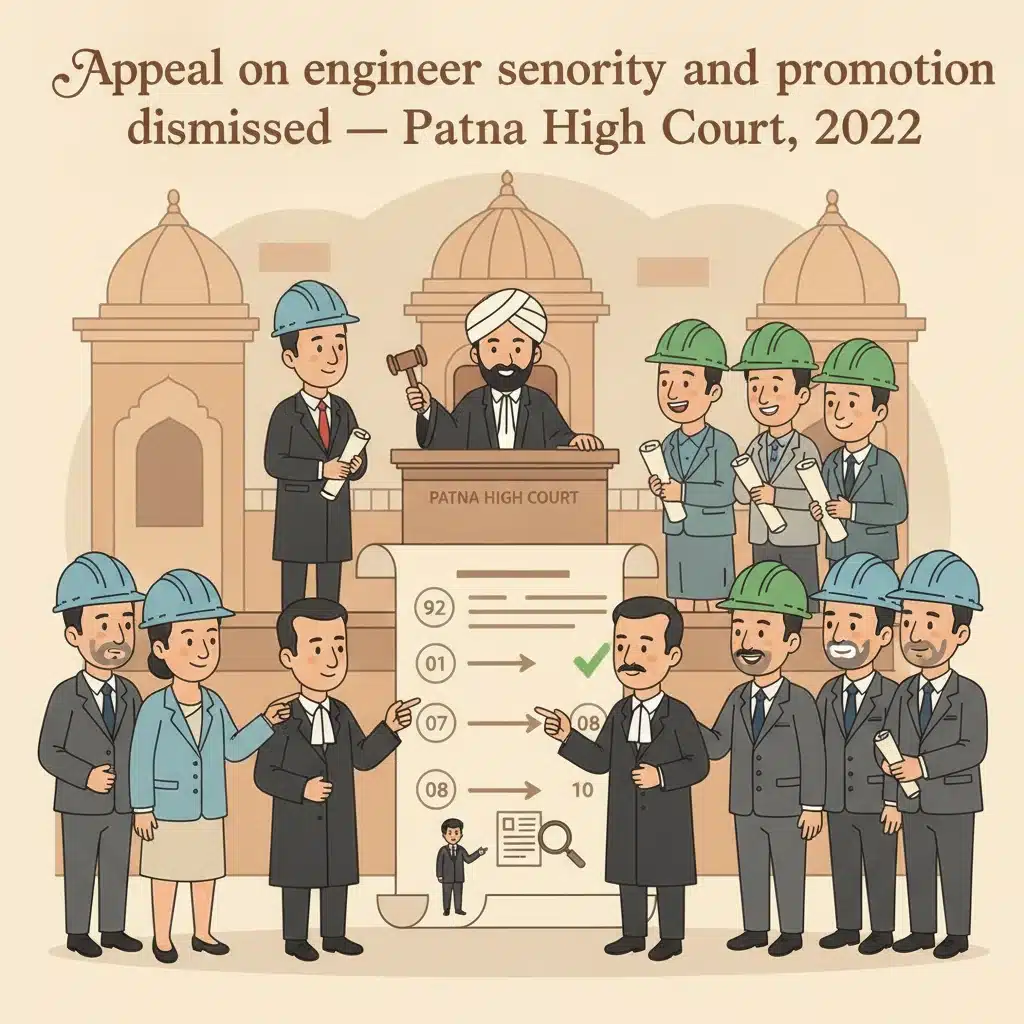
This case arises from a long-running dispute in the Water Resources Department of the State of Bihar over seniority between two groups of Assistant Engineers: promotees and direct recruits.
Some Junior Engineers were promoted to the post of Assistant Engineer. Others were directly recruited as Assistant Engineers through the Bihar Public Service Commission. Both sets of officers formed a combined cadre from which the next promotional post is Executive Engineer, and thereafter Superintendent Engineer.
A provisional gradation (seniority) list of Assistant Engineers was first prepared in 1992. In that list, certain direct recruits were shown senior to the promotee Assistant Engineers. The promotees filed objections.
After considering objections, a final gradation list was published on 14.02.2001. In this final list, the promotee Assistant Engineers (who later became writ petitioners) were placed above the direct recruits (who later became private respondents). The direct recruits did not challenge this final gradation list.
On 09.04.2007, during the reorganisation of the State of Bihar, a fresh gradation list of Assistant Engineers was published. Again, the promotees were shown senior to the direct recruits. This too was not challenged.
On 03.01.2008, another seniority list of Assistant Engineers was prepared and published. The promotees were once more placed senior to the direct recruits. Acting on this seniority position, the department promoted the promotees to the post of Executive Engineer on 29.12.2010.
At that stage, the directly recruited Assistant Engineers approached the High Court in CWJC No. 15224 of 2010 (Beer Chand Thakur & another v. The State of Bihar). They complained that they had been wrongly shown as junior in the Assistant Engineer gradation list and asked that their representation on seniority be decided. On 12.01.2011, the Court disposed of that writ by permitting them to file an exhaustive representation and directed the Principal Secretary to consider it after hearing those likely to be affected.
The direct recruits then filed their detailed representation on 21.01.2011 before the Principal Secretary, Water Resources Department. The promotee officers, whose seniority was threatened, were given notice and they filed objections.
On 06.06.2011, the Principal Secretary passed an order holding that the direct recruits (then private respondents 6 and 7) were senior to the promotees. This order effectively reversed the long-standing seniority position and impacted promotions.
The promotees, now affected by this administrative order, approached the High Court in CWJC No. 10443 of 2011. By judgment dated 30.01.2012, the learned Single Judge allowed their writ petition and set aside the Principal Secretary’s order dated 06.06.2011.
The State of Bihar and its departmental authorities filed Letters Patent Appeal (LPA) No. 679 of 2012 against the Single Judge’s judgment. One of the direct recruits (Birchandra Thakur) filed a separate LPA No. 891 of 2012. Both appeals were heard together and decided by the Division Bench on 16.11.2022.
What the Court Examined and Decided
The Division Bench of the Patna High Court, consisting of Hon’ble Mr. Justice P. B. Bajanthri and Hon’ble Mr. Justice Purnendu Singh, examined whether the Single Judge was right in quashing the Principal Secretary’s order that had declared the direct recruits as seniors to the promotees.
The Court first recounted the Single Judge’s reasoning at length. The learned Single Judge had noted that the dispute was about inter se seniority on the post of Assistant Engineer, which is the feeder post for promotion to Executive Engineer. The promotees were aggrieved because the Principal Secretary had, by order dated 06.06.2011, declared two direct recruits senior to them.
The Single Judge looked at the entire history of seniority lists:
First, in the 1992 provisional gradation list, the promotees were shown junior. They objected.
Next, in the final list published on 14.02.2001, after consideration of objections, the promotees were placed above the direct recruits. The direct recruits did not challenge this list.
Later, on 09.04.2007, a new gradation list was published during the reorganisation of the State. Again the promotees were shown senior to the direct recruits. No challenge was made.
Again, on 03.01.2008, another gradation list of Assistant Engineers was published, with the same seniority position: promotees above direct recruits. This too went unchallenged.
Finally, on 29.12.2010, based on the 03.01.2008 seniority list, the promotees were promoted to the post of Executive Engineer. Only at this stage did the direct recruits file CWJC No. 15224 of 2010, claiming they had been wrongly shown as junior.
The Single Judge highlighted that the direct recruits’ first formal grievance came only in 2010, despite several opportunities to challenge the seniority list earlier. The Court concluded that there was gross delay and laches on their part.
The Single Judge relied on several Supreme Court decisions to explain why delay in challenging seniority lists is very serious in service matters:
In State of M.P. v. Nandlal Jaiswal, the Supreme Court held that Article 226 relief is discretionary, and courts do not usually help those who sleep over their rights. Unexplained delay, especially where third-party rights (like promotions of others) have arisen, is a strong reason to refuse relief.
In P.S. Sadasivaswamy v. State of Tamil Nadu, the Supreme Court observed that in seniority and promotion matters, a person should approach the Court within about six months to a year. Seeking to reopen promotions after many years is like trying to “unscramble a scrambled egg” and should not be encouraged.
In K.R. Mudgal v. R.P. Singh, the Supreme Court held that seniority disputes raised after long gaps (18 years in that case) should be rejected because they disturb settled rights and create administrative chaos.
In Rajendra Pratap Singh Yadav v. State of Uttar Pradesh, the Supreme Court emphasised that final seniority lists enjoy “immense sanctity” and cannot be disturbed at the behest of those who sleep over their rights for years.
The Single Judge further relied on C. Jacob v. Director of Geology and Mining and Union of India v. M.K. Sarkar. These cases cautioned courts against passing routine directions to “consider” old representations on stale matters, because such directions are often misused to revive time-barred claims. They stressed that deciding a late representation in compliance with a court direction does not create a fresh cause of action or cure delay and laches.
Examining the direct recruits’ representation dated 21.01.2011, the Single Judge noted that it referred only to the 1992 provisional seniority list and claimed they had been “waiting” to be heard, but made no mention of the crucial final gradation list dated 14.02.2001 or the later lists of 2007 and 2008. The lack of full disclosure of facts, and the explanation that they were simply waiting, was found to be unacceptable.
The promotee officers had raised the issue of delay directly before the Principal Secretary, pointing out that the claims related back to 1987–2008 and were hopelessly time-barred. They also pointed out that under notification no. 4415 dated 14.10.1987 their seniority had been fixed above that of direct recruits of 1987, and that the direct recruits had never challenged it.
Yet, the Principal Secretary’s order dated 06.06.2011, according to the Single Judge, did not even consider the question of delay. It simply recited the rival cases in two columns, then concluded that the direct recruits were appointed on BPSC recommendation, while the promotees were promotees; it further said that vacancies from 1979 to 1986 had been clubbed and treated as one transaction. The Single Judge observed that these were actually two separate transactions and could not be treated as one, and also flagged that no principles of fixing seniority between direct recruits and promotees were discussed.
On these grounds, the Single Judge held the Principal Secretary’s order unsustainable and set it aside, thereby restoring the seniority of the promotees.
When the matter came in appeal, the Division Bench considered whether there was any legal error in this reasoning that would justify interference.
The Bench noted that the department itself had gone through a detailed process while finalising the seniority list of Assistant Engineers. After the provisional list of 09.04.2007, objections and suggestions were invited. Many were received. A committee was constituted to scrutinise them. Based on the committee’s decision, the department notified the final seniority list on 03.01.2008. This list was then acted upon for promotions, including the promotion of the contesting respondents (promotees) to the post of Executive Engineer and subsequently Superintendent Engineer.
The Bench recorded an important fact: the appellants (State and departmental authorities) had not challenged the order of promotion to the post of Superintendent Engineer granted in favour of the respondents. Despite this, they were trying to reopen the seniority question indirectly through the LPAs.
Referring again to the Supreme Court decision in P.S. Sadasivaswamy v. State of Tamil Nadu and to the more recent decision in Union of India & Ors v. C. Girija, the Division Bench accepted that belated challenges to seniority and promotion orders cannot be entertained when rights have already crystallised and been acted upon.
The Bench held that in these circumstances, the Single Judge’s order could not be interfered with in the LPAs. The appeals were therefore dismissed. However, the Bench clarified that dismissal of the appeals would not prevent the department from considering whether the appellants were otherwise entitled to notional promotion to the post of Superintendent Engineer prior to retirement.
The Court directed the department to review promotions to see whether the appellants were eligible for promotion to Superintendent Engineer before their retirement. If, on such review, they were found eligible, they should be granted promotion to the post of Superintendent Engineer (at least notionally). For this purpose, the department must examine the final seniority list of Executive Engineers and pass a reasoned (speaking) order, communicating the decision to the appellants within a reasonable period of six months.
Why This Judgment Matters
This judgment clearly reinforces that government employees cannot wait for years and then suddenly challenge seniority lists when promotions of others are imminent.
For employees in Bihar, especially in technical departments like the Water Resources Department, the decision shows that once a final seniority list has been published and used for promotions, it becomes very difficult to reopen.
The Patna High Court used rulings of the Supreme Court to explain that delay and laches are crucial in service matters. If someone feels wrongly placed in seniority, they must act quickly. Otherwise, the Court will protect the settled rights of others who have already received promotions.
At the same time, the Court showed a balanced approach by allowing the department to examine whether the appellants deserve notional promotion, without disturbing the promotions already given to others. This protects both stability in the service and the individual claims of deserving officers.
Legal Issues and Answers
-
Issue: Can direct recruits, who did not challenge final seniority lists of Assistant Engineers for many years, later claim seniority over promotees and get the departmental order in their favour sustained?
Answer: No. The Court held that their claims were barred by gross delay and laches, that the final seniority list of 03.01.2008 and earlier lists had attained finality, and that the Principal Secretary’s order dated 06.06.2011 reversing this settled position was unsustainable. -
Issue: Can the Letters Patent Appeals be used to unsettle promotions already granted on the basis of a final seniority list, when those promotions themselves have not been challenged?
Answer: No. The Court found that since the appellants had not assailed the promotions to Superintendent Engineer granted to the contesting respondents, the LPAs could not be entertained to indirectly disturb those settled promotions. -
Issue: Does a court direction to “consider” a representation on seniority revive an otherwise stale claim or wipe out delay and laches?
Answer: No. Relying on Supreme Court precedents such as C. Jacob and M.K. Sarkar, the Court held that such directions do not create a fresh cause of action and cannot be used to bypass limitation or laches.
Cases Cited by the Court
- (2008) 10 SCC 115, C. Jacob v. Director of Geology and Mining
- (2010) 2 SCC 59, Union of India v. M.K. Sarkar
- (1986) 4 SCC 566, State of M.P. v. Nandlal Jaiswal
- (1975) 1 SCC 152, P. S. Sadasivaswamy v. State of Tamil Nadu
- (1986) 4 SCC 531, K.R. Mudgal v. R.P. Singh
- (2011) 7 SCC 743, Rajendra Pratap Singh Yadav v. State of Uttar Pradesh
- (2010) 1 SCC 394, Union of India v. Har Dayal
- (2011) 5 SCC 607, Shankara Cooperative Housing Society v. M. Prabhakar
- (2019) 15 SCC 633, Union of India & Ors v. C. Girija
Case Details
Case Number: Letters Patent Appeal No. 679 of 2012 with Letters Patent Appeal No. 891 of 2012, arising out of Civil Writ Jurisdiction Case No. 10443 of 2011
Case Title (LPA No. 679 of 2012): State of Bihar & Ors v. Upendra Prasad Sharma & Ors
Case Title (LPA No. 891 of 2012): Birchandra Thakur v. The State of Bihar & Ors
Citation: 2022 (4) PLJR 730
Court: High Court of Judicature at Patna
Coram: Hon’ble Mr. Justice P. B. Bajanthri and Hon’ble Mr. Justice Purnendu Singh
Date of Judgment: 16.11.2022
Advocates (in both LPAs):
For the appellants: Mr. Vinay Kumar Pandey, Advocate
For the respondents: Mr. P.K. Shahi, Senior Advocate; Mr. Maruth Nath Roy, Advocate
Nature of the Case: Letters Patent Appeals against a Single Judge’s order in a writ petition concerning service seniority and promotions in the Water Resources Department, Government of Bihar.
Link to the Judgment: Full text of Patna High Court judgment
If you found this explanation helpful and wish to stay informed about how legal developments may affect your rights in Bihar, you may consider following Samvida Law Associates for more updates.




