

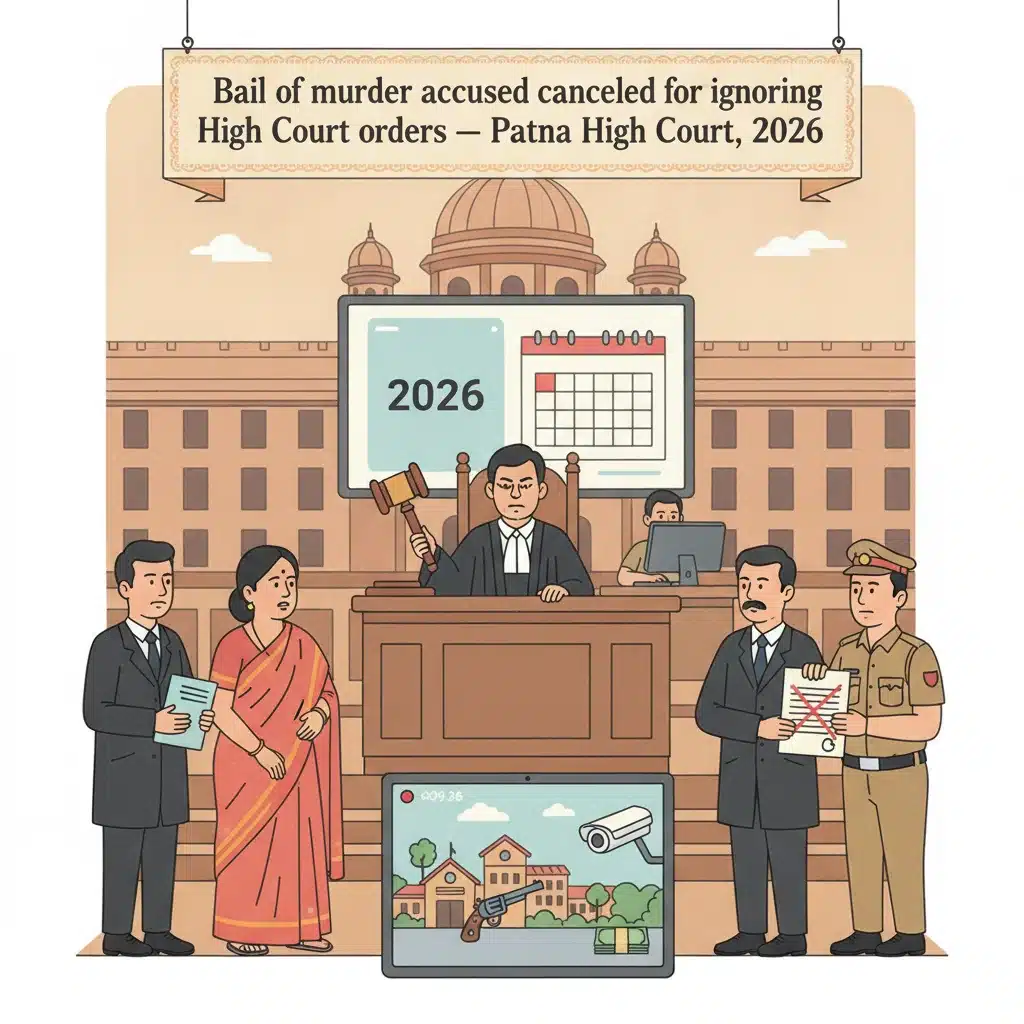
Case Background
The case arises from a morning murder in Patna City. On 08.10.2024, at about 5:00 A.M., the petitioner’s husband, Rajiv Ratan Gupta, went out for his daily morning walk and was shot dead.
According to the written report lodged the same day, there was a land dispute between the deceased and his neighbour, opposite party no.2. Their houses were adjacent. The informant alleged that opposite party no.2 had been pressurising her husband to transfer their newly constructed house to him, threatening that otherwise she would be widowed.
The informant further stated that two or three days before the incident, opposite party no.2 called her husband and pressured him through other criminals. Opposite party no.2 allegedly knew her husband’s routine of going for a morning walk. In this background, she alleged that opposite party no.2, with others, arranged the killing to grab her house.
On this report, Alamganj P.S. Case No.895 of 2024 was registered on 08.10.2024 against opposite party no.2 as the only named accused and other unknown persons. He was arrested on the date of occurrence itself and remanded to judicial custody on 09.10.2024.
During investigation, CCTV footage showed two persons, Sunny Kumar and Dharmendra Kumar, at the place of occurrence. They were arrested. Dharmendra Kumar’s confessional statement in the case diary said Sunny Kumar fired at the victim, using a weapon supplied by co-accused Shiv Kumar and Rohit Pandey, and that opposite party no.2 paid Sunny Kumar Rs.5,000/- in advance to kill the deceased. Sunny Kumar’s statement recorded that he had met opposite party no.2 about four months before the incident to discuss the crime. Another co-accused, Shiv Kumar @ Hira Choudhary, allegedly stated that he gave the weapon to Rohit Pandey.
A country-made pistol with magazine was recovered near Rohit Pandey’s house. Rs.2,500/- was recovered from Sunny Kumar, and mobile phones were seized from Dharmendra Kumar, Shiv Kumar and Rohit Pandey.
On 31.12.2024, charge-sheet No.1622 of 2024 was submitted against opposite party no.2 and the four co-accused under Sections 103(1) and 61(2) of the Bharatiya Nyaya Sanhita, 2023 and Sections 25(1-B)(a), 26, 27 and 35 of the Arms Act. Cognizance was taken on 17.02.2025. After commitment, charges were framed on 13.08.2025 by the Additional District Judge-I, Patna City, in Sessions Trial No.1309 of 2025.
Opposite party no.2 sought regular bail twice before the Patna High Court. His first bail plea (Criminal Miscellaneous No.10643 of 2025) was heard along with the bail applications of Rohit Pandey and Shiv Kumar @ Hira Choudhary and rejected on 13.05.2025. His counsel then admitted in court that he had five criminal antecedents.
The order dated 13.05.2025 also recorded the informant’s allegation that opposite party no.2 wanted to grab her house, that all the petitioners were “notorious criminals”, that the weapon was recovered near Rohit Pandey’s house, and that an FIR, Alamganj P.S. Case No.1109 of 2024, had been lodged from the informant’s side for threats given to her sister to withdraw the case. The Court found all petitioners involved in the murder and refused bail.
His second bail application (Criminal Miscellaneous No.56740 of 2025) was dismissed on 26.09.2025, with the High Court finding no fresh ground to reconsider bail.
Meanwhile, regular bail of co-accused Sunny Kumar was rejected twice (18.08.2025 and 01.04.2026). Co-accused Rohit Pandey’s bail was rejected on 13.05.2025 and again on 09.01.2026. Co-accused Shiv Kumar @ Hira Choudhary’s bail was rejected on 13.05.2025; his later application was withdrawn on 10.04.2026. Only Dharmendra Kumar was granted bail on 19.08.2025, mainly on the ground that he was not named in the FIR, had only two antecedents, and had been in custody since 17.10.2024.
Despite two High Court rejections, opposite party no.2 filed another bail petition before the Trial Court in Sessions Trial No.1309 of 2025. He disclosed the two High Court orders in paragraph 2 of his petition but, in paragraph 3, mentioned only two criminal antecedents (Alamganj P.S. Case No.878 of 2024 and Khusrupur P.S. Case No.140 of 2022).
On 28.03.2026, the District & Additional Sessions Judge-I, Patna City, granted him regular bail. This order relied, among other things, on the fact that Dharmendra Kumar had been granted bail and on certain perceived weaknesses in the prosecution case noted from the case diary. By then, six prosecution witnesses had been examined, including the doctor and the Investigating Officer.
The widow-informant then approached the Patna High Court under Section 483(3) of the Bharatiya Nagarik Suraksha Sanhita, 2023, seeking cancellation of this bail order.
What the Court Examined and Decided
The Patna High Court looked closely at one central question: was the trial court’s order dated 28.03.2026 granting bail to opposite party no.2 so wrong in law, or so careless about earlier High Court orders and important facts, that it should be set aside?
The Court first explained the legal position. It drew a line between two situations:
One situation is “cancellation of bail” because of what happens after bail is granted – for example, the accused misuses liberty, threatens witnesses, tampers with evidence, tries to flee, or breaks bail conditions. In such cases, as earlier held in Dolat Ram and other Supreme Court cases, very strong reasons and supervening circumstances are needed.
The other situation is “annulment” or setting aside of a bail order because the order itself was bad from the beginning – for example, if the court granting bail ignored serious material, applied wrong principles, or went against binding higher court orders. In such a case, as laid down in Puran, Neeru Yadav, Deepak Yadav, State of Karnataka v. Sri Darshan and similar cases, the superior court can interfere even without any later misconduct by the accused.
This case, the High Court said, fell into the second category. The main complaint was that the trial court had acted in disregard of two earlier High Court orders refusing bail and that it relied on a wrong understanding of “parity” with Dharmendra Kumar while also trying to re-assess the evidence in detail at the bail stage.
On judicial discipline, the High Court cited State of Maharashtra v. Captain Buddhikota Subha Rao, Bimla Devi v. State of Bihar and Kalyan Chandra Sarkar. These decisions say that once a superior court has rejected bail, a subordinate court can grant bail to the same accused only if there is a real, material change of circumstances which directly affects the earlier decision. Otherwise, the lower court is, in effect, overruling the higher court, which is impermissible.
Applying this to the case, the High Court found that the trial court’s order did not even properly record the bail history. It mixed up the date of the first rejection (13.05.2025) with the number of the second application (Cr. Misc. No.56740 of 2025), and crucially, it failed to refer at all to the second rejection order dated 26.09.2025.
The High Court noted that its earlier order of 13.05.2025 had refused bail after considering the FIR, the case diary entries (especially paragraphs 25, 29 and 32 linking opposite party no.2 with the alleged contract killing), the gravity of the offence, his criminal antecedents, and the separate FIR, Alamganj P.S. Case No.1109 of 2024, about threats to the informant’s side.
Later, on 26.09.2025, the High Court had again refused bail to opposite party no.2, finding no fresh ground, even though by then Dharmendra Kumar had already been granted bail on 19.08.2025. This meant that the High Court had consciously decided that Dharmendra’s bail could not be used as a reason to grant bail to opposite party no.2.
Against this background, the High Court examined what “new” circumstances existed when the trial court granted bail on 28.03.2026. The only developments in between were that six prosecution witnesses (including the doctor and Investigating Officer) had been examined and some time had passed.
The High Court held that these were not the kind of substantial changes that allow a lower court to depart from the High Court’s earlier view. In fact, relying on X v. State of Rajasthan, it noted that once trial has started and prosecution witnesses are being examined in a serious case like murder, courts should ordinarily be slow to grant bail, not more inclined.
On the plea of parity with Dharmendra Kumar, the Patna High Court held that the trial court had misapplied the concept.
The Court stressed that opposite party no.2’s role, as alleged, was very different and more serious. He was the only person named in the FIR, with a clear motive described: a land dispute, a desire to grab the informant’s newly built house, and threats that the wife would be widowed. He was alleged to be the “supari-giver” who met the shooter months in advance and paid Rs.5,000/- as advance. The earlier High Court orders had recorded that he had five criminal antecedents and that a separate FIR for threats (Alamganj P.S. Case No.1109 of 2024) had been lodged from the informant side.
Dharmendra Kumar, by contrast, was not named in the FIR, no specific act of firing was attributed to him, and he had only two antecedents. He had been granted bail mainly on the length of his custody and his lesser role.
Because of these clear differences, the High Court held that opposite party no.2 could not claim parity with Dharmendra Kumar. Moreover, since Dharmendra’s bail predated the second rejection of bail to opposite party no.2, that line of argument was already closed; the High Court had implicitly rejected parity when dismissing the second bail application on 26.09.2025.
The Court then turned to how the trial court had handled the evidence. It found that the trial court went far beyond what is permissible at the bail stage. By weighing confessional statements of co-accused against absence of call detail records, relying on a tea vendor’s statement, and discussing the alleged Rs.20 lakh paid by the informant’s brother, the trial court effectively conducted a mini-trial and gave a finding that the implication of opposite party no.2 was doubtful.
Citing Puran and Kalyan Chandra Sarkar, the High Court held that such detailed evaluation of admissibility and credibility is reserved for trial. At the bail stage, only a broad prima facie view is taken, without deciding on the strength or weakness of the prosecution evidence.
The High Court also noted that the trial court completely ignored Alamganj P.S. Case No.1109 of 2024, which had been treated as a significant circumstance by the Co-ordinate Bench earlier. This omission, along with the failure to consider criminal antecedents fully and the misreading of the bail history, made the order perverse and unsustainable.
On the argument that no post-bail misconduct had been shown, the Court clarified that the present case was about setting aside an unjustified bail order, not about cancellation for later misconduct. In such cases, as the Supreme Court has held, the superior court does not need to wait for new incidents; it can interfere if the original bail order is illegal or perverse.
The High Court acknowledged that opposite party no.2 had been in custody for about seventeen and a half months before being granted bail and that he is said to be 65% disabled and walking with crutches. However, it emphasised that these were not new facts; they existed when the High Court had earlier refused bail on 26.09.2025. These personal circumstances could not authorise the trial court to disregard binding High Court orders.
In the end, the Patna High Court concluded that the order dated 28.03.2026 was passed:
• in disregard of two earlier High Court orders refusing bail,
• without recording any real change in circumstances,
• by giving undue weight to a misplaced and already rejected plea of parity,
• by prematurely re-assessing the prosecution evidence, and
• by ignoring relevant material like Alamganj P.S. Case No.1109 of 2024.
Therefore, it set aside the trial court’s order, cancelled the bail, and ordered opposite party no.2 to surrender within one week, failing which the Senior Superintendent of Police, Patna, must secure his arrest and commit him to custody.
The Trial Court was directed to proceed with the Sessions Trial and conclude it as expeditiously as possible, preferably within six months, without being influenced by any observations in the High Court’s order. The High Court clarified that its comments on the material in the case diary were only for deciding the cancellation application and not an opinion on the merits of the criminal trial.
Why This Judgment Matters
This decision is important for families of murder victims and for criminal trials generally.
First, it shows that if the High Court has already refused bail, a lower court cannot lightly grant bail on the same facts. The trial court must respect earlier High Court orders and can grant bail only if there is a solid, clear change in circumstances. Otherwise, its order can be struck down.
Second, the judgment warns against using “parity” loosely. Just because one co-accused is on bail does not mean every other accused must be released. Courts must look at each person’s role, criminal history and the earlier High Court reasoning.
Third, it emphasises that bail hearings are not mini-trials. The trial court should not decide whether witnesses are believable or whether confessional statements are admissible at this stage. Those issues are for full trial.
Fourth, the judgment protects complainants where there are allegations of threats. Here, a separate FIR for threats from the accused side was treated as an important factor in refusing bail originally, and the High Court found fault with the trial court for ignoring it later.
Finally, by directing that the trial be finished preferably within six months, the Patna High Court tried to balance the rights of the accused with the victim’s right to timely justice.
Legal Issues and Answers
Issue: Can a Sessions Court grant regular bail to an accused in a murder case after the Patna High Court has twice rejected bail on the same material?
Answer: No. Without showing a substantial and material change in circumstances, a subordinate court cannot, in effect, overrule earlier High Court orders. The trial court’s order granting bail was held perverse and was set aside.
Issue: Can an accused claim bail solely on the ground that a co-accused has been granted bail (parity), when their roles and earlier orders differ?
Answer: No. Parity is not automatic. Where the applicant’s alleged role and criminal antecedents are graver, and the High Court has already refused to extend parity earlier, the trial court cannot rely on parity to grant bail.
Issue: Is detailed weighing of confessional statements and other evidence proper at the stage of deciding bail in a serious case like murder?
Answer: No. At the bail stage, courts should not conduct a mini-trial or deeply assess credibility and admissibility of evidence. Doing so makes the bail order vulnerable to being termed perverse.
Cases Cited by the Court
- State of Maharashtra v. Captain Buddhikota Subha Rao, 1989 Supp (2) SCC 605
- Bimla Devi v. State of Bihar & Ors., (1994) 2 SCC 8
- Kalyan Chandra Sarkar v. Rajesh Ranjan @ Pappu Yadav & Anr., (2004) 7 SCC 528
- Dolat Ram & Ors. v. State of Haryana, (1995) 1 SCC 349
- Deepak Yadav v. State of U.P. & Anr., (2022) 8 SCC 559
- Neeru Yadav v. State of U.P. & Anr., (2014) 16 SCC 508
- Ajwar v. Waseem & Anr., (2024) 10 SCC 768
- State of Karnataka v. Sri Darshan etc., 2025 SCC OnLine SC 1702
- Kusha Duruka v. State of Odisha, (2024) 4 SCC 432
- Himanshu Sharma v. State of Madhya Pradesh, (2024) 4 SCC 222
- Abdul Basit @ Raju v. Mohd. Abdul Kadir Chaudhary, (2014) 10 SCC 754
- Ramesh Bhavan Rathod v. Vishanbhai Hirabhai Makwana Koli & Ors., (2021) 6 SCC 230
- X v. State of Rajasthan & Anr., 2024 SCC OnLine SC 3539
- Puran v. Rambilas & Anr., (2001) 6 SCC 338
- M/s Netsity Systems (P) Ltd. v. State (NCT of Delhi), 2025 SCC OnLine SC 2079
- Mohseen v. State of U.P. & Anr., 2026 SCC OnLine SC 919
- Prabhakar Tewari v. State of U.P. & Anr., (2020) 11 SCC 648
- Babuni Yadav v. State of Bihar, Criminal Miscellaneous No.52258 of 2007 (Patna High Court)
Case Details
Case Number: Criminal Miscellaneous No.34622 of 2026, arising out of Alamganj P.S. Case No.895 of 2024 (G.R. No.711 of 2025)
Case Title: Asha Kumari v. The State of Bihar & Anr.
Citation: 2026 (5) PLJR 67
Coram: Hon’ble Mr. Justice Sandeep Kumar
Date of Judgment: 10.07.2026
Advocates:
- For the Petitioner (informant): Mr. Pawan Kumar, Advocate; Mr. Raghav Vats, Advocate
- For the State: Mr. Nityanand, APP
- For Opposite Party No.2 (accused): Mr. Pramod Kumar, Advocate
Nature of the Case: Petition under Section 483(3) of the Bharatiya Nagarik Suraksha Sanhita, 2023, seeking cancellation/annulment of regular bail granted by the Sessions Court in a murder and Arms Act case.
Link to Judgment: https://patnahighcourt.gov.in/viewjudgment/NiMzNDYyMiMyMDI2IzEjTg==-SvqxA4oYzeM=
If you found this explanation helpful and wish to stay informed about
how legal developments may affect your rights in Bihar,
you may consider following Samvida Law Associates for more updates.




