

Case Background
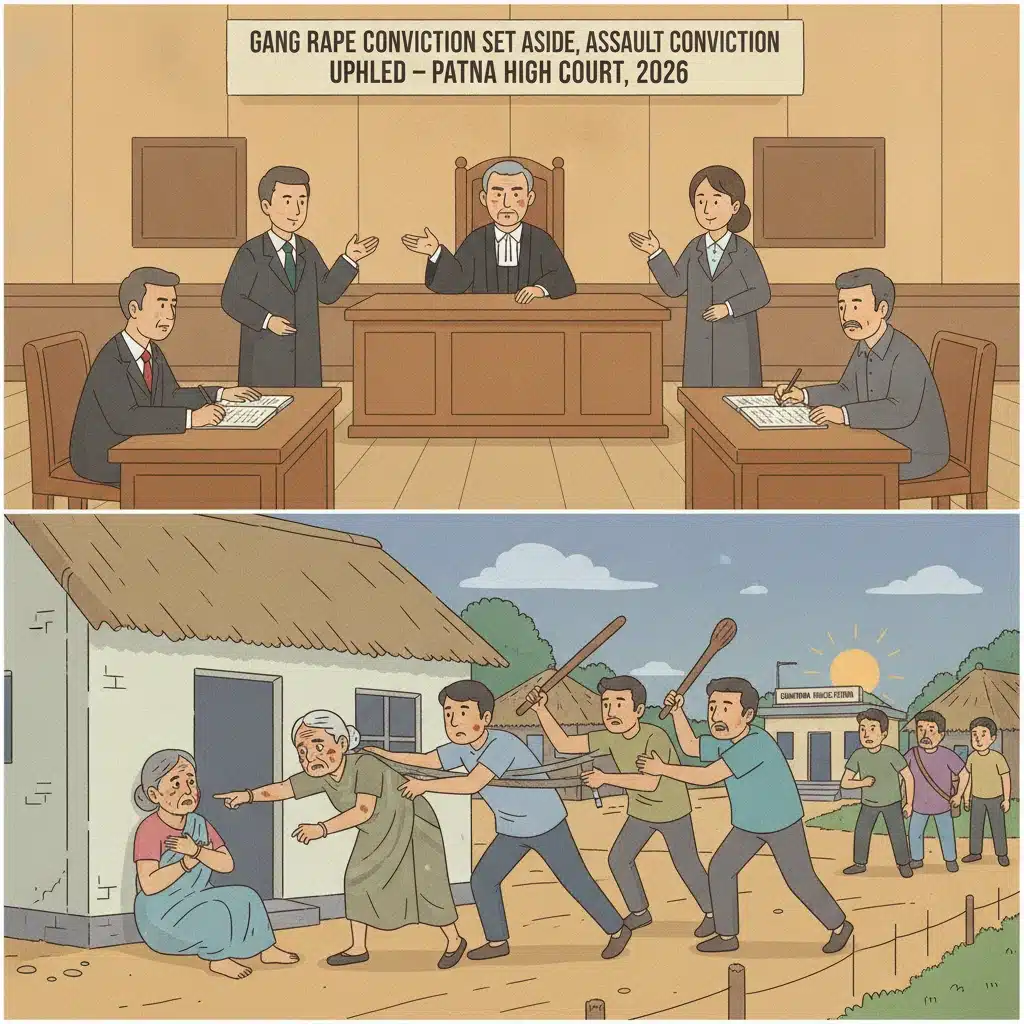
This criminal appeal arose from an incident said to have occurred in the early hours of 18 January 1992 in village Patilar Tola, within Chautarwa Police Station, District West Champaran.
According to the victim’s fardbeyan, recorded at Chautarwa Police Station at about 9:00 a.m. the same morning, a group of men armed with lathis, a wooden club (kunda) and iron rods allegedly entered her house at about 2:00 a.m. They allegedly dragged her out, assaulted her and also beat her mother-in-law. She claimed to have suffered injuries on her right cheek, abdomen, back and ribs, causing bleeding.
The fardbeyan also mentioned that there was a land dispute between the parties, and that about a month prior to the incident one of the accused had threatened the family to give up the disputed land. The informant stated that villagers, named as Shivnath Ram and Dhora (Dhoda) Ram among others, reached the spot on hearing her alarm.
On the basis of this fardbeyan, Chautarwa P.S. Case No. 08 of 1992 was registered initially under Sections 147, 148, 341, 448, 323 of the Indian Penal Code and Section 3(i)(x) of the SC/ST Act.
After investigation, the police filed a charge sheet for more serious offences, including Sections 147, 148, 149, 323, 341, 448, 307 and 376 of the IPC and Sections 3(i)(v)(x) and (xii) of the SC/ST Act. The case was committed to the Court of Sessions, West Champaran, Bettiah.
The 1st Additional Sessions Judge-cum-Special Judge, SC/ST Court, Bettiah framed charges under Sections 148, 323, 307 and 376 IPC and Sections 3(i)(x)(xi) and (v) of the SC/ST Act. The accused pleaded not guilty and claimed trial.
After trial in Sessions Trial No. 207 of 1993, by judgment dated 05.06.2023 and order dated 09.06.2023, the trial court convicted the appellants under Sections 148, 323 and 376(2)(g) IPC and Section 3(i)(xi) of the SC/ST Act and imposed various terms of rigorous imprisonment and fines. All sentences were to run concurrently.
The present criminal appeals (SJ) Nos. 2977 of 2023 and 3048 of 2023 were filed in the Patna High Court challenging that conviction and sentence.
What the Court Examined and Decided
The Patna High Court, through Hon’ble Mr. Justice Shailendra Singh, mainly examined whether the conviction for gang rape under Section 376(2)(g) IPC could be sustained on the evidence on record, while also reviewing the findings on assault and SC/ST Act offences.
The prosecution examined eight witnesses. Two villagers named in the fardbeyan as having reached the spot, PW-1 Shivnath Ram and PW-2 Dhoda Ram, turned hostile and did not support the prosecution version. PW-3 was the husband of the victim, PW-4 was the victim herself, PW-5 and PW-6 were formal witnesses, PW-7 was the doctor, and PW-8 was the Station House Officer acquainted with the Investigating Officer’s handwriting.
The prosecution also relied on documentary exhibits including the victim’s statement under Section 164 Cr.P.C. (Ext-1), injury details from the hospital register (Ext-2), medical opinions (Ext-2/a and Ext-2/b), and signatures of the SHO (Ext-3, Ext-3/a). The defence produced several certified copies of FIRs, orders and sale certificates relating mainly to the land dispute and other litigations between the parties, in addition to the husband’s signature on the fardbeyan (Ext-A).
The trial court had primarily relied on the testimony of the victim (PW-4) to convict for gang rape. In appeal, the defence argued that the victim was not a “sterling witness” whose sole testimony could safely be the basis of conviction for such a serious charge. They relied on the Supreme Court decision in Rai Sandeep @ Deepu vs. State (NCT of Delhi), (2012) 8 SCC 21, which lays down the standard for treating a witness as “sterling”.
The core points urged by the appellants were:
First, the initial fardbeyan recorded on 18.01.1992 at 9:00 a.m. contained only an allegation of assault (marpit) with lathis, iron rods and kunda, and injuries on various parts of the body. It did not contain any allegation of gang rape. The gang rape allegation appeared for the first time months later in her statement under Section 164 Cr.P.C. and then in her deposition at trial.
Second, the defence stressed that the fardbeyan was not recorded in a state of confusion. PW-3, the victim’s husband, specifically stated in cross-examination that the fardbeyan bore his signature, that his wife correctly recorded it, and that he signed it after being satisfied. This, the Court noted, supported the reliability of the first version in the fardbeyan.
Third, the defence pointed to the long-running land dispute between the parties, supported by documents like Ext-B and Ext-C series. They suggested that the allegation of gang rape was a later exaggeration driven by enmity and revenge.
Fourth, they highlighted that the two co-villagers named as eye-witnesses to the occurrence did not back the prosecution; both PW-1 and PW-2 turned hostile.
The State, on the other hand, argued that the victim’s testimony in court clearly supported the allegation of gang rape and that her Section 164 statement corroborated her. The omission in the fardbeyan, according to the State, was because she initially kept silent to protect her public reputation, and her later disclosure should be accepted, especially when medical evidence showed a laceration on the private part.
The High Court carefully compared the different statements of the victim and other prosecution evidence.
The Court noted that the alleged incident took place at 2:00 a.m., and the fardbeyan was recorded at 9:00 a.m. the same day. The victim alleged assault and injury and spoke of the land dispute motive but did not mention rape. Her husband’s evidence strengthened the reliability of this fardbeyan as the first version.
The victim later claimed that she did not mention rape earlier to save her honour, but the Court found this explanation unsupported. Significantly, her husband did not state anything about her silence being due to concern for public reputation.
The Court further noted that the victim had deposed during trial that she became unconscious after the occurrence and that her statement was recorded after she regained consciousness. However, the medical records proved by PW-7 showed that she was examined on the same day at 10:25 a.m., just 1 hour 25 minutes after recording the fardbeyan, and again the next day. Neither of the medical reports mentioned that she was unconscious when brought to the hospital. This weakened her later claim of unconsciousness and of not knowing events immediately after the incident.
The High Court also pointed out that the allegation of gang rape emerged only several months after the FIR, in her Section 164 Cr.P.C. statement before the Judicial Magistrate. This was viewed as a “development” and an “afterthought”.
Another critical aspect examined was the inconsistency between the testimonies of the victim and her husband regarding what happened after the alleged rape.
PW-3, in cross-examination, stated that at the time of occurrence there was no light; when the accused entered after breaking the tatt, he fled and returned after half an hour to find no one at the door and his wife lying unconscious. In contrast, in his examination-in-chief, he claimed that after about one hour he returned and saw his wife being dragged by the accused towards a nearby orchard where, according to him, they raped her one by one. The High Court highlighted this internal contradiction.
The victim (PW-4), in her examination-in-chief, stated that after the gang rape she somehow returned home and collapsed in the courtyard, and then her husband came and took her to the hospital. But in her Section 164 statement she had said that after rape and insertion of the front barrel of a gun into her private part she became unconscious and knew nothing of later events, only regaining consciousness at about 8:00 a.m. and then coming to the courtyard. These differing versions about her condition and movements further reduced the reliability of the later gang rape narrative.
The Court also underlined serious gaps in investigation. The Investigating Officer, who allegedly inspected the places of occurrence, was not examined. PW-8, the SHO, only stated that the IO was traceless. The Court held that such a plea cannot relieve the prosecution of its duty to produce a government officer whose evidence was crucial for a fair investigation. No site plan was prepared, no weapons were recovered, and the victim’s clothes or other incriminating materials were not seized or produced in court.
Referring to the Supreme Court judgment in Ravishwar Manjhi and Ors. vs. State of Jharkhand, (2008) 16 SCC 561, the High Court reiterated that in such serious cases the IO’s examination is necessary to show fair investigation and to pinpoint the exact place and manner of occurrence.
The Court held that the trial court’s reliance on the victim’s “restatement” recorded during investigation was legally flawed. Such a statement under Section 161 Cr.P.C., not being duly proved, can only be used for contradiction under Section 145 of the Evidence Act, not as substantive corroborative evidence, and that procedure had not been followed.
Considering all these inconsistencies, omissions, hostile witnesses, investigation lapses and the admitted background of land dispute and civil litigation, the Patna High Court concluded that the prosecution had failed to establish the allegation of gang rape under Section 376 IPC beyond reasonable doubt.
However, the Court accepted that there was a simple occurrence of marpit (assault) and that the acts amounted to an offence under Section 3(i)(xi) of the SC/ST Act. The medical evidence confirmed simple injuries, including one on the private part which, though present, was not of the nature to clearly suggest gang rape as described.
Therefore, the Court upheld the conviction under Sections 148 and 323 IPC and Section 3(i)(xi) of the SC/ST Act, for which the appellants had already undergone the sentences imposed by the trial court.
Consequently, the High Court set aside the judgment of conviction and order of sentence only to the extent of the offence under Section 376 IPC and partly allowed the appeals. Since the appellants had already served the sentence for the remaining offences and were in judicial custody, the Court directed that they be released at once if not required in any other case.
Why This Judgment Matters
This judgment of the Patna High Court is important for both victims and accused in serious criminal cases, especially those involving allegations of sexual violence and SC/ST Act offences.
First, it shows that courts place significant weight on the first statement given to the police (fardbeyan or FIR). If later versions contain major additions or changes, especially after a long gap, courts will examine them with great caution.
Second, it underlines that when there is long-standing enmity, such as land disputes, courts will carefully scrutinise serious allegations to ensure that criminal law is not being misused to settle personal scores.
Third, it stresses the duty of the police to conduct a proper, fair and complete investigation. Non-examination of the Investigating Officer, absence of site plan, and non-seizure of relevant articles can seriously weaken the prosecution.
At the same time, the judgment clarifies that where evidence does show assault and caste-based atrocity, the court will uphold those convictions even if the graver charge of gang rape fails. Thus, victims are not left entirely without remedy, but convictions must rest on reliable, legally admissible evidence.
Legal Issues and Answers
- Issue: Did the prosecution prove beyond reasonable doubt that the appellants committed gang rape under Section 376(2)(g) IPC?
- Answer: No. The Patna High Court found major inconsistencies between the victim’s fardbeyan, later statements and medical evidence, hostile eye-witnesses, and serious investigation lapses. In view of these doubts and the admitted land dispute, the Court held that gang rape was not proved beyond reasonable doubt and set aside the conviction under Section 376 IPC.
- Issue: Were the convictions for rioting with deadly weapons, causing hurt and committing atrocities under the SC/ST Act justified?
- Answer: Yes. The Court held that a case of simple marpit and atrocity under Section 3(i)(xi) of the SC/ST Act was established. It upheld the conviction and sentence under Sections 148 and 323 IPC and Section 3(i)(xi) of the SC/ST Act, noting that the appellants had already served these sentences.
Cases Cited by the Court
- Rai Sandeep @ Deepu vs. State (NCT of Delhi), (2012) 8 SCC 21 – cited for the concept of a “sterling witness” and the need for consistency in testimony when relying on a solitary witness.
- Ravishwar Manjhi and Ors. vs. State of Jharkhand, (2008) 16 SCC 561 – relied on for the importance of examining the Investigating Officer and preparing a site plan to demonstrate fair investigation.
Case Details
Case Number: Criminal Appeal (SJ) No. 2977 of 2023 with Criminal Appeal (SJ) No. 3048 of 2023; arising out of Chautarwa P.S. Case No. 08 of 1992; Trial No. 207 of 1993.
Case Title: Gauri Shankar Choudhary @ Gauri Shankar Chowdhary @ Gauri Choudhary & Ors. vs. The State of Bihar & XXX (wife of YYY); and Surendra Dubey @ Benga Pandit vs. The State of Bihar & XXX (wife of YYY).
Citation: 2026 (5) PLJR 187
Coram: Hon’ble Mr. Justice Shailendra Singh.
Date of High Court Judgment: 16.06.2026 (uploaded on 22.06.2026).
Advocates:
In Criminal Appeal (SJ) No. 2977 of 2023 – For the appellants: Mr. Bashishtha Narayan Mishra, Advocate; Mr. Brij Kishor Mishra, Advocate; Mr. Avinash Raj, Advocate. For the State: Mr. Binay Krishna, Special Public Prosecutor.
In Criminal Appeal (SJ) No. 3048 of 2023 – For the appellant: Mr. Ramakant Sharma, Senior Advocate; Mr. Rahul Singh, Advocate; Mr. Mayank Raj, Advocate. For the State: Mr. Binay Krishna, Special Public Prosecutor.
Nature of the Case: Criminal appeals (single judge) against judgment of conviction and sentence by the 1st Additional Sessions Judge-cum-Special Judge, SC/ST Court, Bettiah, arising from a sessions trial based on a police case.
Link to Judgment: https://patnahighcourt.gov.in/viewjudgment/MjQjMjk3NyMyMDIzIzEjTg==-XeVdy6dZT9Y=
If you found this explanation helpful and wish to stay informed about how legal developments may affect your rights in Bihar, you may consider following Samvida Law Associates for more updates.




