

Case Background
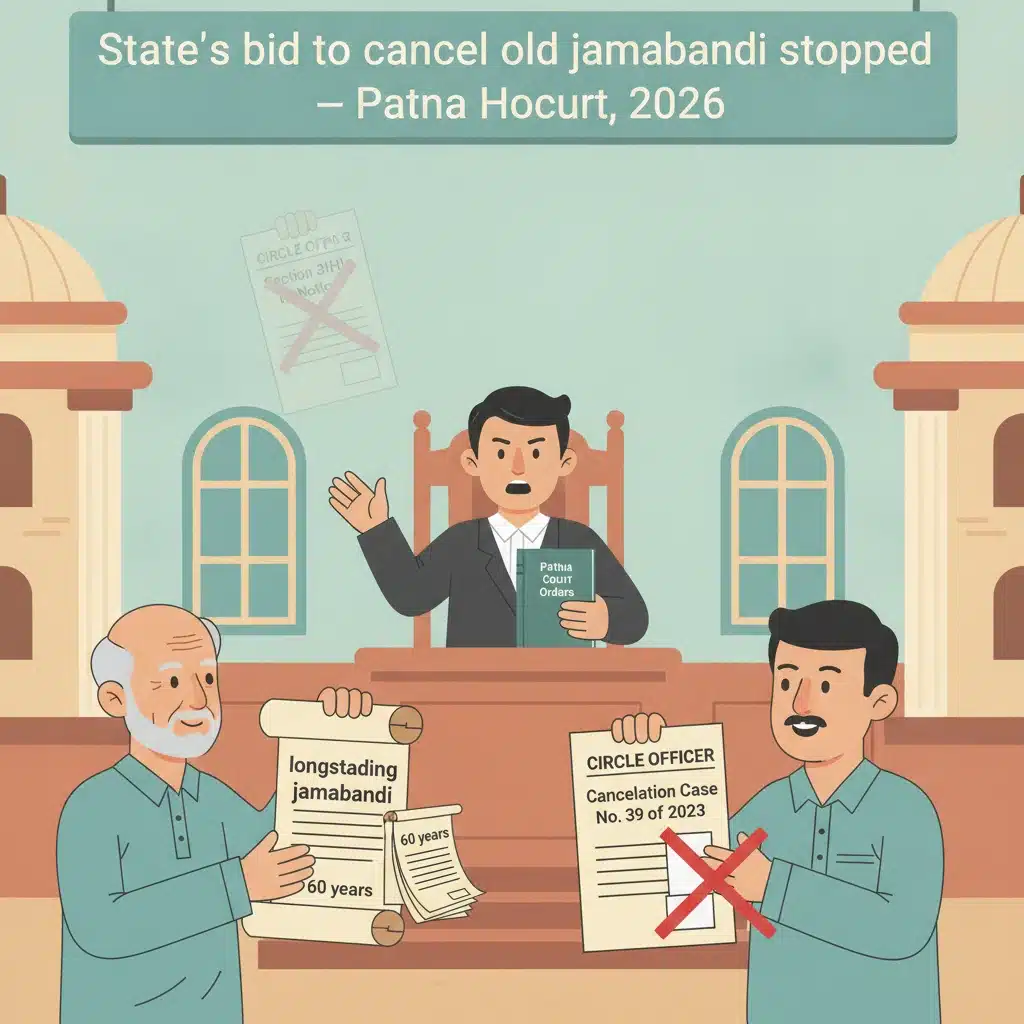
The petitioner is a landholder whose family has been receiving government rent receipts for their land for about 60 years. These receipts are issued by the revenue authorities and show that the State has been accepting rent for the land over a long period.
According to the petitioner, there is a longstanding jamabandi in respect of this land. Jamabandi is the government’s record showing who is recognised as the tenant or raiyat and from whom rent is taken. A longstanding jamabandi generally indicates settled possession and acceptance by the State.
Earlier, the petitioner’s two brothers had approached the Patna High Court regarding the same land. In that earlier case, the Court had clearly held that there was a longstanding jamabandi which had been allowed by the State to continue for many years.
In that previous matter, a notice had been issued under Section 3(H). That notice was set aside by the Court. The Court had also categorically held that if the State of Bihar wanted to dispute the landholder’s rights, its only legal option was to approach a competent Civil Court and get the dispute decided there.
Despite this clear direction, events took a different turn in the present case. The petitioner’s rent receipts, which had been issued for decades, were suddenly stopped. No civil suit was filed by the State. Instead, the State authorities adopted a different route.
What the Court Examined and Decided
The petitioner came to the Patna High Court under its civil writ jurisdiction, challenging the stoppage of rent receipts and subsequent steps taken by the revenue authorities.
The petitioner’s counsel argued that the State was trying to overreach and bypass the earlier order of the High Court, passed in the case filed by the petitioner’s brothers. Instead of going to a civil court, as directed earlier, the authorities allegedly “designed a separate approach” by stopping rent receipts.
It was further submitted that the authorities did not stop at merely withholding rent receipts. During the pendency of this writ petition itself, the Circle Officer recommended cancellation of the petitioner’s jamabandi. Acting on this recommendation, the Additional Collector initiated Cancellation Case No. 39 of 2023 to cancel the jamabandi.
The High Court heard both sides and examined the documents on record. After doing so, the Court made strong observations about the conduct of the State authorities.
The Court held that this was “yet another case” where the State had acted in a very autocratic manner. It found that the authorities had shown defiance not only towards the orders of the Court in the earlier case, but had also bypassed several judicial pronouncements on the subject of cancellation of longstanding jamabandi.
The Court noted that there are clear legal principles laid down in earlier decisions: a longstanding jamabandi cannot be cancelled in summary proceedings. If the State wants to challenge such jamabandi, the only proper legal course is to file a civil suit in a competent Civil Court. Administrative officers like Circle Officers and Collectors cannot take short-cuts by using summary proceedings to unsettle such rights.
In this particular matter, the Court highlighted that even while the writ case was pending before it, the Circle Officer went ahead and recommended cancellation. The Additional Collector followed this recommendation and instituted a cancellation case.
This step was found to be directly against the principle that once a matter is pending before a Court, executive authorities must not take steps that prejudice or pre-judge the issue.
To reinforce this principle, the Patna High Court relied on an old but important judgment: The King vs. Parmanand and Others, reported in AIR (36) 1949 Patna 222. In that case, the Court had laid down a “cardinal principle” of law.
The key passage from that decision, quoted in this judgment, is that when a matter is pending for decision before a Court of justice, nothing should be done which might disturb the free course of justice. The Court in that old case had clearly said it would “discountenance any attempt” by any executive official, however high, to prejudge the merits of a case and to usurp the functions of the Court that has seisin (that is, is already dealing) with the case.
Applying this settled principle, the Patna High Court in the present matter concluded that the revenue authorities had exceeded their jurisdiction. They acted beyond their lawful powers by initiating Cancellation Case No. 39 of 2023 while the dispute was already before the High Court and despite earlier directions that any challenge should be through a civil suit.
The Court stated that the action of the Circle Officer, Khaira, Jamui, deserved to be deprecated. The initiation of the cancellation case was held to be “bad” in law. In simple terms, the Court declared that the cancellation proceeding could not stand.
On the core grievance of the petitioner—stoppage of rent receipts—the Court directed corrective action. The Circle Officer, Khaira, Jamui, was specifically ordered to start issuing rent receipts in favour of the petitioner with immediate effect.
This means the petitioner’s position as a recognised rent-paying landholder, which had continued for around 60 years, must now be respected again by the revenue authorities. They cannot withhold rent receipts as a way to weaken or question his rights.
The Court also looked ahead to possible future steps by the State. It clarified that if the State remains adamant about taking action against the petitioner in relation to this land, there is only one lawful remedy available: to go before a competent Civil Court and have the dispute decided there.
The Court went further and issued a strong warning. It stated that any action taken by the State apart from approaching the Civil Court would be treated as contemptuous. This means such conduct may expose the concerned officials to contempt of court proceedings for disobeying judicial orders.
Finally, in light of these findings, the Patna High Court allowed the writ application. The petitioner’s challenge succeeded, the cancellation case was invalidated, and rent receipts were ordered to be restored.
Why This Judgment Matters
This judgment is significant for landholders across Bihar who have longstanding jamabandi and have been paying rent to the State for many years.
First, it makes clear that government officers cannot suddenly stop issuing rent receipts or start cancellation proceedings to unsettle old land records, especially when courts have already spoken on the matter.
Second, it reinforces that if the State wants to challenge such established land rights, it must go through a proper civil suit before a Civil Court. Short-cuts like summary cancellations by revenue officials are not acceptable.
Third, the judgment protects the integrity of ongoing court proceedings. Once a case is pending before a court, executive officers must not try to “prejudge” it by starting parallel proceedings that directly affect the same issue.
For ordinary citizens and landholders, this ruling sends a clear message: if your jamabandi is old and rent receipts have been issued for decades, officials cannot casually cancel it through internal departmental processes. They must respect court orders and legal procedures.
Legal Issues and Answers
- Issue: Can revenue authorities stop issuing rent receipts and initiate summary cancellation of a longstanding jamabandi, despite earlier High Court directions to pursue only a civil suit?
Answer: No. The Patna High Court held that such action exceeds their jurisdiction, violates settled law, and is impermissible when a matter is pending before the Court. The cancellation case was held bad, and rent receipts were ordered to resume. - Issue: What is the proper remedy for the State if it wants to challenge longstanding jamabandi and related land rights?
Answer: The only remedy available to the State is to file a civil suit before a competent Civil Court. Any other action will be treated as contemptuous.
Cases Cited by the Court
- The King vs. Parmanand and Others, AIR (36) 1949 Patna 222.
Case Details
Case Number: Civil Writ Jurisdiction Case No. 16876 of 2022
Case Title: Krishna Kumar Goenka vs. The State of Bihar & Others
Court: High Court of Judicature at Patna
Coram: Hon’ble Mr. Justice Sourendra Pandey
Date of Judgment: 18-06-2026
Citation: 2026 (5) PLJR 14
Advocates for Petitioner: Mr. Sumeet Kumar Singh, Advocate; Mr. Abhilasha Kumari, Advocate
Advocates for Respondents (State): Mr. Raj Kishore Roy, GP-18; Mr. Navnit Kumar, AC to GP-18
Nature of the Case: Writ petition under civil writ jurisdiction challenging stoppage of rent receipts and initiation of jamabandi cancellation proceedings.
Status of Writ Petition: Allowed.
Link: https://patnahighcourt.gov.in/viewjudgment/MTUjMTY4NzYjMjAyMiMxI04=-aho28UHRZ3U=
If you found this explanation helpful and wish to stay informed about
how legal developments may affect your rights in Bihar,
you may consider following Samvida Law Associates for more updates.




